Aerospace electronics assembly creates a category of contamination risk that differs from most cleanroom applications: the failure may not surface until the component is in service, by which point the assembly record is all that stands between a traceable root cause and a liability gap. Particle contamination on a circuit board or connector contact during integration can cause intermittent failure under thermal cycling, vibration, or vacuum — conditions that are rarely reproduced in acceptance testing. The planning decisions that prevent this — filtration level, maintenance access geometry, ESD layering, and documentation structure — need to be made before the room layout is fixed, not resolved during commissioning. What follows is structured to help engineers and quality teams evaluate those decisions at the stage where they still have design freedom.
High-Reliability Assembly Risk Profile
Aerospace electronics does not tolerate the same contamination margin as many other controlled environments. When a particle bridges a trace, contaminates a connector, or settles on an optical surface during integration, the assembly continues downstream through test, shipment, and installation. Detection at that point is difficult; detection in service may be impossible before a failure occurs. The severity is not guaranteed in every deployment, but the consequence profile — mission-critical failures in inaccessible systems — justifies a design posture that assumes contamination will cause damage if it reaches the work surface.
ISO 14644-1:2015 provides the classification framework most aerospace programs use to define cleanliness targets. For high-reliability electronic assembly, ISO Class 7 is often cited as a practical minimum, which limits airborne concentration to ≤352,000 particles per m³ at 0.5 µm. That figure is a design baseline drawn from the standard, not a universal regulatory floor — program specifications, customer requirements, and the nature of the hardware (commercial avionics versus space flight hardware) will determine whether Class 7 is the right target or whether Class 6 or better is warranted. What matters at the risk-profiling stage is that the cleanliness class is defined by the assembly requirement, not by what a given modular product happens to be rated to achieve.
The downstream consequence of under-specifying the risk profile at concept stage is that the room gets built to a class that satisfies the initial program scope, and then a follow-on program or a customer audit reveals the gap. Upgrading a cleanroom mid-program is disruptive in ways that go beyond construction — it can invalidate assembly records, require re-qualification of processes, and create traceability questions about components already in the supply chain. Establishing the correct contamination risk profile before the room is designed is the most cost-effective risk control available.
Filtration Level and Maintenance Access Planning
Filter selection for aerospace electronics cleanrooms is relatively straightforward compared to the access problem that follows from it. HEPA filters, as a filter class, are designed to capture at least 99.97% of particles at 0.3 µm — the most penetrating particle size for fibrous filter media — and that performance figure, referenced in ISO 29463-1:2024, is the baseline against which filter selection should be evaluated. For programs requiring cleaner than ISO Class 7, ULPA-class filters may be appropriate. The selection decision is driven by the classification target; the harder decision is how filter changes will be executed without disrupting active assembly or compromising traceability records.
Filter maintenance access is the most commonly missed early decision in aerospace cleanroom projects. Teams specify filtration level correctly, then build the workstation layout and work-instruction structure around the room — and the access problem only surfaces at the first scheduled filter change, when the workflow is already established. If ceiling-mounted fan filter units require removal from above and the gowning corridor is not sized for service access, maintenance will either require partial work stoppage or will be deferred, which creates a different audit exposure. Access geometry should be confirmed in the room design package before panel fabrication begins.
Pre-filtration staging addresses part of this problem by extending terminal filter life and reducing the frequency at which maintenance access is needed. That is a lifecycle trade-off, not a guaranteed efficiency gain — it depends on the ambient particle load and the quality of pre-filter selection. The modular upgrade path from ISO 7 to ISO 6 or ISO 5 via filtration modifications is also an engineering trade-off rather than a standard design sequence: it is viable when ceiling load capacity and pre-filter staging are planned at concept stage, but difficult to retrofit if the structural architecture was not designed to accommodate additional filter elements.
| Élément de filtration | Caractéristiques principales | Maintenance Access Implication |
|---|---|---|
| Filtre HEPA | Captures ≥99.97% of particles 0.3 µm | Filter change access must be designed not to disturb sensitive work areas or records |
| Pre-filtration system | Extends terminal filter life; reduces maintenance frequency | Reduces how often maintenance access is needed; protects clean zones during filter service |
| Conception de la cascade de pression | Pressurization hierarchy directs airflow from more critical to less critical areas | Filter access must be planned to preserve pressure differentials and prevent cross-contamination |
| Modular upgrade path | ISO 7 cleanroom can be upgraded to ISO 6 or 5 via filtration modifications | Future upgrades require planning for physical access to add or replace filters without reconstruction |
Pressure cascade design reinforces the filtration architecture by directing airflow from higher-cleanliness zones toward lower-cleanliness areas, limiting cross-contamination risk during normal operation. Where filter access requires opening ceiling panels or service doors, the effect on pressure differentials needs to be evaluated as part of the maintenance procedure, not treated as a one-time commissioning concern.
Workstation Cart and Inspection Hold-Point Control
Stable workstation layout is a functional requirement for high-reliability assembly, not a preference. When component routing changes between work orders, when carts carrying sensitive hardware move through undefined paths, or when inspection hold points are not physically fixed in the room layout, contamination control becomes dependent on individual discipline rather than engineered constraints. Aerospace programs that rely on AS9100 or NASA workmanship standards for flight hardware will expect evidence that hold points are real boundaries, not procedural intentions.
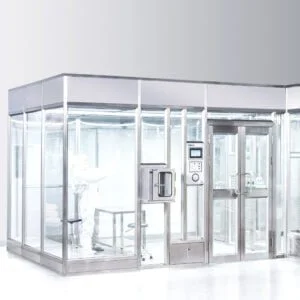
Modular cleanroom architecture supports this by allowing the room layout to be configured around the assembly workflow — including accommodation for oversized aerospace components that would otherwise require ad hoc handling — and reconfigured if the program scope changes. That reconfigurability is a planning criterion, not a feature that applies uniformly across all modular products. The specific capability depends on panel sizing, structural connections, and whether floor penetrations for utilities were designed with repositioning in mind. Teams evaluating modular options should confirm reconfiguration scope during procurement, not assume it.
The inspection hold-point problem has a documentation dimension that connects forward to audit exposure. If a hold point is defined in work instructions but the physical layout does not enforce it — if carts can bypass it, if the inspection station is not bounded by a structural or airflow transition — then the hold point is difficult to defend in a quality review. Room layout and quality-system documentation should be aligned from the design stage, and the room layout drawing should be part of the quality record package, not a separate facilities document.
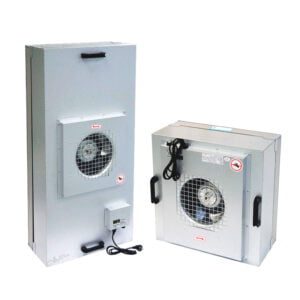
For programs where Unités de filtrage des ventilateurs are used to create localized unidirectional airflow over critical workstations, the workstation position relative to the FFU should be fixed in the layout drawing and treated as a process parameter — if the workstation moves, the airflow validation is no longer current.
ESD Verification Across Floor Bench and Operator Contact
ESD control in aerospace cleanrooms is often treated as a flooring specification problem: the floor meets a dissipative resistivity requirement, a certificate is filed, and the topic is closed. That approach creates a layered failure risk. Flooring alone does not control ESD if bench surfaces are not grounded, if grounding connections have degraded, or if operator contact points — wrist straps, footwear, and garments — are not verified independently and regularly. A single non-conformance at any of these points can invalidate assembly records for components already in the supply chain, particularly if the program uses ESD-sensitive part designations tied to traceability records.
ANSI/ESD S20.20 provides a testing framework that addresses ESD control as a system, not as a flooring material specification. Whether S20.20 applies formally to a given program depends on the project scope and customer requirements, but its structure — verifying floor, bench, and operator contact points as distinct elements — is the correct model for aerospace electronics regardless of whether the standard is formally invoked.
| Point de vérification | Ce qu'il faut confirmer | Pourquoi c'est important |
|---|---|---|
| Plancher | Surface resistivity/conductivity meets electrostatically dissipative requirements | Controls static generation from personnel movement and rolling carts |
| Bench/workstation | Dissipative worksurface and reliable grounding connections | Protects components handled during assembly from ESD damage |
| Operator contact points | Wrist strap, footwear, and garment grounding continuity | Ensures operators remain grounded; prevents human-body ESD events |
| Material outgassing | Materials are silicone-free and do not release volatile contaminants | Avoids molecular contamination that can deposit on aerospace components |
Material outgassing is a related but distinct contamination mechanism. Silicone-containing materials used in workstation construction, gasketing, or cart components can volatilize and deposit molecular contamination on component surfaces, particularly on optical elements, connector contacts, and wire bonds. This type of contamination is not particle-detectable and will not be captured by airborne particle counts. Aerospace cleanroom material selection should confirm silicone-free construction for any item with regular work-surface contact, and that confirmation should be documented before the room is commissioned, not identified during an incoming audit.
Documentation Needed for Aerospace Quality Review
Aerospace quality reviews draw on a broader documentation landscape than most other cleanroom applications. ISO 14644-1:2015 establishes the classification framework and test methods for airborne particle cleanliness. AS9100 defines the quality management system requirements that most aerospace primes will expect to be demonstrated. Programs involving NASA space flight hardware may reference additional workmanship and contamination control standards specific to that customer. ASTM E2352 provides guidance on contamination control in aerospace. These standards do not govern the same things — treating them as interchangeable or assuming one satisfies the others creates gaps that surface during audits rather than during design.
The practical implication for project teams is that the documentation package needs to be scoped against the specific program requirements before room design begins, not assembled from whatever records exist at closeout. A quality review will test whether the cleanroom documentation supports the assembly records — whether particle counts, filter certifications, ESD verification logs, and maintenance procedures form a coherent and defensible chain. If the room was built to a class that was not formally specified in the program contract, or if filter change records do not reference the filter model and date installed, those gaps will be visible in an audit even if the room performed well.
The documentation landscape also has a temporal structure. Classification data establishes what the room achieved at commissioning. Maintenance records establish what has been done to sustain that performance. If those two bodies of evidence are in different filing systems, owned by different teams, and were never aligned during handover, the audit package will be incomplete even if every individual record exists somewhere. Coordinating documentation structure at handover is a project management task, but the conditions for success are set by the room design — specifically by whether maintenance access and monitoring systems were designed to generate records that can be linked to the original classification baseline.
Handover Records for Filter and Room Performance
Handover documentation for aerospace cleanrooms is not a closeout formality. Aerospace customers and quality auditors will use it to assess whether the room can sustain the claimed performance class, whether filter changes can be performed traceably, and whether the maintenance program is defined well enough to be executed without interpretation. Gaps in the handover package often trace back to layout and access decisions made before the first panel was installed — not to record-keeping failures at project close.
A well-structured handover package should include initial classification data, filter documentation, monitoring data from the commissioning period, and maintenance instructions. These are not necessarily standard deliverables — whether they are required depends on the project contract and the customer’s quality requirements — but they represent what a defensible package looks like when an aerospace quality review tests it.
| Record Component | What It Should Include | Audit Value |
|---|---|---|
| Initial classification data | ISO 14644 airborne particle counts and recovery tests | Confirms cleanroom met required cleanliness class at handover |
| Filter documentation | HEPA filter certification, pressure drop, installation details | Establishes filtration baseline; supports filter performance traceability |
| Données de surveillance continue | Trends for particle counts, room pressure, temperature during commissioning | Demonstrates environmental stability under operating conditions |
| Consignes d'entretien | Filter change procedures, access requirements, scheduled tasks | Assures auditors that ongoing performance can be sustained and documented |
Continuous monitoring integration strengthens the handover record set by providing trend data for particle counts, room pressure, and temperature during the commissioning period. That data demonstrates environmental stability under operating conditions rather than at a single point-in-time classification test. It also creates the reference baseline against which future monitoring data is compared. Modular cleanrooms that incorporate real-time monitoring during commissioning have a structural advantage here: the data exists and can be exported. The risk is that monitoring data generated during commissioning is not transferred to the quality record package at handover, which means it exists but cannot be used to support an audit. That transfer needs to be defined as a specific handover task, with a named record recipient, before the commissioning period begins.
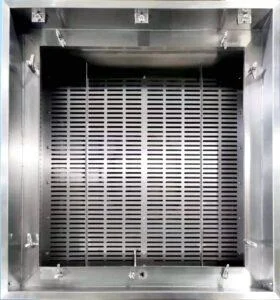
Filter documentation — certification records, pressure drop at commissioning, installation details including filter model, batch, and location — establishes the performance baseline that future filter changes will be measured against. If a Filtre à air HEPA/ULPA à mini-plis is installed during initial fit-out, the specification and certification should be held in the same file as the room classification record, not in a facilities procurement file. The connection between filter identity and room performance is what makes the record defensible.
The decisions that determine whether an aerospace electronics cleanroom supports quality review with confidence are made in the design phase, not at commissioning. Filtration level, maintenance access geometry, ESD verification structure, and documentation scope all need to be defined before the layout is fixed — because once the room is built and the workflow is established around it, the cost of correcting a design-stage omission is measured in program disruption, not in revision hours.
Before procurement or design sign-off, confirm: that the cleanliness classification is specified against the assembly requirement rather than a product default; that filter change access is mapped against the active workflow and does not require work stoppage; that ESD verification covers floor, bench, and operator contact points independently; and that the handover documentation scope is contractually defined and assigned to a named custodian. Those four confirmations will surface the gaps that most commonly remain invisible until the first audit.
Questions fréquemment posées
Q: Does this guidance apply if our program currently requires only ISO Class 8, with no customer-mandated upgrade path?
A: The structural decisions still apply, but the risk profile changes meaningfully. ISO Class 8 may be defensible for some commercial avionics assemblies, but the article’s filtration access, ESD layering, and documentation requirements are driven by the consequence of latent failure — not by classification level alone. If your hardware could enter service with an undetected contamination-related defect, the design posture described here applies regardless of which class the room is certified to. If your program scope genuinely limits exposure to that failure mode, then some requirements can be scaled back — but that judgment should be documented in the risk profile, not left as an assumption.
Q: Once the room is commissioned and classification data is confirmed, what is the immediate next step to protect the handover record before active assembly begins?
A: Assign a named custodian for the handover documentation package before commissioning ends. The article identifies the most common failure mode: monitoring data, filter certification records, and classification data exist in separate systems owned by separate teams and are never formally linked. The practical next step is to define — in writing, before the commissioning period closes — who holds the master record, which documents must be transferred into it, and by what date. That transfer task should appear on the project closeout checklist with a named owner, not be treated as an implicit responsibility of the facilities team.
Q: At what point does the modular upgrade path from ISO 7 to ISO 6 or 5 stop being viable without significant structural rework?
A: The upgrade path closes when ceiling load capacity and pre-filter staging were not designed into the original structure. Adding filter elements increases ceiling dead load; if the structural connections and support panels were sized for a single filter layer, retrofitting a pre-filter stage may require panel replacement rather than addition. The practical threshold is at concept-stage sign-off — if load capacity and pre-filter plenum depth are not specified in the original design package, assume the upgrade path will require structural assessment rather than a straightforward filtration modification.
Q: How does a modular cleanroom compare to a stick-built room for aerospace programs where the layout must stay fixed once assembly workflows are established?
A: For programs with a fixed, long-term workflow, the reconfigurability advantage of modular construction is less relevant, and the comparison shifts to documentation quality and filter access geometry. Stick-built rooms can be engineered for stable layouts equally well, but modular systems typically offer faster initial classification, standardized filter integration, and supplier-provided handover documentation — which reduces the project management burden of assembling an audit-ready record package. The deciding factor is usually whether the program requires a faster path to qualified operation or whether long-term structural permanence and site-specific engineering take priority.
Q: Is continuous environmental monitoring during commissioning worth the added cost if the program only requires a single-point classification test at handover?
A: Yes, for aerospace electronics specifically, because a single classification test establishes performance at one moment under controlled conditions, while trend data from the commissioning period demonstrates stability under actual operating loads — personnel movement, equipment cycling, cart traffic. That distinction matters in a quality audit when a reviewer asks whether the room holds classification during production, not just at an empty-room test. The cost of monitoring during commissioning is small relative to the program disruption of a failed audit; the risk is not in deploying monitoring but in failing to transfer the data into the quality record before the commissioning team demobilizes.