Most cleanroom envelope procurements fail at qualification, not at fabrication. A supplier delivers panels, doors, and ceiling assemblies that match the specification on paper, but when the certifier arrives, there is no IQ protocol owner, no deviation log, and no traceable link between test results and the acceptance criteria in the original user requirements specification. At that point, the problem is contractual — responsibility is disputed — and resolving it costs time the project schedule does not have. The judgment that prevents this is not which panels to buy, but which acceptance obligations to assign before the first quotation is issued. What follows gives procurement teams, QA leads, and project engineers a structured basis for writing a cleanroom envelope URS that makes bids genuinely comparable before RFQ.
URS inputs for ISO class, GMP use and pressure concept
The most consequential omission in early-stage cleanroom URS documents is the failure to distinguish ISO class from GMP grade. Specifying ISO 5 sets a particle count limit — 3,520 particles per cubic metre at 0.5 µm — but says nothing about microbial contamination limits. Grade A under EU GMP Annex 1 adds a separate microbiological requirement, and a cleanroom that consistently passes particle counts can still fail a regulatory audit on microbiological grounds if the pressure concept, surface selection, and material finish were only sized to meet the particle figure. These two specifications must appear side by side in the URS, not as alternatives.
Pressure differential requirements follow from the GMP grade decision, not from ISO class alone. A cascade direction that is appropriate for a non-sterile operation may be insufficient for a sterile filling suite, and the specific pressure differential values — typically within a 5–15 Pa working range, with at least 10 Pa maintained between adjacent grades — need to be written as acceptance criteria, not left to the supplier’s default design assumptions. If the cascade direction is ambiguous in the URS, suppliers will make their own assumptions, and those assumptions may not survive the contamination risk assessment that comes during qualification.
Cleaning agent and disinfectant compatibility is a parallel URS input that is frequently deferred to the process team and then forgotten at procurement stage. If sporicidal agents, hydrogen peroxide vapour, or chlorine-based disinfectants are part of the validated cleaning programme, that must be stated in the URS so panel coatings, sealants, door seals, and window frames can be evaluated for material compatibility before quotation. An incompatible material may look identical to a compatible one in a brochure; the difference appears during cleaning validation, where degraded surfaces create particle traps and cleaning cycle failures that require material replacement after installation.
Clarifying whether the cleanroom supports non-sterile, sterile, containment, or hybrid operations at URS stage is not procedural — it directly determines the pressure concept direction, the required airlock configuration, and the material specification. Teams that defer this classification until after procurement often discover that the envelope already ordered cannot be reconfigured to support the actual process hazard without structural changes.
| URS Element to Specify | Чому це важливо | Risk If Not Addressed |
|---|---|---|
| Target ISO class and GMP grade (e.g., ISO 5 vs Grade A) | ISO 5 particle limits do not equal Grade A microbial limits; distinct specification prevents compliance gaps | Failed audits from missing microbial contamination control |
| Room pressure differential and cascade direction (e.g., 5–15 Pa, ≥10 Pa between grades) | Directly affects cross-contamination prevention and is a standard regulatory audit check | Uncontrolled airflow risking cross-contamination and audit findings |
| Cleaning agents and disinfectants to be used | Ensures envelope material compatibility; avoids degradation, particle traps, and cleaning validation failures | Material degradation creating cleanability failures and rework |
| Cleanroom operation type (non-sterile, sterile, containment, hybrid) | Drives pressure concept and material selection aligned with real process hazards | Costly redesign when process hazard is identified after design |
Door, window, wall and ceiling requirements to specify
Leaving surface, door, and ceiling access details to supplier discretion during fabrication is a planning decision with predictable consequences. Suppliers optimise for manufacturability; QA and validation teams optimise for cleanability, testability, and audit defensibility. When the URS does not define these requirements, the envelope that arrives may be technically supplied but practically difficult to qualify.
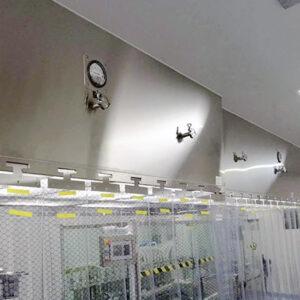
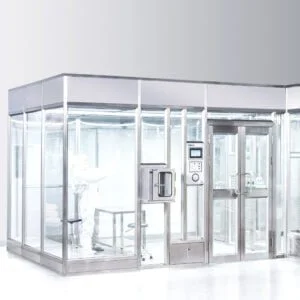
Wall, ceiling, and floor surfaces must be specified in terms of cleanability, not just aesthetics. Smooth, non-porous, non-shedding surfaces with flush joints and coved internal corners are not stylistic preferences — exposed seams, protruding fixings, and sharp internal angles are among the most commonly cited audit findings because they create particle traps that cannot be reliably cleaned. The URS must state these as acceptance-level requirements so the supplier cannot substitute a lower-grade finish and still claim conformance.
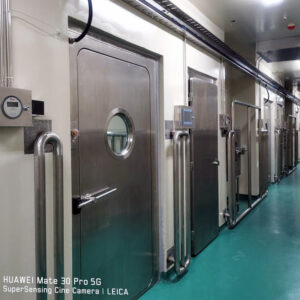
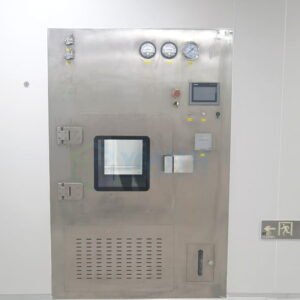
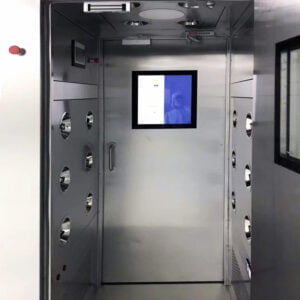
Door specifications carry a direct pressure cascade implication. Flush-mounted, self-closing doors with appropriate seals and interlocking between adjacent grades are design inputs, not upgrade options. A door that is not flush-mounted creates a ledge; a door without a closing mechanism relies on operator discipline to maintain differential pressure; a door pair without an interlock allows simultaneous opening, which collapses the pressure cascade between grades. Each of these failure modes is a contamination risk and an audit check point. The URS must specify interlocking requirements as a functional requirement, not leave them as a supplier design preference.
Window specification follows the same logic. Flush-mounted tempered glass or polycarbonate with minimal frame depth prevents ledge formation; window frames with visible depth accumulate particles and cannot be reliably wiped clean in a routine cleaning cycle. Where polycarbonate is specified, chemical compatibility with the cleaning agents named elsewhere in the URS should be confirmed before procurement.
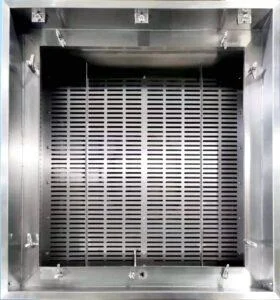
Ceiling access is the requirement most commonly omitted until after installation, when filter integrity testing reveals it is either inaccessible or requires breaking the ceiling plane to replace a filter. HEPA filter replacement, scan testing, and plenum access for maintenance must each be considered when defining ceiling panel locations and access hatch dimensions. A ceiling design that passes commissioning but prevents scan testing in the operational phase is not a compliant installation — it is a deferred problem with a fixed maintenance cost. The URS should name access requirements by location and opening size, and the supplier’s response should confirm compliance with those requirements explicitly.
Utility penetrations through the envelope are a pressure integrity risk that is difficult to remediate after installation. The URS should require that all penetrations are sealed flush, that protrusions into the cleanroom are minimised, and that maintenance access to services does not require compromising the envelope seal. Penetrations that are sealed poorly or overbuilt with protruding conduit fittings are common sources of uncontrolled air leakage that only become visible during pressure differential testing.
| Envelope Component | Key Specification to Require | Typical Risk If Inadequate |
|---|---|---|
| Wall, ceiling, floor surfaces | Smooth, non-shedding, non-porous, cleanable; flush joints; coved corners | Particle traps, cleanability failures, audit findings |
| Двері | Flush-mounted, self-closing, interlocked between grade transitions, proper seals | Pressure cascade integrity loss, cross-contamination |
| Windows | Flush-mounted, tempered glass or polycarbonate, minimal frames | Ledges collecting particles, compromised cleanability |
| Ceiling access | Specified panel locations and size for HEPA filter replacement, testing, and maintenance | Filter integrity testing and replacement become costly or impossible |
| Utility penetrations | Sealed, minimal protrusions, accessible for maintenance without compromising integrity | Uncontrolled air leakage, pressure failures |
Acceptance records that should be named before quotation
The hidden trade-off in most cleanroom envelope bids is that a lower-cost quotation almost always prices the physical envelope accurately while quietly omitting qualification support. Two bids quoting comparable panels at different prices may differ primarily in which acceptance records are included in scope — and that difference is invisible until validation begins. The only way to make bids genuinely comparable is to name every required acceptance record in the URS and require each bidder to state which records they provide and which are the responsibility of the installer or independent certifier.
Certificates of compliance and extractables or leachables data for critical materials — panels, sealants, coatings, door seals — must be named as supplier deliverables in the URS. Regulatory inspectors routinely ask for documented material compatibility, particularly in sterile manufacturing environments where cleaning agent contact and product protection are audit priorities. If this data is not assigned to the supplier at URS stage, no contractual mechanism exists to require it after purchase order issuance.
IQ and OQ protocols present a common scope gap. The supplier delivers equipment; the installer connects it; the certifier tests it; but the protocol that links each installation check to the original acceptance criteria is unassigned. When the QA team asks who owns the IQ protocol, the answer is often that no one does. This is not a communication failure — it is a procurement failure that could have been prevented by assigning protocol ownership in the URS.
As-built drawings are frequently excluded from supplier scope without being explicitly removed. A supplier may deliver fabrication drawings that reflect the design intent, but as-built documentation reflecting what was actually installed — revised penetration locations, substituted sealant products, modified access panel positions — is a separate deliverable that must be assigned to a specific party. Without as-built documentation, the QA team cannot verify that the installed envelope matches the design basis, which is a standard pre-requisite for closing Installation Qualification.
SAT reports, deviation records, and qualification testing results each need responsible-party assignment in the URS for the same reason. Particle counting, HEPA integrity testing, pressure differential verification, temperature mapping, and smoke visualisation studies all generate results that only qualify the system if they are traceable back to the acceptance criteria defined in the URS. A test result that demonstrates operational performance without reference to original acceptance criteria may satisfy the certifier but may not satisfy QA or a regulatory inspector asking whether the system was qualified against its design intent.
| Acceptance Record | Що потрібно уточнити в ЄРПН | Risk If Not Named |
|---|---|---|
| Certificates of compliance and extractables/leachables data | Require for critical materials (panels, sealants, coatings); specify supplier responsibility | Validation delay, audit findings due to missing documented compatibility |
| IQ/OQ protocols | Define whether supplier, installer, or certifier writes and executes each protocol | Gaps in qualification execution, disputed responsibility |
| As‑built drawings | State which party delivers final as‑built documentation | Inability to verify installation against design, QA rejection |
| SAT reports | Specify supplier role in performing and documenting Site Acceptance Test | Schedule conflicts, hidden costs if SAT responsibility is unassigned |
| Deviation records | Require supplier to provide all field deviation documentation | Loss of traceability, QA cannot close qualification deviations |
| Qualification testing reports (particle counting, HEPA integrity, pressure differential, temperature mapping, smoke studies) | Require that testing is traceable back to URS acceptance criteria and define who provides results | Qualification may not prove system meets original requirements, risking compliance |
У "The Посібник з кваліфікації IQ OQ PQ on this site provides further detail on protocol structure and evidence requirements that the URS can reference as a qualification framework.
Supplier, installer and certifier scope boundaries
Vague scope boundaries between the supplier, the installation contractor, and the independent certifier are one of the most reliable sources of hidden cost and schedule conflict in cleanroom projects. The problem does not surface at contract signing — it surfaces during qualification, when a task that everyone assumed was covered by someone else turns out to be uncovered by anyone. Resolving it after the fact requires either negotiating scope additions with parties who have already been paid, or absorbing the work internally under time pressure.
SAT, IQ, OQ, and PQ responsibility must each be assigned to a named party in writing before RFQ. The assignment does not need to be final at URS stage — it may be negotiated with the supplier — but requiring bidders to respond to a stated responsibility model in their quotation forces the boundary into the open. A supplier whose price assumes hardware delivery only will respond differently to a requirement for IQ protocol provision than a supplier who expected to provide that support. Both quotations are valid; the difference must be visible before price comparison, not discovered after award.
Field change and material substitution control is an area where the consequences of vague scope boundaries are particularly common. During fabrication and installation, substitutions occur — a sealant product is unavailable, a panel finish is revised, a penetration location changes. If no documented process exists for controlling and recording those changes, the as-built condition diverges silently from the design basis. When qualification begins, the deviation log is empty, but the installed system is not identical to the designed system. This is a pattern that generates qualification findings that are difficult to close without regression testing or partial reinstallation.
HEPA filter testability is a specific scope boundary that is frequently left to the filter manufacturer’s standard offering rather than specified as an envelope requirement. Confirming that the filter manufacturer provides documentation on scan-test access methods and replacement procedures — not just filter efficiency data — is a pre-procurement check that affects long-term GMP compliance. A filter that was correctly installed and initially certified but cannot be scan-tested in place without removing ceiling panels is a maintenance liability that the URS, not the commissioning report, should have resolved.
| Обсяг робіт | What to Define in Writing | Risk If Boundaries Are Vague |
|---|---|---|
| SAT execution | Which party performs SAT and documents results | Hidden costs, schedule conflicts between supplier and installer |
| IQ execution | Which party writes and executes Installation Qualification | Qualification gaps when supplier delivers hardware but no IQ support |
| OQ execution | Which party writes and executes Operational Qualification | Disputed ownership of performance verification |
| PQ execution | Which party writes and executes Performance Qualification | Incomplete evidence chain delays final acceptance |
| Field change, material substitution, drawing revision control | Require a documented plan for controlling changes during fabrication and installation | Uncontrolled substitutions lead to validation failures |
| HEPA filter testability and replacement access | Confirm filter manufacturer provides testability documentation and replacement access information, not just efficiency claims | Loss of long‑term maintainability and testability, GMP compliance risk |
У "The pharmaceutical modular cleanroom page on this site illustrates how envelope and filtration system scope can be structured together to support defined qualification boundaries.
RFQ readiness when evidence requirements are comparable
A cleanroom envelope RFQ is only evaluable when all bidders have responded to the same evidence requirements. If the URS named acceptance records, assigned scope responsibilities, and defined qualification support obligations, comparing quotations becomes a structured exercise. If the URS left those elements open, apparent price differences between bids often reflect differences in what is included, not differences in panel quality.
A weighted evaluation model — one that scores technical conformity, documentation completeness, qualification support, timeline realism, and total operational impact separately — makes this comparison tractable. The weighting does not need to be formal or elaborate; its function is to prevent a decision based on unit price alone when the qualification support gap between bids may represent more downstream cost than the price difference itself. A quotation that is 15% lower in panel cost but excludes as-built drawings, SAT support, and deviation records may represent a significantly higher total project cost once validation effort is accounted for.
Before issuing the RFQ, confirm that the equipment data sheet being used for comparison defines installation constraints, maintenance clearances, and cleaning compatibility in addition to dimensional and filtration performance data. Two data sheets that look equivalent on panel type, finish, and ISO class compliance may differ materially in what they say — or do not say — about access panel locations, seal replacement intervals, and penetration sealing methods. Those differences become acceptance risks, and identifying them before quotation is substantially cheaper than identifying them after installation.
Timeline realism is a criterion that is often treated as aspirational during bid evaluation. An unusually short delivery and installation schedule should prompt a direct question about what is compressed — fabrication lead times, installation sequencing, or the qualification testing period. A supplier who has not allocated testing time in their project schedule has either omitted qualification from their scope model or assumed that testing will happen in parallel with other installation activities, both of which create handover risk.
| Evaluation Criterion | What to Assess in Quotations | Risk If Not Compared |
|---|---|---|
| Technical conformity | Alignment with URS envelope material, finish, and dimensional requirements | Non‑compliant panels or surfaces accepted on price alone |
| Documentation completeness | Which acceptance records, certificates, and as‑built deliverables are included in the scope | Bids exclude critical evidence, making QA acceptance impossible |
| Qualification support | Evidence of SAT, IQ/OQ/PQ responsibility and protocol provision | Vendor ships hardware but leaves qualification unsupported; costs escalate |
| Timeline realism | Delivery, installation, and qualification schedule transparency | Overly optimistic schedules mask installation and testing risks |
| Total operational impact | Installation constraints, maintenance clearances, cleaning compatibility, and filter replacement access | Hidden constraints cause acceptance delays and long‑term cleanability issues |
A cleanroom envelope URS that only defines panel type, ISO class, and room dimensions is a procurement document, not a qualification document. The gap between the two is where most cleanroom projects accumulate their worst late-stage costs — disputed IQ ownership, missing as-built drawings, deviation records that were never kept, and test results that cannot be traced back to the original acceptance criteria. None of these failures require a technical deficiency in the installed envelope to occur; they require only that the URS did not assign responsibility for the evidence before bidders were asked to price the work.
Before issuing an RFQ, the minimum check is whether every acceptance record the QA team will need at qualification closure has been named in the URS and assigned to a specific party. If the answer to that check is not clearly yes, the bids that return will be priced differently for reasons that will not be visible until the certifier arrives.
Поширені запитання
Q: What if the cleanroom is intended for both sterile and non-sterile operations at different times — how should the URS handle a hybrid pressure concept?
A: The URS must define the most demanding operational state as the design basis and specify whether the pressure concept is fixed or switchable between modes. A hybrid operation that allows the pressure cascade direction to vary without a formal change control procedure creates an uncontrolled contamination risk; regulatory inspectors will expect evidence that the envelope was designed and qualified for the worst-case condition, not for a convenient average of both.
Q: Once the URS is complete and the RFQ is issued, what is the first thing to verify when quotations arrive before doing any price comparison?
A: Confirm that each bid explicitly responds to every named acceptance record and scope assignment in the URS before comparing any figures. A bid that does not address IQ protocol ownership, as-built drawing responsibility, or SAT support in its response has not answered the URS — it has answered a simpler question about panel supply. Treating that bid as comparable to one that addresses qualification scope in full produces a price comparison that is structurally misleading.
Q: At what project scale or complexity does a weighted evaluation model become necessary, and is it overkill for a small single-room installation?
A: A weighted model is most critical when qualification support scope varies between bidders, which happens regardless of project size whenever evidence requirements are not uniformly specified. Even a single-room installation can generate a six-figure gap between the cheapest bid and the total project cost if documentation and SAT support are excluded from one quotation and absorbed internally during validation. The model does not need to be elaborate — scoring five criteria on a simple scale is sufficient to prevent a unit-price decision from obscuring qualification risk.
Q: How does the advice change if the project is a retrofit or expansion of an existing certified cleanroom rather than a new build?
A: The evidence obligations become more demanding, not less. A retrofit must demonstrate that the existing classification is maintained or improved after the modification, which requires a documented design basis comparison between the original and revised envelope conditions. The URS for a retrofit should additionally define which existing acceptance records remain valid, which require revalidation, and how field changes during installation will be controlled so the deviation log reflects the actual delta between the pre- and post-modification states.
Q: Is it realistic to require all named acceptance records from a single modular cleanroom supplier, or does that obligation need to be split across the supply chain?
A: It is realistic to require the supplier to be contractually accountable for delivering or coordinating every named record, even where some records originate from the installer or an independent certifier. The critical point is that the URS assigns a single responsible party for each deliverable — not necessarily as the author, but as the entity accountable for ensuring the record exists, is complete, and is handed over at qualification closure. Splitting accountability without a named coordinator is the condition that produces empty deviation logs and missing as-built drawings at the end of a project.
Пов'язаний вміст:
- Контрольний список BIBO HEPA для житлових приміщень URS для EU GMP Додаток 1 Стратегія контролю забруднення
- Контрольний список URS обладнання для чистих приміщень GMP для команд QA, інженерів та закупівельників
- Weighing, Sampling and Dispensing Booth URS for GMP Areas
- Які вимоги до кабіни зважування відповідно до GMP повинні бути визначені в технічному завданні (URS) до отримання пропозиції від постачальника
- Cleanroom Door, Window, Wall and Ceiling System Acceptance Guide for Modular Cleanrooms
- Сфера постачання для чистих приміщень: яке обладнання, фільтри та документацію слід визначити покупцям
- Постачальник обладнання для чистих приміщень для проектів у сферах GMP, біотехнологій, біобезпеки та критично важливого виробництва
- Постачальник модульних чистих приміщень для проектів у фармацевтичній, біотехнологічній, напівпровідниковій галузях та у сфері критично важливого виробництва
- Контрольний список запитів на закупівлю обладнання для чистих приміщень GMP: Креслення, матеріали, повітряні потоки, контроль та документи