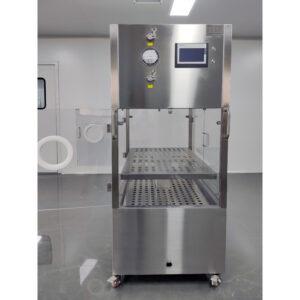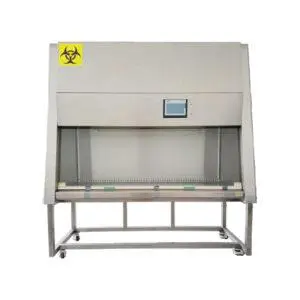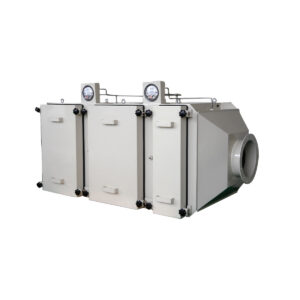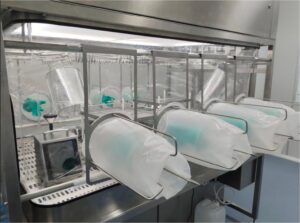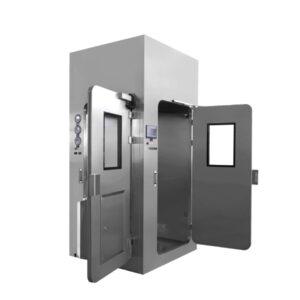
Especificar una unidad de transferencia sin confirmar la relación de presión a ambos lados de la pared es una de las causas más previsibles de observaciones en la fase final de la puesta en marcha en proyectos de salas blancas. El patrón de fallo es siempre el mismo: se encarga una caja de paso dinámica como mejora rutinaria, la orientación de la puerta y el cableado del enclavamiento se tratan como detalles de instalación, y la falta de coincidencia entre la dirección del flujo de aire y la cascada de presión prevista solo sale a la luz durante la cualificación —una vez que se ha realizado la abertura en la pared y se ha fijado la unidad en su lugar—. Modificar la configuración de la puerta o la lógica de enclavamiento en esa fase implica revisar los planos de fabricación, los detalles de las penetraciones en la pared y, posiblemente, los espacios libres de acceso a los filtros, que nunca se compararon con la distribución de la sala. La decisión que evita esto es sencilla: confirmar la relación de presión entre salas, la secuencia de las puertas y el acceso de servicio antes de que la unidad entre en fase de fabricación, no después de que llegue a la obra.
Casos de uso de las cámaras de transferencia dinámicas en la transferencia de materiales farmacéuticos
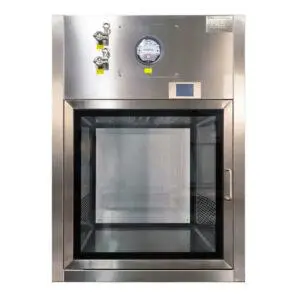
El argumento a favor de una caja de transferencia dinámica no es que sea una versión mejorada de una unidad estática, sino que ciertas interfaces de transferencia requieren un flujo de aire activo cuando una barrera pasiva resulta insuficiente. Una caja de paso estática proporciona una separación física entre dos espacios; no aporta nada al control de la contaminación más allá del enclavamiento que impide la apertura simultánea de las puertas. Cuando ambos lados de la transferencia comparten la misma clasificación de limpieza, esto suele ser suficiente. Cuando la interfaz conecta espacios con diferentes niveles de limpieza, o cuando una sala limpia se conecta a un pasillo no controlado o a una zona de apoyo, una barrera pasiva no puede mantener la integridad ambiental del lado de mayor grado durante la apertura de la puerta.
El Anexo 1 de las BPF de la UE es específico en este punto para los entornos de máxima clase: las compuertas de paso que dan servicio a zonas de Clase A o Clase B requieren un suministro activo de aire filtrado. Se trata de un requisito normativo directo, no de una preferencia de diseño, y elimina la opción estática para esas interfaces, independientemente de otras limitaciones del proyecto. En el caso de diferencias de grado inferiores, la decisión sigue basándose en el riesgo: la cuestión es si el riesgo de transferencia justifica el control técnico adicional y la carga que suponen la cualificación y el mantenimiento de los componentes de flujo de aire activo.
Esa carga es real y debería tenerse en cuenta a la hora de tomar la decisión de selección antes de realizar cualquier pedido.
| Factor | Caja de pases estática | Caja de pases dinámica |
|---|---|---|
| Relación con la limpieza | El mismo nivel de limpieza | Diferentes niveles, o de sala limpia a no sala limpia |
| Interfaz de grado A/B (Anexo 1 de las BPF de la UE) | No es suficiente: requiere aire filtrado de forma activa | Obligatorio: suministro de aire activo con filtro HEPA |
| Método de control de la contaminación | Barrera física pasiva | Barrera de aire activa, purga vertical, flujo descendente unidireccional con filtro HEPA |
| Asistencia para el flujo de aire | Ninguno | Flujo de aire HEPA recirculado; sin conductos externos |
| Carga que suponen la cualificación y el mantenimiento | Baja | Nivel superior (componentes activos, pruebas de integridad de los filtros HEPA) |
La tabla anterior plantea la disyuntiva entre «estático» y «dinámico» como un criterio de decisión, no como una jerarquía de rendimiento. La elección de una unidad dinámica en un caso en el que una unidad estática habría sido suficiente añade al ciclo de vida pruebas de integridad de los filtros HEPA, validación de los ciclos de purga, procedimientos de sustitución de filtros y monitorización de la presión diferencial, sin aportar a cambio una mejora proporcional en la garantía de seguridad. La pregunta clave a la hora de definir las especificaciones es si el riesgo de transferencia y las características de la sala requieren un flujo de aire activo, y si el diseño del sistema de climatización de la instalación está preparado para soportarlo.
Lógica de flujo de aire y presión HEPA para equipos de transferencia activa
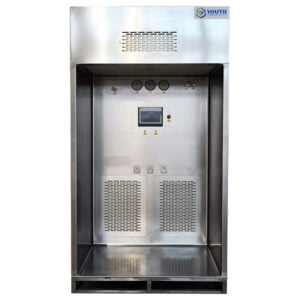
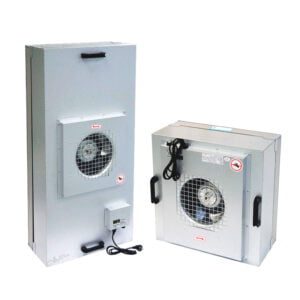
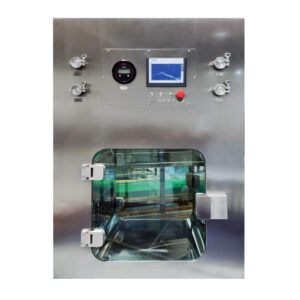
Una caja de paso dinámica genera su propio flujo de aire internamente. La unidad aspira el aire de la sala a través de una etapa de prefiltro, lo hace pasar por un filtro HEPA H14 y lo expulsa en forma de flujo descendente unidireccional hacia la cámara de transferencia. Dado que el ventilador y el sistema de filtración son autónomos, la unidad no requiere conexión al sistema de climatización de la instalación; sin embargo, esa independencia tiene un límite que afecta a su especificación.
El flujo de aire activo cumple dos funciones durante una operación de transferencia. Mientras la puerta está abierta, el flujo descendente crea una barrera de aire que reduce la probabilidad de que entren contaminantes desde el lado de menor grado. Una vez cerrada la puerta, el flujo de aire continuo purga la cámara antes de que se pueda abrir la puerta opuesta. Se trata de mecanismos de control de la contaminación a nivel de proceso, y dependen de que la secuencia de enclavamiento funcione según lo previsto. El flujo de aire en sí mismo —la barrera y la purga— no sustituye a una cascada de presión de sala correctamente diseñada, sino que la complementa. Una caja de paso dinámica situada en una pared donde la relación de presión de la sala es indefinida, inversa o inconsistente no mantendrá de forma fiable la dirección de movimiento del aire prevista, independientemente de lo que haga el ventilador interno. La caja de paso puede complementar una cascada bien diseñada, pero no puede corregir una inadecuada.
Esta distinción cobra especial importancia durante la coordinación del diseño de los sistemas de climatización. Si no se ha establecido el diferencial de presión entre las dos estancias —o si se da por supuesto en lugar de calcularse—, resulta difícil predecir la contribución del flujo de aire de la unidad dinámica y aún más difícil validarla. La consecuencia práctica de esta limitación es que la revisión de la cascada de presión se considere una comprobación previa a la fabricación, en lugar de una actividad de puesta en servicio.
Los datos de diseño, como los índices de eficiencia HEPA H14 y la clasificación de prefiltros G4, reflejan las especificaciones del fabricante para familias de productos concretas y deben confirmarse con la unidad concreta que se vaya a adquirir. No se trata de requisitos mínimos reglamentarios universales, aunque el rendimiento H14 se ajusta a los requisitos de filtrado a los que se hace referencia en el Anexo 1 de las BPF de la UE para entornos de grado A/B.
Detalles sobre los sistemas de enclavamiento y el acceso a los filtros que influyen en la homologación
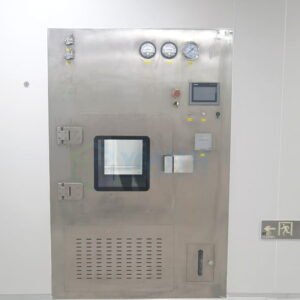
El alcance de la homologación de una cámara de transferencia dinámica es más amplio de lo que la mayoría de los equipos prevén en el momento de la compra. La homologación de una unidad estática consiste, esencialmente, en una verificación física: el funcionamiento del enclavamiento de la puerta, los materiales de las superficies y el ajuste dimensional. Una unidad dinámica añade pruebas de integridad del filtro HEPA, mediciones de la velocidad y la uniformidad del flujo de aire, pruebas de recuento de partículas y de tiempo de recuperación, y la validación de la secuencia de purga del enclavamiento. Cada uno de estos aspectos requiere que la unidad, tal y como se entrega, cuente con características de diseño específicas y que estas sean accesibles.
El puerto de prueba DOP/PAO es el detalle más importante que hay que confirmar antes de realizar el pedido. Sin un puerto de prueba accesible, no se puede llevar a cabo la prueba de integridad del filtro HEPA in situ —normalmente mediante un método de exposición a aerosoles— con el nivel de calidad exigido para el mantenimiento continuo de la cualificación. Si antes de la fabricación no se comprueba la ubicación del puerto en relación con la posición de instalación y el espacio de acceso a la sala, este podría acabar situado en la cara equivocada de la unidad u obstaculizado por la estructura de la pared. Se trata de un problema que no puede resolverse sin una modificación física tras la instalación. Del mismo modo, el sello de gel de borde afilado H14 es lo que da sentido a la prueba de integridad del filtro HEPA; un filtro instalado sin este sello de gel puede superar las comprobaciones de velocidad del flujo de aire, pero presentar una vía de fuga que solo una prueba de exposición a aerosoles podrá detectar.
El enclavamiento electromagnético con purga retardada es fundamental para la lógica de contención, no solo por razones de comodidad. La duración de la purga —el periodo durante el cual ambas puertas permanecen bloqueadas después de que se cierre una, antes de que se desbloquee la del lado opuesto— es el intervalo en el que el flujo de aire de la cámara elimina cualquier contaminante que haya entrado mientras la puerta estaba abierta. La duración específica es un parámetro de diseño y validación que debe confirmarse con el fabricante y documentarse en el protocolo de cualificación; no se trata de un valor normativo fijo. Lo que importa para la planificación de la cualificación es que la lógica esté documentada, sea comprobable y repetible.
| Característica de diseño | Repercusiones en la cualificación y el mantenimiento | Qué hay que comprobar antes de realizar un pedido |
|---|---|---|
| Enclavamientos electromagnéticos con purga retardada | Evita la apertura simultánea de las puertas; es imprescindible para la validación de la secuencia de contención y purga | Duración de la purga y lógica de desbloqueo de la puerta |
| Puerto de prueba DOP/PAO | Permite realizar pruebas de fugas (integridad) de los filtros HEPA in situ | Ubicación y accesibilidad del puerto |
| Filtro HEPA H14 con sellado de gel y borde afilado | Ofrece una eficiencia del 99,995% y un sellado sin fugas, lo cual es fundamental para superar la prueba de integridad. | Compatibilidad del sellado de gel y procedimiento de cambio del filtro |
| Prefiltro lavable G4 | Protege el filtro HEPA y prolonga su vida útil; la carga afecta al flujo de aire y al diferencial de presión | Frecuencia de limpieza e indicador de sustitución |
| Manómetro de presión diferencial / pantalla digital con alarma | Los monitores supervisan la carga de los filtros para verificar su rendimiento de forma continua | Requisitos relativos al punto de consigna de la alarma y a la calibración |
La supervisión de la presión diferencial en las etapas del prefiltro y del filtro HEPA es importante más allá de la calificación inicial. La carga del filtro cambia con el tiempo, y un prefiltro saturado reduce el caudal de aire a través del filtro HEPA y disminuye la velocidad de flujo descendente de la que depende el modelo de control de la contaminación. Un punto de consigna de alarma que no se calibre ni se revise como parte del mantenimiento periódico no proporcionará una alerta temprana útil. Se trata de una consideración que abarca todo el ciclo de vida, no solo la puesta en servicio, y debe abordarse en el plan de mantenimiento antes de que la unidad entre en servicio.
Para los equipos que estén tramitando la documentación de homologación, el Comparación entre la caja de paso estática y la caja de paso dinámica aborda las diferencias de diseño y homologación con un nivel de detalle estructurado que puede servir de apoyo para la elaboración de planos de URS.
Retrasos en la puesta en marcha debidos a una dirección de presión poco clara o a la lógica de las puertas
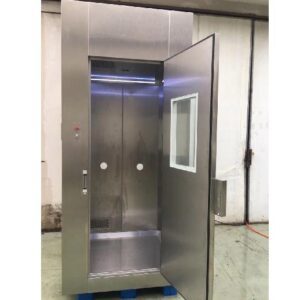
La orientación de la puerta no es una variable de instalación, sino una decisión de fabricación que debe resolverse antes de fabricar la unidad. La dirección de apertura en cada cara de la cámara de transferencia determina en qué lado se articula la puerta, cómo funciona la secuencia de desbloqueo del enclavamiento en relación con el acceso a la sala y si el movimiento de la puerta interfiere con el desplazamiento del personal o con la estructura de las paredes a ambos lados. Algunos fabricantes utilizan un sistema de códigos de dirección que debe especificarse en el momento del pedido; las configuraciones no estándar, como las disposiciones en forma de L o de tres vías, requieren una notificación previa explícita y presentan unas dimensiones diferentes.
El modo de fallo en este caso es previsible: un equipo de proyecto selecciona una unidad dinámica, considera la orientación de las puertas como un detalle que se confirmará más adelante y recibe una unidad configurada para una disposición genérica en línea recta que no se ajusta a la distribución real de las paredes ni al flujo operativo. Corregir esto tras la entrega —o, peor aún, tras la instalación— implica realizar un corte adicional en la pared, reorientar los conjuntos de bisagras que quizá no se puedan reconfigurar in situ, o ajustar el cableado de enclavamiento que se haya tendido en la cara equivocada. Cada una de estas acciones genera una laguna en la documentación que debe subsanarse antes de que pueda proseguir la homologación.
La misma lógica se aplica a las interfaces de cableado de los enclavamientos. El enclavamiento dinámico de la caja de paso debe cablearse para que se adapte a los sistemas de control de puertas y de alarma de la instalación, y dicha interfaz debe diseñarse antes de que se finalice la apertura en la pared. Si el diseño del sistema de control está incompleto en el momento de la adquisición del equipo, al menos deben definirse el trazado del cableado y la interfaz del cuadro eléctrico, de modo que la unidad se encargue con las provisiones eléctricas correctas. Descubrir que la señal de enclavamiento requiere una configuración de salida diferente una vez que la unidad está fijada en la pared supone un retraso en la puesta en servicio del que es difícil recuperarse sin que se aprecien trabajos de rectificación.
Una comprobación útil que conviene realizar antes de realizar cualquier pedido: confirmar el sentido de apertura de la puerta, el espacio libre para la apertura en ambos lados, los requisitos de conexión del cableado del sistema de enclavamiento y el espacio libre para el acceso al filtro, comparándolo con el plano arquitectónico de la pared en cuestión. Estas comprobaciones no deben realizarse tras la entrega.
Umbral de compra una vez confirmadas la trayectoria del flujo de aire y la relación con la estancia
No se debe elegir una cámara de transferencia dinámica simplemente porque la estrategia de control de la contaminación de un proyecto parezca más completa al incluir un flujo de aire activo en las especificaciones. Se debe elegir porque la interfaz de transferencia —la pared concreta, el diferencial de limpieza concreto, el flujo operativo concreto— genera un riesgo que el flujo de aire activo reduce de forma cuantificable y que la cascada de presión de la instalación está diseñada para soportar. Cuando no se confirmen esas condiciones, la unidad dinámica supone un coste adicional, una carga de cualificación y una complejidad de mantenimiento sin una base de garantía defendible.
La evaluación de riesgos documentada constituye el criterio de selección, no una justificación posterior a la compra. Si la evaluación de riesgos no se ha completado antes de la adquisición, la especificación es prematura, independientemente de las presiones presupuestarias o de plazos. La evaluación debe abordar qué es lo que se transfiere, la clasificación de limpieza a ambos lados de la pared, cualquier requisito normativo relativo al aire filtrado activo en dicha interfaz y las consecuencias de un incumplimiento. Cuando se aplica el Anexo 1 de las BPF de la UE y la interfaz da servicio a un entorno de grado A o B, el requisito de aire filtrado de forma activa no es una decisión discrecional, sino un elemento fijo de la especificación. Para otras interfaces, la evaluación se basa realmente en el riesgo y la opción dinámica puede ser o no el resultado adecuado.
El diagrama de presión del sistema de climatización constituye una comprobación paralela previa a la compra. Una caja de paso dinámica instalada en una pared en la que no se haya calculado ni documentado la relación de presión entre habitaciones no puede homologarse de forma que demuestre que la dirección del flujo de aire es fiable y repetible. La norma ISO 14644-3 establece el marco de métodos de ensayo para la determinación de la concentración de partículas en suspensión y las mediciones relacionadas en entornos controlados; el protocolo de cualificación debe ser coherente con dichos métodos, y la cascada de presión debe ser lo suficientemente estable como para soportarlos.
| Elemento de confirmación | Por qué es importante | Qué verificar |
|---|---|---|
| La evaluación del riesgo de transferencia justifica el flujo de aire activo | Impide que se utilice una unidad dinámica como mejora predeterminada; garantiza que el control técnico se ajuste al riesgo real | Evaluación de riesgos documentada que abarca ambas partes de la transferencia |
| Se ha documentado la diferencia en cuanto a la limpieza | Se recomienda su uso dinámico para distintos niveles de limpieza o en interfaces de grado A/B. | Clases de sala limpia en ambos lados y cualquier requisito del Anexo 1 relativo al aire filtrado |
| Se revisa el diseño de la cascada de presión de la sala | Una cámara de paso dinámica permite el funcionamiento en cascada, pero no puede compensar un régimen de presión inadecuado en la sala. | Diagrama de presión del sistema de climatización que muestra la relación entre las distintas estancias |
Si alguno de los elementos de confirmación de la tabla anterior no puede verificarse antes de realizar el pedido, eso indica que la adquisición se adelanta al diseño, y que esa discrepancia saldrá a la luz más adelante, en una fase en la que su resolución resultará más costosa.
En Página del producto «Dynamic Pass Box» abarca las configuraciones disponibles, las opciones dimensionales y las especificaciones de los filtros que pueden ajustarse a un URS confirmado.
El valor práctico de confirmar la trayectoria del flujo de aire, la dirección de la presión y la configuración de las puertas antes de la fabricación no es una mera precaución de procedimiento, sino que marca la diferencia entre una decisión de control de la contaminación que se puede defender en la cualificación y otra que requiere una explicación. Una caja de paso dinámica que esté correctamente especificada para su interfaz, con la orientación de las puertas fijada, la lógica de enclavamiento documentada, el acceso a los filtros revisado en función de la distribución de la sala y la cascada de presión confirmada por el diseño del sistema de climatización, generará un registro de cualificación que resista cualquier escrutinio. La misma unidad solicitada sin esas confirmaciones generará observaciones durante la puesta en servicio, solicitudes de reelaboración y desviaciones en la cualificación que consumirán un tiempo que nunca se había presupuestado.
Antes de realizar un pedido, los datos mínimos que deben confirmarse son: la clasificación de limpieza y el nivel de presión a ambos lados de la pared, la base de riesgo documentada para el flujo de aire activo, la dirección de la puerta y el espacio libre de apertura en cada cara, la interfaz de cableado del enclavamiento, y el espacio necesario para el acceso a la sustitución del filtro y al puerto de prueba. Si alguno de estos aspectos queda sin resolver, la especificación está incompleta, y el coste de resolverlos aumenta considerablemente una vez que comienza la fabricación.
Preguntas frecuentes
P: ¿Qué ocurre si aún no se ha diseñado nuestro sistema de cascada de presión para la sala cuando tengamos que hacer el pedido?
R: Especificar una cámara de paso dinámica antes de definir la cascada de presión conlleva un alto riesgo de incompatibilidad y debe evitarse. Si los plazos de adquisición exigen realizar un pedido anticipado, lo mínimo que hay que hacer es acordar con el ingeniero de climatización qué lado de la pared será la zona de mayor grado y fijar esa suposición en los requisitos de diseño (URS). La dirección del flujo de aire de la unidad quedará fijada según esa asignación; invertir la relación de presión posteriormente puede hacer que la barrera resulte ineficaz y crear una deficiencia en la homologación que requiera una reelaboración física. Siempre que sea posible, hay que definir primero la cascada de presión, ya que el coste de corregir una instalación desajustada supera con creces el coste de retrasar la orden de compra.
P: Una vez que hayamos confirmado la relación de presión y la orientación de la puerta, ¿qué documentación debe estar formalizada antes de emitir la orden de compra?
R: Se debe fijar una Especificación de Requisitos del Usuario (URS) que recopile todos los detalles específicos de la interfaz. Como mínimo, debe incluir: la clasificación de limpieza y el nivel de presión a ambos lados de la pared, la dirección de apertura de la puerta y el espacio libre de giro para cada cara, los requisitos de cableado de enclavamiento y de la interfaz de control, la ubicación del puerto de prueba DOP/PAO y el espacio de acceso al filtro, así como la evaluación de riesgos documentada que justifique el flujo de aire activo. La fijación de este documento permite coordinar los equipos de ingeniería, validación y compras antes de que se asuman compromisos de fabricación, y evita que el pedido siga adelante basándose en suposiciones sin confirmar.
P: ¿Es imprescindible que una caja de paso dinámica tenga siempre una configuración de pared recta, o puede instalarse en una disposición en forma de L o de tres vías?
R: Las cajas de paso dinámicas pueden fabricarse en configuraciones en forma de L o de tres vías, pero estas no son estándar y deben especificarse en el momento del pedido con las dimensiones exactas y los códigos de orientación de las puertas. Modificar in situ una unidad de paso recto para adaptarla a una abertura en ángulo comprometerá la estructura, la alineación de los enclavamientos y el sellado de la sala limpia. Si su recorrido de transferencia de material requiere una disposición no lineal, consulte al fabricante desde el principio, facilítele los planos arquitectónicos de la abertura en la pared y los espacios libres adyacentes, y confirme las opciones viables; por ejemplo, revisando la guía de configuración disponible en la Página del producto «Dynamic Pass Box».
P: Si nuestro diferencial de presión entre salas ya es sólido y está bien documentado, ¿sigue ofreciendo una caja de transferencia dinámica una ventaja cuantificable en cuanto al control de la contaminación con respecto a una estática?
R: Sí, ofrece una protección que una caja de paso estática no puede proporcionar. Una fuerte cascada de presión reduce el riesgo en estado estacionario, pero cuando se abre la puerta, el diferencial de presión puede colapsar momentáneamente o incluso invertirse, lo que permite que los contaminantes transportados por el aire entren en el lado de mayor grado de limpieza. Una caja de paso dinámica contrarresta esto con una barrera activa de flujo descendente durante el periodo en que la puerta está abierta y un ciclo de purga validado tras el cierre de la puerta. Cuando las consecuencias de incluso una breve brecha relacionada con la transferencia son inaceptables, la unidad dinámica añade una capa de protección frente a eventos transitorios que una cascada robusta por sí sola no cubre.
P: Cuando el presupuesto es limitado y no existe ninguna normativa que obligue a utilizar un flujo de aire activo, ¿cómo se justifica el gasto adicional que supone una caja de paso dinámica frente a una estática?
R: La justificación debe basarse en una evaluación del riesgo de contaminación específica de la instalación, no en una norma reglamentaria por defecto. Si la evaluación muestra que un único incidente de contaminación durante la transferencia de material podría dar lugar al rechazo del lote, a una limpieza exhaustiva o a costes de investigación del producto que superen el capital incremental y el mantenimiento a lo largo del ciclo de vida de una unidad dinámica, la inversión es justificable desde el punto de vista operativo. Cuando el riesgo de transferencia es bajo y una caja de paso estática con enclavamiento puede mantener la segregación de forma fiable, es poco probable que el coste adicional del flujo de aire activo aporte un valor proporcional. La decisión se basa en un equilibrio económico en función del riesgo, no en una mejora del rendimiento.