Les défaillances de verrouillage détectées lors d’un audit GMP sont rarement des défaillances logiques — il s’agit plutôt de défaillances de périmètre. Un plan de test qui considère toutes les portes de sas comme fonctionnellement équivalentes passera tous les contrôles de séquence normale, mais ne permettra pas de détecter que le sas de transfert des déchets desservant une salle BSL-2 nécessite que le verrouillage de sa double porte soit lié à un signal de fin de cycle de désinfection, ou que le sas d’entrée du personnel d’une salle HPAPI nécessite une réponse de compensation d’évacuation mesurée en secondes, et non en minutes. Ces lacunes n’apparaissent pas comme des points à corriger lors de la mise en service ; elles se révèlent être des défaillances critiques lorsqu’un inspecteur demande des preuves spécifiques à chaque parcours et que le dossier SAT ne peut pas les fournir. Les décisions qui permettent d’éviter cela sont prises lors des phases de conception (URS) et d’aménagement, et non lors de l’exécution des essais — plus précisément, il s’agit de déterminer quels parcours existent, quel événement de confinement chaque transition de porte représente, et ce que la logique de déverrouillage doit confirmer avant d’autoriser l’ouverture de la porte suivante.
Cas de test d'interverrouillage par personnel et itinéraire de transport
Le type d’itinéraire constitue le principe d’organisation adéquat pour la planification des tests de verrouillage, mais c’est souvent celui qui fait défaut. Un même plan de sas peut présenter des ferrures de porte identiques sur un itinéraire réservé au personnel et sur un itinéraire réservé aux matériaux, mais les conséquences d’une défaillance du verrouillage sont radicalement différentes dans chaque cas : l’une entraîne un risque de contamination des tenues, l’autre un risque d’intrusion de particules lors d’un transfert non contrôlé. Les plans de test qui regroupent tous les verrouillages sous une structure générique de “ séquence à double porte ” négligent systématiquement les conditions spécifiques à chaque zone et produisent des rapports SAT qui ne peuvent pas être mis en correspondance avec les risques propres à chaque parcours.
Pour les sas de personnel, le test doit vérifier que la séquence d’habillage est imposée par la logique de verrouillage, et pas seulement que les portes s’enchaînent correctement. Une porte qui se déverrouille avant la fin de l’habillage représente un risque de non-conformité critique au regard des BPF, et le rapport d’essai doit démontrer que la dépendance de séquence est réelle et qu’elle a été mise à l’épreuve. Les sas à matériaux imposent une exigence distincte : les interfaces indépendantes de surveillance environnementale doivent être opérationnelles et enregistrer les données au moment du transfert, afin que tout événement d’intrusion de particules pendant le fonctionnement des portes soit capturé et traçable. Il s’agit d’un point de coordination lors de la planification des essais : si l’interface de surveillance n’est pas encore mise en service, l’essai de verrouillage du MAL ne peut pas fournir de preuves complètes.
Pour les configurations de confinement spécialisées, les critères d’acceptation s’écartent considérablement de la logique standard des sas. Dans les zones HPAPI et OEB 4–5, le temps de réponse de la compensation d’évacuation après l’ouverture de la porte est une valeur de conception qui doit être définie lors de l’URS et confirmée lors des essais — un délai de réponse de 2 secondes est un objectif couramment appliqué pour le confinement des poussières actives, mais il doit être considéré comme un critère d’acceptation spécifique au projet, et non comme un seuil réglementaire universellement imposé. Les passages de déchets BSL-2/3 nécessitent une catégorie d’essais totalement différente : il faut vérifier que le verrouillage est bien lié au signal de fin du cycle de désinfection par UV ou par produits chimiques, et le comportement de maintien de l’alimentation locale doit être testé indépendamment afin de confirmer que la logique de verrouillage reste valable en cas de coupure de courant. Les sas d’équipement dotés de grandes ouvertures ajoutent la stabilité de la pression comme critère d’essai principal — une chute de pression supérieure à 30% pendant le déplacement de l’équipement indique que la séquence de purge ou le rideau d’air ne compense pas suffisamment.
| Route Type | Exigences relatives aux essais | Critères d'acceptation / Seuil | Pourquoi c'est important |
|---|---|---|---|
| Sas pour le personnel (PAL) | Vérifier l'ordre d'enfilage des tenues et la synchronisation correcte du verrouillage des portes | La séquence d'habillage doit être menée à bien ; tout manquement entraîne une non-conformité critique au regard des BPF. | Évite les non-conformités aux BPF dues à des séquences de saisie incorrectes |
| Sas pour matériaux (MAL) | Interfaces de surveillance environnementale indépendantes permettant de suivre la pénétration de particules | Les interfaces de surveillance doivent fonctionner et enregistrer les données entrantes | Empêche la pénétration incontrôlée de particules lors du transfert de matières |
| HPAPI / OEB 4–5 zones | Réaction de compensation de l'échappement après l'ouverture d'une porte | Réaction dans les 2 secondes suivant l'ouverture de la porte afin de confiner les poussières en suspension | Assure le confinement des poussières pharmaceutiques actives dangereuses |
| Systèmes de transfert des déchets BSL-2/3 | Verrouillage des deux portes lié aux cycles de désinfection par UV et produits chimiques ; test de la maintien de l'alimentation locale et de l'autodiagnostic | Les dispositifs de verrouillage doivent garantir l'achèvement du cycle de désinfection ; l'autodiagnostic doit fonctionner même en cas de coupure de courant. | Assure le confinement le long des itinéraires de transport des déchets dangereux |
| Sas pour équipements (grandes ouvertures) | Double verrouillage indépendant, rideaux d'air locaux et séquence de purge ; essai de perte de charge | Perte de charge ≤ 30% pendant le déplacement de l'équipement | Assure la stabilité de la pression dans la salle lors des transferts à grande ouverture |
| Tous les itinéraires / Prévention du talonnage | Test de la logique anti-suivi trop rapproché avec compteurs de présence et réglage de la vitesse des ventilateurs | Alarme de délai d'attente ≤ 5 secondes | Empêche les accès non autorisés et les cas de « tailgating » |
Le système anti-suivi, lorsqu'il est installé, fonctionne comme un dispositif de contrôle du niveau d'occupation qui s'ajoute à la séquence de base à double porte et qui est souvent testé séparément, voire pas du tout. Si ce système utilise des compteurs de présence pour déclencher l'ajustement de la vitesse du ventilateur, le test doit vérifier à la fois le délai de déclenchement de l'alarme (un délai maximal de 5 secondes est généralement visé) et la réponse du ventilateur, car une réponse trop lente de ce dernier va à l'encontre de l'objectif visé, même si l'alarme se déclenche correctement.
Contrôles de séquence normale, d'alarme, de contournement et de coupure d'alimentation
La séquence normale de verrouillage — la porte A se ferme, le capteur de position confirme la fermeture, un délai fixe s'écoule, la remise en pression est vérifiée, la porte B se déverrouille — semble simple sur le papier. En pratique, cette séquence repose sur quatre événements de confirmation distincts, et n'importe lequel d'entre eux peut entraîner une défaillance qui ressemble à une erreur logique mais qui est en réalité un problème lié à un capteur, au système CVC ou à un élément mécanique. Les protocoles de test qui se contentent d’enregistrer « réussi » ou « échoué » pour l’ensemble de la séquence, sans consigner les étapes de confirmation intermédiaires, compliquent l’isolation des défauts et ne fournissent aux auditeurs aucune base permettant de distinguer un système validé d’un système qui a simplement réussi le test le jour de l’essai.
La vérification de la récupération de pression au sein de la séquence — qui consiste généralement à s’assurer que la pression différentielle entre les zones s’est stabilisée à un niveau égal ou supérieur à la valeur cible de conception (≥ 10 Pa est une valeur courante) avant le déverrouillage de la porte B — est l’étape la plus souvent considérée comme une simple formalité. Elle ne devrait pas l’être. Si ΔP fluctue au-delà d’une tolérance définie (±1,5 Pa est un paramètre de conception raisonnable) pendant la fenêtre de confirmation, le système doit prolonger le délai ou déclencher un avertissement plutôt que de poursuivre la séquence. Les essais doivent tester cette condition de manière délibérée : simuler une instabilité du système CVC ou un joint de porte mal positionné, et vérifier que la logique réagit en bloquant l’ouverture, et non en autorisant l’ouverture de la porte suivante. Un système qui autorise l’ouverture de la porte B sur la base d’une lecture momentanément stable, mais qui dérive immédiatement par la suite, ne fonctionne pas conformément à sa conception.
Le comportement en cas de coupure d'alimentation et de dérogation à l'alarme incendie nécessite un test spécifique, car la logique doit répondre simultanément à deux exigences contradictoires : la sécurité des personnes exige une capacité d'évacuation en « fail-open », tandis que le contrôle de la contamination exige l'enregistrement de l'état final. Les normes NFPA 101 et EN 16005 définissent le cadre régissant les issues de secours ; l’essai de verrouillage doit confirmer que le système bascule en mode « ouverture en cas de défaillance » lors du déclenchement de l’alarme incendie, tout en capturant un instantané de l’état inviolable permettant de reconstituer ce qui était ouvert, ce qui était verrouillé, ainsi que le personnel ou le matériel en transit au moment de la désactivation. Sans cet instantané, toute enquête post-événementielle commence par une lacune.
| Scénario de test | Comportement attendu / Critère | Pannes courantes / Remarques relatives au diagnostic |
|---|---|---|
| Séquence normale | Porte A complètement fermée → capteur de position confirmé → délai fixe ≤ 1,5 s → récupération de ΔP vérifiée à ≥ 10 Pa → déverrouillage de la porte B | Un délai incorrect ou une remise à niveau de pression incorrecte peuvent indiquer une dérive du capteur ou une fuite au niveau du joint de la porte. |
| Logique à verrouillage par pression | Si la variation de ΔP dépasse ±1,5 Pa, le système prolonge le délai ou déclenche des alertes jusqu'à ce que la stabilité soit rétablie. | Empêche les déverrouillages intempestifs ; des fluctuations répétées peuvent indiquer une instabilité du système de chauffage, de ventilation et de climatisation |
| Contournement des alarmes de coupure de courant et d'incendie | Le système passe en mode de sortie « fail-open » ; l'état final est enregistré (conformément aux normes NFPA 101 et EN 16005) | Le personnel ne doit pas se retrouver coincé ; les registres doivent être inviolables afin de garantir la traçabilité. |
| Diagnostic de l'alarme sonore | L'alarme se déclenche en cas de dysfonctionnement ; parmi les causes courantes, on peut citer un mauvais alignement entre le verrou et la gâche (défaillance de la détection magnétique), une rupture de fil ou un bouton d'urgence bloqué. | Les tests systématiques des alarmes permettent de distinguer les défauts mécaniques des défauts électriques. |
Le test des alarmes sonores est souvent considéré comme un simple contrôle fonctionnel — l’alarme retentit-elle ? — plutôt que comme un exercice de diagnostic. Les causes courantes de défaillance (défaillance de la détection magnétique due à un désalignement de la tôle de verrouillage, rupture de fil, bouton d’urgence bloqué) produisent chacune des signatures d’alarme différentes et nécessitent chacune une action corrective différente. Un rapport de test qui se contente de confirmer le déclenchement de l’alarme n’apporte aucune valeur diagnostique si celle-ci se déclenche de manière intermittente pendant le fonctionnement. Enregistrer la condition de défaillance à l’origine de chaque alarme de test, et pas seulement la réponse de l’alarme, permet de disposer de données qui faciliteront l’isolation future des défauts sans nécessiter un nouveau test complet.
Interactions entre la douche à air et le sas de transfert avec la logique des portes
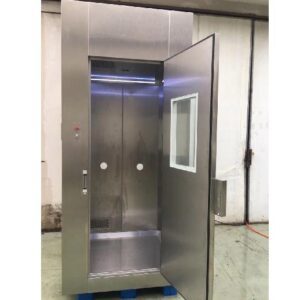
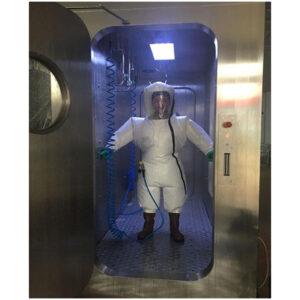
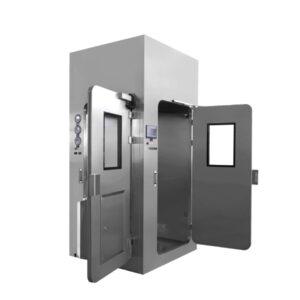
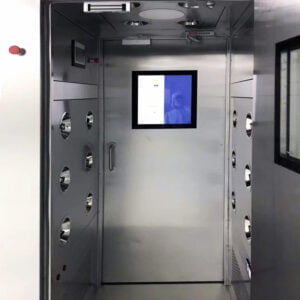
Une douche à air intégrée au parcours d’accès du personnel modifie la logique de verrouillage, qui passe d’une séquence à deux portes à une séquence à trois états : la porte extérieure se ferme, le cycle de la douche à air se déroule jusqu’à son terme, et ce n’est qu’alors que la porte intérieure se déverrouille. Le test doit confirmer que la porte intérieure ne peut pas être déverrouillée avant la fin du cycle, même si le capteur de position de la porte extérieure a déjà confirmé sa fermeture. Cela semble évident, mais il s'agit d'un point de coordination entre le contrôleur de la douche à air et l'automate de verrouillage qui est souvent supposé plutôt que vérifié. Si les deux systèmes communiquent via un relais à contact sec plutôt que par une poignée de main numérique, la dérive de synchronisation est un mode de défaillance réaliste qui doit être testé sur plusieurs cycles, et non pas seulement lors d'une confirmation en un seul passage.
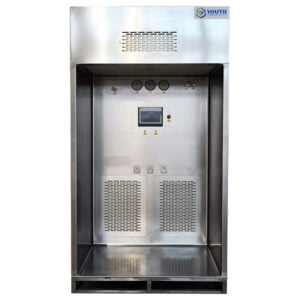
La douche à air pour salle blanche de Youth Filter Ces configurations comprennent des signaux de sortie d'interverrouillage conçus pour s'harmoniser avec la logique de commande des portes — veillez à vérifier, lors de l'achat, que le protocole de communication correspond bien aux exigences du système de gestion technique du bâtiment ou du contrôleur d'interverrouillage, car les spécifications d'interface non compatibles constituent une source fréquente de retards lors des dernières étapes de la mise en service.
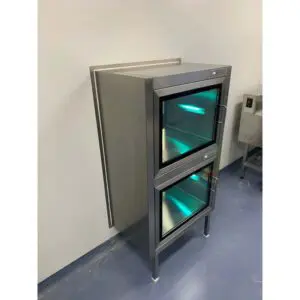
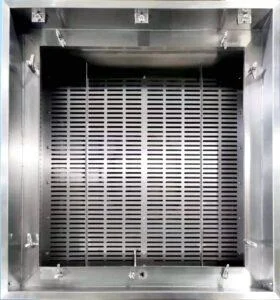
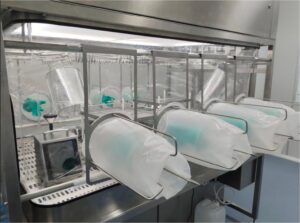
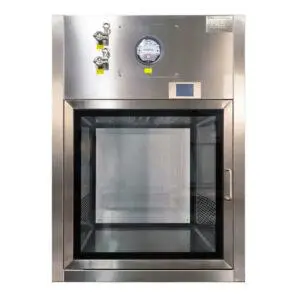
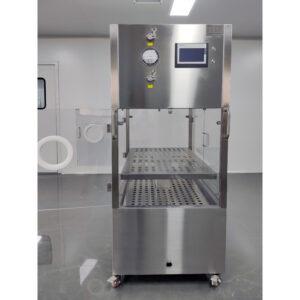
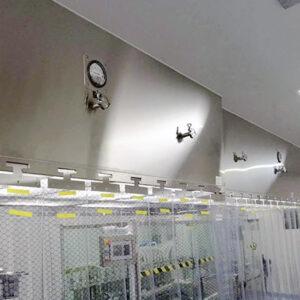
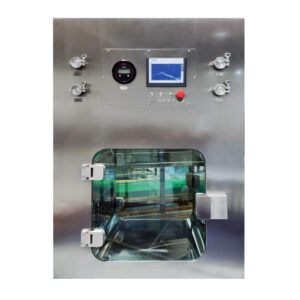
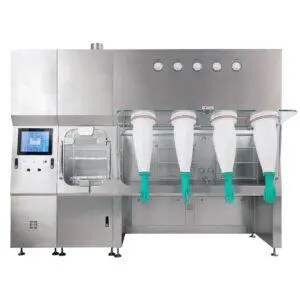
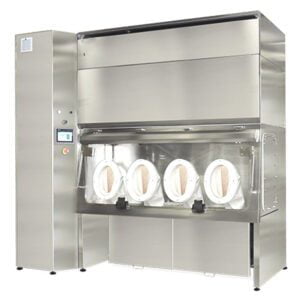
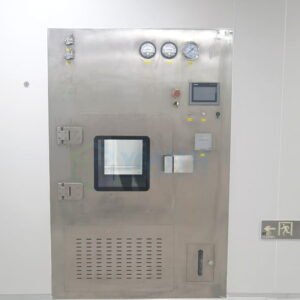
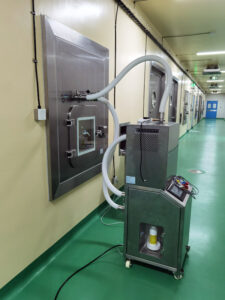
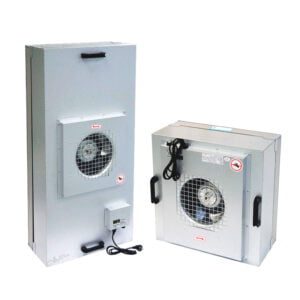
Pour les sas dynamiques situés sur les voies de transfert de matériaux, le verrouillage « une porte à la fois » constitue la logique de confinement de base ; les essais doivent confirmer son bon fonctionnement dans les mêmes conditions de mise à l’épreuve que celles appliquées aux sas pour le personnel : tentatives simultanées d’actionnement des portes, coupure de courant en cours de cycle et comportement de l’alarme lorsqu’une porte reste ouverte au-delà du délai d’attente. Ventilé boîtes de transfert dynamiques introduire une exigence de coordination supplémentaire : la vérification de l’intégrité du filtre HEPA et du flux d’air interne doit être considérée comme faisant partie intégrante de la même séquence d’essais que le test de verrouillage, et non comme une activité de mise en service distincte. Une boîte de transfert qui réussit son test de verrouillage mais dont le filtre HEPA est défectueux ne fonctionne pas comme une barrière anti-contamination, quelle que soit la précision de la séquence d’ouverture des portes. Séparer artificiellement ces tests génère un rapport de validation qui ne permet pas de démontrer l’efficacité du système dans son ensemble.
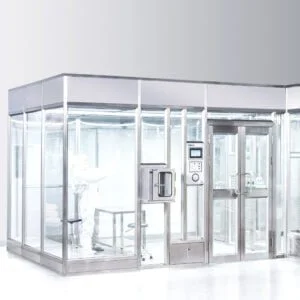
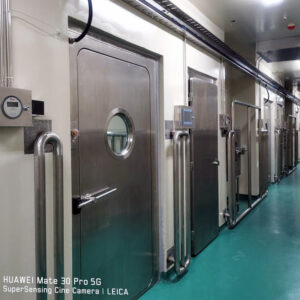
Le même principe de coordination s'applique à la relation physique entre les choix d'agencement des sas et les paramètres de temporisation des verrouillages. Un sas de transfert ou un sas dimensionné pour un flux de transfert de matière spécifique intègre, de par ses dimensions, un temps de transit implicite. Si le délai de déverrouillage est défini sans tenir compte du temps de réponse réel du système VAV pour cette zone, ce décalage de synchronisation se traduira par un problème opérationnel, même si le test de verrouillage a été réussi. Pour en savoir plus sur l’interaction entre le dimensionnement du sas de transfert et les décisions relatives à la configuration des flux d’air et des interverrouillages, consultez le Chambres de passage et sas pour salles blanches modulaires : Guide de dimensionnement et de configuration traite ces interdépendances en détail.
Risques liés à l'ergonomie qui conduisent les opérateurs à contourner les contrôles
Un dispositif de verrouillage qui entrave le fonctionnement courant finira par être contourné. Le mécanisme est généralement informel — un loquet magnétique laissé déverrouillé, un bouton d’urgence maintenu partiellement enfoncé, une porte calée — et il est rarement consigné comme un écart, car les opérateurs le perçoivent comme une solution de contournement face à un système défaillant, et non comme un échec du contrôle de la contamination. Au moment où cette pratique est découverte, le contournement s’est normalisé et la temporisation initiale du dispositif de verrouillage a déjà généré un historique de valeurs hors spécifications.
La cause technique la plus courante de ce problème réside dans un décalage temporel entre le délai de déverrouillage et le temps de réponse à pleine course du système VAV. Si le déverrouillage de la porte se déclenche avant que les registres d’alimentation et d’évacuation n’aient atteint leurs points de consigne pour l’état suivant de la zone, la différence de pression n’est pas encore stabilisée au moment où la porte intérieure s’ouvre. Il en résulte une perturbation en cascade momentanée qui se traduit par une variation de pression. L’observation en service suggère que ce décalage pourrait être à l’origine d’une part importante des événements de pression hors spécifications dans les zones contrôlées par verrouillage — un chiffre couramment cité dans la pratique technique est d’environ 78%, bien qu’il faille le considérer comme une indication plutôt que comme une statistique validée par l’industrie. Quoi qu’il en soit, l’implication en matière de conception est claire : le délai de déverrouillage doit être fixé à une valeur au moins égale au temps de course complète du VAV multiplié par un facteur de marge (1,5× est une valeur cible couramment appliquée) afin de garantir une stabilité réelle de la pression, et non pas simplement le temps écoulé, avant le déverrouillage de la porte.
Le deuxième type de défaillance en matière d’ergonomie est de nature mécanique, et non logique. L’affaissement de la porte ou la déformation du cadre peuvent entraîner l’enclenchement mécanique de la languette de verrouillage alors que la porte ne peut en réalité pas s’ouvrir : le dispositif de verrouillage indique “ déverrouillé ”, l’opérateur appuie, rien ne bouge, et sa première conclusion est que le système fonctionne mal. À force de répétitions, la réaction passe du signalement du défaut à sa prévention, en désactivant le verrou. Ce type de défaillance est particulièrement fréquent dans les salles blanches à cloisons modulaires, où la rigidité du cadre de porte dépend du bon assemblage des cloisons, et il est difficile à détecter lors des essais de réception car la déformation se développe souvent sous une charge opérationnelle soutenue, et non pendant le cycle de mise en service initial. L’intégration d’un contrôle de la force d’ouverture de la porte et d’une vérification de l’alignement du cadre dans le périmètre de la qualification de l’installation (IQ) — plutôt que de les traiter comme des points à régler sur une liste de retouches — réduit le risque qu’une dérive mécanique déclenche un contournement du système six mois après la remise des clés.
Ces deux modes de défaillance ont en commun la même solution en amont : la fenêtre de retard acceptable et le temps de course du VAV doivent être définis et convenus dès la phase d’URS, et les exigences de rigidité du châssis doivent être incluses dans le cahier des charges de l’équipement, sans être laissées à l’appréciation de l’installateur. Tenter de renégocier l’un ou l’autre de ces éléments après l’installation implique de refaire la qualification opérationnelle (OQ) et de reconstituer les preuves de la SAT, ce qui représente un coût disproportionné pour un paramètre qui aurait pu être corrigé en un seul cycle de révision de l’URS.
Conserver les preuves relatives au système d'interverrouillage avec les dossiers SAT
La documentation SAT relative aux systèmes de verrouillage est souvent constituée d’un ensemble de fiches d’essai individuelles plutôt que d’un dossier de preuves cohérent. Cette distinction est importante lors d’un audit : un ensemble de résultats « réussi/échoué » confirme que les essais ont bien été effectués, mais il ne permet pas à un inspecteur de reconstituer le fonctionnement attendu du système, de vérifier si les critères d’acceptation ont été respectés dans les limites de tolérance, ni si les écarts constatés lors des essais ont été correctement résolus avant l’acceptation du système. La structure IQ/OQ/PQ fournit le cadre permettant de dresser ce tableau complet.
Les données IQ doivent confirmer l’état physique et logique de l’installation : emplacements des capteurs, versions du micrologiciel et protocoles de communication entre le contrôleur de verrouillage, la quincaillerie de porte, le système de gestion du bâtiment (BMS) et toute interface de surveillance. Il ne s’agit pas de simples formalités : un capteur mal positionné par rapport à la gâche de porte, ou une version de micrologiciel qui ne correspond pas à la configuration validée, crée une lacune de qualification qui doit être comblée avant de pouvoir procéder à la qualification opérationnelle (OQ). Les essais de qualification opérationnelle (OQ) sont soumis aux critères d’acceptation quantitatifs les plus spécifiques : précision de synchronisation à ±0,2 seconde, vérification du seuil de pression à ±0,5 Pa, confirmation de la conformité des issues de secours aux normes NFPA 101 et EN 16005, et évaluation des faux déclenchements liés au « tailgating » dans des conditions de circulation réalistes. Ces chiffres doivent être définis dans le cahier des charges fonctionnel (URS) et repris dans le protocole d’essai en tant que critères d’acceptation spécifiques au projet — ils représentent la précision que le système doit démontrer, et non des exigences réglementaires issues d’une norme unique désignée. La qualification de performance (PQ) passe de la validation des fonctions individuelles à la validation du comportement du système dans des conditions opérationnelles réalistes : simulation de pics de fréquentation, rétablissement de la pression dans un délai défini (≤ 3 secondes est un objectif de conception courant) et essais d’interception d’accès en condition de charge.
| Phase de validation | Axes de vérification | Éléments de preuve / Critères clés |
|---|---|---|
| IQ (Installation Qualification) | Emplacement des capteurs, version du micrologiciel, procédures d'établissement de la communication | Localisation documentée des capteurs, vérification du micrologiciel et du protocole de communication |
| OQ (Qualification opérationnelle) | Précision de synchronisation, seuils de pression, issues de secours, système anti-suivi | Précision de chronométrage : ±0,2 s, seuils ΔP : ±0,5 Pa, conformité aux normes d'évacuation en cas d'incendie selon les normes NFPA 101/EN 16005, évaluation des faux déclenchements dus au « tailgating » |
| PQ (Qualification de performance) | Simulation des pics de trafic, rétablissement de la pression, piste d'audit, interception des accès | Rétablissement de la pression ≤ 3 secondes, vérification complète de la piste d'audit, tests d'interception d'accès en charge |
| Intégrité des données (toutes les phases) | Archives inviolables, autorisations basées sur les rôles, conservation à long terme | Autorisations basées sur les rôles, journaux inviolables, synchronisation NTP, conservation pendant au moins 10 ans, archivage en écriture unique défini lors de la phase URS |
La couche d’intégrité des données s’applique à l’ensemble des trois phases et c’est à ce niveau que les exigences de l’annexe 1 des BPF de l’UE relatives aux enregistrements électroniques et aux pistes d’audit deviennent directement applicables. Les événements liés aux portes, les courbes ΔP, les modifications des autorisations des opérateurs et les accusés de réception des alarmes doivent être consignés dans un format inviolable, horodatés via une synchronisation NTP, et conservés pendant une durée définie lors de la phase URS — une durée minimale de 10 ans est un objectif couramment spécifié pour les applications BPF. L’intégration avec un LIMS ou un MES garantit que les journaux d’événements des interverrouillages sont disponibles comme preuves à l’appui lors d’enquêtes sur les écarts, sans nécessiter d’extraction manuelle des données. Un système qui génère des journaux conformes pendant la validation mais qui ne peut pas les produire à la demande lors d’une enquête sur un écart a respecté la lettre de l’exigence sans en satisfaire l’esprit. La méthode d’archivage en écriture unique et la structure des autorisations basée sur les rôles doivent toutes deux être définies avant l’installation du système, car la mise en place a posteriori de contrôles d’accès et de fonctionnalités d’intégrité des journaux après la mise en service est techniquement complexe et nécessite une requalification des fonctions concernées.
Le critère pratique permettant d'évaluer tout plan de test des interverrouillages réside dans sa capacité à fournir des preuves spécifiques à chaque parcours de transfert au sein de l'établissement — et non pas simplement à confirmer que les portes s'enchaînent correctement de manière isolée. Un compte-rendu de test PAL qui ne démontre pas le respect de la séquence d'habillage, un test MAL qui ne confirme pas le fonctionnement de l'interface de surveillance, et un test du passage des déchets qui ne parvient pas à démontrer le couplage avec le cycle de désinfection sont tous incomplets, quel que soit le nombre de fiches de test qu'ils contiennent.
Avant de finaliser le périmètre du plan de test, assurez-vous que les tolérances en matière de retard de libération et les temps de course des vannes VAV ont été convenus et consignés dès la phase de protocole, et non reportés à la mise en service. Vérifiez que la structure du dossier SAT — notamment les données que le système doit enregistrer, la durée de conservation des enregistrements et les interfaces d’intégration que les journaux doivent prendre en charge — est définie dans le cahier des charges fonctionnel (URS). Les décisions prises en amont permettent d’obtenir des preuves d’essai valables face à un examen réglementaire ; celles reportées à la phase de mise en service génèrent des rapports de mise en service qui nécessiteront des retouches pour être défendables.
Questions fréquemment posées
Q : Notre installation utilise un système de gestion technique du bâtiment (BMS) tiers qui n'avait pas encore été mis en service au moment où les essais d'interverrouillage étaient prévus. Pouvons-nous tout de même établir un rapport d'essai MAL valide ?
R : Non — un essai de verrouillage de sas (MAL) n’est pas complet si l’interface de surveillance environnementale n’est pas active et n’enregistre pas les données pendant l’essai. Si le système de gestion du bâtiment (BMS) n’est pas encore mis en service, l’essai MAL ne peut pas démontrer que les particules pénétrant lors du fonctionnement des portes sont capturées et traçables, ce qui constitue une exigence fondamentale des preuves spécifiques à l’itinéraire. La réponse appropriée consiste soit à reporter le test MAL jusqu’à ce que l’interface de surveillance soit opérationnelle, soit à définir formellement le périmètre du test comme une qualification partielle, avec un point en suspens documenté nécessitant un nouveau test avant la validation de la qualification partielle (PQ).
Q : Une fois que le dossier SAT relatif au système de verrouillage a été accepté, quelle est la première tâche opérationnelle à effectuer avant la mise en service de la salle blanche ?
R : Vérifiez que les tolérances de retard de déclenchement du VAV convenues lors de la qualification opérationnelle (OQ) sont bien prises en compte dans les points de consigne du système de gestion technique du bâtiment (BMS) en production, et assurez-vous que la force d’actionnement des portes et l’alignement des châssis sont conformes aux spécifications avant que le personnel ne commence à circuler normalement. Ces deux éléments — la configuration temporelle et l’état mécanique — constituent les causes les plus courantes d’un déclenchement prématuré du contournement. Détecter tout écart entre les paramètres validés et les points de consigne réels lors de la passation de relais permet d’éviter le problème plus complexe consistant à reconstituer les preuves de la qualification opérationnelle (OQ) après qu’un événement de pression hors spécifications (OOS) s’est déjà produit en production.
Q : À partir de quel moment l'allongement du délai de déverrouillage cesse-t-il d'améliorer la stabilité de la pression et commence-t-il à poser un problème d'ergonomie ?
R : La limite supérieure utile correspond au point à partir duquel le délai allonge sensiblement le temps de transit par rapport aux attentes des opérateurs concernant cet itinéraire. En pratique, un délai de déclenchement fixé à 1,5 fois le temps de course complète du VAV permet d’assurer la stabilité de la pression sans entraîner d’attente perceptible dans la plupart des configurations — les délais supérieurs à cette valeur doivent être justifiés par une caractéristique spécifique du système CVC, et non appliqués par défaut par mesure de prudence. Les délais qui semblent arbitraires aux yeux des opérateurs sont les conditions les plus susceptibles d’inciter à un contournement informel ; ainsi, tout délai dépassant l’objectif de 1,5 fois doit être réévalué à la lumière des données réelles de réponse du VAV, plutôt que d’être conservé par mesure de précaution.
Q : Un essai statique de verrouillage d'une chambre de transfert est-il équivalent à un essai dynamique de verrouillage d'une chambre de transfert, ou ces essais nécessitent-ils des protocoles différents ?
R : Ces tests requièrent des protocoles différents. Un test de verrouillage d’un passe-plat statique doit uniquement confirmer la séquence « une porte à la fois », le comportement de l’alarme de délai d’attente et la réponse en cas de coupure de courant. Un sas dynamique ajoute une exigence de coordination : la vérification de l’intégrité du filtre HEPA et du flux d’air interne doit être traitée comme faisant partie de la même séquence de test, et non comme une activité de mise en service distincte. Les séparer donne lieu à un rapport de validation qui confirme la séquence correcte des portes, mais ne permet pas de démontrer que l’unité fonctionne comme une barrière anti-contamination, car un filtre HEPA défaillant compromet l’objectif de confinement du verrouillage, quelle que soit la précision de la séquence des portes.
Q : Les essais d'interverrouillage répondent-ils à l'exigence de vérification de la cascade de pression pour une salle blanche, ou s'agit-il de deux activités de qualification distinctes ?
R : Il s’agit d’activités distinctes qui ne se substituent pas l’une à l’autre. Les essais d’interverrouillage confirment que la logique de transition des portes, le comportement des alarmes et les réponses en cas de dérogation fonctionnent correctement — ils ne caractérisent pas le profil de pression différentielle maintenu entre les zones en conditions de fonctionnement, ce que permettent d’établir les essais de cascade de pression. Une installation peut disposer d’un système d’interverrouillage entièrement validé et néanmoins échouer à un essai de cascade de pression si le dimensionnement du système CVC, les fuites dans les pièces ou la réponse des registres sont inadéquats. Ces deux essais doivent être réalisés et leurs rapports croisés dans le dossier de qualification, mais ils portent sur des modes de défaillance différents et sont régis par des critères d’acceptation distincts.