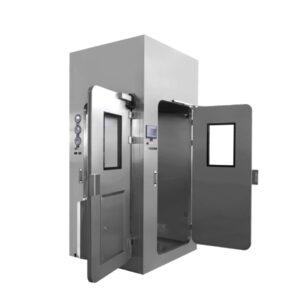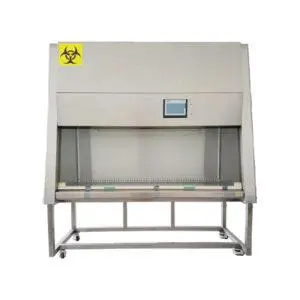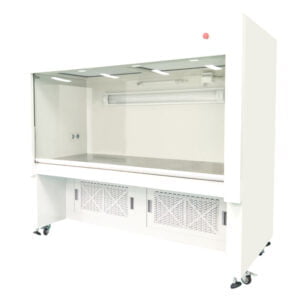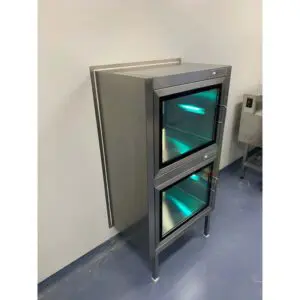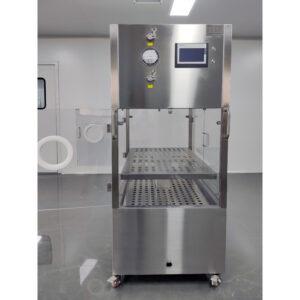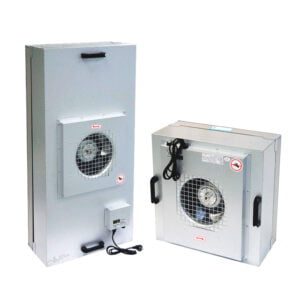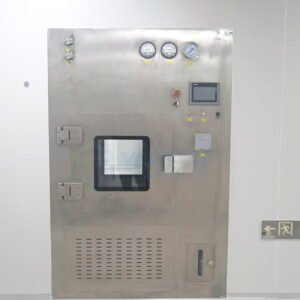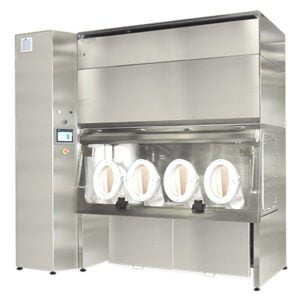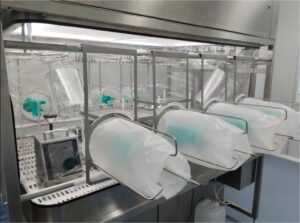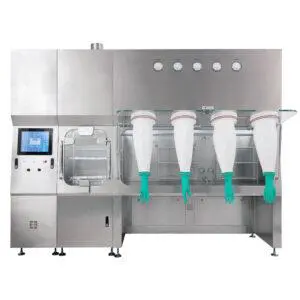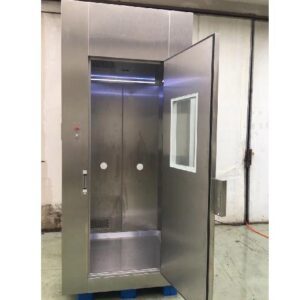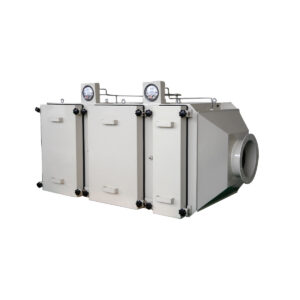
Freestanding LAF unit delivery requirements are set by the narrowest point on the route from the unloading dock to the final position—not by the room dimensions or the installed footprint. When a unit ships as a single assembled envelope, every doorway, corridor turn, and lift car it must pass through becomes a constraint the project team needs to record before the order is placed. Getting those measurements on paper early is the difference between a smooth installation day and an unplanned reassembly decision made under time pressure.
Measure the complete delivery path
The delivery route is the controlling document for every dimension discussion that follows. Walk the full path from where the truck unloads to the unit’s final location, and record what actually limits movement at each transition point.
Freestanding LAF delivery route decision checks
| État d'avancement du projet | Action de l'acheteur | Limite à conserver |
|---|---|---|
| A unit must pass through doors | Record clear openings and route turns | No clearance allowance is prescribed |
| A lift is on the route | Record usable dimensions and permitted load for project review | No lift capacity is assumed |
| Shipping dimensions differ from installed dimensions | Request both envelopes and packaging information | No packaging or disassembly option is presumed |
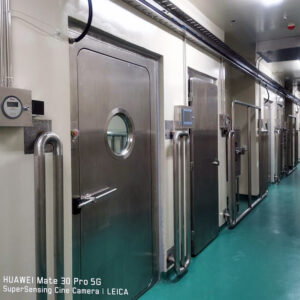
Clear opening width is the first number to capture at every doorway, and it is not the same as the nominal door size. Frame depth, door hardware, and any recessed threshold trim all reduce the usable passage. A corridor turn adds a second constraint: the unit’s length determines how much swing room it needs to clear the corner, and a wide unit needs more lateral clearance even when the straight-run width looks sufficient. Record both dimensions at every turn.
If the route crosses a lift, record three numbers for that car: interior width, interior depth, and the rated load capacity. Both the unit itself and whatever handling frame or skid it rides on have to fit inside simultaneously, and the combined weight needs to fall within the lift’s permitted load. Neither dimension is implied by the other—a car that holds the unit’s footprint may not hold the unit plus a pallet truck, and a car rated for the unit’s weight may not have the floor area. Send both sets of figures to the project team for review; do not assume a fit in either direction.
Record clear openings, turn geometry, and lift capacity as a single measured route document—any one of the three can stop delivery at the last step.
The goal of this survey is a written route record, not a rough estimate. Projects increasingly ask for this document as a formal attachment to delivery planning, and having it early means constraints can be addressed in the design or logistics phase rather than on the day the truck arrives.
Compare shipping and assembled envelopes
A drawing of the installed unit shows the finished configuration; it does not show what arrives on the pallet. These are two distinct envelopes, and delivery planning requires both.
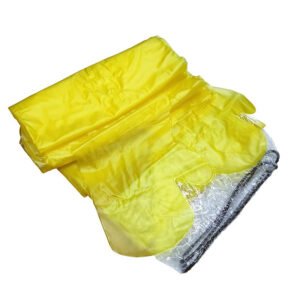
Les shipping envelope includes packaging, crating, any shipping frame, and the unit’s configuration as it leaves the factory—which may differ from the installed configuration. Some freestanding LAF units ship with the plenum section nested or with the frame partially disassembled to reduce height or width. Others ship fully assembled and represent their maximum envelope from the moment they leave the dock. Without a drawing or datasheet that shows the crated dimensions explicitly, the installed drawing cannot confirm whether the unit will pass through a given doorway.
Produits associés
- Unité à flux d'air laminaire – Unité LAF — Examiner la gamme locale d'unités de traitement de l'air à la lumière du cahier des charges du procédé et du site.
- Filtre à air HEPA/ULPA à mini-plis — Étudiez la gamme de filtres pour l'unité locale proposée, sous réserve d'une compatibilité d'interface confirmée.
- Filtre à air Gel Seal HEPA/ULPA — Examiner la gamme de filtres à interface d'étanchéité correspondant à l'unité proposée ; vérifier la géométrie d'accouplement réelle.
- BanFxa iovn lnpLa es alre m l)allicfae(iulAduaàrtrbche — Ne comparez une solution alternative de zone de travail locale de type « banc » que si son encombrement correspond à la même tâche du processus ; vérifiez la configuration et la couverture.
- Chariot mobile LAF à flux laminaire vertical / horizontal — Envisager une solution mobile en zone locale pour une tâche de travail ou de transfert délimitée, puis vérifier l'itinéraire, la zone d'utilisation et les interfaces de service ; cela n'implique aucune équivalence avec une unité fixe.
Request both envelopes from the supplier at the same time, along with packaging information that describes what comes off and in what order. This matters for two reasons. First, some packaging elements add significant width—extended crating flanges or a protective corner frame can push total width past the doorway limit even when the unit itself would clear. Second, knowing what packaging can be removed before entry, and what tools or crew that requires at the unloading point, is part of delivery planning, not an afterthought.
Consider a project where the delivered unit clears the building’s freight entrance with packaging intact but cannot turn the final corridor without removing the crating. If the team discovers this on delivery day, it creates a staging problem: the unit needs floor space to unpack safely, and that floor space may be inside a controlled area with its own access rules. If the team discovers it during design coordination, it becomes a line item in the delivery plan with a designated unpacking zone already identified.
The comparison between shipping and installed envelopes also surfaces any disassembly options that may exist. Some units are designed to separate into sections—plenum, motor assembly, filter bank—for delivery through a constrained route. Whether that option is available, and what it involves, is a question for the supplier during design coordination, not a capability to assume.
Assign assembly and handling duties
A route workaround—shipping in sections, removing packaging at the threshold, repositioning inside the room—only works if the right people and equipment are present and their roles are defined before delivery day.
Field assembly is the clearest example. If a unit must be separated into sections to pass through the route, someone has to put it back together on-site. That person needs to be identified, qualified, and scheduled. The supplier may offer field assembly as a scoped service, or the installation contractor may hold that responsibility, or it may fall to the buyer’s own maintenance team. None of these arrangements can be assumed; each needs to be confirmed explicitly, because the scope of what the supplier delivers ends at a defined point, and what happens after that point is a separate accountability.
Handling equipment raises a parallel question. Depending on the unit’s weight and footprint, moving it from the unloading point to its final position may require a pallet truck, a low-profile dolly, or a powered lift device. Confirm that whatever handling equipment is needed can itself travel the route—a standard pallet truck may not fit through the same doorway the unit barely clears, and a low-profile dolly may be needed where ceiling height limits a tilted approach. Identify who provides the handling equipment and who operates it; in many projects the supplier’s scope ends at the building threshold, and site handling is the buyer’s or contractor’s responsibility.
When a route constraint changes the delivery method, trace the full chain of who does what—assembly scope, handling equipment, and access to the room—before the delivery date is set.
Access to the final position matters separately from access along the route. A cleanroom or controlled area may have its own entry protocol, gowning requirement, or restricted entry window. If the unit needs to be positioned, leveled, and connected before that area is commissioned, the delivery sequence may need to coordinate with commissioning milestones. If the area is already operating, there may be a narrow window for a large delivery, and that window needs to be known in advance so handling and assembly can be completed within it.
YOUTH’s project coordination typically addresses assembly and handling scope during design review, so that the boundary between supplied service and site responsibility is established before the delivery schedule is confirmed.
Lectures complémentaires
- Commencez par cartographier le processus protégé : guide zone par zone pour le choix des filtres FFU, LAF et HEPA — Définir le cahier des charges de la zone de traitement en amont avant de préciser le périmètre des équipements.
- Interfaces entre les FFU, les LAF et les caissons HEPA : éléments à vérifier concernant les conduits, l'alimentation électrique, les commandes et l'accès pour la maintenance — Assurer la coordination des responsabilités relatives aux couloirs aériens et aux réseaux de services publics dans les zones voisines.
- Après une modification de la configuration, vérifiez à nouveau ces interfaces entre les FFU, les LAF et les boîtiers des terminaux — Réexaminer les interfaces concernées lorsque les modalités approuvées changent.
Close route constraints before dispatch
Every unresolved route constraint is a risk that lands on delivery day, when options are fewest and costs are highest. The practical rule is that nothing about the route should be uncertain when the dispatch date is set.
Work through the route record systematically. For each point where a dimension is tight, confirm whether the unit clears with or without packaging, and whether the confirmation is based on measured numbers from both sides or on an assumption. If a constraint exists that the current configuration cannot meet, the available responses are: adjust the unit’s configuration or shipping method, adjust the route (temporary removal of a door, use of an alternative entry), or stage assembly at a point before the constraint. Each of these options has a lead time and a cost, and none of them is fast to arrange after dispatch has been confirmed.
Resolve exceptions before the dispatch date is fixed, not after. A supplier notified of a route constraint two weeks before delivery has options. A supplier notified after the unit has left the factory has fewer, and the buyer who discovers the constraint when the truck is in the parking lot has almost none. The asymmetry is worth taking seriously: the information cost of doing the route survey early is low, and the cost of not doing it can include redelivery, field modification, or unplanned disassembly under uncontrolled conditions.
Late discoveries also carry a secondary risk that is easy to overlook. A unit that is maneuvered through a constrained route under improvised conditions is more likely to sustain handling damage—to filter media, to the housing structure, or to controls and wiring. That damage may not be visible until the unit is energized, and attributing it to delivery handling after the fact is difficult. A clean delivery, with constraints resolved in advance and appropriate handling equipment in place, removes that ambiguity.
Before delivery details are fixed, the route record to send YOUTH should include measured clear openings at every doorway and turn on the path, lift dimensions and load rating if a lift is involved, any access restrictions at the destination, and the confirmed scope for handling and assembly on-site. With that information in hand, the configuration, shipping method, and delivery sequence can all be matched to what the site actually allows.
Références
- ISO 14644-4:2022 Salles blanches et environnements contrôlés associés – Partie 4 : Conception, construction et mise en service — Utilisez le cadre public « des exigences à la vérification » pour structurer le cahier des charges du projet ; celui-ci ne prescrit ni technologie ni modèle contractuel.
- ISO 14644-3:2019 Salles blanches et environnements contrôlés associés – Partie 3 : Méthodes d'essai — Repérez la portée définie pour les tests de performance ; son résumé ne fournit aucune limite universelle pour la validation du projet.
- IEST-RP-CC002 Dispositifs à flux unidirectionnel pour air purifié — Identifiez les aspects liés aux performances des dispositifs de purification de l’air avant de valider les preuves du projet ; le résumé ne fournit aucune procédure d’essai.
- ISO 14644-7:2004 Salles blanches et environnements contrôlés associés – Partie 7 : Dispositifs de séparation — Distinguer le champ d'application de la conception des dispositifs locaux de la protection de l'ensemble du processus.
Questions fréquemment posées
Q : Which dimensions matter if the unit is delivered in several pieces?
A : Utilisez les dimensions de transport spécifiques à chaque pièce, et pas uniquement le gabarit de l’ensemble final assemblé. Vérifiez chaque pièce par rapport à l’itinéraire et confirmez quel assemblage est prévu à destination ; ne partez pas du principe qu’une pièce peut être démontée sur place.
Q : La comparaison des capacités de levage doit-elle se baser uniquement sur le poids unitaire ?
A : Comparez la charge de levage réelle prévue dans le cadre de l’étude de manutention du projet, en incluant l’emballage et les équipements de manutention lorsqu’ils sont transportés avec la pièce. Un chiffre basé uniquement sur le poids unitaire peut ne pas refléter le déplacement proposé.
Q : Une vérification réussie au niveau des ouvertures de porte suffit-elle à garantir la faisabilité de la livraison ?
A : Non. L’itinéraire comprend également les virages, l’accès à l’ascenseur, l’espace de circulation et la zone de positionnement ou d’assemblage final. Résolvez le segment limitant pour la configuration livrée avant de considérer l’itinéraire comme praticable.