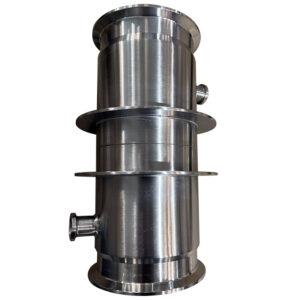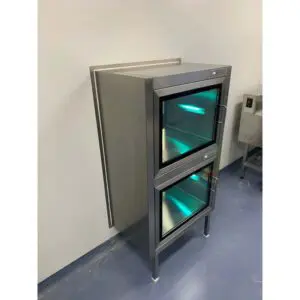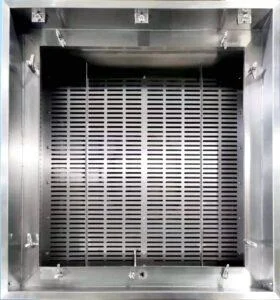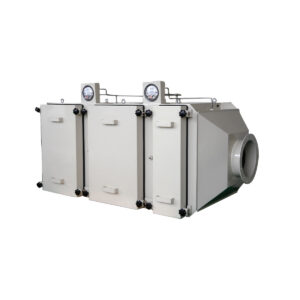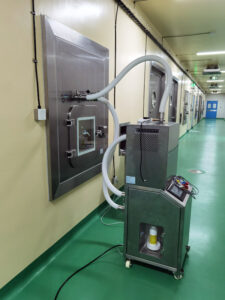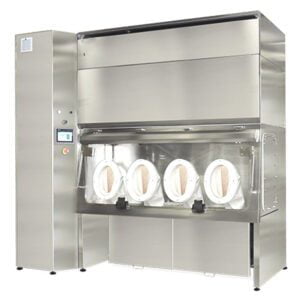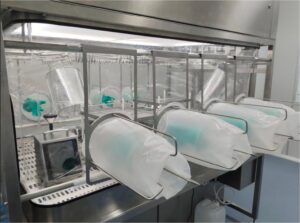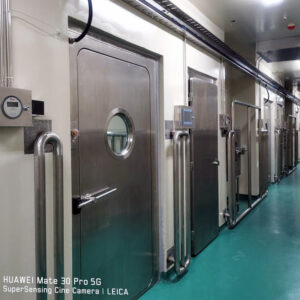
Facilities that defer the safe-change decision until after layout approval often discover the consequences only when ductwork drawings are already coordinated and structural penetrations are fixed. A BIBO housing sized to the airstream can run close to 18 feet in length, require perimeter clearance for room-side serviceability, and sit in the technical area above the cleanroom — none of which is easy to accommodate after the mechanical package is closed. The result is duct rework, ceiling height conflicts, or permanent access constraints that an early specification decision would have avoided. The judgment this article is designed to support is knowing which exhaust applications actually require safe-change housing, what validation interfaces must be defined before procurement, and where standard GMP filtration remains the more appropriate solution.
Aseptic Facility Exhaust Risks That Can Justify BIBO Housing
The trigger for evaluating BIBO is not cleanroom classification — it is what the exhaust airstream carries and what happens to the operator when that filter is eventually changed. Supply-side filtration and exhaust-side filtration are not equivalent problems, and treating them as if they were leads either to scope inflation or to genuine exposure gaps on the exhaust path.
The exhaust streams that most directly justify BIBO housing in pharmaceutical and biotech settings involve filters that have accumulated high drug concentrations — particularly where a HEPA unit sits in the exhaust path of an isolator handling active pharmaceutical ingredients. In that scenario, a standard housing offers no containment mechanism during the filter change event. The operator requires full PPE, and the surrounding area faces a real contamination risk from particulate release. When the airstream contains viruses, bacteria, or other pathogens — as in BSL exhaust systems or isolation rooms — the same logic applies: the standard housing provides effective filtration during operation but no safe mechanism for removing the loaded filter from the airstream.
Industry application data suggests that BIBO safe-change procedures can reduce operator exposure by up to 95% in high-containment environments. That figure should be treated as a directional indicator of the safety benefit, not as a certified performance guarantee, but it does reflect the design intent: the bag-in/bag-out sequence keeps the contaminated filter sealed throughout the change, preventing the exposure event that an unprotected change would create.
| Scénario de risque | Without BIBO Housing | With BIBO Housing |
|---|---|---|
| HEPA filter exposed to high drug concentration (e.g., isolator exhaust with active pharmaceutical ingredient) | Operator must wear full PPE; surrounding area faces contamination risk during filter change | Bag-in/bag-out safe-change procedure; operator exposure reduced by up to 95% |
| Exhaust air containing viruses, bacteria, or pathogens (isolation rooms, biosafety labs) | No containment during filter change; risk of pathogen release into facility | Filter sealed inside containment bag system throughout change; prevents environmental release |
The risk scenarios in these two categories — high drug concentration exhaust and pathogen-bearing exhaust — are the conditions that make BIBO a contamination-control decision rather than a hardware preference. If neither condition is present in the exhaust design, the case for BIBO becomes much harder to justify on risk grounds alone.
FDA-Regulated Maintenance Controls Around Used Filters
The FDA’s aseptic processing guidance and 21 CFR partie 211 establish a general requirement for maintaining cleanroom integrity and controlling contamination sources during maintenance activities. They do not prescribe the specific hardware features of a BIBO housing. What they do create is a compliance context in which the filter change event itself must be a controlled procedure — and the housing specification determines whether that control is realistic to execute.
Room-side serviceability is the foundational requirement. If testing, filter exchange, and challenge aerosol injection require access from outside the cleanroom boundary, the maintenance procedure inherently creates an integrity risk at the point of access. A housing that allows all of those activities from the cleanroom side eliminates that exposure pathway, which is the practical maintenance-integrity argument for BIBO in regulated environments.
Prefilter management matters more than it is often specified. A MERV 8–11 prefilter protecting the HEPA stage extends HEPA service life and reduces the frequency of safe-change events — which directly limits cumulative operator exposure. Differential pressure monitoring on each filtration stage provides the operational signal that triggers a change before the HEPA is overloaded, and the pressure monitoring lines themselves must include sterile isolation valves and sterilization ports if the facility operates under aseptic conditions. Leaving those ports unspecified at procurement typically means adding them later at higher cost and with limited installation access.
| Fonction de contrôle | What Should Be Specified | Pourquoi c'est important |
|---|---|---|
| Room-side serviceability | Filter testing, change, and challenge aerosol injection all accessible from the cleanroom side | Maintains cleanroom integrity and avoids breaching controlled spaces during maintenance |
| Prefilter management | MERV 8–11 prefilter changed on a timely schedule; long-life prefilter to reduce change frequency | Extends HEPA filter life and limits operator exposure during filter changes |
| Contrôle de la pression différentielle | DP gauges on each filtration stage; sterile isolation valves and sterilization ports on pressure lines | Enables performance monitoring and safe isolation of monitoring lines |
| Automatic filter scanning system | Optional system to verify filter tightness during maintenance | Provides automated integrity verification, supporting regulatory compliance |
An automatic filter scanning system is available as an optional feature and can support regulatory compliance by providing documented, automated verification of filter tightness at each maintenance event. Whether that level of automation is warranted depends on the frequency of filter changes and the audit documentation requirements of the specific facility — but it is easier to include in the original housing specification than to retrofit.
Layout Rework Caused By Late Safe-Change Decisions
The ownership question — whether BIBO belongs in the room equipment list, the HVAC package, or the project URS — is where layout conflicts typically originate. When the decision is deferred or left ambiguous between packages, the BIBO housing can fall out of early layout coordination entirely, only surfacing as a physical requirement after duct routing and above-ceiling structure are already committed.
The space demands are not trivial. BIBO housing sits in the technical area above the cleanroom and requires both vertical clearance for filter insertion and bag handling, and horizontal clearance around the housing perimeter for the safe-change procedure itself. A traditional housing can approach 18 feet in length. Customization can compress the footprint to approximately 6 feet, but that option must be specified before procurement — it cannot be assumed. Both figures should be treated as design-range planning inputs, not as fixed standards, but the planning implication is clear: the earlier the housing dimensions are introduced into the layout, the lower the risk of structural conflict.
| Layout Factor | Exigence typique | Consequence of Late Decision |
|---|---|---|
| Vertical space allocation | BIBO housing installed above cleanroom in the technical area; height required for filter insertion and bag handling | Duct rework or insufficient clearance if not planned early |
| Housing length | Traditional BIBO can be up to 18 ft; customization can reduce footprint to approximately 6 ft | Unplanned long housing forces layout conflicts and costly rework |
| Perimeter maintenance access | Adequate clearance around housing to allow safe bag-in/bag-out filter change | Lack of access prevents proper maintenance or requires structural modifications |
The downstream cost of a late decision is not just financial. When safe-change hardware is added after layout approval, the result is often a permanently constrained service access condition — one that maintenance personnel will navigate around at every filter change event for the life of the facility. That operational friction can affect how reliably the change procedure is followed, which is the kind of maintenance gap that shows up in audit observations. For GMP cleanroom projects where commissioning timelines are compressed, this is one of the few decisions where early resolution has a disproportionately large payoff.
Validation Interfaces Buyers Should Define Before Purchase
The gap between the BIBO hardware specification and the validation requirement is where most procurement errors occur. Buyers who specify the housing without defining the validation interfaces create a situation where those interfaces must be added after delivery — or the validation protocol must be modified to work around their absence. Neither outcome is efficient, and the second can create documentation gaps that are difficult to close during qualification.
The FDA’s Process Validation Guidance frames validation as a lifecycle activity requiring documented evidence that a process consistently delivers a quality result. For BIBO housing, that principle means the filter-change method, integrity verification procedure, and pressure monitoring approach all need to be validated as an integrated system — not just the filter itself. That validation scope should be defined before the purchase order is placed, because several of the relevant interfaces are either optional features or require custom fabrication.
Requiring factory acceptance test reports on both the filter and housing from the OEM is a practical procurement check, not a regulatory mandate, but it is one of the most effective ways to surface specification mismatches before the equipment ships. Single-OEM responsibility for both filter and housing eliminates the accountability gap that appears when a performance mismatch is discovered on-site and each supplier attributes the issue to the other party’s component.
| Interface / Requirement | Ce qu'il faut confirmer | Pourquoi c'est important |
|---|---|---|
| Factory acceptance tests (FAT) | Require FAT reports on both filters and filter housings from the OEM | Reduces on-site validation surprises and confirms specification compliance |
| Single OEM responsibility | Ensure the same manufacturer supplies filter and housing | Avoids performance mismatches and simplifies accountability |
| Fully-welded housing | Specify lifetime warranty against leaks | Prevents bypass contamination paths |
| Integrity testing procedures | Confirm DOP/PAO test of containment bag seal, airflow test, filter integrity test, and pressure differential verification | Confirms the BIBO system performs safely under operational conditions |
| Local aerosol injection | For pharmaceutical applications, inject challenge aerosol locally into the housing rather than remotely | Avoids cross-contamination of other areas during integrity testing |
| Optional validation accessories | Define need for scan sections, Magnehelic DP gauges, zero-leak bubble tight dampers, fumigation ports, inlet/outlet transitions | Facilitates ongoing validation and maintenance access |
| High-hazard decontamination provisions | Specify on-site disinfection ports and bio-sealed valves for high-hazard discharge systems | Enables safe isolation and decontamination before filter removal |
For pharmaceutical applications, the local aerosol injection requirement deserves particular attention. Injecting challenge aerosol remotely — through shared ductwork — risks cross-contaminating other areas of the facility during the integrity test. Local injection, directly into the housing, isolates the test to the unit being verified. This is not a universally codified protocol, but it is a practical requirement that should be written into the purchase specification rather than resolved during on-site qualification. Similarly, on-site disinfection ports and bio-sealed valves for high-hazard discharge systems allow safe isolation and decontamination before filter removal — specifying them before purchase is substantially less expensive than retrofitting them into an installed housing. The bag-in bag-out housing specification should include all interfaces the validation protocol will eventually require, not just the housing shell.
Decision Boundary Between Standard GMP Filtration And BIBO
The supply-versus-exhaust distinction is the most consistently underweighted variable in BIBO scoping decisions. Applying safe-change logic to supply air in a standard pharmaceutical cleanroom inflates project scope without improving contamination control outcomes. Missing it on exhaust streams carrying high drug concentrations or biological hazards creates the exact operator exposure risk BIBO is designed to eliminate. The practical boundary runs along contamination level and airstream direction, not cleanroom classification.
For supply air in pharmaceutical cleanrooms, operating rooms, and low-risk controlled environments, ceiling-mounted terminal HEPA modules remain the appropriate standard. The filter change on the supply side does not expose the operator to a contaminated airstream, and the risk profile does not justify safe-change hardware. The standard terminal housing is the right fit for that application, and specifying otherwise adds cost and complexity without a corresponding safety or compliance benefit.
The threshold shifts when the exhaust airstream contains particles of health concern. For exhaust with low drug concentration where filter change can be performed within an isolator with minimal contaminant carryover, standard procedures may be sufficient. When the HEPA is in direct contact with high concentrations of active pharmaceutical ingredient, that threshold has been crossed and BIBO safe-change housing is the appropriate control. Exhaust from BSL environments, isolation rooms, and biosafety labs sits at the same side of that boundary — the airstream itself is the hazard, and the filter change event is when that hazard is most likely to reach the operator.
| Application / Airstream | Standard GMP Filtration | BIBO Logement |
|---|---|---|
| Supply air (pharmaceutical cleanrooms, low-risk cleanrooms, operating rooms) | Ceiling-mounted terminal HEPA modules are adequate | Not required for supply side |
| Exhaust with low drug concentration (filter change inside isolator, minimal contaminant carryover) | Filter change within isolator may be sufficient | Typically not necessary |
| Exhaust with high drug concentration (HEPA in direct contact with active pharmaceutical ingredient) | Not recommended; exposure risk during change | Safe-change BIBO housing required |
| Exhaust from isolation rooms, biosafety labs (air containing viruses, bacteria, pathogens) | Standard housing offers no containment during change | BIBO housing required to protect operators and environment |
This boundary is an engineering and risk-based determination, not a bright regulatory line codified in FDA guidance. What makes it audit-defensible is documenting the rationale: the airstream characterization, the contamination level assessment, and the selection decision. A facility that can show the filter-change method was reviewed as a contamination-control decision — not just the hardware specification — is in a substantially stronger position during an inspection than one that selected BIBO (or declined it) without a documented basis.
The most consequential procurement decision in a BIBO specification is not the housing model — it is the completeness of the interface list defined before purchase. Validation accessories, decontamination ports, differential pressure monitoring provisions, and local aerosol injection points are all easier and less expensive to include in the original order than to add after installation. If any of those items are left to be resolved during commissioning, the project carries retrofit risk and potential qualification delays that compound in a compressed timeline.
Before procurement closes, confirm that the airstream justification is documented, the housing dimensions have been introduced into the facility layout early enough to prevent access conflicts, and the validation protocol requirements are reflected in the purchase specification rather than deferred to qualification. The filter-change method is a facility operation, not just a hardware detail — and the review record that supports that method is what makes the BIBO decision defensible in an audit.
Questions fréquemment posées
Q: Does the BIBO housing decision need to be captured in the URS, the HVAC package, or the room equipment list — and does it matter which?
A: It matters significantly, because the package that owns the decision determines whether BIBO dimensions enter layout coordination early enough to avoid conflicts. When ownership is left ambiguous between packages, the housing often falls out of above-ceiling coordination entirely, surfacing only after duct routing and structural penetrations are fixed. Assigning it explicitly in the URS — with cross-reference to both the HVAC and room equipment packages — is the most reliable way to ensure the physical requirements are introduced before mechanical drawings are closed.
Q: If the validation protocol is still being drafted when procurement opens, is it safe to finalize the housing specification anyway?
A: No — finalizing the housing before the validation protocol is drafted is one of the most common sources of retrofit cost in BIBO projects. Interfaces such as local aerosol injection ports, disinfection ports, bio-sealed valves, scan sections, and differential pressure monitoring provisions are either optional features or require custom fabrication. If the validation protocol later requires any of these, adding them to an installed housing is substantially more expensive and may involve access constraints that were not present during original installation. The practical approach is to draft at least a preliminary validation interface list before the purchase order is placed, even if the full protocol is not yet finalized.
Q: At what point does an exhaust stream with low drug concentration cross the threshold where BIBO becomes necessary rather than optional?
A: The article establishes a directional boundary but does not define a specific concentration threshold, because the determination is risk-based rather than codified in FDA guidance. The relevant factors are whether the filter is in direct contact with active pharmaceutical ingredient at levels that create a measurable operator exposure risk during change, and whether the change can be performed within an isolator with minimal contaminant carryover. When neither condition provides adequate control, that is the practical threshold where BIBO becomes the appropriate selection — and the rationale for that assessment should be documented as part of the airstream characterization, not assumed.
Q: How does BIBO safe-change housing compare to performing the filter change inside a glove-bag or with full PPE for facilities that cannot accommodate the housing footprint?
A: BIBO is the more defensible option for high-hazard exhaust streams, but the comparison is worth making explicitly. A glove-bag or PPE-based procedure depends entirely on operator technique, is not repeatable in a documented, validated sense, and leaves the surrounding area exposed during the change event. BIBO keeps the loaded filter sealed throughout the sequence regardless of operator dexterity. Where the housing footprint genuinely cannot be accommodated, the fallback is not a straightforward equivalency — it requires a documented contamination-control rationale that addresses the exposure gap, and that rationale is more difficult to sustain in an audit than a properly specified and validated housing.
Q: Is a BIBO housing still the right investment for a facility that changes exhaust HEPA filters infrequently — for example, once every several years?
A: Low change frequency reduces cumulative exposure events but does not eliminate the risk at each individual change. The exposure risk during a single uncontrolled change of a HEPA loaded with high-concentration API or biological hazard is not meaningfully lower because that change happens rarely — if anything, infrequent changes may result in a more heavily loaded filter at the time of removal, increasing the particulate release risk. Where the airstream justification for BIBO exists, change frequency is a factor in prefilter scheduling and service planning, not in the fundamental decision about whether safe-change containment is required.