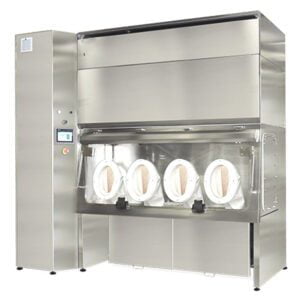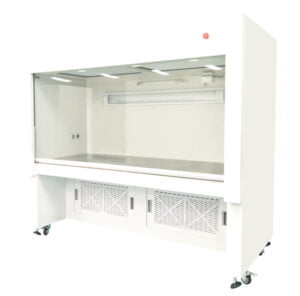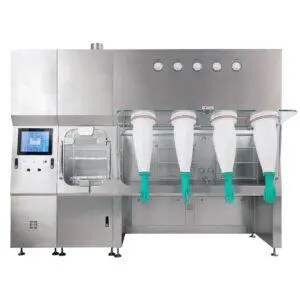
Commissioning a booth without first fixing the material hazard classification is one of the most consistently expensive sequencing errors in pharmaceutical facility projects. Teams that defer the OEL or OEB determination until after supplier shortlisting often discover during qualification that the booth satisfies the specified cleanroom class but provides no verified containment for the active being handled—a gap that typically forces a containment retrofit, restarts the cleaning validation, and delays occupancy by months. The problem is not usually the equipment itself; it is that the protection target was never clearly defined before the procurement conversation began. What follows is structured to help biosafety officers, QA teams, and engineering leads identify the thresholds and decisions that must be confirmed before a booth supplier is selected, so the evaluation criteria match the actual exposure risk rather than a generic cleanroom specification.
Powder-handling task sequence before booth supplier selection
Material hazard, OEL, and OEB band must be treated as fixed inputs before supplier engagement, not as post-selection checks. This sequencing matters because the booth specification follows from the hazard, and any specification written before the hazard is defined will optimize for something other than containment—typically cleanroom class, footprint, or price.
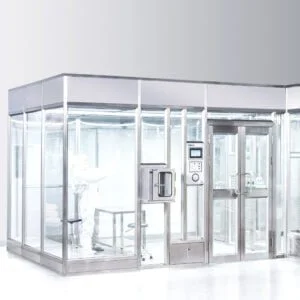
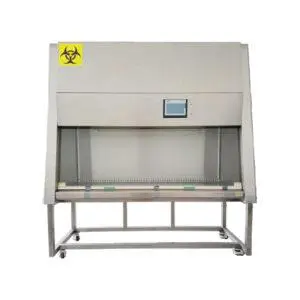
A practical source of confusion is that weighing booth, dispensing booth, sampling booth, downflow booth, and powder containment booth are used interchangeably across manufacturer catalogues, facility specifications, and procurement documents. The naming overlap does not reflect a technical or regulatory classification; it reflects commercial labelling. Two booths with different names can share identical airflow configurations, and two booths with the same name can have entirely different containment performance. Clarifying terminology in supplier discussions is useful for avoiding miscommunication, but it does not substitute for defining what the booth is being asked to protect against.
The sequence that avoids downstream problems runs in this order: confirm material hazard and OEB target, define the protection objective for each task—weighing, sampling, dispensing—then write the specification and approach suppliers. Reversing any step in that sequence tends to transfer the hazard-definition work onto the supplier, where it is resolved by commercial rather than risk-control logic.
Weighing, sampling, and dispensing booth protection targets
A booth installed in an ISO 5 cleanroom can deliver unidirectional downflow and meet particle count requirements while still failing to contain a potent API at the operator breathing zone. ISO cleanroom classification and operator containment are not the same design objective, and treating the cleanroom class as a proxy for containment verification is a common failure risk that surfaces during qualification or, more problematically, during a regulatory inspection.
There are three distinct protection targets: the operator, the product, and the surrounding environment. Each requires its own verification evidence from the supplier, and each can fail independently of the others. A booth that protects the product from cross-contamination through high-quality unidirectional downflow may still allow aerosol migration toward the operator if the return air path is compromised by an oversized container or an open transfer step. A booth that contains powder within the working zone may exhaust that air without secondary HEPA filtration, creating an environmental release risk for potent or sensitising materials. These are not theoretical edge cases; they are the distinctions that determine which verification evidence the supplier needs to provide before the booth is accepted.
| Protection Target | Opis | Co należy zweryfikować |
|---|---|---|
| Ochrona operatora | Protect operators from inhaling airborne powders | Surrogate powder containment test results, not just cleanroom class (e.g., ISO 5) |
| Ochrona produktu | Protect products from cross-contamination | Unidirectional downflow performance during weighing, sampling, and material transfer |
| Ochrona środowiska | Prevent pollution of the surrounding area | Whether air is exhausted through HEPA filtration or recirculated with validated filtration |
Treating the three protection goals as a single pass/fail question—does the booth work?—compresses decisions that need to remain separate. The most defensible procurement path assigns an explicit verification requirement to each protection target before supplier comparison begins.
Downflow, return air, and cleaning-route decisions
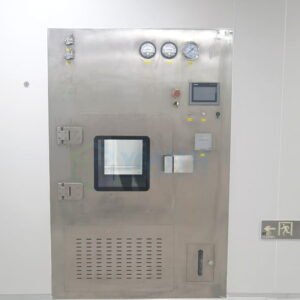
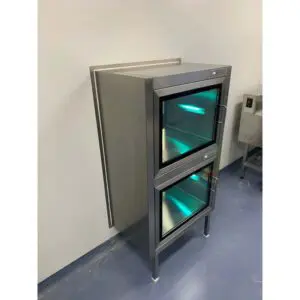
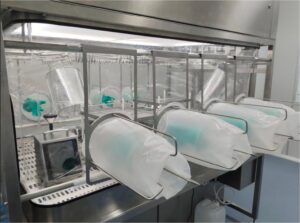
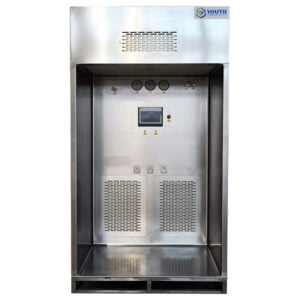
Most pharmaceutical weighing booths use a negative-pressure unidirectional downflow concept: air is drawn down through overhead HEPA filtration, past the operator and open containers, and returned through low-level grilles before recirculation or exhaust. This is a typical design approach, not the only acceptable containment configuration, and the suitability of any specific arrangement depends on the materials handled and the facility’s HVAC interface.
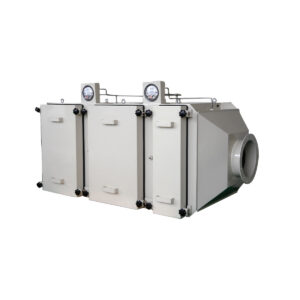
The recirculation versus once-through exhaust decision is where the airflow concept most directly affects both containment robustness and facility scope. A recirculating booth retains conditioned air within the facility envelope and reduces the HVAC load; it is often the practical default in facilities where temperature and humidity control is critical and the materials being handled do not impose vapour or sensitisation risks that argue for exhaust. A once-through exhaust arrangement removes contaminated air from the facility entirely, improving containment robustness for potent or sensitising APIs, but it requires a dedicated exhaust duct, HEPA filtration at the point of exhaust, and HVAC capacity to make up the extracted volume. Neither option is universally correct; the choice should follow from the hazard assessment and the HVAC design brief, not from the booth catalogue default.
Cleaning route is a decision that is easy to defer and difficult to correct after installation. The internal geometry of the booth—corner radii, exposed fastener counts, grille accessibility, and filter changeout path—determines whether cleaning can be validated for the materials handled and whether filter maintenance can be completed without creating a secondary contamination risk. For shared booth configurations used across multiple product campaigns, the cleaning validation scope expands in proportion to the number of materials moving through the same downflow zone. A task-specific booth narrows the cleaning validation to one material set but increases the equipment footprint. The trade-off is real, and neither configuration avoids validation work; the shared-booth option concentrates it on changeover and residue limits rather than eliminating it.
Workflow risk from generic booth configurations
Relying on generic containment claims without configuration-specific testing creates an exposure gap that may not be visible until audit or incident. A containment figure from a manufacturer’s catalogue represents a test outcome under the conditions the test was run—those conditions may not reflect the containers, powder quantities, operator movements, or transfer methods used in the actual process. When any of those variables differ from the test conditions, the published number ceases to describe the real exposure profile at the operator breathing zone.
The downstream risk is not limited to operator exposure. A safety case built on generic containment claims that are later shown to reflect a different operating configuration is difficult to defend in front of a regulatory inspector or during an occupational hygiene review. The mismatch between the catalogue claim and the actual use conditions often only becomes visible when an environmental monitoring result, a biological monitoring finding, or a containment challenge test conducted during qualification produces a result inconsistent with the supplier’s published performance. At that point, the booth has already been installed, the HVAC interface has been built, and the cleaning validation has been started.
| Testing Condition | Dlaczego to ma znaczenie | Co należy potwierdzić |
|---|---|---|
| Container type | Dust generation varies with container shape and opening | Test uses the exact container types handled in routine operations |
| Powder quantity | Affects airborne concentration and exposure risk | Test uses representative powder quantities, not minimal amounts |
| Operator movements | Arm and body movements disturb unidirectional air | Test includes realistic hand and arm actions during weighing and transfer |
| Transfer method | Scooping, pouring, or tipping produce different dust profiles | Test mirrors the actual transfer technique used in production |
| Booth configuration | Doors, partial walls, and inlet/outlet positions change airflow | Test is performed on the specific booth model and layout to be purchased |
The practical implication is that independent surrogate powder containment testing for the specific booth configuration, using representative task conditions, should be treated as a verification requirement in the procurement stage rather than an optional confirmation step after installation.
Booth supplier approval after hazard and acceptance checks are fixed
The User Requirement Specification is the gate document that makes supplier comparison meaningful. Approaching suppliers before the URS is written means evaluating proposals against criteria that have not yet been fixed, which transfers specification authority to the supplier’s product range. For a booth procured to handle materials with defined OEB classifications and explicit operator protection targets, that transfer is a risk-control gap, not just a procurement inefficiency.
A well-structured URS for a weighing, sampling, or dispensing booth covers internal dimensions, material hazard and OEB/OEL target, airflow configuration, filtration specification and HEPA grade, monitoring and alarm requirements, construction material and surface finish, and the scope of qualification documentation expected at delivery. The qualification documentation element is worth specifying explicitly. EudraLex Volume 4 Annex 15 frames IQ, OQ, and PQ as a structured sequence with defined acceptance criteria and documented evidence; where regulatory submissions are anticipated, aligning the supplier’s documentation package with that framework before the order is placed avoids rework during the qualification stage. Asking for a documentation scope at the quotation stage rather than raising it at factory acceptance is one of the lower-effort ways to reduce qualification delay.
| URS Element | Co należy określić | Dlaczego to ma znaczenie |
|---|---|---|
| Internal dimensions | Required internal dimensions | Ensures booth fits facility layout and operator ergonomics |
| Material hazard/OEB/OEL target | OEL and OEB band for handled materials | Defines the containment performance requirement |
| Airflow configuration | Unidirectional downflow and recirculation vs. once-through exhaust | Determines how operator, product, and environment are protected |
| Filtration specification | HEPA filter grade and acceptable pressure drop | Confirms filter efficiency matches cleanroom and containment needs |
| klasa HEPA | e.g., H13 or H14 | Higher grade improves particle removal but affects energy and fan sizing |
| Monitoring and alarm requirements | Airflow, differential pressure, and filter alarm setpoints | Protects GMP compliance and alerts to containment failures |
| Materiał konstrukcyjny | Stainless steel grade and surface finish | Affects cleanability, chemical resistance, and particle shedding |
| Qualification documentation scope | IQ, OQ, PQ protocols and reports | Supports regulatory submission and on-site validation |
| After-sales service expectations | Warranty, maintenance, and response times | Reduces downtime and maintains long-term containment performance |
| Independent containment test | Surrogate powder test for the specific booth design | Validates real-world operator protection beyond generic manufacturer claims |
Independent surrogate powder containment test results for the specific booth design—not cross-referenced from a different model or a different operating configuration—should appear as a named deliverable in the supplier comparison. For booths intended for use with materials in OEB4 bands or above, or where the operator protection target is defined by an OEL rather than a cleanroom class, accepting generic containment claims in place of configuration-specific test data leaves the operator safety case without quantified support. Requesting those results before award, and confirming that the test conditions reflect the planned operating scenario, is not an additional diligence burden; it is the point at which the specification is verified rather than assumed.
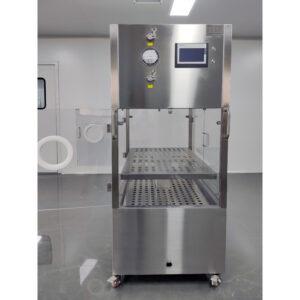
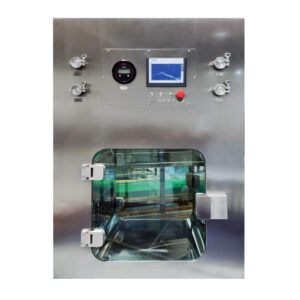
For a detailed view of how dispensing and sampling booth configurations differ by API handling scenario, the comparison in Pharmaceutical Dispensing Booth vs Sampling Booth covers the configuration decisions by OEB containment context. Youth Filter’s Kabina wydawcza, kabina do pobierania próbek i kabina ważąca product range provides a reference point for specification discussions, including airflow configuration and documentation options.
The most useful output from this evaluation sequence is a booth specification that connects each protection target to a named verification method before any supplier receives a request for quotation. If the OEB band is defined, the airflow concept is chosen, the recirculation decision is made, and the cleaning route is assessed, the supplier comparison becomes a check against fixed criteria rather than a negotiation over which criteria apply.
What typically remains underspecified at the point of supplier engagement is the containment test condition—specifically, whether the supplier’s published data reflects the container types, powder quantities, and operator movements that match the planned process. Confirming the test basis before award, and carrying that confirmation through to the FAT acceptance criteria, is the checkpoint that prevents catalogue performance from being treated as validated performance once the booth is in use.
Często zadawane pytania
Q: If we only handle non-hazardous excipients, do we still need to define an OEB band and request containment testing from the supplier?
A: No. When the material poses no inhalation risk and is not classified as potent, the booth design requirement shifts from operator containment to product protection and cross-contamination control. You can then specify the required cleanroom class and downflow quality without OEB-based containment verification. Document the hazard assessment so the basis for excluding containment testing is traceable during audit.
Q: What should happen immediately after we select a booth supplier to ensure the equipment will meet our containment targets?
A: Structure a factory acceptance test that replicates your planned operating conditions—using a surrogate powder with representative containers, powder quantities, and operator movements. Verifying the specific configuration against the URS-defined containment targets at the supplier’s facility catches performance gaps before shipment, avoiding expensive remediation during site qualification.
Q: How do we specify a shared weighing booth that will be used for multiple APIs spanning different OEB bands, including potent compounds?
A: Base the specification on the worst-case material that will be handled. The airflow configuration, HEPA filtration, and containment performance must satisfy the most stringent OEB band, and the cleaning validation must address residue limits for all materials. The supplier’s containment test data should reflect the most challenging operating condition, not an average or best case.
Q: For an OEB3 powder, when can a recirculating booth be used instead of a once-through exhaust arrangement?
A: Recirculation is typically acceptable for OEB3 when the return air passes through verified secondary HEPA filtration and the compound has no sensitising or vapour risks. If the API is a respiratory sensitiser or the facility HVAC cannot guarantee safe recirculation, once-through exhaust is the safer choice. The decision should follow a risk assessment based on the full toxicological profile, not the OEB band alone.
Q: Is independent surrogate powder containment testing worth the expense for a booth that will only handle OEB2 materials?
A: For straight‑forward, low‑potency OEB2 tasks where the supplier’s test conditions closely match your container types, transfer methods, and operator movements, well‑documented generic test data may be sufficient. If any of those variables differ, independent testing provides the only direct evidence that operator exposure stays within the OEL—making it a worthwhile investment to close a potential compliance gap before the booth enters service.