Should assembly and packaging run in the same medical-device cleanroom, or does the project need a boundary between them? The answer is not a default in either direction. It depends on whether the two processes actually impose compatible contamination-control conditions, and whether either one creates a risk for the other that a shared space cannot manage.
Process Conditions That Drive a Shared or Separate Space
A shared room is plausible only when assembly and packaging impose compatible contamination-control conditions and neither process creates an unmanaged risk for the other. This is a narrower test than asking whether both processes could theoretically meet the same airborne-particle target. Two processes can be assigned the same target and still be poor candidates for sharing a room, because the target describes an outcome, not the conditions that produce it.
What matters is what each process does to the air and surfaces around it, and what each process needs protected from the other. Assembly work on a medical device may involve component handling, fixturing, and in-process adjustment that generates particulate or requires open access to sub-assemblies. Packaging work may involve material unwrapping, seal formation, labeling, or case preparation that sheds fibers or introduces outside materials into the space. Where these activities happen in sequence on the same line, in the same air volume, the question is whether the packaging activity can contaminate an assembly step still in progress nearby, or whether assembly debris can compromise a packaging operation that depends on a clean sealing surface.
The compatibility test also depends on operating state. A room evaluated only “at rest” does not reveal how the two processes interact once people, material movement, and equipment are active “in operation.” If assembly and packaging run concurrently in the same space, the conditions that matter are the ones present during that concurrent operation, not a static baseline. Where the two processes run sequentially with full changeover and clearance between them, the compatibility picture changes, because the unmanaged-risk question becomes about changeover effectiveness rather than simultaneous interaction.
This condition-based test is also what later distinguishes a genuinely shared room from a shared room that merely has not yet identified its unmanaged risks. A project team that confirms compatible conditions and an absence of unmanaged cross-process risk has a supportable basis for one room. A project team that has only confirmed a shared particle target has not yet done that work.
Map Open Product Exposure Across Assembly and Packaging
Map every period of open product exposure because a sealed device, an exposed component, and an unpackaged primary pack do not present the same room-planning task. Exposure mapping is distinct from the compatibility test above: it asks not whether the two processes get along, but what state the product itself is in at each point along the combined assembly-and-packaging sequence, and what that state requires from the surrounding air and surfaces.
A device that is already sealed in its primary packaging no longer depends on room-level air quality for its internal cleanliness; the packaging barrier is doing that work. A component or sub-assembly that is open, whether mid-assembly or waiting for the next operation, is exposed to whatever the room air and surrounding activity can deposit on it. An unpackaged primary pack, meaning product that has completed assembly but has not yet received the packaging barrier that will protect it afterward, sits in a different condition again: it has none of the protection a sealed device has, and none of the containment a component fixture might offer during assembly.
Where a layout places long periods of open exposure adjacent to packaging-material handling, the project has created a condition that the compatibility test above must specifically address, because open exposure removes the barrier that would otherwise make two processes tolerable neighbors. Where exposure periods are short and tightly sequenced, with product moving quickly from open to sealed, the same adjacency carries a different weight.
This mapping exercise does not by itself answer whether the room should be shared, zoned, or separated. It produces the specific exposure conditions that the next analysis, tracing how debris, people, materials, and cleaning actually move across a proposed boundary, has to test against.
Trace Debris, People, Materials, and Cleaning Across the Boundary
| Interface to trace | Evidence to check at the proposed boundary | Uso de la decisión |
|---|---|---|
| Assembly debris and packaging-material shedding | Whether either process creates material that becomes an unmanaged risk for the other | Test whether shared contamination-control conditions remain defensible |
| People and material routes | The chosen routes through or across the boundary | Make movement between assembly and packaging explicit in the zoning decision |
| Line clearance and cleaning methods | How clearance and cleaning interact with both processes at the boundary | Determine whether the interface can remain shared or justifies local zoning or separate rooms |
| Acceso para mantenimiento | How maintenance access interacts with the proposed boundary | Check whether access introduces an unmanaged cross-process risk |
Once exposure periods are mapped, the next task is tracing how physical and operational interfaces behave at the line between assembly and packaging, whether that line is a proposed wall or simply a zone boundary inside one room. Assembly debris and packaging-material shedding are the first interfaces to examine, because they test the compatibility judgment directly: material generated by one process has to be evaluated for whether it becomes an unmanaged risk to the other, not just whether it stays under a general room target.
People and material routes matter independently of debris. Even where airborne particulate is well controlled, a route that sends personnel or incoming packaging materials directly through an area where product sits open for assembly introduces a transfer risk that particle counts alone will not capture. The route itself, not just the air it passes through, is part of the boundary.
Line clearance and cleaning methods interact with both processes at whatever boundary is proposed. A cleaning method suited to packaging-material residue may not address assembly debris, and the reverse also holds. Where clearance between process runs is incomplete or the cleaning method does not address both material types, a boundary that looked adequate on paper can still allow cross-contamination in practice.
Maintenance access is the last interface to check, and it is often the one a layout overlooks. Access points, whether for equipment service or material replenishment, can reintroduce exactly the cross-process risk the rest of the layout was designed to avoid, if that access was not evaluated against the same boundary logic as routine operation.
Each of these interfaces can independently justify local zoning or separate rooms even when one airborne-particle target has been proposed for the whole space. A single target describes an endpoint; it does not resolve how debris, routes, cleaning, and access behave at the point where assembly and packaging meet.
Compare One-Room Controls With Zoned or Separate-Room Layouts
| Layout direction | Supported decision basis | Límite de la evidencia |
|---|---|---|
| One shared room | Assembly and packaging impose compatible contamination-control conditions, and neither process creates an unmanaged risk for the other | A proposed airborne-particle target alone does not resolve debris, material shedding, line clearance, cleaning, or maintenance-access interfaces |
| Local zoning or separate rooms | Assembly debris, packaging-material shedding, line clearance, cleaning methods, or maintenance access justifies a distinct boundary | The chosen boundary still has to be recorded with routes, operating state, monitoring points, and verification responsibilities in the project requirements |
With the exposure map and interface trace complete, the project has what it needs to weigh a shared room against zoning or separation. The supported basis for one shared room is specific: assembly and packaging impose compatible contamination-control conditions, and neither process creates an unmanaged risk for the other. That basis has to rest on the interface-level evidence already traced, not on the fact that a single airborne-particle target was proposed for the space. A proposed target describes what the room is meant to achieve; it does not by itself resolve debris, shedding, clearance, cleaning, or access.
Local zoning or separate rooms become the supportable direction where any of those interfaces, assembly debris, packaging-material shedding, line clearance and cleaning methods, or maintenance access, cannot be resolved within one undivided space. Zoning does not require abandoning a shared facility footprint; it means introducing a defined boundary, whether a physical partition, a controlled transfer point, or a managed route, that addresses the specific interface risk identified in the trace. Separate rooms go further, typically where exposure periods are long, where cleaning methods for the two processes are genuinely incompatible, or where maintenance access cannot be reconciled with continuous operation of the other process.
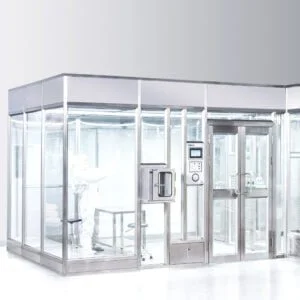
The conditions favoring each direction are not fixed in advance. Where product exposure is brief and tightly sequenced, and routes and cleaning methods can be shown to serve both processes without conflict, a shared room with well-defined internal practices may be defensible. Where exposure is extended, where packaging-material handling is heavy, or where maintenance access cannot avoid passing through an active assembly area, a zoned or separate layout addresses risks that procedural controls in a single room cannot reliably cover. This is also where a modular cleanroom approach becomes relevant to the comparison, since internal boundaries, transfer points, and room divisions are easier to define and adjust within a modular structure than in a monolithic build, which matters once a project moves from choosing a direction to specifying how that direction is physically realized.
Whichever direction the evidence supports, the decision still has to be recorded with its routes, operating state, monitoring points, and verification responsibilities attached. A layout direction without that record is an intention, not a documented decision.
Document the Zoning Decision in the URS and Verification Plan
| Decision record | Qué hay que documentar | Why it belongs in the project requirements |
|---|---|---|
| Chosen boundary | The approved shared, locally zoned, or separate-room boundary | Makes the zoning decision explicit before layout approval |
| People and material routes | The selected routes associated with the boundary | Makes cross-boundary movement reviewable |
| Estado de funcionamiento | The operating state used for the zoning decision | Ties the boundary decision to the conditions being evaluated |
| Puntos de control | The monitoring points associated with the chosen layout | Connects the zoning decision to planned monitoring |
| Verification responsibilities | The responsibilities for verifying the chosen boundary and controls | Makes the verification handoff explicit |
Once the project has reached a direction, shared, locally zoned, or separate, that decision has to be written into the user requirements specification and verification plan in terms specific enough that layout approval and later verification can both act on it. The chosen boundary is the first entry: whether it is a full room separation, a zoned area within one room, or a documented absence of any boundary, the project record has to state which one was approved and why, referencing the compatibility and interface evidence that supported it.
People and material routes belong in the same record, because a boundary decision without its associated routes leaves open exactly the movement risk the interface trace was meant to resolve. The operating state used to evaluate the boundary needs to be specified as well; a decision evaluated at rest does not automatically hold once the room is in operation with both processes active, so the record should state which state the decision was based on.
Monitoring points tie the boundary decision to how it will be checked once the room is built and running. Where zoning has been introduced specifically to separate assembly debris from packaging-material handling, the monitoring points should correspond to that separation rather than to a generic room-wide scheme. Verification responsibilities close the record: someone has to be accountable for confirming that the boundary, routes, and monitoring points as built match what was approved in the requirements.
This documentation step is also where the customer’s own project information becomes usable in a supplier’s configuration or quotation review. A boundary decision, its routes, its operating state, and its monitoring points give a supplier concrete parameters to configure against, rather than a general request for a shared or zoned cleanroom. Without that record, layout approval has nothing stable to verify against, and verification planning has to reconstruct decisions that should have already been fixed before construction began.
Preguntas frecuentes
Q: Is a common airborne-particle target enough to justify one room for assembly and packaging?
A: No. A shared target does not resolve assembly debris, packaging-material shedding, line clearance, cleaning, maintenance access, or movement across the proposed boundary. Review those interfaces and confirm that neither process creates an unmanaged risk for the other.
Q: Which product states should be included in the exposure review?
A: Include every period of open product exposure across assembly and packaging. Assess a sealed device, an exposed component, and an unpackaged primary pack as distinct planning states rather than assuming one room decision applies equally to all three.
Q: When could local zoning be considered instead of separate rooms?
A: Consider local zoning when the issue can be tied to a specific boundary or interface, such as debris, material shedding, line clearance, cleaning, or maintenance access. Test the proposed zone against that issue; if the cross-process risk remains unmanaged, reassess whether separate rooms are needed.
Q: How should maintenance work be included in the room-sharing decision?
A: Map how maintenance personnel, tools, and access cross the proposed boundary during the relevant operating state. The layout decision should identify whether that access creates an unmanaged risk and how its verification responsibility will be assigned.
Q: Do ISO 14644-4 or ISO 13485 prescribe the exact cleanroom class or layout for this decision?
A: No. These standards provide design, start-up, verification, and quality-management context, but they do not assign a cleanroom class, airflow value, filter grade, process-equipment requirement, or specific layout for this project. Define those choices from the process conditions, applicable requirements, and the documented zoning decision.