In high-containment environments, a single airborne contaminant breach can compromise product integrity or operator safety. The critical vulnerability often lies not during normal operation, but during the maintenance of the primary safety barrier: the filter housing. Traditional Bag-In/Bag-Out (BIBO) systems provide physical containment for filter change-outs, but they operate as passive, blind barriers. You lack real-time data on their performance integrity, turning a routine procedure into a high-risk event based on assumption rather than verification.
Integrating continuous air monitoring directly with BIBO housings addresses this blind spot. This fusion transforms containment from a static concept into a dynamic, data-driven safety system. The strategic shift is from scheduled, preventive maintenance to condition-based, predictive safety protocols. Real-time detection of particulate or molecular breaches provides immediate feedback, enabling proactive intervention before a localized issue becomes a facility-wide incident. For pharmaceutical, biotech, and nuclear facilities, this integration is no longer a luxury—it’s an operational imperative for risk management and regulatory compliance.
How BIBO Integration Enables Real-Time Contamination Detection
The Strategic Shift from Passive to Active Containment
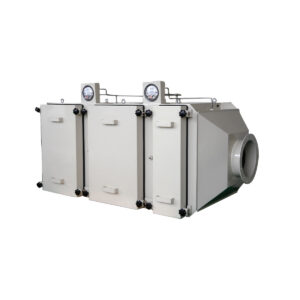
A BIBO system’s primary function is operator protection during high-risk filter maintenance, not merely air filtration. Integrating monitoring transforms this passive hardware into an active safety node within the larger containment ecosystem. The core principle involves placing sensors within the housing’s airstream to detect particulate or molecular breaches as they occur. This provides critical, immediate feedback on system integrity, converting a potential exposure event into a controlled, monitored procedure. The integration directly impacts operational safety protocols and reduces the total cost of risk by preventing incidents rather than merely responding to them.
Establishing a Performance Baseline for Deviation Alerts
Effective monitoring requires a known baseline of “normal” operation. The integrated system establishes this baseline for parameters like differential pressure and particle counts downstream of the filter. Continuous comparison against this baseline allows for instantaneous deviation alerts. A sudden spike in downstream particles or an abnormal pressure drop triggers a defined alarm hierarchy, facilitating rapid investigation and corrective action. This capability ensures continuous environmental safety is demonstrated through data, not assumed through periodic manual testing. In my experience, facilities that implement this baseline approach identify minor integrity issues weeks before they would have been caught during a scheduled manual test, preventing costly shutdowns.
Key Technical Foundations for Monitoring System Integration
Leak-Tight Housing as the Non-Negotiable Foundation
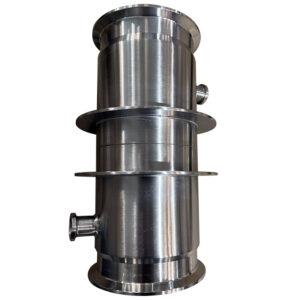
Successful monitoring integration is entirely dependent on the inherent design integrity of the BIBO housing itself. Filtration efficiency is irrelevant if the housing leaks. These units are typically constructed from heavy-gauge stainless steel (304 or 316L) and must be rigorously tested to standards like ASME N510 for leak-tight performance. This certified structural integrity and material traceability form the non-negotiable foundation. The strategic implication is clear: procurement must prioritize validated, certified housings over those with secondary features, as the entire safety premise of monitoring depends on this foundational performance.
Built-In Ports and Taps Enable Sensor Integration
The physical integration of sensors relies on standard technical features engineered into quality housings. These include upstream and downstream pressure taps for differential pressure (DP) transducers and integrated test ports, such as 3/8-inch or larger couplings, for probe insertion or isokinetic sampling lines. These are not afterthoughts but critical design elements that support the housing’s role as a monitored node. Their presence and placement are dictated by the need for representative sampling without disrupting airflow or creating new leak paths. Specifiers must verify these features are included and positioned correctly for the intended sensor technology during the design phase.
Critical Monitoring Parameters and Optimal Sensor Placement
Matching Sensors to Contaminant and Compliance Silos
Real-time detection focuses on key parameters, with sensor selection dictated by the target contaminant and the governing regulatory framework. The market is fragmented by distinct regulatory silos—pharmaceuticals (cGMP, ISO 14644-1), nuclear (ASME AG-1), and biocontainment (BSL-3/4). Each has unique compliance requirements and target Occupational Exposure Limits (OELs). Optical particle counters detect size-specific particles (e.g., ≥0.3µm) for sterile areas, while electrochemical sensors monitor toxic gas breakthrough from adsorption beds in nuclear or chemical applications. Sensor selection must align precisely with these domain-specific standards.
Strategic Placement Dictates Data Accuracy
Sensor placement is as critical as sensor selection. Poor placement yields misleading data. Differential Pressure sensors must connect to true upstream and downstream plenums. Airborne particle counters require carefully designed sampling lines connected to test ports to prevent particle loss and ensure isokinetic or representative airflow. For monitoring during bag change-out, a dedicated sensor at the bagging port itself is essential to detect releases at the point of highest risk. The following table outlines the core parameters, their measurements, and the primary sensors used.
Core Parameters for Continuous Assurance
This framework outlines the essential measurements for maintaining a state of control.
| Parameter | Typical Measurement/Specification | Primary Sensor Type |
|---|---|---|
| Differential Pressure (DP) | Filter loading/failure indicator | Pressure transducer |
| Airborne Particles | ≥0.3µm particle detection | Optical particle counter |
| Toxic Gases | Adsorption bed breakthrough | Electrochemical sensor |
| Airflow Integrity | Leak detection at bagging port | Pressure/particle monitor |
Source: ISO 14644-3: Test methods. This standard provides the test methodologies for verifying parameters like airborne particle concentration and pressure differentials, which form the basis for the continuous monitoring of these critical parameters in a controlled environment.
Ensuring Safety During Operations and BIBO Change-Out Procedures
Continuous Verification During Normal Operation
Integrated monitoring provides continuous verification that the containment barrier is intact during normal facility operation. Data streams are compared in real-time against established baselines and regulatory OELs. An exceedance triggers a predefined alarm hierarchy—first local, then facility-wide—initiating emergency protocols. This continuous proof of performance is a cornerstone of modern quality systems, moving beyond periodic testing to demonstrate ongoing control. It shifts the safety paradigm from reactive to proactive, allowing investigation of anomalies before they escalate.
Validating Containment During the Critical Change-Out
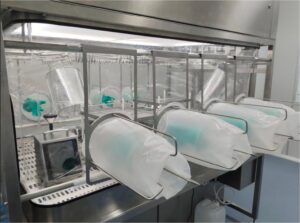
The system’s value peaks during the BIBO procedure itself. Monitoring provides step-by-step verification: establishing a pre-change baseline ambient condition, detecting any release at the bagging port during the old filter’s removal, and confirming post-installation integrity before system restart. This transforms maintenance from a high-risk event based on procedure alone into an engineered, verifiably safe process. It directly reduces operational liability by providing a data log proving containment was maintained throughout. We compared procedures with and without real-time port monitoring and found the latter often missed minor, transient releases that contributed to background contamination.
Advanced Integration: In-Situ Testing and Smart IIoT Systems
Moving Beyond Invasive Checks with In-Situ Testing
Advanced integration enables non-invasive in-situ integrity testing. Dedicated injection and sampling modules allow for automated challenge aerosol testing (e.g., PAO, DOP) while the filter remains safely housed in its BIBO unit. This trend points toward a future where standardized, non-invasive testing becomes a regulatory expectation, making periodic, invasive scan tests with manual probes obsolete. It enhances safety by eliminating exposure risk during testing and increases operational efficiency by reducing downtime.
The Rise of Predictive Maintenance with IIoT
The next evolution is smart, IIoT-ready systems. Cloud-connected DP transmitters and particle counters enable remote monitoring and data analytics. This shifts the maintenance paradigm from fixed calendar-based replacements to condition-based strategies triggered by actual performance data. Predictive algorithms can forecast filter loading and schedule change-outs just-in-time, optimizing inventory and labor. The strategic implication is a move toward operational intelligence, where data analytics drive decisions, reduce unplanned downtime, and lower long-term operational costs.
Implementation Guide: Technical Considerations & Sensor Selection
Defining the Hazard and Detection Sensitivity
Implementation starts with a clear definition of the hazard: Is it viable particles, non-viable particles, or a specific toxic gas? The answer dictates sensor technology—optical scattering for particulates, electrochemical for gases. Furthermore, the required detection sensitivity must align with the OEL or cleanliness classification (e.g., ISO Class 5). This definition ensures the selected system has the appropriate resolution and accuracy to provide meaningful, actionable data rather than just data noise.
Navigating the Modularity vs. Complexity Trade-Off
BIBO housings offer various modules: prefilters, scanning ports, injection manifolds. This modularity enables precise application fit but creates a critical trade-off. Each added module increases system complexity, introduces potential leak points, and adds to validation and maintenance costs. Specifiers must rigorously justify each add-on against a genuine operational need. The following table guides sensor selection and highlights key considerations for different contaminant types.
Sensor Selection by Contaminant Type
Choosing the right tool for the job is fundamental to system effectiveness.
| Contaminant Type | Recommended Sensor | Key Consideration |
|---|---|---|
| Particulates (general) | Optical particle counter | Sampling line design |
| Specific gases (e.g., toxics) | Electrochemical sensor | Target gas sensitivity |
| Filter integrity | DP transmitter | Up/downstream taps |
| In-situ testing | PAO injection/aerosol photometer | Non-invasive module |
Source: Technical documentation and industry specifications.
Evaluating System Costs and Justifying Your Investment
Shifting from CapEx to Total Cost of Ownership (TCO)
Justification requires moving beyond upfront capital expenditure (CapEx). A true evaluation analyzes Total Cost of Ownership, which includes installation, validation, maintenance, filter changes, downtime, and risk mitigation. While integrated smart systems carry a higher initial price, their value is realized in operational savings: avoided contamination events, reduced downtime through predictive scheduling, lower labor costs, and demonstrable regulatory compliance. Facilities with high downtime costs or extreme hazards will find greater long-term value in data-generating, predictive systems.
Quantifying Risk Mitigation and Operational Efficiency
The investment case must quantify the avoidance of negative outcomes. What is the cost of a product batch loss? A regulatory citation? A facility shutdown for decontamination? An integrated monitoring system is a strategic asset for business continuity, directly mitigating these risks. The convergence of high-tech industries—pharmaceuticals, nuclear, and advanced manufacturing like EV batteries—on these systems indicates a proven ROI across sectors. The following table contrasts the financial mindset of traditional versus integrated approaches.
Financial Analysis: Traditional vs. Integrated Systems
Understanding the full financial picture requires looking beyond the purchase order.
| Cost Component | Traditional System | Integrated Smart System |
|---|---|---|
| Primary Focus | Capital Expenditure (CapEx) | Total Cost of Ownership (TCO) |
| Maintenance Strategy | Calendar-based replacement | Condition-based, predictive |
| Operational Value | Basic containment | Risk & downtime mitigation |
| Long-term ROI Driver | Lower upfront cost | Data-driven efficiency |
Source: Technical documentation and industry specifications.
Next Steps: Selecting and Procuring Your Integrated BIBO System
Forming a Cross-Functional Procurement Team
Procurement begins by assembling a cross-functional team involving process engineers, EHS personnel, containment specialists, and facility designers. This ensures the selected system achieves technical performance while integrating seamlessly into the larger facility ecosystem for true interoperability. A team with only a maintenance or procurement focus will likely overlook critical integration or compliance requirements, leading to costly sub-optimization or retrofits.
Conducting Evidence-Based Design Validation
Supplier selection requires deep vertical expertise in your industry’s regulatory framework. Leverage evidence-based strategies during design validation. Insist on surrogate testing—using a benign material like lactose to challenge the system—to predict its performance against OELs before handling active pharmaceutical ingredients or hazardous agents. This step, informed by principles in standards like ASME N510, prevents costly post-installation discoveries of inadequate containment. Prioritize vendors offering IIoT connectivity and data analytics to support a future-ready predictive maintenance strategy.
Developing Balanced Functional Specifications
The final step is developing clear, balanced functional specifications. These specs must articulate required performance (e.g., “maintain ISO Class 5 downstream during operation”) and necessary features while consciously balancing modularity against complexity. The goal is to procure a system that delivers both technical containment and strategic operational intelligence. The following table outlines a structured procurement pathway.
A Structured Pathway to Procurement
A methodical approach reduces risk and ensures the system meets all operational requirements.
| Procurement Step | Key Action | Strategic Outcome |
|---|---|---|
| Team Formation | Cross-functional engineering | Ecosystem interoperability |
| Supplier Selection | Vertical regulatory expertise | Compliance assurance |
| Design Validation | Surrogate testing (e.g., lactose) | Performance prediction |
| Specification | Balance modularity vs. complexity | Operational intelligence |
Source: ASME N510: Testing of Nuclear Air Treatment Systems. While focused on nuclear systems, this standard’s principles for rigorous in-situ testing and validation of air treatment system integrity are directly relevant to the design validation and performance prediction steps in the procurement process.
The decision to integrate monitoring transforms your BIBO system from a component into a cornerstone of your containment strategy. The core priorities are clear: establish a performance baseline for real-time deviation detection, select sensors and placement based on specific hazards and compliance needs, and validate the entire system’s performance before operational use. This approach ensures safety is continuously demonstrated, not periodically assumed.
Need professional guidance on specifying and implementing an integrated BIBO continuous air monitoring system? The engineers at YOUTH specialize in designing containment solutions that provide both certified protection and operational intelligence. Contact our technical team to discuss your application requirements and develop a validated specification. You can also reach us directly at Contact Us for a preliminary consultation.
Frequently Asked Questions
Q: How do you justify the higher upfront cost of an integrated BIBO monitoring system?
A: Justification requires a total cost of ownership (TCO) analysis that quantifies risk mitigation, not just capital expenditure. The value lies in avoiding contamination events, regulatory non-compliance, and costly operational downtime through predictive maintenance and real-time alerts. This means facilities with high downtime costs or extreme hazards should prioritize data-generating, predictive systems as a strategic asset for business continuity.
Q: What are the key technical features to look for in a BIBO housing to enable sensor integration?
A: The foundational requirement is a leak-tight housing, typically 304 or 316L stainless steel, certified to standards like ASME N510. For integration, you need upstream/downstream pressure taps for differential pressure monitoring and integrated test ports, such as 3/8-inch couplings, for probe or sampling line insertion. For projects where safety is paramount, prioritize certified structural integrity and material traceability over secondary features during procurement.
Q: How does sensor placement and selection differ for pharmaceutical versus nuclear containment applications?
A: Selection and placement are dictated by distinct regulatory silos and target Occupational Exposure Limits (OELs). While differential pressure is universal, particle counters for leaks or gas sensors for adsorption beds must align with domain-specific standards like cGMP or ASME AG-1. If your operation requires compliance in a specific sector, plan for sensor validation against that industry’s unique compliance framework from the outset.
Q: What is the role of continuous monitoring during the actual BIBO filter change-out procedure?
A: Monitoring transforms the change-out from a high-risk event into an engineered, verifiable process. It establishes a pre-change baseline, detects potential releases at the bagging port in real-time, and confirms post-installation housing integrity before system restart. This means facilities should use the integrated system to provide continuous safety demonstration during maintenance, directly reducing operational liability.
Q: How do in-situ testing and IIoT connectivity change the maintenance strategy for BIBO systems?
A: In-situ testing modules allow for automated integrity tests (e.g., with PAO aerosol) without filter removal, while IIoT-ready, cloud-connected sensors enable predictive maintenance. This shifts the paradigm from fixed calendar-based replacements to condition-based strategies triggered by actual performance data. If your goal is operational intelligence, expect to optimize change-out schedules and lower inventory costs through data analytics.
Q: What is a critical mistake to avoid when specifying modular features for a BIBO system?
A: The key mistake is over-engineering by adding unnecessary modules like extra prefilters or scanning ports without rigorous justification. Each added component increases system complexity, potential leak points, and validation costs. For projects where lifecycle cost control is critical, you should justify every add-on against a genuine operational need to avoid escalating long-term complexity.
Q: What evidence-based strategy should we use during the design validation of an integrated system?
A: Insist on surrogate testing during design validation, such as using an inert material like lactose to predict system performance against target Occupational Exposure Limits (OELs) before handling active pharmaceutical ingredients or hazardous agents. This prevents costly retrofits. Facilities handling high-value or dangerous materials should build this surrogate challenge testing into their vendor qualification process.
Related Contents:
- Understanding BIBO | Hazardous Material Containment
- Safe Chemical Handling with BIBO Systems
- BIBO vs. Traditional Containment: Which is Better?
- BIBO Automation: Enhancing Safety and Efficiency
- Top 5 BIBO Containment Solutions for 2025
- BIBO Systems: Ensuring Food Safety in Processing
- BIBO Safety Certifications: What You Need to Know
- Essential BIBO System Components Explained
- BIBO Filter Housing | Design Principles & Components