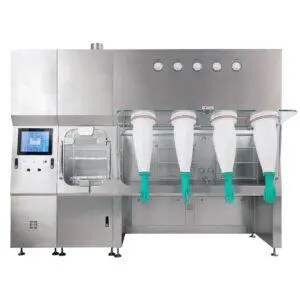
Specifying the wrong enclosure at the concept stage is one of the more expensive planning errors in a lab buildout, because the mismatch is rarely obvious until commissioning or a first audit forces the issue. A standard biosafety cabinet approved for microbiology work is not interchangeable with a fume hood approved for chemical vapor control — even when both sit on a bench, both have a sash opening, and both are described as containment equipment. The core distinction is not aesthetic; it is the direction, filtration path, and objective of the airflow inside each enclosure. Understanding which hazard type drives that airflow objective is the judgment that separates a correctly specified room from one that needs costly remediation, equipment replacement, or workflow suspension before it ever reaches routine operation.
How hazard type determines whether a cabinet or hood belongs in the room
The decision starts not with the equipment but with the hazard. Specifically: is the primary risk a biological aerosol, a chemical vapor, a sterile product exposed to contamination, or some combination? Each answer points to a different airflow objective, and no single enclosure handles all three equally well.
A fume hood is designed to capture and remove chemical vapors and gases by drawing room air inward across the work surface and exhausting it outdoors. That directional flow is effective at protecting the operator from volatile compounds. It does nothing for biological containment, and it creates no sterile field for the product — room air, unfiltered, flows freely over the work area.
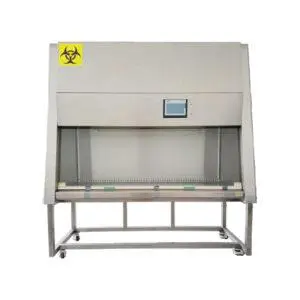
A biosafety cabinet works differently. It supplies HEPA-filtered air downward across the work surface and draws inward air at the front aperture to prevent aerosols from escaping toward the operator. HEPA filtration captures particulates and biological agents with high efficiency. What HEPA does not capture is vapors and gases. This is not a marginal limitation — it is a predictable failure point. When volatile chemicals are used in a standard, non-ducted BSC, vapors pass through the HEPA filter unchanged, accumulate in the recirculated airstream, expose the operator, and can degrade the filter material itself over time. That sequence is not an unlikely misuse scenario; it is a foreseeable consequence of applying the wrong airflow logic to the wrong hazard type.
For work that involves both biological materials and volatile or toxic chemicals concurrently, neither a standard non-ducted BSC nor a conventional fume hood is sufficient on its own. Based on risk assessment, that combination points toward specific BSC configurations — canopy-connected models such as Type A1, A2, or C1, or hard-ducted models such as Type B1 or B2 — which are designed to route chemical-bearing exhaust out of the cabinet rather than recirculate it. Selecting one of these models should follow a formal risk assessment, not a general preference, because the facility infrastructure required to support them (exhaust ductwork, airflow monitoring, interlocks) becomes part of the safety case.
Which protection goals matter most for the operator the sample and the room
Not every enclosure protects every party. Fume hoods protect the operator and the environment by exhausting vapors away from the work area, but they offer no protection to the product and no barrier against sample contamination. Biosafety cabinets of Class II type are the primary choice when the requirement covers personnel, product, and environmental protection simultaneously.
The enclosure type that is most frequently misapplied in this comparison is the laminar flow hood, sometimes called a clean bench. It supplies HEPA-filtered air horizontally or vertically across the work surface, creating an exceptionally clean zone for sterile products. The protection direction, however, is outward — toward the operator. Any biological or chemical hazard present in the work area moves with that airflow directly into the operator’s breathing zone. Using a laminar flow hood for work involving hazardous biological materials is not a gray area; it is a predictable operator exposure outcome.
| Enclosure Type | Protects Operator | Protects Product/Sample | Protects Environment |
|---|---|---|---|
| Fume Hood | Yes, via exhaust | No | Yes, via exhaust outdoors |
| Class II BSC | Yes | Yes (HEPA-filtered downflow) | Yes |
| Laminar Flow Hood | No | Yes (HEPA-filtered horizontal/vertical flow) | No |
The practical implication of this three-way matrix is that any process requiring product sterility and operator protection from biological aerosols belongs in a Class II BSC, not a laminar flow hood and not a fume hood. The enclosure selection question is really a question about which protection failures the organization is willing to accept — and the answer in regulated pharmaceutical or biotech environments is typically none of the above, which is why Class II BSCs dominate those settings. For a more detailed comparison of laminar flow hoods and biosafety cabinets across specific workflow types, see Laminar Flow Hood vs BSC: Choosing Wisely.
How airflow direction changes contamination and exposure outcomes
Airflow direction is where two enclosures that look similar on the outside diverge completely in outcome. In a fume hood, all air movement is inward from the room, across the work surface, and out through the exhaust duct. There is no filtration of supply air, no laminar downflow to protect the product, and no HEPA barrier between the exhaust stream and the outdoors (or the facility air handling system, depending on configuration). The directional flow captures vapors effectively precisely because it pulls everything away from the operator, but that same movement draws room air — and whatever particulates or contaminants it carries — directly over the work area.
In a Class II BSC, two airflow components work together. HEPA-filtered air flows downward over the work surface in a laminar pattern, creating a clean zone around the product. Simultaneously, inward airflow at the front aperture prevents aerosols generated at the work surface from escaping into the room. These two flows serve fundamentally different protection goals, and combining them in a single enclosure is what makes a BSC capable of simultaneous personnel and product protection.
| Aspect | Fume Hood | Class II Biosafety Cabinet (BSC) |
|---|---|---|
| Primary Airflow Direction | Inward from room, across work area, to exhaust | Combined inward inflow and HEPA-filtered laminar downflow |
| Filtration of Supply Air | None (room air) | HEPA-filtered |
| Primary Protection Goal | Operator and environment from chemical vapors | Personnel, product, and environment from particulates/aerosols |
| Sterile Field for Product | No | Yes |
The design threshold worth tracking in this comparison is the Type B2 BSC, which exhausts 100% of its cabinet air to the facility exhaust system rather than recirculating any portion. That figure represents the highest level of chemical safety available within the Class II BSC classification. The trade-off, however, is a hard facility dependency: if the facility exhaust system fails, a Type B2 cabinet loses all containment immediately, because there is no recirculated air path to maintain the protective airflow balance. That dependency is not a reason to avoid Type B2 configurations where chemical safety requires them — it is a reason to treat exhaust system reliability, alarm integration, and failure response as design requirements, not afterthoughts.
Where mixed microbiology and chemistry workflows create confusion
The planning error that surfaces most often in mixed-use labs is the assumption that any BSC will handle chemical vapors adequately as long as the chemical volumes are small. That assumption is not supported by how HEPA filtration works. HEPA media captures particles — biological aerosols, spores, fine particulates — through a combination of impaction, interception, and diffusion. Vapor molecules are far too small to be captured by any of those mechanisms. A standard non-ducted BSC recirculates a portion of its cabinet air back through the HEPA filter before returning it to the work area. If volatile chemicals are present, that recirculated air carries vapor with it on every pass, and the concentration inside the cabinet can build rather than dissipate. This is the mechanical reason why specific cabinet configurations exist for mixed biological and chemical work — not a compliance footnote, but a direct consequence of what HEPA filters can and cannot do.
| BSC Type | Exhaust Path for Chemicals/Vapors | Key Consideration for Mixed Work |
|---|---|---|
| Type A1 / A2 (Canopy-Connected) | Must be canopy-connected to facility exhaust per risk assessment | Not for routine volatile chemicals; requires specific setup. |
| Type B1 | ~70% exhausted, ~30% recirculated | For small amounts of volatile/toxic chemicals used with biologicals. |
| Type B2 | 100% exhausted | Highest chemical safety; fully dependent on functional facility exhaust. |
| Standard (non-ducted) BSC | Not designed for chemical vapors | HEPA filters do not capture vapors; never use for volatile chemicals. |
The practical planning implication is that teams working with both biological materials and trace volatile chemicals need to identify the specific BSC type that matches their exhaust requirements before procurement, not after installation. A Type B1 cabinet, which exhausts approximately 70% of its air and recirculates the remainder, is designed for work involving small amounts of volatile or toxic chemicals alongside biological materials — offering a balance between chemical vapor management and biological containment. A Type B2, exhausting 100%, provides greater chemical safety but removes the recirculation buffer entirely, requiring a fully reliable facility exhaust infrastructure. Neither of these is a drop-in substitute for a standard Type A2 cabinet, and specifying one without the supporting ductwork and monitoring infrastructure renders the chemical protection feature non-functional from day one.
The confusion in shared labs often deepens when microbiology and chemistry workflows happen in the same space but are managed under separate procurement decisions. The result is a room where some processes run in an appropriate enclosure and others run in whatever is available, creating a patchwork containment logic that is difficult to defend during an audit and even harder to correct without significant disruption.
When one enclosure is clearly wrong for the task
Two scenarios in this comparison have no gray area, and both produce predictable downstream consequences when they occur.
Using volatile chemicals in a standard, non-ducted BSC — typically a Type A2 — creates a chemical exposure hazard for the operator through the recirculated airstream and risks progressive filter degradation as vapors interact with the HEPA media. When this is discovered during an audit or an incident investigation, the response typically involves cabinet decontamination, filter replacement, workflow suspension, and a reassessment of whether the cabinet can be returned to service in its current configuration. The cost is not just equipment; it is the time and validation work required to re-establish a safe operating baseline.
Using a fume hood for work that requires product sterility — sterile cell culture, biological sample preparation under aseptic conditions, work with live organisms that must remain viable — produces a different but equally predictable failure: product contamination. Unfiltered room air moving across the work surface carries whatever particulate burden the room holds, and there is no laminar downflow to displace it. A single contaminated batch may be recoverable, but a workflow systematically run in the wrong enclosure introduces a systemic contamination risk that may not surface until production losses, failed sterility tests, or regulatory findings force a root cause analysis. At that point, the equipment specification error that should have been caught at the design stage becomes a quality system issue.
The CDC Biosafety in Microbiological and Biomedical Laboratories (BMBL) and NSF/ANSI 49 define what BSCs are designed and certified to contain. Framing those documents as the source of a prohibition misses the point — the reason a fume hood is wrong for biological product work is not that a standard says so, but that its airflow mechanics make product protection structurally impossible. The standards confirm what the physics already requires.
Which decision checks should be made before equipment approval
Equipment approval is where planning assumptions should be tested against installed reality. Three categories of checks are worth completing before sign-off, and each one targets a specific failure mode rather than a generic quality checkpoint.
| Check Category | What to Confirm | Why it Matters |
|---|---|---|
| Certification | Equipment meets ANSI/ASHRAE 110 (fume hood) or NSF/ANSI 49 (BSC) standards. | Ensures installed performance meets industry safety and containment standards. |
| Safety Features | For ducted BSCs (B1/B2), verify exhaust failure alarms and supply blower interlocks are present. | Prevents contaminated air from blowing back into the lab during an exhaust system failure. |
| Maintenance Protocol | Plan for regular HEPA filter replacement/decontamination (BSC) or airflow/duct inspection (fume hood). | Operational costs and safety protocols differ significantly, impacting long-term budgeting and lab safety. |
The certification check — confirming that a fume hood meets ANSI/ASHRAE 110 and a BSC meets NSF/ANSI 49 — establishes that the equipment was tested to perform as its classification implies. This matters at the approval stage because installed performance depends on both the cabinet’s design and the conditions of the installation: duct connections, room air balance, supply air velocity, and surrounding equipment can all affect whether the certified performance is actually achieved in place.
The safety feature check for ducted BSCs (Types B1 and B2) is specifically tied to the exhaust dependency risk described earlier. An exhaust failure alarm and a supply blower interlock that shuts off the cabinet when exhaust flow drops below the required level are not standard across all BSC types — they are features specific to the hard-ducted configurations that need them. Approving a Type B2 installation without confirming these interlocks are present and functional creates a scenario where an exhaust system failure silently compromises containment without any indication to the operator.
The maintenance check is often underweighted at the procurement stage because it involves operational costs rather than capital costs. BSCs require periodic HEPA filter replacement, surface decontamination, and recertification — typically annually — and the certification process for a biological safety cabinet requires a qualified field certifier to test airflow, filter integrity, and containment performance in situ. Fume hoods require regular airflow testing and duct inspection but do not involve HEPA filter replacement. Neither maintenance model is trivial, and facilities that budget for capital equipment without planning for ongoing certification and maintenance tend to find their equipment operating outside its validated performance range well before the next scheduled review.
The core judgment this comparison requires is identifying the dominant hazard first — biological aerosol, chemical vapor, sterile product exposure, or a mixture — and selecting or splitting enclosures based on that hazard profile rather than on cost, space, or familiarity. Splitting a mixed-use workflow across both a BSC and a fume hood is often the technically correct answer, but it is also the more expensive and space-intensive one. Teams that defer that decision and force a single enclosure to cover a hazard profile it was not designed or certified to handle typically encounter the problem later, at a point where the remediation is more disruptive and more costly than the original procurement decision would have been.
Before finalizing equipment approval for any lab handling biological materials, chemical vapors, or both, the most useful confirmation is not which enclosure category was selected — it is whether the airflow objective of the selected enclosure actually matches the dominant hazard in the specific workflow it will support. That alignment check, made explicitly and documented, is what distinguishes a defensible specification from one that was made by analogy.
Frequently Asked Questions
Q: Our lab runs biological workflows Monday through Wednesday and solvent-based chemistry Thursday through Friday on the same bench — can a single enclosure handle both schedules safely?
A: No single standard enclosure handles both safely, and scheduling them sequentially does not change the mechanical limitation. HEPA filters do not capture vapors, so solvent work in a non-ducted BSC leaves residual vapor in the recirculated airstream that persists into subsequent biological sessions. The defensible answer is to split the workflows across a ducted BSC (Type B1 or B2) for chemical days and a Class II BSC for biological-only work, or to specify a hard-ducted model from the outset that is rated for both — provided the facility exhaust infrastructure required to support it is already in place or budgeted alongside the equipment.
Q: After the right enclosure is selected and installed, what should happen before the lab runs its first live workflow?
A: The enclosure needs to be certified in place, not just accepted based on factory documentation. For a BSC, that means a qualified field certifier testing airflow velocity, HEPA filter integrity, and containment performance under installed conditions — including room air balance and supply air velocity — because surrounding equipment and duct connections can shift performance away from the factory-certified baseline. For a fume hood, an ANSI/ASHRAE 110 containment test at the installed sash height confirms whether the airflow at that location actually captures vapors as the design intends. Running a first workflow before these in-situ checks are completed means operating under an unvalidated assumption.
Q: Does a Class II Type A2 BSC ever become the wrong choice for a lab that only handles biological materials — no chemistry involved?
A: Yes, in one specific scenario: when the biological work requires a level of chemical safety because trace disinfectants, fixatives, or preservatives with volatile components are used routinely alongside the biological materials, even in small quantities. An A2 cabinet recirculates a portion of its air, so even low-volatility compounds accumulate over time in that recirculated stream. If the lab’s biological workflow is genuinely free of any volatile component — including cleaning agents applied inside the cabinet — a Type A2 remains appropriate. The boundary condition is not the biological hazard level; it is whether any vapor-generating material enters the cabinet at all.
Q: A fume hood is already installed and certified in the space — is there any scenario where it can serve as a temporary substitute for a BSC while procurement is pending?
A: No. A fume hood cannot substitute for a BSC even temporarily for work requiring biological containment or product sterility. The airflow mechanics that make it effective for vapor capture — inward, unfiltered room air across the work surface — are the same mechanics that make it structurally unable to protect the product or contain biological aerosols. Using it as an interim measure for biological work creates a foreseeable contamination or exposure outcome, not an acceptable interim risk. The correct interim action is to suspend the biological workflow until the appropriate enclosure is available, or to identify an off-site certified facility that can host it.
Q: Is the annual recertification cost for a BSC significantly higher than maintaining a fume hood over a five-year period, and does that difference affect which enclosure makes sense for a lower-throughput lab?
A: BSC recertification is generally more expensive per event than fume hood airflow testing, because a BSC requires a qualified field certifier to test filter integrity, airflow, and containment performance in situ — typically annually under NSF/ANSI 49 guidance — while a fume hood requires airflow and duct inspection without HEPA filter evaluation or replacement cycles. Over five years, that difference compounds, particularly when filter replacement costs are added. However, for a lower-throughput lab, the relevant question is not which unit costs less to maintain, but whether a fume hood can meet the protection requirements at all. If the work involves biological aerosols or sterile products, a fume hood cannot legally or safely substitute regardless of cost — so the maintenance cost comparison only becomes meaningful once both enclosures are technically eligible for the workflow.
Related Contents:
- Laminar Flow vs Fume Hoods: Key Differences
- BSC Certification: Ensure Your Lab’s Compliance
- How to Choose a Biosafety Cabinet for Pharmaceutical QC, Cell Culture, and Hazardous Drug Work
- Class I Biosafety Cabinets: Features and Uses
- Laminar Flow Hood vs BSC: Choosing Wisely
- Laminar Flow Hood Airflow: Understanding Dynamics
- Recirculating vs Ducted BSCs: Pros and Cons
- Class II A2 Biosafety Cabinets: Features & Uses
- Biosafety Cabinet Airflow: Understanding Patterns