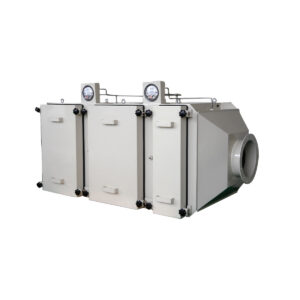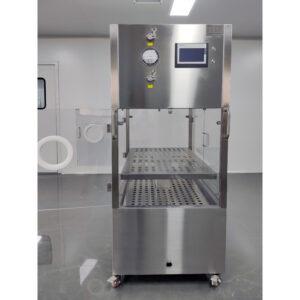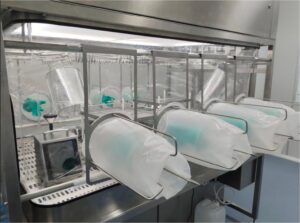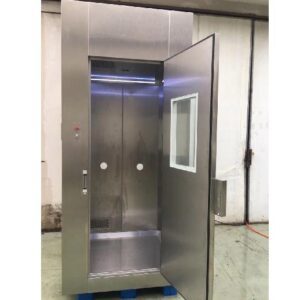
Most air shower specification problems surface at the wrong project stage. Dimensional mismatches between housing widths and wall rough openings are discovered after cleanroom panels are already installed, leaving procurement teams choosing between expensive panel rework and custom fabrication with lead times long enough to push qualification back by weeks. Interlock failures are often found only during formal acceptance testing, when fixing the control logic requires revisiting installed wiring and door hardware rather than a line item in a purchase order. The decisions that prevent these problems — nozzle velocity targets, cycle timing, interlock scope, filter grade, and acceptance criteria — need to be written into the specification before fabrication begins, not confirmed during commissioning. What follows is a technical framework for making those decisions at the right stage, with enough precision to hold suppliers accountable at delivery.
Air Shower Performance Parameters: Nozzle Velocity, Count, and Distribution Angles
Nozzle exit velocity is the primary performance variable in any air shower, because particle dislodgement from garment surfaces is a function of airstream momentum at the point of contact. A design target of approximately 20–25 m/s at the nozzle exit — equivalent to roughly 7,800 feet per minute — is a widely used engineering benchmark for removing particles down to 5 µm from cleanroom garments. This figure is a practical design criterion, not a regulatory floor set by ISO or FDA, but it functions as a defensible go/no-go threshold during commissioning and provides a concrete performance basis for comparing supplier proposals. Specifying only blower motor wattage or airflow volume without translating those figures into confirmed nozzle exit velocity creates an audit gap: two units with identical blower ratings can produce meaningfully different velocities depending on nozzle diameter, count, and plenum pressure drop.
The choice between a 90-degree turn configuration and a straight-through layout has direct consequences for both nozzle count and protocol requirements that often go unaddressed in early specifications. Straight-through designs typically accommodate more nozzles and provide front-and-back garment coverage without requiring the user to perform a deliberate rotation during the cycle. The 90-degree turn design reduces nozzle count and relies on the personnel completing a full turn inside the chamber to achieve equivalent coverage — which means the cleaning protocol itself becomes part of the specification, not just the hardware. If that rotation requirement is not written into the operational SOP and communicated during gowning training, the geometric gap in coverage exists regardless of how well the unit performs at the nozzle face.
| Design Type | Key Characteristic | What to Clarify in Specification |
|---|---|---|
| 90-Degree Turn | Fewer nozzles; requires user to perform a 360-degree turn for full coverage. | Include protocol for user rotation during the cycle to ensure effective decontamination. |
| Straight-Through | More nozzles; typically provides direct, front-and-back coverage. | Confirm nozzle count and distribution pattern to ensure complete garment coverage without user rotation. |
Fixed stainless steel nozzle arrays are preferable for ISO 5 and equivalent high-classification environments despite their lower angular coverage compared to rotary systems. Rotary nozzle designs improve garment coverage geometry but introduce rotating mechanical components that require quarterly maintenance and present a genuine risk of metallic particle generation — a contamination mode that is difficult to trace and nearly impossible to defend in an ISO 5 zone audit. For applications where angular coverage is the primary concern and the environment is ISO 7 or lower classification, rotary systems can be evaluated on their maintenance schedule and housing material, but for highest-class zones the case for fixed arrays is straightforward.
Cycle Time and Dwell Requirements by Contamination Level and Garment Type
Cycle time is the specification parameter most frequently compressed in the name of throughput, and the consequence is measurable. Particle challenge studies have shown that reducing blow-off cycles below 15 seconds can reduce decontamination efficacy by 40–60%, a degradation that invalidates the contamination control assumptions underpinning the facility’s classification strategy. The minimum GMP-grade blow-off cycle is generally treated as 20 seconds in pharmaceutical installations, but the baseline design inputs — 4–8 seconds of active cleaning plus 2–4 seconds of purge — represent a functional minimum for basic decontamination, not a configuration that can be applied uniformly across all garment types and cleanliness classifications. A facility operating ISO 5 with full-body coveralls, hood, and gloves requires a longer dwell time than one processing personnel in standard lab coats into an ISO 8 environment.
The adjustable cycle range available on most commercial air shower controllers — commonly from 10 seconds up to several minutes — is a specification input, not a default. The correct setting must be derived from the garment type in use and the cleanliness target of the downstream zone, and it should be documented in the equipment specification before purchase, not adjusted ad hoc during commissioning. Suppliers frequently ship units with a factory default of 10–15 seconds because it demonstrates acceptable operation during a short site visit. That default needs to be overridden before personnel entry qualification testing begins, because any particle count data collected with a sub-optimal cycle time will need to be discarded and the test repeated.
| Cycle Component | Baseline Duration | Risk if Unclear / Under-Specified |
|---|---|---|
| Cleaning (Blow-off) | 4-8 seconds | Ineffective particle dislodgement, failing to meet decontamination efficacy targets. |
| Purge | 2-4 seconds | Residual contaminated air may remain in the chamber, transferring particles into the cleanroom. |
| Total Adjustable Cycle | 10 seconds to several minutes | Throughput may be prioritized over cleaning efficacy, leading to a ~40-60% reduction in decontamination performance. |
One practical check: if the specification document does not distinguish between cycle time for gowned pharmaceutical personnel and cycle time for maintenance technicians in street clothes, it is under-specified. Garment type changes the dislodgement difficulty, and a cycle optimized for a lint-free bunny suit will not adequately process woven fabric. Where multiple garment types will use the same air shower, the cycle time should be set to the longest required configuration and enforced operationally, not switched between users.
Interlock Logic and Door Control: Single-Door vs. Double-Door Configuration
The single most consequential specification omission in pharmaceutical air shower installations is not a technical performance parameter — it is the absence of magnetic interlocking on both the entry and exit doors. A single-door interlock configuration reduces control hardware cost and simplifies the panel logic, but in practice it creates an operational failure mode that is nearly impossible to prevent through procedure alone. When only the entry door is interlocked, personnel can hold the exit door open during a busy shift change without triggering any system response. Unprocessed air transfers directly from the non-cleanroom side into the controlled environment through the open chamber, short-circuiting the entire cycle and undermining every particle count assumption the facility’s contamination control strategy depends on. This failure pattern does not require malicious intent — it happens organically during high-traffic periods when operators prioritize throughput over protocol.
The correct interlock logic requires that both the entry and exit doors remain locked and energized for the full duration of the programmed cleaning and purge cycle, and that neither door can be opened while the other is open. This is the functional design intent described in ISO 14644-4 for controlled-entry systems, where physical barriers and sequenced access control are used to prevent unprocessed air from migrating between zones. The interlock must also be fail-secure: if power is interrupted, doors should default to the locked position rather than releasing. Any configuration that allows easy manual override — a common cost-reduction during design review — creates a pathway that will be used during the next urgent situation and will not appear in the maintenance log.
| Risk if Interlock is Vague or Missing | Consequence | What the Contract Must Specify |
|---|---|---|
| Both doors can open concurrently | Short-circuits the decontamination cycle; unprocessed air enters the cleanroom. | Magnetic or equivalent interlock on both entry and exit doors. |
| Doors unlock prematurely | Personnel can exit before cycle completion, negating the cleaning process. | Doors remain locked (energized) for the entire programmed cleaning and purge cycle. |
| Interlock can be manually overridden | Allows doors to be propped open during high traffic, bypassing the protocol. | Interlock system must be fail-secure with no easy bypass for operational convenience. |
A specification that describes the interlock requirement only as “magnetic door locks” without specifying the logic conditions — both doors locked during cycle, no concurrent opening, fail-secure on power loss — will likely be delivered as a single-door configuration or as a dual-lock system without the concurrent-opening prevention logic, because both meet a loose reading of the stated requirement. The interlock control sequence should be written as a functional requirement in the purchase specification, confirmed in the factory acceptance test (FAT) protocol, and retested during site acceptance testing (SAT) before personnel entry qualification begins. For pharmaceutical facilities operating under FDA 21 CFR Part 211, the integrity of personnel entry protocols is an implied requirement of the facility design and procedural control obligations, making interlock documentation a defensible audit record, not an optional commissioning note. For further context on air shower applications and their configuration implications, this overview of key features and benefits covers additional installation considerations.
HEPA Filter Specification Within Air Shower Units
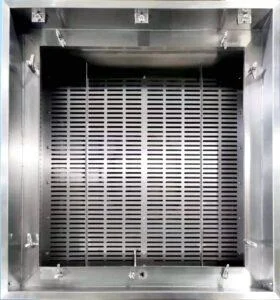
The HEPA filter inside an air shower serves a function that is easy to misstate: it does not filter the incoming air supply to the cleanroom. It filters the air being recirculated through the blow-off nozzles to ensure that the air stream itself does not re-contaminate the garment it is cleaning. A unit blowing unfiltered or inadequately filtered air through the nozzles would transfer suspended particles from the chamber onto garment surfaces during the cycle, reversing the decontamination purpose entirely. The final HEPA stage in an air shower should be specified at 99.99% efficiency for particles at 0.3 µm, which corresponds to H14 grade under EN 1822. The applicable filtration grade should be confirmed against the classification of the downstream zone — not assumed from the supplier’s standard offering, which may be specified at 99.97% (H13) by default.
The pre-filter upstream of the HEPA stage is a lifecycle cost decision as much as a performance specification. A replaceable pre-filter at approximately 30% efficiency captures the coarser particle fraction from the recirculated air and significantly extends the service life of the more expensive HEPA element. The practical specification question is not whether to include a pre-filter — it should always be included — but whether the housing design provides genuine access for replacement without tools, and whether the pre-filter dimensions are standard or proprietary. Proprietary pre-filter formats create a long-term supply chain dependency that compounds over the facility’s operating life. Confirming filter accessibility and format during procurement review costs nothing; discovering that pre-filter replacement requires partial disassembly of the housing typically creates a maintenance burden that leads to deferred servicing and accelerated HEPA loading.
| Filter Component | Efficiency / Specification | Primary Role & Clarification Need |
|---|---|---|
| Final HEPA Filter | 99.99% of particles at 0.3 µm. | Ensure cleaned, recirculated air does not re-contaminate personnel. Confirm HEPA grade in specification. |
| Pre-Filter | Typically 30% efficiency (replaceable). | Protect the HEPA filter, extend its service life, and reduce long-term operating costs. Specify accessibility for replacement. |
HEPA integrity within the air shower housing should also be specified as a field-verifiable condition. Scan testing of the installed HEPA filter at commissioning, using the same photometer methodology applied to room-level HEPA installations, confirms that the filter is undamaged and properly seated before the unit enters service. A HEPA filter that passed factory QC but was damaged during shipping or installation may show no visible defect and still allow significant penetration at the 0.3 µm test particle size. Specifying HEPA scan testing as a commissioning acceptance activity — rather than accepting a certificate of conformance alone — closes this risk. Youth Filter’s cleanroom air shower product line details filtration configurations available for different cleanroom classifications.
Validation Testing: Particle Count Method and Pass/Fail Acceptance Criteria
Nozzle exit velocity measurement is the go/no-go criterion for air shower acceptance, and it is frequently absent from both the purchase specification and the commissioning protocol until the FAT is already scheduled. The consequence is that degraded blower performance or partial nozzle clogging is discovered during formal acceptance testing, when the remediation timeline disrupts qualification and may require re-engagement with the equipment manufacturer under warranty terms that were not written to cover performance shortfalls discovered late. The measurement location and acceptance threshold need to be written into the specification document before procurement, not determined on-site by whoever has an anemometer.
A defensible commissioning framework uses nozzle face measurement — at or within 50 mm of the nozzle exit — as the standard reference point. With a clean, newly installed HEPA filter, a well-specified air shower should produce approximately 32 m/s at this location. As the filter loads over its service life, velocity will decline; a reading of approximately 28 m/s measured at the same location should function as a maintenance trigger, indicating that either the HEPA filter requires replacement or blower performance has degraded to a point requiring inspection. These are design-derived reference figures, not universally standardized pass/fail limits from a single testing authority, but they provide a practical commissioning and maintenance-trigger framework that can be written into both the acceptance protocol and the preventive maintenance plan. ISO 14644-4 provides the general testing framework reference for air shower acceptance as part of cleanroom construction and start-up qualification, though it does not prescribe these specific velocity values.
| Test Condition | Measurement Location | Nozzle Velocity Benchmark | Purpose / Action |
|---|---|---|---|
| Initial Acceptance (Clean Filter) | At nozzle face (or 5 cm from it) | 32 m/s | Go/No-Go criterion for commissioning. Proceed only if met. |
| Maintenance Trigger (Dirty Filter) | At nozzle face (or 5 cm from it) | 28 m/s | Indicates filter loading or blower degradation; triggers maintenance. |
Particle count testing before and after the air shower cycle — comparing upstream and downstream readings using a calibrated particle counter at the relevant size fractions — provides a direct measure of decontamination efficacy that complements velocity data. The velocity reading confirms the unit is operating as specified; the particle count comparison confirms that the operating parameters are achieving the contamination reduction the facility’s classification strategy requires. Both data sets should be captured at initial commissioning and at any point where nozzle velocity falls to the maintenance trigger threshold, because a drop in velocity changes the particle count outcome even if the cycle time remains unchanged. Writing both measurements into the acceptance criteria before procurement makes the pass/fail condition unambiguous and removes the interpretive uncertainty that frequently delays final sign-off.
The decisions that create the most downstream risk in air shower specification share a common characteristic: they appear minor or deferrable at the procurement stage and become expensive only when discovered in the field. Interlock logic that allows concurrent door opening, cycle times set to factory defaults, HEPA grades assumed from supplier literature, and nozzle velocity thresholds undefined until commissioning are each individually manageable if caught early. Together, they represent the difference between a personnel entry protocol that holds up under audit and one that requires remediation after the facility is partially operational.
Before finalizing any air shower purchase specification, confirm three things in writing: the nozzle exit velocity target and the measurement method that will be used to verify it at acceptance; the interlock configuration, including the specific conditions under which each door is permitted to open; and the cycle time appropriate for the garment type and downstream classification of the zone being served. These three parameters, clearly stated in the specification and verified during FAT and SAT, define the performance boundary of the installation. Everything else — filter grade, pre-filter format, housing dimensions — should be confirmed against those anchors, not specified independently.
Frequently Asked Questions
Q: Does the 20-second minimum cycle time apply if the air shower feeds an ISO 7 or ISO 8 zone rather than a pharmaceutical-grade environment?
A: No — the 20-second minimum is a GMP pharmaceutical benchmark, not a universal requirement. For lower-classification zones such as ISO 7 or ISO 8, the governing input is garment type and the contamination control strategy for that specific zone, which may permit shorter cycles. The 20-second figure becomes the defensible floor when the downstream space is subject to FDA 21 CFR Part 211 or equivalent pharmaceutical regulatory expectations. Facilities outside that regulatory scope should derive cycle time from garment dislodgement difficulty and the particle count targets of the zone, not from the pharmaceutical default.
Q: Once nozzle velocity drops to the 28 m/s maintenance trigger during operation, what is the correct sequence of actions before allowing personnel entry to continue?
A: Stop personnel entry qualification counts from being credited until the root cause is identified and corrected. The first diagnostic step is filter differential pressure — if the HEPA element is loaded, replace it and re-measure velocity at 50 mm from the nozzle face. If velocity remains below the acceptance threshold after filter replacement, the blower requires inspection for performance degradation. Both corrective actions must be completed and velocity confirmed at or above the commissioning baseline before particle count efficacy data collected after the trigger reading can be relied upon, because any counts taken during degraded velocity conditions reflect a different operating state than the validated configuration.
Q: If the facility already has single-door interlocked air showers installed, is there a retrofit path short of full replacement?
A: Yes, but the scope is more involved than a simple control panel swap. Retrofitting dual-door interlocking with concurrent-opening prevention requires adding magnetic lock hardware to the previously uncontrolled door, modifying the PLC or relay logic to enforce the full sequencing conditions, and rewiring the door position sensors — all within an installed housing that may not have been designed with that wiring pathway. The retrofit is technically feasible in most cases, but the cost and lead time should be evaluated against the cost of non-compliance during audit. More critically, the retrofitted interlock logic must be retested under SAT conditions before the unit re-enters service, because a wiring modification that passes visual inspection can still fail the concurrent-opening prevention test under load.
Q: Is a rotary nozzle system ever the right choice for an ISO 6 environment, or does the metallic particle risk make fixed arrays the only defensible option at that classification?
A: ISO 6 sits in a grey zone where the decision depends on the specific process sensitivity of the downstream space rather than the classification number alone. The metallic particle contamination risk from rotary systems is real and difficult to trace during investigation, which makes fixed stainless steel arrays the lower-risk default. However, if the ISO 6 application is not handling exposed product — for example, a secondary packaging area or equipment maintenance space — and the facility has a documented quarterly maintenance programme for the rotary mechanism and a baseline particle profile that would make metallic contamination detectable, rotary systems can be evaluated on their merits. For any zone where exposed pharmaceutical product or critical components are present, the traceability problem with metallic particles makes fixed arrays the only configuration that is straightforward to defend in an audit.
Q: How early in the design process should air shower housing dimensions be confirmed against the cleanroom wall rough opening, and who is responsible for that coordination?
A: Dimensional confirmation must happen before wall panel installation is committed — ideally at the point when panel shop drawings are issued for approval, not after fabrication begins. Manufacturer housing widths vary by 50–100 mm across suppliers, and a late-stage change after panels are installed forces a choice between custom fabrication at premium lead times or panel rework, both of which affect the qualification schedule. Responsibility for the coordination sits with the project engineer or commissioning manager, who should issue the confirmed air shower housing dimensions to the panel contractor as a hold point on the shop drawing approval. Treating it as a procurement detail to be resolved after structural decisions are made is the documented origin of most late-stage dimensional conflicts.