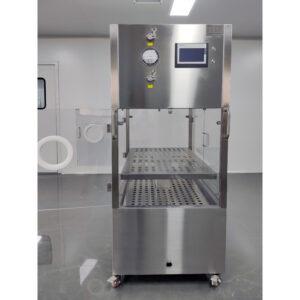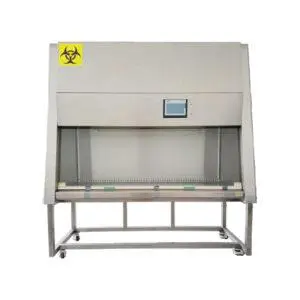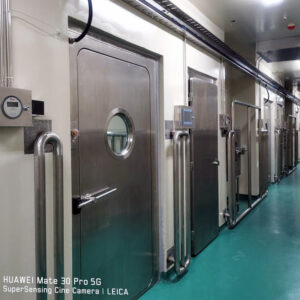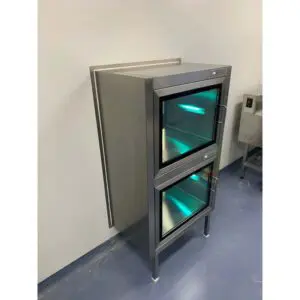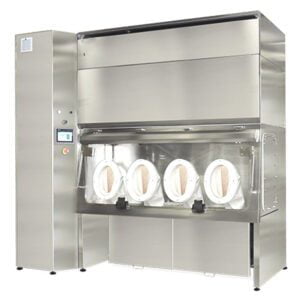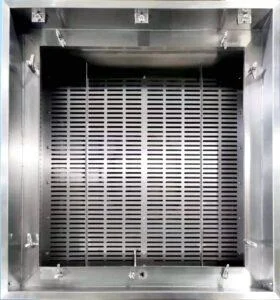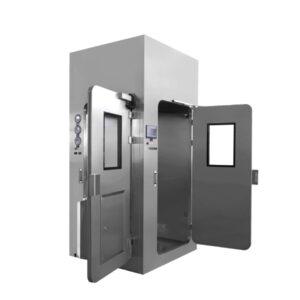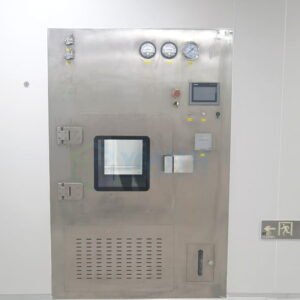
Selecting cleanroom furniture is a technical specification with direct operational consequences. The wrong material choice can turn a critical asset into a persistent contamination source, compromising product integrity and regulatory compliance. This decision extends beyond surface aesthetics to the chemical compatibility of every component with your stringent cleaning protocols.
The accelerating pace of biopharma and microelectronics manufacturing demands environments that are both pristine and adaptable. Furniture must withstand aggressive disinfectants without degrading, while its design must support, not hinder, contamination control efforts. Ignoring chemical compatibility risks costly replacements, process deviations, and facility downtime.
Stainless Steel vs. HPL: Core Material Properties Compared
Defining the Material Hierarchy
The core decision pivots between stainless steel and engineered laminates. Stainless steel, particularly grades 304 or 316, is the benchmark for critical applications. Its non-porous nature and ability to be electropolished to an ultra-smooth finish (<0.8 µm Ra) provide inherent microbial control and broad-spectrum chemical resistance. High-pressure laminate (HPL) constructed with phenolic or epoxy resins offers a high-performance alternative, engineered for non-porosity, impact resistance, and antibacterial properties.
Application in Critical Environments
The strategic application of these materials is dictated by the cleanroom’s classification and process risks. For ISO Class 5 (Class 100) and higher classifications, or areas involving potent compounds, stainless steel’s seamless cleanability is often non-negotiable. In controlled environments like packaging or less critical labs, premium HPL provides a durable, cost-effective surface that meets rigorous hygiene standards. Standard office-grade laminates introduce unacceptable risks of particle emission and chemical degradation.
Impact on Long-Term Operational Integrity
The long-term impact of material selection is measured in lifecycle cost and compliance. Prioritizing initial cost over compatibility is a false economy. In our evaluations, facilities that opted for substandard materials faced frequent refurbishment and increased particle counts within 18 months. The true value lies in materials that maintain integrity under repeated chemical exposure, ensuring the furniture supports the cleanroom’s mission for its entire service life.
Stainless Steel vs. HPL: Core Material Properties Compared
| Material | Key Grades/Type | Primary Chemical Resistance & Finish |
|---|---|---|
| Stainless Steel | AISI 304, 316 | Excellent broad-spectrum resistance |
| High-Pressure Laminate (HPL) | Phenolic, epoxy resin | High resistance to common agents |
| Standard Laminate | Not specified | Unacceptable contamination risk |
Source: IEST-RP-CC012.3:2021 Considerations in Cleanroom Design. This standard provides guidance on selecting cleanroom materials that are cleanable, non-shedding, and compatible with processes. It supports the requirement for non-porous, engineered surfaces like those detailed in the table.
Chemical Resistance Ratings for Common Cleanroom Disinfectants
The Problem of Agent-Specific Degradation
Material selection is meaningless without validation against specific chemical agents. Standard operating procedures (SOPs) mandate potent disinfectants like isopropyl alcohol (IPA), hydrogen peroxide, and alkaline detergents. While stainless steel and HPL generally resist these, performance is not universal. Exposure to an incompatible chemical, even a common solvent, can cause laminate delamination, metal pitting, or plasticizer leaching from components.
The Solution: Evidence-Based Compatibility Charts
The solution is moving from claims-based to evidence-based procurement. Manufacturers provide detailed chemical resistance charts for their specific material grades and finishes. These charts are the definitive reference, rating resistance as “Excellent,” “Good,” or “Not Recommended” for hundreds of agents. This documented proof is becoming table stakes for specification. It transforms a subjective choice into an auditable technical decision.
Validating Against Your Protocol
Validation requires a direct cross-reference. The cleanroom’s approved list of cleaning agents must be checked against the manufacturer’s compatibility data for the exact furniture material. This step confirms that daily and weekly cleaning rotations will not degrade the investment. Industry experts recommend treating this cross-reference as a mandatory line item in the procurement checklist, ensuring the furniture will perform under your specific operational conditions.
Chemical Resistance Ratings for Common Cleanroom Disinfectants
| Chemical Agent Category | Example Agents | Material Compatibility Requirement |
|---|---|---|
| Alcohols | Isopropyl Alcohol (IPA) | High resistance required |
| Oxidizing Agents | Hydrogen Peroxide, Sodium Hypochlorite | Documented compatibility charts |
| Acid/Alkaline Detergents | Various pH cleaners | Prevents degradation, discoloration |
| Incompatible Chemicals | Not specified | Particle emission risk source |
Source: Technical documentation and industry specifications.
Note: Specific resistance ratings (e.g., “Excellent,” “Good”) must be sourced from manufacturer-provided chemical compatibility charts for the exact material grade and disinfectant.
Evaluating Furniture Design for Seamless Cleanability and Hygiene
The Requirement: Hygienic Design Principles
Superior material properties are nullified by poor design. True cleanroom compatibility mandates furniture built on hygienic design principles. This is a non-negotiable specification that differentiates it from standard laboratory or industrial furniture. The core requirement is the elimination of all particle-trapping crevices, ledges, and inaccessible areas that compromise cleaning efficacy and become microbial harborage sites.
Methods for Achieving Cleanable Construction
Hygienic design is executed through specific construction methods. Seams should be continuously welded or sealed with FDA-compliant sealants. Corners require large radii for easy, single-stroke wiping. A fully enclosed construction, with sealed backs and undersides, prevents contamination accumulation in dead spaces. Non-essential horizontal surfaces should incorporate a slight slope to prevent the pooling of cleaning solutions, a detail often overlooked in standard designs.
The Decision Framework for Design Evaluation
Evaluating design requires a physical or detailed specification review. Look for the absence of screw heads, overlapping joints, and hollow cavities. Check that leveling feet are fully enclosed and that hinge mechanisms are shielded or of a cleanroom-specific design. This framework ensures the furniture’s physical form actively supports the contamination control mission, making it a reliable component of the controlled environment.
Evaluating Furniture Design for Seamless Cleanability and Hygiene
| Design Principle | Key Feature | Purpose/Outcome |
|---|---|---|
| Seam Construction | Welded, tightly sealed | Eliminates particle-trapping crevices |
| Corner Design | Rounded, large radii | Enables easy wiping |
| Surface Design | Slopes on horizontals | Prevents solution pooling |
| Overall Construction | Fully enclosed undersides | Eliminates inaccessible dead spaces |
Source: IEST-RP-CC012.3:2021 Considerations in Cleanroom Design. This RP details hygienic design requirements for cleanroom surfaces, including the need for cleanable construction, sealed seams, and the avoidance of ledges and crevices that can harbor contamination.
Compatibility of Gaskets, Fasteners, and Other Critical Components
The Systems Approach to Contamination Control
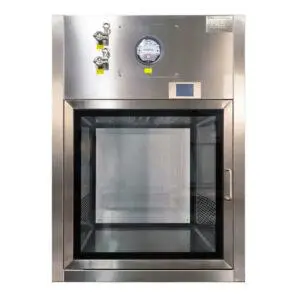
Contamination control fails at the weakest link. A holistic systems approach is vital. The primary work surface may be chemically inert, but if the silicone gasket in a pass-through swells upon contact with alcohol, or a polymer fastener degrades, the entire assembly becomes a liability. Every component must be evaluated as part of a unified system with shared resistance properties.
Specifying Compatible Secondary Materials
Specification must extend to the bill of materials. Elastomer seals and gaskets should be rated for repeated exposure to your disinfectant suite. Hinges, drawer slides, and leveling feet must be constructed from compatible metals or engineered polymers. Overlooking these elements leads to premature failure, particle generation, and introduces reactive substances into the controlled environment.
Validating the Complete Assembly
Validation requires documentation for all consumable and wear components. Request material data sheets (MSDS) or compatibility statements for gaskets, adhesives, and plastic components. This ensures the furniture functions as a cohesive unit under chemical exposure, maintaining its integrity and performance throughout its lifecycle without introducing new variables into your contamination control equation.
Long-Term Maintenance and Cleaning Protocols for Material Integrity
Preserving the Investment Through Correct Protocols
The longevity of chemically resistant furniture depends on adherence to correct maintenance protocols. Using abrasive pads on a stainless steel electropolished finish will destroy its smooth surface. Applying a non-compatible disinfectant to HPL can cause irreversible staining or coating failure. The manufacturer’s cleaning guidelines are part of the product’s performance specification.
Calculating Total Cost of Ownership
The strategic consideration is total cost of ownership. This model must include the long-term costs of specialized, compatible cleaning agents, potential refurbishment cycles, and labor. Durable, chemically resistant materials often have higher upfront costs but significantly lower lifetime costs by avoiding replacement and reducing contamination incidents. This analysis reveals the true value proposition.
Integrating Protocols into SOPs
Maintenance protocols must be integrated into the facility’s formal SOPs. This often includes a rinsing step with purified water to remove disinfectant residues, as recommended by standards like EU GMP Annex 1. Proper integration protects the material warranty and ensures the furniture continues to meet its performance specifications, safeguarding both the physical asset and the processes it supports.
Integrating ESD Requirements with Chemical Resistance Needs
The Dual-Mandate Challenge
In electronics or pharmaceutical weighing applications, furniture must fulfill a dual mandate: provide reliable electrostatic discharge (ESD) protection and resist chemical cleaners. ESD-safe materials, such as dissipative laminates or conductive coatings, can be vulnerable to certain solvents. Isolated ESD measures, like a wrist strap point, are insufficient if the entire work surface degrades.
Ensuring Coordinated Protection
Effective integration requires materials that maintain their electrical properties under chemical exposure. This means specifying ESD-protective laminates with documented chemical resistance, conductive chairs with cleanroom-suitable upholstery, and ensuring all components provide a coordinated, dissipative path to ground. The system must remain functional after hundreds of cleaning cycles.
Validation for Combined Performance
Validation must test for combined performance. Seek evidence that the ESD protective materials have been tested against the facility’s cleaning agents. The surface resistivity should remain within the safe dissipative range (typically 10^6 to 10^9 ohms/sq) after accelerated life testing with those chemicals. This confirms the furniture will reliably perform both critical safety functions.
How to Validate Material Compatibility with Your Cleanroom SOPs
The Procedural Safeguard of Cross-Reference
Validation is the procedural safeguard that bridges specification and operation. The most critical step is a direct cross-reference. Take the cleanroom’s master list of approved cleaning and disinfecting agents and match each one against the chemical resistance data provided by the furniture manufacturer for the exact material grade. Document this alignment. This creates an auditable trail that proves due diligence and ensures daily operations will not degrade the assets.
Seeking Independent and Standardized Evidence
Beyond manufacturer claims, seek evidence of independent or standardized material testing. Ask for test reports showing performance against common disinfectants per recognized methods (e.g., ASTM or DIN standards). Furthermore, require proof of design compliance, such as certification from the Scientific Equipment and Furniture Association (SEFA) for hygienic design. This layered evidence base strengthens the validation.
Integration into the Quality Management System
The final step is formal integration. The validation documentation—compatibility charts, test reports, and certification—should be annexed to the furniture specification and incorporated into the facility’s quality management system (QMS). This makes the furniture a verified, qualified component of the controlled environment, directly supporting compliance with overarching standards like ISO 14644-1:2015 for particulate control.
How to Validate Material Compatibility with Your Cleanroom SOPs
| Validation Step | Key Action | Evidence/Standard |
|---|---|---|
| Agent Cross-Reference | Match SOP agents to manufacturer charts | Documented alignment |
| Material Testing | Seek evidence of standard testing | ASTM, DIN test methods |
| Design Certification | Require hygienic design proof | SEFA certification |
| Quality System Integration | Create auditable proof | Verified component of QMS |
Source: ISO 14644-1:2015 Cleanrooms and associated controlled environments — Part 1: Classification of air cleanliness by particle concentration. While focused on air classification, this standard underpins the cleanroom’s performance requirements. Validating that furniture materials and cleaning protocols do not compromise particulate cleanliness is a fundamental compliance activity aligned with this standard.
A Decision Framework for Selecting Chemically Compatible Furniture
A strategic framework moves beyond checklist compliance to ensure resilient asset selection. First, match core material properties to the environmental classification and chemical load. Second, mandate certified hygienic design—it is non-negotiable for cleanability. Third, verify the chemical compatibility of every component, including gaskets and fasteners, adopting a systems view. Fourth, integrate ESD needs from the outset, ensuring protective materials are also chemically resistant.
Evaluate options through dual lenses: lifecycle cost and adaptability. Model total cost of ownership, factoring in durability and maintenance. Favor modular, reconfigurable designs that can adapt to process changes, extending the furniture’s useful life and protecting your investment. Finally, insist on documented validation against your specific SOPs to create an auditable chain of custody from specification to operation.
Need professional guidance to specify cleanroom furniture that meets your exact chemical and classification requirements? The experts at YOUTH can help you navigate material selection, hygienic design, and validation protocols to ensure full compatibility. Review our engineered solutions for controlled environment furnishing and workstations to see specifications built for demanding applications.
Frequently Asked Questions
Q: How do you choose between stainless steel and high-pressure laminate for cleanroom furniture?
A: The decision hinges on your environment’s criticality. Stainless steel (grades 304 or 316) offers superior, broad-spectrum chemical resistance and an ultra-smooth, non-porous surface ideal for the highest hygiene standards. Modern phenolic/epoxy HPL provides a high-performance, impact-resistant alternative engineered for cleanability. This means facilities in ISO Class 5 or higher, or those using aggressive disinfectants, should prioritize stainless steel despite its higher initial cost for long-term integrity and compliance with IEST-RP-CC012.3.
Q: What is the most critical step for validating furniture against our specific cleaning SOPs?
A: The essential step is a documented cross-reference between your cleanroom’s approved list of disinfectants and the manufacturer’s chemical resistance charts for every material, including gaskets and fasteners. You must verify that daily chemical exposure will not cause degradation or particle emission. For projects where regulatory audit trails are mandatory, plan to require evidence of material testing against standard protocols and seek furniture certified to hygienic design principles.
Q: Why is furniture design as important as material selection for cleanroom compatibility?
A: Even chemically resistant materials can harbor contamination if poorly designed. True cleanroom furniture must follow hygienic design principles, featuring welded seams, large-radius corners, and fully enclosed undersides to eliminate particle traps and allow seamless wiping. This design-focused approach ensures the furniture supports the room’s contamination control mission. If your SOPs require rigorous particulate monitoring per ISO 14644-1, you should specify these design features as non-negotiable.
Q: How do you integrate ESD protection needs with chemical resistance requirements?
A: You must specify materials that maintain both properties simultaneously. This requires ESD-safe laminate work surfaces or conductive elements that are also validated against your cleaning agents to prevent degradation of their electrical properties. Isolated measures are insufficient. For operations in electronics or pharmaceutical weighing, expect to validate that the entire dissipative path—from surface to ground—remains functional after repeated chemical exposure.
Q: What long-term costs should we model when selecting cleanroom furniture?
A: Beyond purchase price, model the total cost of ownership including specialized compatible cleaning agents, adherence to specific rinsing protocols, and potential refurbishment costs if materials degrade. Premium materials like stainless steel often have higher upfront costs but lower long-term maintenance, preserving warranty and integrity. This means facilities should evaluate options through a lifecycle value lens, favoring durable solutions that minimize operational downtime and contamination risk.
Q: What is a strategic framework for selecting chemically compatible cleanroom furniture?
A: Use a four-step decision framework: first, match core material properties to your cleanroom’s ISO classification and chemical agents; second, mandate certified hygienic design; third, verify compatibility of all components and systems like ESD; fourth, evaluate lifecycle costs and prefer modular designs for future flexibility. This integrated approach ensures furniture is a resilient asset. For new facilities, start this specification process during early design phases to align with cleanroom design considerations.
Related Contents:
- The Complete Cleanroom Furniture Selection and Specification Guide for Contamination-Controlled Environments: 2025 Edition
- HPL Cabinets vs Stainless Steel: Which is Best for You?
- Aluminum vs Stainless Steel HEPA Housing Boxes 2025
- Stainless Steel Chemical Shower Rooms: Durability Guide
- Cleanroom Sinks: Stainless Steel vs. Epoxy Resin Comparison
- Material Comparison for Laminar Air Flow Units
- Cleanroom Furniture Material Selection Guide: Stainless Steel vs. Plastic vs. Melamine Performance Comparison for ISO-Classified Environments
- LAF Garment Cabinets: Stainless Steel Advantages
- LAF Garment Cabinets: Material Compatibility Guide