For facility managers and cleanroom engineers, the choice between Electronically Commutated (EC) and Alternating Current (AC) motors for Fan Filter Units (FFUs) is often reduced to a simple upfront cost comparison. This approach overlooks the total cost of ownership, where operational efficiency, control integration, and long-term reliability dictate financial and operational outcomes. The real decision hinges on understanding how core motor technology translates into energy consumption, system intelligence, and lifecycle value.
The regulatory landscape is shifting, with standards like IEC 60034-30-1 mandating higher efficiency classes. Simultaneously, the demand for data-driven, agile cleanroom environments in biopharma and microelectronics makes advanced control non-negotiable. Selecting the right motor technology is no longer just an equipment choice; it’s a strategic decision impacting energy budgets, facility scalability, and compliance.
EC vs AC Motors: Core Technology and Operation Compared
Defining the Architectural Divide
The operational divergence begins at the power conversion level. A traditional AC induction motor operates directly from the mains supply. Its rotational speed is inherently linked to the input frequency, making variable speed control dependent on an external Variable Frequency Drive (VFD). This adds complexity, points of failure, and often reduces efficiency at partial loads. In contrast, an EC motor is a brushless DC motor with integrated power electronics. It rectifies AC to DC internally and uses a microprocessor for electronic commutation, enabling precise, stepless speed control from a single, compact unit.
The Efficiency Implications of Design
This architectural difference is the root cause of the efficiency gap. The AC motor+VFD combination suffers from losses in both components, especially at reduced speeds where the motor operates far from its optimal design point. The EC motor’s integrated design allows its electronics to optimize performance across the entire speed range. Furthermore, EC motors typically incorporate built-in Power Factor Correction (PFC), minimizing reactive power losses and reducing the burden on the facility’s electrical infrastructure—a detail easily overlooked in initial system design but critical for large-scale installations.
From Component to System
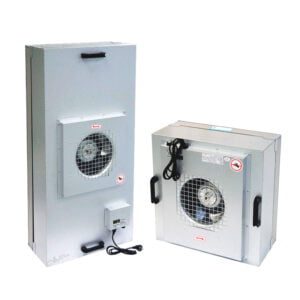
The core technology dictates the unit’s role within the larger facility ecosystem. An AC FFU is essentially a fan motor. An EC FFU is an intelligent, networked airflow device. The integrated microprocessor is not just for speed control; it is the gateway for communication, diagnostics, and integration into a Building Management System (BMS). This fundamental shift redefines the FFU from a passive component to an active data point in the cleanroom’s control strategy.
Energy Consumption and Operating Cost Comparison
Quantifying the Efficiency Advantage
Energy efficiency is the primary operational differentiator with direct financial impact. While AC motors can be efficient at full load, their performance degrades significantly at the partial speeds often required for maintaining cleanroom conditions. EC motors maintain high efficiency across their entire operating range due to optimized electronic commutation. Real-world performance data consistently shows EC FFUs consume 30-40% less energy than equivalent AC units. For a facility, this differential is not marginal; it is transformative for the operating budget.
Calculating Operational Expenditure
The financial impact scales with the size of the installation. Consider a facility with 100 FFUs operating 24/7. The annual energy savings from switching to EC technology can exceed 35,000 kWh. At an industrial electricity rate of $0.12 per kWh, this translates to over $4,200 in direct cost avoidance annually. This creates the core financial trade-off: a lower capital expenditure (CapEx) for AC versus a significantly reduced operational expenditure (OpEx) for EC. Industry experts recommend modeling this over a 5-10 year horizon to see the full picture.
Secondary Cost Synergies
The energy savings analysis must extend beyond the FFU’s power meter. EC motors convert more electrical energy into useful airflow and less into waste heat. This reduced thermal load lowers the demand on the facility’s cooling systems. In our experience, this can lead to downsizing chiller capacity or reducing HVAC runtime, yielding additional, substantial energy savings that are rarely attributed back to the motor selection but are a direct result of it.
Energy Consumption and Operating Cost Comparison
The following table summarizes the key performance parameters that drive operating cost differences between the two technologies.
| Parameter | AC Motor FFU | EC Motor FFU |
|---|---|---|
| Typical Energy Savings | Baseline | 30-40% less |
| Efficiency at Low Speed | Low, significant losses | High, maintained |
| Power Factor | Often requires correction | Integrated PFC |
| Annual kWh Savings (100 units) | 0 kWh | >35,000 kWh |
Source: IEC 61800-9-2:2017 Adjustable speed electrical power drive systems – Energy efficiency. This standard defines the methodology for evaluating the overall efficiency of complete motor-drive systems, providing the framework for comparing the energy performance of AC systems with external drives versus integrated EC motor systems.
ROI Analysis: Calculating Payback with Real Data
Building the Total Cost of Ownership Model
A rigorous Return on Investment (ROI) analysis moves beyond unit price to evaluate Total Cost of Ownership (TCO). The primary driver is energy savings, calculated using the power differential (typically 30-50 Watts per unit), the number of units, local energy costs, and annual operational hours. With the typical savings noted earlier, a 100-FFU installation often achieves a payback period on the EC premium in 1 to 3 years. Every year of operation beyond the payback period represents net positive cash flow.
Incorporating Secondary Financial Benefits
The financial model must include ancillary savings. The extended filter life enabled by precise, stable airflow control reduces consumable costs. The brushless, sealed design of EC motors minimizes routine maintenance labor and parts. Furthermore, the reduced heat load can decrease capital expenditure for the facility’s cooling system—a holistic project cost saving that should be factored into new construction or major retrofit analyses. We compared lifecycle costs for several projects and found that omitting these secondary benefits understated the EC ROI by 15-25%.
ROI Analysis: Calculating Payback with Real Data
This table outlines the critical cost factors and typical values used to calculate a comprehensive payback period.
| Cost Factor | Typical Value / Impact |
|---|---|
| Power Savings per Unit | ~40 Watts |
| Annual Cost Savings (100 units) | >$4,000 |
| Typical Payback Period | 1-3 years |
| Secondary HVAC Savings | Reduced cooling load |
| Filter Life Impact | Extended lifespan |
Source: Technical documentation and industry specifications.
Control, Integration, and Performance Characteristics
The Intelligence Advantage
The integrated electronics of EC motors enable a level of control that is now a primary differentiator. EC units offer precise, stepless speed control via simple 0-10V analog signals or digital protocols like MODBUS RTU, BACnet MS/TP, or even Ethernet-based options. This allows for real-time adjustment based on particle counts or pressure differentials and provides feedback for RPM, power consumption, and alarm status. This capability enables seamless integration into a central BMS, allowing for the monitoring and control of thousands of units from a single interface—a critical specification for large-scale semiconductor or pharmaceutical facilities.
Operational and Environmental Performance
Beyond control, the performance characteristics impact the cleanroom environment. EC motors provide a soft-start function, eliminating high inrush current that stresses electrical systems. They operate at significantly lower noise levels, typically between 49-57 dBA, reducing ambient sound in the workspace. Vibration is also minimized, which can be crucial for sensitive manufacturing processes. This network scalability and refined performance transform FFUs from simple fans into intelligent, responsive system components.
Control, Integration, and Performance Characteristics
The control and performance capabilities are fundamentally different, as shown in this comparison.
| Characteristic | AC Motor FFU | EC Motor FFU |
|---|---|---|
| Speed Control | Requires external VFD | Integrated, stepless |
| Communication Protocols | Limited, often analog | MODBUS, BACnet |
| Noise Level | Higher | 49-57 dBA |
| Startup Profile | High inrush current | Soft start |
| System Integration | Complex wiring | Simplified 2-wire |
Source: IEC 61800-9-2:2017 Adjustable speed electrical power drive systems – Energy efficiency. The standard’s focus on complete drive systems underscores the integration advantage of EC motors, where the drive and motor are a unified, optimized component, enabling advanced control and communication features.
Maintenance Requirements and Lifetime Durability
Shifting from Reactive to Predictive
Maintenance profiles differ radically. AC motors with brushed designs or those paired with external VFDs in electrical cabinets may require periodic servicing of brushes, bearings, and drive components. EC motors are fundamentally brushless and typically use sealed, permanently lubricated bearings, aiming for a maintenance-free operational life. More importantly, the advanced control capabilities enable a strategic shift from scheduled, reactive maintenance to a predictive, data-driven model.
Enabling Data-Driven Facility Management
Networked EC FFUs provide continuous diagnostic data. Facility managers can monitor individual motor health, track filter loading through power draw trends, and receive early warnings for performance deviations. This data accessibility allows for optimization of filter change-outs and service intervals, preventing unplanned downtime and maximizing facility utilization. It turns the FFU network from a maintenance burden into a tool for operational reliability and planning.
Maintenance Requirements and Lifetime Durability
The maintenance strategy and requirements evolve with the motor technology, impacting long-term operational reliability.
| Aspect | AC Motor FFU | EC Motor FFU |
|---|---|---|
| Brushes/Bearings | May require servicing | Brushless, sealed |
| Maintenance Strategy | Scheduled, reactive | Predictive, data-driven |
| Downtime Risk | Higher | Lower, monitored |
| Key Diagnostic Data | Limited | Real-time RPM, power |
Source: Technical documentation and industry specifications.
Installation and System Integration Considerations
Evaluating True Installed Cost
While EC FFUs carry a higher unit cost, the total installed cost picture can be different. Their advanced control is integrated, often utilizing simplified 2-wire cabling for both power and communication (e.g., using a BUS system). This drastically reduces installation labor, conduit, and wiring costs compared to an AC system attempting to achieve similar networked control, which would require separate power wiring, control wiring, and external VFD panels. For greenfield projects or large retrofits, this installation efficiency is a major factor.
The Systems Engineering Perspective
The choice of motor technology influences ancillary system design. The significantly lower heat load from EC motors can reduce the required capacity and runtime of room cooling systems. This impacts the capital cost of HVAC equipment and its long-term energy consumption. Successful implementation now heavily depends on vendor expertise in system integration and BMS protocol support, not just unit manufacturing. Specifiers must ensure the selected fan filter unit system provider can deliver a fully integrated solution with guaranteed protocol interoperability.
Which Motor Type Is Better for Your Specific Application?
Defining the Application Tiers
The optimal choice creates a clear two-tier application landscape. AC motor FFUs, with their lower purchase price and simpler technology, remain a viable option for cost-sensitive applications with static, unchanging airflow requirements. This might include certain storage areas or less critical manufacturing environments where airflow setpoints are fixed for life.
The Case for EC in Dynamic Environments
For dynamic cleanrooms in innovation-driven sectors like cell therapy, advanced biologics, or semiconductor manufacturing, smart EC systems are superior. They provide the agility for precise environmental control during different process phases, ensure data integration for regulatory compliance (e.g., FDA 21 CFR Part 11), and deliver undeniable sustainability benefits. Critically, regulatory trends like the EU Ecodesign directives and standards such as GB/T 22722-2008 are mandating higher motor efficiency, making EC technology a compliance requirement in many regions, not just an optional upgrade.
Decision Framework: Selecting the Right FFU Motor
A Strategic Selection Process
A strategic framework must look beyond the motor unit to the total facility design. First, conduct a detailed TCO/ROI analysis incorporating local energy rates, operational hours, and secondary HVAC synergies. Second, evaluate the required control ecosystem: define needs for BMS integration, data logging, and future scalability. Third, adopt a systems approach: pair high-efficiency motors with advanced low-resistance filter media to minimize total system energy draw.
Partner and Implementation Criteria
Fourth, consider the FFU control network as a potential centralized facility management hub for other systems. Finally, vet suppliers rigorously on their systems integration competency, protocol support, and long-term software/firmware update policies. These factors will determine operational success more than hardware specifications alone.
Decision Framework: Selecting the Right FFU Motor
This framework outlines the key decision factors and the data required to evaluate them.
| Decision Factor | Key Consideration | Priority Data Point |
|---|---|---|
| Financial | Total Cost of Ownership | Local energy cost, hours |
| Control Needs | BMS integration, scalability | Required protocol (e.g., BACnet) |
| System Design | HVAC synergy | Reduced cooling capacity possible |
| Compliance | Regional efficiency regulations | e.g., EU Ecodesign directives |
| Vendor Selection | Long-term support | Systems integration competency |
Source: IEC 60034-30-1:2014 Rotating electrical machines – Efficiency classes and GB/T 22722-2008 Energy efficiency limits for small-power motors. These standards establish mandatory minimum efficiency classes (IE codes) for motors, forming the critical compliance baseline that informs the regulatory aspect of the selection framework.
The decision between EC and AC motors is not merely technical but financial and strategic. Prioritize a total cost of ownership analysis that captures energy, maintenance, and system synergy savings. Define your control and data requirements clearly, as they dictate scalability and compliance capability. The initial capital cost differential is often negated by operational savings within a standard project timeline.
Need professional guidance to model the ROI for your specific cleanroom application or to specify a fully integrated FFU system? The engineering team at YOUTH can provide detailed lifecycle cost analyses and system integration support. Contact us to discuss your project parameters and control requirements.
Frequently Asked Questions
Q: How do the fundamental operating principles of EC and AC motors impact their suitability for a cleanroom FFU application?
A: The core difference is that AC motors rely on mains frequency for speed, often needing an external VFD for control, while EC motors have integrated electronics that rectify power and use a microprocessor for precise, stepless speed adjustment. This integrated architecture is the root cause of EC’s superior efficiency and control capabilities. For projects where dynamic airflow adjustment and system integration are priorities, the EC’s inherent design makes it the more suitable choice.
Q: What is the realistic energy savings expectation when switching from AC to EC motor FFUs?
A: Real-world operational data consistently demonstrates that EC Fan Filter Units consume 30-40% less electrical power than comparable AC units. For a facility with 100 FFUs running continuously, this can yield annual savings exceeding 35,000 kWh. This means facilities with high energy costs or sustainability targets should model these savings directly against the higher unit cost to calculate a compelling operational payback.
Q: Beyond direct energy costs, what secondary financial benefits should be included in an EC motor ROI analysis?
A: A comprehensive total cost of ownership model must account for EC technology’s lower waste heat output, which reduces the cooling load on facility HVAC and can lower chiller capital costs. Furthermore, precise speed control extends the operational life of expensive HEPA/ULPA filters. If your operation is planning new construction or a major HVAC upgrade, these systemic savings can significantly shorten the calculated payback period for the higher initial investment.
Q: How do EC motors enable advanced facility management compared to basic AC FFU systems?
A: EC motors provide integrated control via analog signals or digital protocols like MODBUS, offering real-time feedback on RPM and power use for seamless Building Management System (BMS) integration. This transforms FFUs into networked, intelligent components, enabling centralized monitoring and control of thousands of units. For large-scale semiconductor or pharmaceutical facilities, this scalability and data accessibility are critical for operational control and compliance reporting.
Q: Which international standards are essential for evaluating the energy efficiency of these motor systems?
A: For AC induction motors, the IEC 60034-30-1 standard defines the International Efficiency (IE) classification (IE1-IE4). For complete variable speed systems like EC motors, IEC 61800-9-2 provides the methodology for determining the energy efficiency of the entire Power Drive System. This means your specification and vendor evaluation should request test data aligned with these relevant standards to ensure accurate performance comparisons.
Q: What are the key maintenance differences between EC and AC motor FFUs over their lifetime?
A: EC motors are fundamentally brushless and typically use sealed bearings, drastically reducing routine mechanical upkeep compared to some AC designs. More critically, EC systems enable a shift from scheduled to predictive maintenance through network diagnostics that monitor motor health and filter loading in real-time. If minimizing unplanned downtime is a priority, the data accessibility of a networked EC system provides a strategic advantage for maintenance planning.
Q: How does the choice between EC and AC affect the complexity and cost of FFU system installation?
A: While EC FFUs have a higher unit price, their advanced control is integrated, often using simplified 2-wire cabling for combined power and communication. Achieving similar networked control with AC units typically requires separate control boards and more complex wiring, increasing labor and material costs. For new installations targeting smart building integration, the EC approach can offer a lower total installed cost for an equivalent level of functionality.
Q: In a two-tier market, what specific application factors dictate choosing a lower-cost AC motor FFU?
A: AC motor FFUs remain a technically suitable and cost-effective solution for applications with static, unchanging airflow requirements and minimal need for integration with a central BMS. This means facilities with simple, cost-sensitive cleanrooms or those with very stable environmental control profiles can achieve their goals without the premium for EC technology’s advanced features.
Related Contents:
- Top 3 Fan Filter Unit Applications in Pharmaceutical Manufacturing
- Energy-Efficient Mobile LAF Carts: 2025 Top Picks
- Proven FFU Maintenance Tips to Extend Unit Lifespan
- Fan Filter Units or Laminar Flow Hoods: Which to Choose?
- Emerging Trends: The Future of Fan Filter Unit Technology
- How Fan Filter Units Create Laminar Airflow in ISO Class 5 Cleanrooms
- Cleanroom Fan Filter Unit Specifications | Technical Comparison
- The Complete Fan Filter Unit Guide for Cleanroom Managers: Technical Selection, Installation, and Performance Optimization 2025 Edition
- Fan Filter Unit CFM Output, Energy Efficiency, and Motor Technology: 2025 Performance Specifications Comparison