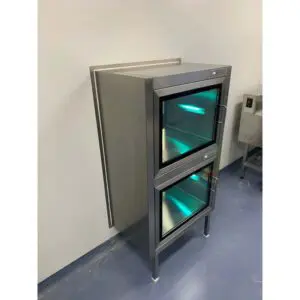
Selecting cleanroom furniture is not an interior design decision. It is a critical component of your contamination control strategy. The wrong specification can compromise airflow, introduce particle traps, and invalidate your ISO 14644 certification, turning capital equipment into a liability. Professionals face a complex procurement landscape where the line between adequate and compliant is defined by material science and design philosophy, not just durability.
This focus is essential because cleanroom furniture operates as an active, integrated system within the validated environment. Every surface, seam, and material choice must contribute to maintaining the stringent particle counts mandated for your ISO class and application. A shift from evaluating general utility to assessing direct contamination control performance is non-negotiable for safeguarding product yield and regulatory standing.
What Makes Cleanroom Furniture Different from Standard Lab Furniture?
The Core Design Philosophy
Standard lab furniture is engineered for chemical resistance and load-bearing durability in open environments. Cleanroom furniture is engineered as a component of the contamination control envelope. Its primary function shifts from utility to prevention—preventing the generation, accumulation, and shedding of particles. This mandates a convergent feature set where seamless surfaces, certified non-shedding materials, and electrostatic discharge (ESD) properties become a baseline, not an upgrade.
Strategic Procurement Implications
This philosophical difference transforms the procurement process. Evaluation moves beyond catalog specifications to forensic examination of how a piece contributes to or detracts from the validated state. A single design flaw, like a poorly sealed joint, can act as a particle harbor, breaching integrity despite advanced air filtration. The furniture must demonstrably support the cleanroom’s operational protocols, making supplier selection a critical risk management decision. In my experience, the most common oversight is assuming a “cleanroom-grade” label guarantees integration, without auditing the supplier’s control over material sourcing and fabrication.
The Compliance Baseline
The requirements are dictated by international standards. Furniture must be designed and installed in a manner that does not compromise the air cleanliness classification as defined in ISO 14644-1:2015. This standard sets the particle concentration limits that the entire environment, including all surfaces within it, must consistently meet. Therefore, furniture is not a passive occupant but an active participant in maintaining compliance.
Key Material Specifications: Non-Shedding & ESD Properties
The Science of Non-Shedding Surfaces
Material selection dictates the long-term particle contribution of furniture. Surfaces must be constructed from inherently non-particulating materials that resist abrasion and degradation from repeated cleaning. Common choices include high-pressure laminates (HPL) with sealed edges, polished stainless steel, and specific non-porous polymers. The key is long-term stability; a surface that appears suitable initially may begin to shed micro-particles after months of sanitization cycles, introducing a latent contamination source.
ESD as a Foundational Requirement
In environments handling sensitive electronics or certain pharmaceuticals, controlling electrostatic discharge is not optional. ESD can attract airborne particles to surfaces and products, or directly damage micro-components. Furniture must provide consistent, reliable static dissipation pathways. This requires materials with engineered surface resistivity and proper grounding integration into the furniture’s structure. Industry experts recommend verifying ESD performance data over the product’s expected lifespan, not just at installation.
Evaluating Material Performance
The table below outlines key material types and their primary cleanroom applications, providing a framework for initial specification.
Primary Material Types and Applications
| Material Type | Key Property | Primary Application |
|---|---|---|
| High-Pressure Laminate (HPL) | Non-particulating, non-shedding | General work surfaces |
| Polished Stainless Steel | Non-porous, high cleanability | Pharmaceutical, biotech |
| Non-Porous Plastics | Resists abrasion, degradation | Seating, accessories |
| ESD-Safe Materials | Consistent static dissipation | Microelectronics, sensitive devices |
Source: IEST-RP-CC012.3:2021 Considerations in Cleanroom Design. This guideline provides detailed material selection criteria for cleanroom construction, emphasizing non-shedding properties and compatibility with contamination control strategies, directly informing furniture specification.
Seamless Construction & Hygienic Design: A Critical Comparison
Eliminating Particle Harborage
Hygienic design principles demand the elimination of all crevices, gaps, and overlapping seams. Where standard furniture uses screws, rivets, or simple butt joints, cleanroom furniture requires welded, bonded, or thermally formed seams that are coved smooth. This applies to corners, the junctions between tops and sides, and leg attachments. These seamless transitions prevent microbes and particles from accumulating in areas inaccessible to routine cleaning.
The Detail of Joinery
A forensic assessment of joinery is where compliance is validated or compromised. Rounded, coved corners with a minimum radius are easier to clean and inspect than sharp 90-degree angles. Drawers should feature sealed gaps and preferably be of a cantilever design to avoid under-shelf contamination traps. We compared traditional lab casework to cleanroom-specific designs and found the particle count contribution from poorly designed joints could be orders of magnitude higher.
Integration with the Environment
The furniture’s physical form must also support the cleanroom’s airflow pattern. Designs should minimize horizontal surfaces that can disrupt laminar flow and avoid creating dead zones where particles can settle. The strategic takeaway is that assessment must scrutinize the entire assembly, as the most significant contamination risks are often hidden in the construction details, not the surface material.
Chemical Resistance & Surface Finishes: Evaluating Performance
Withstanding Sanitization Regimes
Furniture surfaces are subject to aggressive, frequent cleaning with disinfectants (e.g., sporicidal agents), alcohols (IPA), and solvents. Chemical resistance is therefore a performance requirement for material integrity. Surfaces must not corrode, stain, swell, or degrade upon long-term exposure. This degradation can itself become a source of chemical or particulate contamination, undermining the cleaning process it is meant to support.
The Role of Surface Finish
Complementing chemical resistance, the physical finish must be smooth, impervious, and non-porous. Gloss or semi-gloss finishes are preferred as they offer minimal texture for particle adhesion and allow for complete, efficient wipe-down. A matte or textured finish, while aesthetically pleasing in an office, can trap particles and retain moisture, creating a biofilm risk. The performance requirement is for long-term stability under chemical exposure.
Specification Based on Data
The following table outlines the critical surface characteristics required to withstand cleanroom operational protocols.
Critical Surface Characteristics for Cleanrooms
| Surface Characteristic | Performance Requirement | Example Agents |
|---|---|---|
| Chemical Resistance | High, long-term stability | Disinfectants, alcohols |
| Solvent Resistance | No degradation, staining | Aggressive solvents |
| Surface Finish | Smooth, impervious, non-porous | Gloss, semi-gloss |
| Texture | Minimal for particle adhesion | Easy wipe-down |
Source: ISO 14644-4:2022 Cleanrooms and associated controlled environments — Part 4: Design, construction and startup. This standard specifies requirements for surface finishes and material compatibility in cleanroom construction, ensuring they withstand rigorous cleaning protocols without becoming a contamination source.
Modularity vs. Fixed Design: Flexibility for Future Needs
Modularity as a Compliance Feature
In a cleanroom, modularity is a core contamination control strategy, not just a layout convenience. A system based on standardized modular dimensions (e.g., 750mm, 900mm worktop heights) and a unified mounting grid ensures components integrate without creating particle-trapping gaps or misalignments. This preserves the consistency of the environment and prevents disruptions to laminar airflow patterns that fixed, custom-built installations might cause.
Enabling Future-Proof Operations
Processes evolve. A modular system allows for reconfiguration or expansion without the need for invasive construction that could compromise the cleanroom envelope. Benches, shelving, and accessories can be rearranged or added while maintaining design integrity. This flexibility protects your long-term investment and ensures the environment can adapt to new production needs or regulatory changes without introducing compliance risks from mismatched furniture.
The Standardization Imperative
The strategic value lies in enforcing this standardization across all purchases. The table below contrasts key design attributes, highlighting how modularity supports compliance.
Design Attributes Supporting Compliance and Flexibility
| Design Attribute | Key Feature | Compliance Benefit |
|---|---|---|
| Modular Dimensions | Standardized (e.g., 750mm, 900mm) | Seamless component integration |
| Unified Grid System | Prevents particle-trapping gaps | Maintains laminar airflow |
| Reconfigurability | Adapts to process changes | Sustains particle-controlled environment |
| Design Consistency | Avoids uncontrolled micro-environments | Preserves cleanroom integrity |
Source: IEST-RP-CC012.3:2021 Considerations in Cleanroom Design. This recommended practice covers layout and design principles for cleanrooms, including the importance of modularity and standardized systems to support contamination control and future flexibility.
Integrating Furniture with Cleanroom Protocols and Validation
Beyond Specification: Operational Integration
Specifying compliant furniture is only the first step. Its performance is contingent on integration with validated operational protocols. Even the best furniture will fail if cleaned with incompatible chemicals or at insufficient frequencies. The furniture selection process must include a review of the manufacturer’s recommended cleaning procedures and ensure they align with your site’s standard operating procedures (SOPs).
The Human Factor
With furniture optimized as a minimal particle source, the operator becomes the dominant variable. This places critical importance on ergonomic design. Workstations at correct heights, easily accessible storage, and comfortable seating reduce excessive movement and operator fatigue. Minimizing this movement directly reduces particulate generation from cleanroom garments, making ergonomics a tangible component of contamination control. Easily overlooked details include the placement of monitors and controls to prevent operators from leaning over critical zones.
Documentation and Traceability
For regulated industries, furniture must be part of the validation documentation. This includes material certifications, cleanability data, and installation records. The furniture should be included in routine environmental monitoring plans to verify it is not contributing to particle counts. This closed-loop process ensures the furniture remains a controlled component of the compliant environment throughout its lifecycle.
Cost Considerations: Initial Investment vs. Total Cost of Ownership
Reframing the Investment
The financial analysis for cleanroom furniture requires a paradigm shift from capital expense to risk mitigation. The premium for certified, seamlessly constructed furniture should be viewed as an insurance policy against contamination events. A single batch loss in pharmaceuticals or a yield drop in microelectronics can incur costs far exceeding the total furniture budget for a room.
Calculating Total Cost of Ownership
A true Total Cost of Ownership (TCO) model must incorporate cost-of-contamination variables: scrap, rework, downtime, investigation resources, and potential regulatory actions. Durable, high-performance furniture that maintains its integrity over a decade reduces these risks and avoids frequent replacement cycles. The ROI calculation shifts from simple depreciation to the value of sustained compliance and production integrity.
Strategic Cost Analysis
The following table contrasts typical cost considerations with their strategic implications for cleanroom procurement.
Cost Factor Analysis for Cleanroom Furniture
| Cost Factor | Typical Consideration | Strategic Implication |
|---|---|---|
| Initial Capital Expense | Premium for certified materials | Viewed as contamination insurance |
| Contamination Event Cost | Single day’s production loss | Can exceed furniture capital expense |
| Total Cost of Ownership (TCO) | Includes cost-of-contamination variables | Mitigates operational/compliance liabilities |
| ROI Calculation | Shifts to risk mitigation | Prevents yield loss, scrap, downtime |
Source: Technical documentation and industry specifications.
Selecting the Right Furniture for Your ISO Class & Application
Specification Rigor Scales with ISO Class
The target ISO class is the primary driver for specification stringency. Furniture for an ISO Class 5 (Class 100) cleanroom requires exponentially more rigorous material and design controls than furniture for an ISO Class 8 environment. The maximum allowable particle concentration defined in ISO 14644-1:2015 dictates the permissible particle generation rate from all sources, including furniture surfaces.
Partnering with Specialists
This context mandates partnering with vertically integrated cleanroom specialists, not general laboratory furniture manufacturers. Specialists control material sourcing, fabrication in clean environments, and possess the traceability required for regulated audits. For pharmaceuticals or medical devices, explicit third-party certification of furniture systems to standards like ISO 14644-1 and EU GMP Annex 1 is often a market-access credential, providing auditable evidence of compliance.
Implementing a Final Selection Checklist
The final procurement step is applying a unified checklist across all furniture categories. This checklist should encapsulate the 12 critical specifications derived from the previous sections—from material non-shedding and ESD data to seam construction and modular compatibility. The table below summarizes key selection drivers.
Key Drivers for Furniture Selection by Application
| Selection Driver | Specification Rigor | Critical Requirement |
|---|---|---|
| Lower ISO Class (e.g., 5) | More rigorous specifications | Vertically integrated specialist partners |
| Regulated Sectors (Pharma) | Explicit third-party certification | ISO 14644-1, EU GMP compliance |
| Material & Fabrication | Controlled processes for traceability | Specification assurance |
| Final Procurement | Unified 12-specification checklist | Mandatory gate for all categories |
Source: ISO 14644-1:2015 Classification of air cleanliness. This core standard defines the airborne particle concentration limits for each ISO class, directly dictating the required rigor for all components, including furniture, within the controlled environment.
Procurement success hinges on three priorities: first, treat furniture as an active component of your contamination control strategy, not just infrastructure. Second, base all specifications on the target ISO class and the long-term demands of your sanitization protocols. Third, validate supplier capability through material traceability and design philosophy, not just product claims.
Need professional guidance to specify and integrate cleanroom furniture that meets your exact ISO class and validation requirements? The specialists at YOUTH provide vertically controlled systems designed for compliance from material science to final installation. Review our engineered solutions for cleanroom workstations and casework to begin your specification. For direct consultation, you can also Contact Us.
Frequently Asked Questions
Q: How does cleanroom furniture design actively support ISO 14644 compliance compared to standard lab furniture?
A: Cleanroom furniture is engineered as an active contamination control component, not just durable storage. Its design must prevent particle generation and accumulation through seamless construction and certified non-shedding materials to maintain validated air cleanliness per ISO 14644-1. This shifts procurement criteria from general utility to a product’s direct role in preserving environmental integrity. For any certified space, you must assess furniture specifications as a mandatory baseline for your contamination control strategy.
Q: What material properties are non-negotiable for cleanroom work surfaces and why?
A: Surfaces require non-particulating materials like polished stainless steel or high-pressure laminates that resist abrasion and repeated cleaning without degrading. In many environments, consistent electrostatic discharge (ESD) properties are also essential to prevent static charge from attracting particles or damaging components. This means you should prioritize vendor data on long-term cleanability and ESD performance over initial cost to mitigate direct contamination risk and compliance liability.
Q: Why is seamless, crevice-free construction a critical specification for ISO-compliant furniture?
A: Hygienic design with welded or bonded seams eliminates gaps that trap particles and microbes, which standard furniture joints create. This principle is fundamental to achieving stringent ISO classes, as detailed in guidelines like IEST-RP-CC012.3. Your assessment must forensically examine joinery and component integration, as hidden particle traps can undermine both high-grade materials and your air filtration system’s effectiveness.
Q: How should we evaluate chemical resistance and surface finishes for cleanroom applications?
A: Evaluate performance based on long-term exposure data to aggressive disinfectants and solvents, ensuring surfaces won’t corrode or degrade. Complementary smooth, impervious finishes (gloss or semi-gloss) minimize texture for particle adhesion and enable effective wipe-down. This means for facilities with rigorous sanitization protocols, you must verify that furniture will not become a contamination source during routine cleaning that maintains your validation state.
Q: Is modular furniture just a convenience or a genuine compliance feature for cleanrooms?
A: Modularity is a core compliance feature when it adheres to standardized dimensions and a unified grid system. This ensures components integrate without particle-trapping gaps or misalignments that disrupt laminar airflow, as supported by cleanroom design principles in ISO 14644-4. For operations anticipating process changes, you should enforce this standardization to allow reconfiguration while sustaining a cohesive, particle-controlled environment.
Q: What is the strategic financial case for investing in premium cleanroom furniture?
A: Justification requires a Total Cost of Ownership model that factors in contamination risk mitigation. The higher initial investment acts as insurance against catastrophic production loss, scrap, and downtime, which often far exceeds the furniture’s capital cost. This means your ROI calculation must shift from evaluating purchase price alone to quantifying the operational and compliance liabilities prevented over the asset’s lifespan.
Q: How do we select furniture based on our specific ISO class and regulated application?
A: Selection is dictated by your target ISO class, with cleaner environments (lower class numbers) demanding more rigorous specifications. For regulated sectors, explicit third-party certification to standards like ISO 14644-1 is a market-access credential. This means you should partner with vertically integrated cleanroom specialists who control fabrication for traceability, rather than generic manufacturers, to ensure auditable compliance and systemic integrity.
Related Contents:
- The Complete Cleanroom Furniture Selection and Specification Guide for Contamination-Controlled Environments: 2025 Edition
- ISO 14644-1 Laminar Air Flow Compliance
- ISO 14644 Cleanroom Equipment Standards | Compliance Guide
- Cleanroom Furniture Material Selection Guide: Stainless Steel vs. Plastic vs. Melamine Performance Comparison for ISO-Classified Environments
- LAF Garment Cabinets: Meeting ISO 14644 Standards
- Non-Shedding vs. Nonporous Cleanroom Furniture Materials: Technical Requirements and Testing Methods
- Cleanroom Furniture Chemical Compatibility: Which Materials Resist Common Disinfectants and Solvents?
- ISO 14644 and GMP Compliance Standards for Cleanroom Equipment: Complete Certification Requirements and Testing Protocols
- Biosafety Passboxes: Meeting ISO 14644 Standards