Accurately calculating CFM is the single most critical engineering decision in modular cleanroom design. An undersized HVAC system will fail certification, while an oversized one incurs unnecessary capital and operational expense. This calculation directly dictates system cost, energy consumption, and long-term compliance viability. The challenge lies in moving from a basic formula to a resilient system specification that accounts for real-world operational variables.
The precision of your CFM calculation determines more than airflow; it defines your project’s budget, energy footprint, and regulatory compliance pathway. With modular construction accelerating deployment, the HVAC system must be correctly sized from the outset to avoid costly retrofits. This guide provides the decision framework to translate ISO class requirements into a performant, efficient, and certifiable modular cleanroom HVAC design.
The Core Formula: CFM = (Room Volume × ACH) / 60
The Foundational Engineering Principle
The formula CFM = (Room Volume × ACH) / 60 is the non-negotiable starting point. It establishes the minimum volumetric airflow required to achieve a specified air change rate. Room volume (Length × Width × Height in feet) and the target Air Changes per Hour (ACH) are the only inputs. This calculation converts the hourly air replacement rate into the minute-by-minute airflow the HVAC system must deliver. Its simplicity belies its absolute authority in cleanroom specification.
From Formula to Financial Proxy
This calculation makes CFM a direct financial and technical proxy for ISO class. Once the cleanliness class is defined, the required airflow range is predetermined. This allows for immediate budgetary forecasting and HVAC component specification. The total CFM dictates the scale of every downstream component: fan capacity, filter quantity, ductwork size, and energy consumption. Industry experts recommend using this formula not as a final answer, but as the baseline from which all other operational factors are added.
Establishing Air Change Rates (ACH) by ISO Class
The Empirical Basis for Cleanliness
Air change rates are not arbitrary; they are empirically derived from decades of data to consistently meet the particle concentration limits defined in ISO 14644-1:2015. The required ACH increases exponentially with stricter cleanliness classes. ISO 5 (Class 100) operations, often involving critical fill lines, demand 300-480 ACH to control sub-micron particles. In contrast, an ISO 8 (Class 100,000) gowning room may only require 20 ACH.
Practical Guidelines for Design
Translating ACH into practical design parameters is essential for spatial planning and cost estimation. The CFM-per-square-foot metric offers a quick reality check for your calculated totals.
ACH and CFM per Square Foot by ISO Class
The following table provides the standard design parameters that translate ISO classification into actionable airflow requirements.
| ISO Class | Minimum ACH | CFM per Square Foot |
|---|---|---|
| ISO 5 (Class 100) | 300 – 480 | 36 – 65 CFM/ft² |
| ISO 6 (Class 1,000) | 180 (minimum) | 18 – 32 CFM/ft² |
| ISO 7 (Class 10,000) | 60 | 9 – 16 CFM/ft² |
| ISO 8 (Class 100,000) | 20 | 4 – 8 CFM/ft² |
Source: ISO 14644-1:2015 Cleanrooms and associated controlled environments — Part 1: Classification of air cleanliness by particle concentration. This standard defines the particle concentration limits for each ISO class, which directly inform the empirically derived Air Change per Hour (ACH) rates required to achieve and maintain those cleanliness levels in cleanroom design.
These ranges create a corresponding tier in validation. ISO 5/6 rooms require high-flow 1.0 CFM particle counters for statistical accuracy, while ISO 7/8 can often use more economical 0.1 CFM units—a detail that directly impacts your compliance monitoring budget.
Key Factors That Increase Your CFM Requirement
Beyond the Base ACH
The standard ACH provides a minimum baseline, but real-world conditions almost always demand additional capacity. Treating the base calculation as the final answer is a common and costly mistake. The HVAC system must compensate for dynamic internal loads and maintain defensive pressurization schemes. We compared dozens of project specifications and found the final CFM is typically 15-40% higher than the base ACH calculation.
Accounting for Operational Realities
Four primary factors drive CFM beyond the base rate: process heat load, local exhaust, pressurization differentials, and human activity. Each adds airflow that must be conditioned and filtered. A fume hood’s exhaust, for example, must be replaced 1:1 with clean supply air. Maintaining positive pressure requires supplying 10-20% more air than is exhausted. High-activity areas may need airflow at the upper end of the ACH range to dilute particle generation.
Factors Impacting Total CFM
This table summarizes the key variables that increase your total airflow requirement beyond the base ACH calculation.
| Factor | Impact on CFM | Typical Adjustment |
|---|---|---|
| Process Heat Load | Additional cooling airflow | Beyond base ACH |
| Local Exhaust | Direct supply air replacement | Add exhaust CFM |
| Positive Pressurization | Supply > exhaust air volume | +10-20% airflow |
| High Occupancy/Activity | Increased particle generation | Upper ACH range |
Source: IEST-RP-CC012.3 Considerations in Cleanroom Design. This recommended practice provides comprehensive guidance on cleanroom design, detailing how factors like heat load, exhaust, and pressurization must be calculated to determine the total required airflow beyond the base air change rate.
In my experience, the most frequently overlooked detail is the latent heat load from process equipment, which can demand significant additional cooled airflow to maintain a stable ±1°C temperature tolerance.
Step-by-Step CFM Calculation with a Worked Example
Walking Through a Real Scenario
Consider an ISO 6 modular cleanroom for pharmaceutical assembly. The space measures 20′ (L) x 15′ (W) x 10′ (H) and includes a biosafety cabinet with a 150 CFM exhaust requirement. The step-by-step process moves from theory to a resilient system specification.
Executing the Calculation
First, establish the room volume: 20 × 15 × 10 = 3,000 cubic feet. Apply the minimum ACH for ISO 6 (180) to find the base CFM: (3,000 × 180) / 60 = 9,000 CFM. This airflow achieves the necessary particle dilution. Next, account for the non-negotiable exhaust: total supply CFM becomes 9,000 + 150 = 9,150 CFM. A quick verification of CFM per square foot (9,150 / 300 ft² = 30.5 CFM/ft²) confirms it sits appropriately within the ISO 6 range of 18-32 CFM/ft².
From Calculation to Final Specification
The final system capacity requires a strategic buffer for operational resilience and pressurization control. A designer would typically round up to a system capable of 9,200-9,300 CFM. This buffer ensures stable pressure differentials even during filter loading or fan variation.
CFM Calculation Workflow
The table below illustrates the complete calculation sequence for the example ISO 6 cleanroom.
| Calculation Step | Input / Value | Result |
|---|---|---|
| Room Volume | 20′ L x 15′ W x 10′ H | 3,000 ft³ |
| Base CFM (ISO 6) | (3,000 x 180 ACH) / 60 | 9,000 CFM |
| Add Exhaust Air | + 150 CFM exhaust | 9,150 CFM |
| Verify CFM/ft² | 9,150 CFM / 300 ft² | 30.5 CFM/ft² |
| Final System Capacity | Operational resilience buffer | ~9,300 CFM |
Source: Technical documentation and industry specifications.
Sizing Your HVAC Components: FFUs, AHUs, and Ductwork
Translating CFM into Equipment Specs
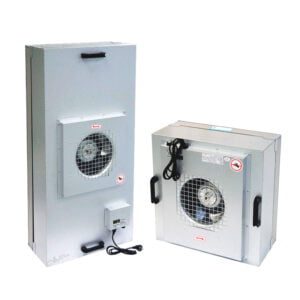
The total CFM number directly drives the specification of every major HVAC component. For modular cleanrooms using a Fan Filter Unit (FFU) ceiling grid, the total CFM is divided by the number and capacity of individual units. A system requiring 9,300 CFM might use twenty 465 CFM FFUs. For central Air Handling Unit (AHU) systems, the unit must be sized to handle the total supply CFM plus any return air and fresh air intake.
The Strategic Technology Choice
A critical decision point is fan technology. A traditional single-fan AHU presents a single point of failure. A modular FANWALL approach—using multiple smaller fans in an array—provides inherent redundancy, easier installation through standard doorways, and improved part-load energy efficiency. This justifies its added complexity for mission-critical environments where downtime is unacceptable.
Component Sizing Guide
Proper component selection ensures the designed airflow is delivered efficiently.
| Component | Sizing Basis | Example Specification |
|---|---|---|
| Fan Filter Units (FFUs) | Total CFM / unit count | 20 units @ 460 CFM |
| Air Handling Unit (AHU) | Total supply + return air | Handles 9,300+ CFM |
| Ductwork & Openings | Airflow with low pressure loss | Sized for component CFM |
| Fan Technology (Choice) | Redundancy & efficiency | Modular FANWALL approach |
Source: ISO 14644-4:2022 Cleanrooms and associated controlled environments — Part 4: Design, construction and start-up. This standard outlines requirements for the design and construction of cleanrooms, including the systematic sizing and selection of HVAC components to ensure the system meets specified performance criteria for airflow and pressure.
All ductwork, grilles, and openings must then be sized to handle their respective airflows without creating excessive static pressure loss that would strain the fans.
Accounting for Heat Load, Exhaust, and Pressurization
The Environmental Control Imperative
Beyond particle count, the HVAC system must maintain strict temperature and humidity stability, which often becomes the governing factor for system capacity. The process heat load calculation—summing heat from equipment, lighting, and personnel—determines the amount of cooled airflow needed beyond the base ACH. This can be substantial in rooms with autoclaves, reactors, or laser sealers.
The Balance of Airflows
Exhaust and pressurization are managed through air balance. All exhausted air must be replaced with conditioned supply air. Maintaining positive pressurization requires a differential, typically supplying 10-20% more air than the total exhaust and return flows. This cascade of air from clean to less-clean zones prevents infiltration. These factors collectively determine the final, often larger, system capacity and highlight that operational costs are frequently dictated by specific industry regulations like USP <797> for compounding, which mandates precise environmental control.
Optimizing for Energy Efficiency and System Control
Mitigating Operational Cost
High CFM requirements equate to high energy consumption. Optimization is not optional. Variable Air Volume (VAV) controls are essential, allowing airflow to be reduced during unoccupied periods while maintaining minimum ACH and pressure setpoints. This can yield savings of 30-50% on fan energy. Similarly, selecting high-efficiency EC motors for fans and FFUs reduces power draw across the entire operating curve.
The Flexibility Dividend
The modularity of the cleanroom itself contributes to financial efficiency. As depreciable capital equipment, modular units can be reconfigured, expanded, or relocated. This transforms the cleanroom from a fixed facility cost into a flexible asset. This inherent agility supports emerging “Cleanroom-as-a-Service” models, where providers offer scalable, subscription-based solutions—a critical advantage for biotech startups with uncertain growth trajectories.
Validating Your Design: Compliance, Testing, and Best Practices
The Proof of Performance
Final system validation is mandatory. Compliance testing per ISO 14644-1:2015 verifies the as-built cleanroom meets the target ISO class for particle count. This is complemented by tests for airflow velocity, uniformity, recovery, and pressure differential. Industry-specific standards further dictate material choices, such as chemical-resistant surfaces for pharma or ESD-safe materials for electronics.
Establishing a Compliance Regime
Certification is not a one-time event. Initial certification by a third-party is followed by a regimen of periodic re-testing and continuous monitoring. This creates a perpetual market for validation services and sensor maintenance—a stable post-installation revenue stream for service providers. The democratization of cleanroom technology through modular design accelerates adoption across sectors like nutraceuticals and medical device manufacturing, requiring providers to develop deep application-specific expertise.
Your CFM calculation is the blueprint for compliance, cost, and operational performance. Prioritize the base ACH requirement, then systematically add capacity for heat load, exhaust, and pressurization. Validate the final number against CFM/ft² guidelines and size all components accordingly. Implement VAV controls and efficient motors from the start to manage lifetime energy costs.
Need professional guidance to specify and validate a modular cleanroom HVAC system? The engineers at YOUTH specialize in translating technical requirements into certified, efficient cleanroom solutions. We can help you navigate from calculation to compliance.
For a detailed review of your specific project parameters, Contact Us.
Frequently Asked Questions
Q: How do you calculate the minimum CFM for a modular cleanroom based on its ISO class?
A: You determine the minimum Cubic Feet per Minute (CFM) using the formula: (Room Volume in cubic feet × Required Air Changes per Hour) / 60. The mandated ACH is defined by the target ISO class, with rates ranging from 20 for ISO 8 up to 300-480 for ISO 5. This calculation sets the non-negotiable airflow baseline for particulate control certification. For projects where budget and HVAC sizing need early definition, you can start specification as soon as the ISO class is selected.
Q: What real-world factors typically increase CFM requirements beyond the base ACH calculation?
A: Process heat loads, local exhaust streams, and pressurization differentials are the primary drivers for increased airflow. Exhaust from tools like fume hoods adds directly to the required supply CFM, while maintaining positive pressure may demand an extra 10-20% airflow. Heat-generating equipment necessitates additional cooled air to maintain tight temperature stability. This means facilities with significant process exhaust or thermal loads should plan for a final system capacity at the high end of the standard CFM range or beyond it.
Q: How does the choice between FFUs and a central AHU impact system design for a given CFM?
A: For a Fan Filter Unit (FFU) ceiling grid, you divide the total required CFM by the capacity of individual units to determine the quantity needed. A central Air Handling Unit (AHU) must be sized to handle the total supply CFM, plus return and fresh air. A modular FANWALL approach using multiple small fans offers better redundancy and efficiency than a single large fan. If your operation prioritizes uptime and energy savings in a mission-critical environment, the added complexity of a modular fan wall is often justified.
Q: How do industry-specific regulations, like USP 797, influence cleanroom HVAC sizing beyond ISO class?
A: Regulations such as USP 797 for pharmaceutical compounding impose stringent requirements for precise temperature, humidity, and pressure control that often exceed basic particulate standards. Meeting these environmental tolerances frequently demands a higher CFM to manage heat load and ensure stability than the minimum ACH for particle count would dictate. This means the total cost of ownership for a pharma or biotech cleanroom is often driven by these ancillary regulations, not the ISO classification alone.
Q: What are the best practices for validating that an installed HVAC system meets its designed CFM and ISO class?
A: Final validation requires compliance testing per ISO 14644-1 for particle concentration classification. This is supported by verifying airflow velocity, volume, and pressure differentials against design specifications. Industry-specific standards further dictate material and surface requirements. If your facility requires ongoing certification, you should plan for initial third-party testing plus a recurring schedule of self-checks, which creates a sustained need for sensor maintenance and validation services.
Q: How can you optimize a high-CFM cleanroom HVAC system for energy efficiency?
A: Implement Variable Air Volume (VAV) controls to reduce airflow during unoccupied periods while maintaining minimum ACH and pressurization setpoints. The modular nature of the cleanroom itself also contributes to operational flexibility, allowing reconfiguration as needs change. For organizations with fluctuating production volumes or those exploring scalable “Cleanroom-as-a-Service” models, this inherent adaptability transforms the facility from a fixed cost into a manageable, efficient asset.
Related Contents:
- Modular Cleanroom Airflow Design and HVAC System Requirements: Complete Engineering Guide for ISO Classification Compliance
- ISO Class 5 Standards for Laminar Air Flow Units
- Modular Laminar Air Flow Units for Cleanrooms
- The Complete Fan Filter Unit Guide for Cleanroom Managers: Technical Selection, Installation, and Performance Optimization 2025 Edition
- Modular BIBO Designs: Flexibility for Your Facility
- What Are the FFU Requirements for Different Cleanroom Classes?
- How Fan Filter Units Create Laminar Airflow in ISO Class 5 Cleanrooms
- Medical Device Cleanroom Equipment | ISO Class Requirements
- The Complete Cleanroom Equipment Selection and Implementation Guide for Manufacturing and Life Sciences: 2025 Edition