Selecting the right cleanroom table top is a critical, yet often oversimplified, technical decision. The choice between solid and perforated surfaces directly impacts laminar airflow integrity, particle control, and ultimately, process yield. Many facilities default to a standard solid top, potentially compromising the efficiency of their most critical zones or misallocating capital on over-engineered solutions where simpler ones suffice.
This decision requires moving beyond a simple product comparison. It demands a protocol-first analysis of your specific cleanroom class, process contamination profile, and operational workflow. The optimal work surface is the one that correctly serves your contamination control strategy, supports certification, and delivers value over its entire lifecycle, balancing airflow efficiency with physical containment needs.
Solid vs. Perforated Tops: Core Differences Defined
The Physics of Airflow Interaction
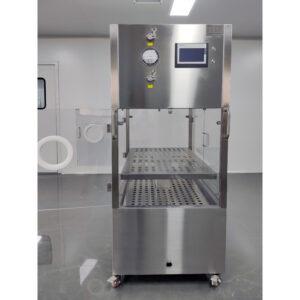
The fundamental divergence lies in how each design interacts with vertical unidirectional airflow. A solid top acts as a complete barrier, deflecting airflow horizontally across its surface. This deflection can create turbulence and stagnant zones where particles settle. A perforated top, engineered with a pattern like a 3/4″ perforation yielding ≥40% open area, allows a significant portion of laminar air to pass through. This maintains a more consistent downward air curtain for efficient particle removal.
Primary Application Domains
This core physical difference dictates their primary applications. Solid tops are the default for general worksurfaces, wet chemistry processes, and small-part assembly where liquid or component containment is paramount. Perforated tops are specialized for maximizing particle removal in critical zones under direct HEPA/ULPA coverage, such as where dry, particle-generating tasks occur. Industry experts recommend inverting the selection logic: define the process sensitivity first, then select the top that serves that protocol.
The System Integration Imperative
Easily overlooked is that the top does not function in isolation. Its performance is contingent on the base design (C-frame, H-frame) and the presence of undershelves. A perforated top on an enclosed cabinet base may see diminished benefit, while a solid top with wire shelving can maintain better perimeter airflow than one with solid shelves. The entire assembly must be evaluated as a system within the room’s certified airflow pattern.
Cost and ROI Comparison: Initial vs. Long-Term Value
Understanding the Cost Hierarchy
A clear price-performance hierarchy exists across materials. The most economical entry point is a coated steel frame with a solid laminate top, suitable for lower-classification support areas. Type 304 stainless steel offers standard corrosion resistance at a moderate cost increase. Electropolished finishes command a premium for superior cleanability and passive surface properties. Perforated stainless tops involve more complex manufacturing than their solid counterparts, adding to the initial cost.
Calculating Total Cost of Ownership
The strategic error is focusing solely on upfront capital expenditure. A cheaper laminate top in an ISO 5 environment may lead to higher contamination risk, increased cleaning labor, and more frequent replacement—negating any initial savings. Conversely, specifying electropolished perforated steel for an ISO 8 packaging area represents a poor ROI. The true calculation must include substantial, often excluded, logistics and freight expenses, potential downtime for reconfiguration, and compatibility with monitoring systems.
The ROI Decision Matrix
We compared total cost of ownership scenarios and found that the highest long-term value comes from matching the top’s capability precisely to the process need. The following table clarifies the initial investment versus the long-term value drivers for common configurations.
| Material & Design | Initial Cost Level | Long-Term Value Driver |
|---|---|---|
| Coated Steel / Laminate | Lowest | Lower cleanroom class suitability |
| Stainless Steel (Type 304) | Moderate | Standard corrosion resistance |
| Electropolished Stainless | High | Superior cleanability, lower labor |
| Perforated Stainless Top | Higher than solid | Complex manufacturing, airflow efficiency |
Source: Technical documentation and industry specifications.
Performance Analysis: Airflow Efficiency vs. Particle Containment
A Fundamental Trade-Off
Performance is a direct trade-off between optimizing laminar flow and providing physical containment. Perforated tops excel in airflow efficiency by shortening the particle removal path, which is critical under direct HEPA coverage. Solid tops prioritize creating a sealed, non-permeable barrier to contain liquids, powders, and components. Their barrier effect, however, can compromise particle removal efficiency if not carefully positioned within the room’s airflow pattern.
Quantifying the Performance Divide
The selection must be driven by the primary contamination risk of the process. A process generating significant airborne particles, like vial filling or powder weighing, needs the removal efficiency of a perforated top. A wet chemistry or biological process requires the absolute containment of a solid top. The key performance metrics—open area percentage for perforated tops and seal integrity for solid tops—must be verified against the facility’s contamination control plan.
Matching Top to Task
The following table breaks down the core performance characteristics to guide the matching of top type to process type.
| Top Type | Primary Strength | Key Performance Metric | Ideal Process Type |
|---|---|---|---|
| Perforated | Airflow efficiency | 40% minimum open area | Dry, particle-generating |
| Solid | Physical containment | Sealed, non-permeable surface | Wet chemistry, assembly |
| Perforated | Particle removal speed | Shorter air path under HEPA | High sensitivity protocols |
| Solid | Barrier effect | Creates horizontal airflow | General worksurface tasks |
Source: IEST-RP-CC012.3: Considerations in cleanroom design. This recommended practice provides guidance on cleanroom design parameters, including material selection and airflow management, which directly informs the performance trade-offs between solid and perforated work surfaces.
Which Top Is Better for Your Cleanroom Class (ISO 5-8)?
Classification as the Primary Filter
Cleanroom classification according to ISO 14644-1 provides the first filter for this decision. For higher-grade environments (ISO 5, ISO 6) where maintaining unidirectional flow and strict particulate counts is paramount, perforated tops are often a technical necessity. They are engineered to support the laminar airflow strategy required for certification and continuous compliance.
Application in Moderate-Grade Environments
In ISO 7 and ISO 8 environments, solid tops may be sufficient, especially for contained processes or support stations away from the critical airflow path. However, a perforated top may still be justified for a high-particulate-generating process within an ISO 7 room. The room’s certification class sets the baseline, but the local process requirement dictates the final choice.
Validation and Verification Implications
A critical, often missed, implication is that the verification equipment needed scales with the class and top selection. Investing in a perforated top for an ISO 5 zone necessitates a complementary investment in a 1.0 CFM particle counter for valid performance measurement at the work surface. The wrong top type can increase validation complexity and risk.
| Cleanroom Class | Recommended Top Type | Technical Rationale | Critical Validation Tool |
|---|---|---|---|
| ISO 5, ISO 6 | Perforated | Supports unidirectional flow | 1.0 CFM particle counter |
| ISO 7, ISO 8 | Solid (often sufficient) | For contained processes | Less complex validation |
| Higher-grade (ISO 5/6) | Perforated necessity | Maintains particulate counts | Required for certification |
Source: ISO 14644-1: Cleanrooms — Part 1: Classification. This standard defines particulate cleanliness classes, establishing the environmental performance requirements that dictate the necessary work surface design to maintain compliance.
Key Selection Criteria: Process, Location, and Equipment
The Process Contamination Profile
First, analyze the process itself. Is it dry or wet? Does it generate airborne particles or involve volatile liquids? Dry, particle-generating tasks (weighing, milling) benefit from the through-flow of a perforated top. Wet processes (dispensing, staining) or small-part assembly need the solid containment of a non-permeable surface. This profile is the non-negotiable starting point.
Location Within the Airflow Pattern
Second, map the table’s precise location relative to the laminar airflow source. A perforated top is most effective when placed directly under a HEPA/ULPA filter. Its value diminishes at the room perimeter. A solid top positioned at the perimeter may have a less disruptive impact on overall room airflow than one placed in the center of a unidirectional stream.
Ancillary Equipment and Integration
Third, consider ancillary equipment. The need for undershelves, microscopes, or dispensers affects airflow interaction. Strategic sourcing must consider the entire furniture ecosystem. Vendors often offer proprietary integration systems, which can create vendor lock-in. A multi-vendor, standards-based approach requires diligent compatibility checks but offers long-term flexibility.
Integration with Bases, Shelving, and Room Layout
Base Design Dictates Air Movement
The table top is one component within a larger system. The base design—whether C-frame, H-frame, or enclosed cabinet—dictates how air moves around and beneath the structure. C-frames offer the least obstruction, while enclosed cabinets can create significant dead zones. The base choice should complement the top’s function.
The Role of Shelving and Modularity
Wire undershelves with truss designs maintain airflow permeability better than solid shelves. For dynamic facilities, post-and-beam systems allow tool-less height adjustment and reconfiguration in minutes. This modularity directly impacts operational downtime and agility. In our experience, the flexibility gained for R&D environments often outweighs the marginal stability of permanent welded fixtures.
Cleanroom-Grade Construction Details
The “cleanroom-grade” designation extends to integration details. Radiused edges prevent snagging of gloves and garments. Aluminum sheet reinforcement within laminate tops prevents warping and ensures long-term flatness. These features ensure the entire assembly minimizes particulate generation and maintains integrity, aligning with principles outlined in standards like ISO 14644-4 for cleanroom design and construction.
Material Guide: Stainless Steel, Laminate, and Finishes
The Stainless Steel Standard
Stainless Steel (Type 304/316) is the industry standard for durability and cleanability. Type 304 offers excellent general corrosion resistance. Electropolished finishes provide a smoother, passive surface that is easier to decontaminate and offers higher corrosion resistance, justifying its premium for critical applications. It is the required material for both solid and perforated tops in most pharmaceutical and biotech settings.
Laminate as a Cost-Effective Solution
Laminate tops feature a sealed wood core with high-pressure plastic laminate, offering a cost-effective, non-shedding solid surface. ESD laminate variants add static dissipation for electronics manufacturing. The critical quality signal is compliance with ANSI/BIFMA structural standards, which indicate vibration resistance and long-term stability for sensitive instrumentation.
Material Selection Framework
The following table provides a clear hierarchy of common material choices to guide specification.
| Material | Key Variant/Finish | Primary Advantage | Compliance Signal |
|---|---|---|---|
| Stainless Steel | Type 304 | Standard corrosion resistance | Industry standard |
| Stainless Steel | Electropolished | Easy-to-decontaminate surface | Highest cleanability |
| Laminate | Sealed wood core | Cost-effective, non-shedding | ANSI/BIFMA standards |
| Laminate | ESD variant | Static dissipation | Process protection |
Source: Technical documentation and industry specifications.
Decision Framework: Choosing the Optimal Work Surface
Assemble a Cross-Functional Team
Begin by convening process engineering, facilities, and quality assurance. Define user requirements and the specific contamination control strategy for each work zone. This collaborative approach prevents siloed decisions that overlook critical operational or compliance needs.
Map Process and Airflow
Second, physically map the process sensitivity and the table’s location within the certified airflow pattern. Overlay the contamination profile (dry/wet, particulate load) onto the room layout. This visual exercise often reveals mismatches between assumed and actual needs, clarifying whether airflow efficiency or containment is the priority.
Evaluate Total Cost and Future Flexibility
Third, conduct a total cost of ownership evaluation. Include logistics, potential for future reconfiguration, and compatibility with environmental monitoring systems. The industry trend toward data-driven monitoring suggests investing in a flexible, integrable furniture system may support future operational intelligence. The optimal choice is the top that correctly serves the protocol, supports its classification, and delivers value over its entire lifecycle.
The decision hinges on three priorities: aligning the top’s physical properties with your process contamination profile, ensuring its design supports your cleanroom’s ISO classification and airflow pattern, and evaluating cost through a total lifecycle lens, not just initial purchase. A misstep in any of these areas can compromise contamination control and operational efficiency.
Need professional guidance to specify the right cleanroom furniture system for your facility? The experts at YOUTH can help you navigate material selection, integration, and compliance requirements to build a optimized controlled environment. Review our comprehensive solutions for cleanroom furnishing and workstations to inform your project specifications.
For a direct consultation on your specific layout and process needs, you can also Contact Us.
Frequently Asked Questions
Q: How does the choice between solid and perforated cleanroom table tops directly impact laminar airflow performance?
A: A solid top deflects vertical airflow horizontally, which can create turbulence and particle-settling zones. A perforated top, designed with a minimum 40% open area, allows air to pass through, maintaining a consistent downward air curtain for efficient particle removal. This means facilities with processes generating significant airborne contamination under HEPA filters should prioritize perforated tops to support their unidirectional flow strategy and meet strict particulate counts.
Q: What are the key factors beyond ISO class for selecting the right cleanroom work surface?
A: You must evaluate three interlocking criteria: the process type (dry/particle-generating vs. wet/containment), the table’s location relative to laminar flow sources, and the ancillary equipment used. A perforated top is most effective directly under a flow source for particle removal, while a solid top is better for liquid containment at a perimeter station. For projects where equipment integration is critical, plan to assess vendor-specific accessory systems to avoid potential lock-in versus standards-based multi-vendor approaches.
Q: How should we calculate the total cost of ownership for cleanroom table tops, including hidden expenses?
A: Look beyond the initial price of the top material to include long-term operational costs like cleaning labor, contamination risk, and potential reconfiguration. A cheaper laminate top in a critical ISO 5 zone may incur higher validation and downtime costs, while an over-specified electropolished stainless steel top in an ISO 8 area offers poor ROI. You must also factor in substantial, often excluded, logistics and freight expenses for a complete financial picture.
Q: Which cleanroom table top material offers the best balance of durability and cleanability for regulated environments?
A: Type 304 or 316 stainless steel is the industry standard, with electropolished finishes providing superior corrosion resistance and a smooth, easy-to-decontaminate surface. For cost-effective, non-shedding solid surfaces, sealed laminate tops are suitable for less critical areas. This means operations requiring the highest level of cleanability and material integrity should specify stainless steel that complies with relevant cleanroom design standards for material integration.
Q: How does cleanroom classification (ISO 5-8) dictate the technical necessity for a perforated work surface?
A: For ISO 5 and ISO 6 environments, maintaining strict unidirectional flow makes perforated tops a technical necessity to support certification. In ISO 7 and ISO 8 areas, solid tops may suffice for contained processes. If your operation requires an ISO 5 zone, plan to invest not only in perforated tops but also in compatible validation equipment, like a 1.0 CFM particle counter, as mandated by ISO 14644-1 for performance measurement.
Q: What integration details should we prioritize when selecting a cleanroom table system for a flexible R&D facility?
A: Prioritize modular post-and-beam systems that allow tool-less reconfiguration to minimize operational downtime. Ensure bases and wire undershelves are designed to maintain airflow permeability, and look for “cleanroom-grade” details like radiused edges and reinforced tops to prevent particulate generation. For dynamic facilities, the operational agility gained from a modular system often outweighs the marginal stability of permanent welded fixtures, directly impacting research velocity.
Q: Why is a protocol-first approach critical when analyzing the performance trade-off between airflow and containment?
A: You must first define your process sensitivity and contamination profile before choosing a top. A process generating airborne particles needs a perforated top’s removal efficiency, while wet chemistry requires a solid top’s containment. This inverted approach ensures the selected surface serves the operational protocol, as selecting a product first can compromise either particle removal efficiency or physical containment, increasing contamination risk.
Related Contents:
- HPL Cabinets vs Stainless Steel: Which is Best for You?
- Aluminum vs Stainless Steel HEPA Housing Boxes 2025
- LAF Garment Cabinets: Stainless Steel Advantages
- Cleanroom Sinks: Stainless Steel vs. Epoxy Resin Comparison
- Stainless Steel Chemical Shower Rooms: Durability Guide
- Ultimate Guide: Stainless Steel Gloves Dispensers [2025]
- Material Comparison for Laminar Air Flow Units
- The Complete Cleanroom Equipment Selection and Implementation Guide for Manufacturing and Life Sciences: 2025 Edition
- ISO 5 Laminar Flow | Cleanroom Classification Standards