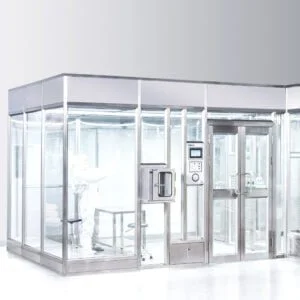
Specifying a modular cleanroom’s HEPA filtration system is a critical design decision that directly impacts capital expenditure, operational costs, and process integrity. A common misconception is that filter sizing is a simple matter of room volume, but this overlooks the complex interplay between air change rates, filter performance under load, and airflow dynamics. An undersized system fails validation, while an oversized one wastes energy and increases heat load, making precise calculation and strategic component selection essential.
This guide provides a step-by-step framework for creating a bulletproof specification. We move beyond basic formulas to address the practical constraints of modular construction, the strategic trade-offs in motor and control selection, and the validation protocols that ensure your investment performs as designed from day one.
How to Calculate Your Total Airflow (CFM) Requirement
The Foundation: Air Changes Per Hour (ACH)
The target ISO classification dictates the required air change rate (ACH), which scales exponentially with cleanliness. An ISO 6 cleanroom demands approximately 180 ACH, while an ISO 8 may require only 20. This nine-fold difference is the primary driver of system scale, energy consumption, and long-term operational cost. The formula is straightforward: (Room Volume in cubic feet) x (ACH) / 60 = Required Net CFM. This calculation yields the delivered clean air volume needed at the filter face.
Accounting for Real-World System Losses
The calculated net CFM is only the starting point. You must account for system static pressure losses from pre-filters, ducting, and the cleanroom envelope itself. Fan Filter Units (FFUs) are rated to deliver a range of CFM at specific static pressures. Selecting units based solely on their maximum free-air rating without derating for your system’s actual pressure drop is a critical error that leads to underperformance. Industry experts recommend adding a 10-15% safety factor to the net CFM before selecting FFUs to ensure they can overcome these losses and maintain target airflow.
Strategic Implications of the CFM Number
This initial calculation has profound financial implications. The exponential increase in FFU count for higher ISO classes directly dictates not only upfront equipment costs but also the facility’s lifetime energy profile and cooling requirements. From the outset, efficiency must be a core financial consideration, not just a technical footnote.
Selecting the Right HEPA FFU Size and Quantity
Navigating Standard Panel Sizes
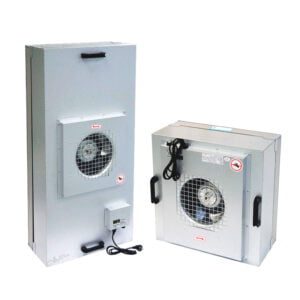
With total CFM established, selection shifts to individual FFU modules, which are constrained by industry-standard ceiling grid dimensions. The dominant sizes are 2’x4’ and 2’x2’ panels, with 4’x4’ units used for high-CFM applications. Each model has a certified output range (e.g., 500-900 CFM for a 2’x4’) at a specified static pressure, typically 0.1” to 1.0” w.g. The choice between HEPA (99.97% on 0.3µm) and ULPA (99.999% on 0.12µm) filters is dictated by application stringency, with HEPA sufficing for most pharmaceutical and electronics applications.
The following table clarifies the standard options and their applications:
| FFU Panel Size | Typical CFM Output Range | Common Application |
|---|---|---|
| 2′ x 4′ | 500 – 900 CFM | Standard modular grids |
| 2′ x 2′ | 250 – 450 CFM | High-density coverage |
| 4′ x 4′ | 1000+ CFM | High-CFM applications |
| Filter Type | Efficiency (on 0.3µm) | Use Case |
| HEPA | 99.97% | Most pharmaceutical/electronics |
| ULPA | 99.999% | Ultra-stringent processes |
Source: IEST-RP-CC001.6: HEPA and ULPA Filters. This recommended practice defines the performance classifications and efficiency ratings essential for selecting the correct filter grade.
Calculating Quantity and Grid Planning
Calculate the minimum FFU quantity by dividing your total required CFM (including safety factor) by a selected mid-range output per unit. You must then round up to ensure the quantity fits logically into your ceiling grid, providing uniform coverage. Forcing an odd quantity into a standard grid creates coverage gaps and turbulent airflow. The strategic value here is the shift from custom construction to configurable components; this modularity enables future reconfiguration or expansion, protecting your capital investment as a flexible asset.
Planning FFU Placement for Optimal Airflow Patterns
Vertical vs. Horizontal Laminar Flow
Physical placement dictates airflow unidirectionality and contamination control. The dominant configuration is vertical laminar flow (VLF), where FFUs in a modular ceiling grid push air downward to be returned through wall or floor panels. Horizontal laminar flow (HLF), with wall-mounted FFUs, is reserved for specific process tunnels or benches. This choice is a fundamental architectural decision that affects room layout, equipment placement, and operator workflow.
Recirculating vs. Once-Pass Configuration
The entire system design bifurcates here. A recirculating system returns conditioned air through a return plenum back to the FFUs, offering high energy efficiency for standard applications. A once-pass system exhausts all air after a single pass, used for applications involving hazardous or volatile contaminants. This architectural choice, often implemented in softwall rooms, dictates construction complexity, pressure cascade design, and operational costs. In our experience, failing to coordinate the FFU layout with the designed return air path is a common oversight that disrupts laminar flow and pressure differentials.
Key Technical Features: Motors, Controls, and Serviceability
Motor and Voltage Selection
Specifying the drive system involves clear efficiency trade-offs. Opting for 230V or 277V motors over standard 115V reduces current draw for immediate operational savings. Upgrading from standard AC to DC/EC (Electronically Commutated) motors offers advanced energy savings, longer life, and superior speed control. This decision directly impacts your facility’s power infrastructure and lifetime electricity costs.
Control Systems and Service Access
Control systems range from individual manual rheostats to centralized, programmable building management systems (BMS). Networked controls enable precise balancing, monitoring, and dynamic adjustment of airflow. For serviceability, Room-Side Replaceable (RSR) filters are a pharmaceutical industry standard, allowing safe filter change-out without requiring plenum access. It’s critical to specify features based on validated need; for instance, test ports and indicator lights are now less common, and procuring them without a specific protocol requirement adds unnecessary cost.
The table below outlines the key technical decisions:
| Feature Category | Option 1 | Option 2 |
|---|---|---|
| Motor Voltage | 115V (Standard) | 230V/277V (Efficient) |
| Motor Technology | AC Motor | DC/EC Motor |
| Control System | Individual Rheostats | Centralized Remote System |
| Service Feature | Standard Filter | Room-Side Replaceable (RSR) |
Source: Technical documentation and industry specifications.
How to Balance and Validate Your Cleanroom System
The Balancing Process
Post-installation balancing is where design intent meets reality. Technicians adjust individual FFU speeds to achieve uniform face velocity across the entire ceiling array, typically targeting 90 feet per minute (FPM) ±20% for laminar flow. This is done with a calibrated anemometer. Uniform velocity is critical for maintaining unidirectional flow and preventing contamination traps caused by turbulence or dead zones.
Visualization and Final Certification
Airflow pattern visualization via smoke studies identifies disruptions caused by equipment, personnel, or improper return air placement. The final step is particle count testing to certify compliance with the target ISO classification, as defined in ISO 14644-4:2022. This phase reveals the value of integrated control systems, which allow for data-driven adjustments and continuous performance monitoring, shifting the value proposition from mere filtration to optimized, auditable environmental management.
The validation steps are standardized:
| Validation Step | Target Parameter | Typical Tool/Method |
|---|---|---|
| FFU Balancing | 90 FPM ±20% face velocity | Calibrated anemometer |
| Airflow Pattern | Unidirectional, laminar flow | Smoke study visualization |
| Final Certification | ISO class particle counts | Particle counter testing |
Avoiding Common Mistakes in Filter Sizing and Layout
The Static Pressure Oversight
The most critical technical error is using an FFU’s maximum free-air CFM rating without derating it for the actual system static pressure. Every filter, pre-filter, and foot of ducting adds resistance. Manufacturers provide performance curves for a reason; failing to consult them guarantees the system will not deliver the required airflow under load.
Poor Grid Integration and Airflow Disruption
Another common pitfall is poor integration of the mechanical design with the architectural plan. This includes forcing a non-standard quantity of FFUs into a ceiling grid, which creates coverage gaps, or failing to coordinate the FFU layout with the location and size of return air grilles. This disrupts the intended laminar flow and pressure cascade. The risk is high when specification authority is over-delegated to equipment suppliers without critical, holistic review by the end-user’s project team.
Creating Your Final Specification and Procurement Checklist
Consolidating Technical Decisions
Your final specification document is your procurement and quality assurance tool. It must translate all prior decisions into unambiguous requirements. This includes: 1) Total calculated CFM and target ACH, 2) FFU quantity, size, filter type and efficiency, 3) Detailed ceiling layout drawings showing airflow configuration, 4) Technical specs for voltage, motor type, and control system, 5) Mandatory service features like RSR, and 6) Required validation protocols.
The Strategic Procurement Framework
This checklist does more than guide a purchase; it encapsulates a lifecycle strategy. By specifying a modular, well-documented system with serviceable components and integrated controls, you ensure the cleanroom is not just fit-for-purpose today but is a reconfigurable asset. This mitigates long-term operational risk and protects against obsolescence, allowing the environment to adapt to future process changes without a complete rebuild.
The foundation of your specification is the relationship between ISO class and air change rates, which dictates all subsequent sizing.
| ISO Class | Typical ACH Range | Airflow Intensity |
|---|---|---|
| ISO 6 | ~180 ACH | Very High |
| ISO 7 | 60-90 ACH | High |
| ISO 8 | ~20 ACH | Moderate |
A successful modular cleanroom project hinges on three priorities: accurately derating FFU CFM for system pressure, designing the ceiling grid and return air path as an integrated airflow system, and specifying controls and service features that reduce long-term operational cost. This approach transforms the specification from a static parts list into a dynamic performance contract.
Need professional guidance to specify and implement a high-performance modular cleanroom system? The engineers at YOUTH specialize in translating complex ISO and IEST requirements into optimized, functional designs, including precise HEPA filtration system integration. Contact our technical team to review your layout and airflow calculations.
Frequently Asked Questions
Q: How do you calculate the total CFM needed for a modular cleanroom to meet a specific ISO class?
A: You determine the volumetric airflow by multiplying your room’s cubic footage by the required air change rate (ACH) for your target ISO classification, then divide by 60. For example, an ISO 6 cleanroom requires about 180 ACH, while an ISO 8 may need only 20. This calculated net CFM must then be derated for system pressure losses from ducting and pre-filters when selecting FFUs. This initial step has major cost implications, as the exponential rise in ACH for higher classes directly dictates your long-term energy consumption and capital expenditure on fan units.
Q: What are the key factors when selecting between HEPA and ULPA filters for a modular cleanroom?
A: The primary factor is your application’s required particle capture stringency. HEPA filters are rated for 99.97% efficiency on particles 0.3 microns in diameter, while ULPA filters capture 99.999% of particles at 0.12 microns. The selection is typically dictated by your process requirements and target ISO class, with ULPA used for the most stringent applications. This choice is foundational, as filter performance specifications are detailed in standards like IEST-RP-CC001.6. For projects where future process upgrades are anticipated, specifying a higher-grade filter from the start can mitigate costly retrofits later.
Q: How does FFU placement impact cleanroom airflow patterns and contamination control?
A: Placement dictates whether you achieve unidirectional laminar flow or create turbulent dead zones. FFUs are installed in a ceiling grid to create vertical laminar flow, pushing air downward to be returned through wall panels, while horizontal flow uses wall-mounted units. The choice between vertical and horizontal flow is a fundamental architectural decision that affects room layout and process equipment placement. This design must integrate with the return air path to maintain proper pressure cascades, as outlined in cleanroom design principles like those in ISO 14644-4:2022. If your process involves large equipment, you must model the FFU grid layout to ensure it doesn’t disrupt the intended airflow pattern over critical zones.
Q: What technical features should we prioritize in FFU specifications for operational efficiency?
A: Prioritize motor voltage and technology for long-term savings. Selecting 230V or 277V motors over 115V reduces current draw, while upgrading from standard AC to DC/EC motors provides advanced energy efficiency and precise speed control. For serviceability, Room-Side Replaceable (RSR) filters are a pharmaceutical standard. This means facilities focused on lifecycle costs should invest in higher-voltage DC/EC motors with a centralized control system, as the energy savings will quickly offset the higher initial capital cost.
Q: What is the process for balancing and validating a newly installed modular cleanroom system?
A: Validation involves adjusting individual FFU speeds to achieve uniform face velocity, typically targeting 90 feet per minute ±20%, followed by smoke studies to visualize airflow and particle count testing to certify the ISO class. This process ensures the design delivers laminar flow without dead zones. For operations requiring continuous compliance data, integrated control systems that enable networked FFU management and monitoring provide a significant advantage in audit readiness and long-term performance optimization.
Q: What is a common critical mistake in specifying HEPA filter fan units?
A: A critical error is selecting FFUs based solely on their maximum free-air CFM rating without accounting for the actual static pressure resistance in your installed system, which includes pre-filters and ductwork. This oversight leads to underperformance, as the units cannot deliver the required clean air volume under load. This means your procurement team must require and review performance curves at your system’s calculated static pressure, not just catalog peak ratings, to avoid a fundamental design failure.
Q: How should we approach pre-filter selection in relation to the final HEPA filtration stage?
A: Pre-filters protect the more expensive HEPA filters by loading up with larger particles, extending their service life. Their efficiency, often rated via the ANSI/ASHRAE 52.2 MERV system, should be selected to match the particulate load expected in your environment. For facilities with high ambient dust or process-generated particles, implementing a multi-stage pre-filtration strategy will significantly reduce maintenance frequency and total cost of ownership for the HEPA system.
Related Contents:
- Fan Filter Units or Laminar Flow Hoods: Which to Choose?
- How to Calculate CFM Requirements for Modular Cleanroom HVAC Systems
- The Complete Fan Filter Unit Guide for Cleanroom Managers: Technical Selection, Installation, and Performance Optimization 2025 Edition
- Fan Filter Unit Air Change Rate Calculation: Step-by-Step Formula for Cleanroom Classification
- Modular Laminar Air Flow Units for Cleanrooms
- Optimizing Airflow Patterns in Fan Filter Unit Systems
- Top 3 Fan Filter Unit Applications in Pharmaceutical Manufacturing
- How Fan Filter Units Create Laminar Airflow in ISO Class 5 Cleanrooms
- ULPA vs HEPA Filters for Laminar Flow Units