Maintaining precise temperature and humidity control is a non-negotiable requirement in pharmaceutical cleanrooms, yet it presents a persistent engineering challenge. The stability of active pharmaceutical ingredients, the prevention of microbial growth, and the consistency of manufacturing processes all hinge on a tightly controlled environment. However, achieving this control often forces a difficult compromise between stringent regulatory compliance, operational energy costs, and system complexity. Many facilities struggle with designs that are either over-engineered for their actual needs or insufficiently robust for future process changes.
This balance is especially critical now, as regulatory scrutiny intensifies and cost pressures mount. The latest revisions to standards like EU GMP Annex 1 place greater emphasis on the continuous monitoring and control of these environmental parameters. Simultaneously, the shift toward more flexible manufacturing models demands infrastructure that can adapt without exorbitant cost. A modular approach to cleanroom construction offers a strategic pathway to resolve these tensions, transforming environmental control from a fixed, costly constraint into a manageable, scalable asset.
Core Principles of Temperature and Humidity Control
Defining the Environmental Baseline
The primary objective is to establish a stable, predictable environment that protects product integrity. Temperature control, typically maintained within a narrow range such as 20-24°C, ensures chemical stability and provides operator comfort. Humidity control, often specified between 30-60% relative humidity (RH), is critical for preventing microbial proliferation, powder clumping, and electrostatic discharge. These parameters are not arbitrary; they are derived from product-specific stability data and process requirements. A common oversight is specifying tolerances tighter than scientifically justified, which exponentially increases system cost and complexity without tangible quality benefit.
The Interdependence with Contamination Control
Effective temperature and humidity management cannot operate in isolation from particulate control. The HVAC system must work in concert with HEPA or ULPA filtration to maintain cleanliness classification. This integration means that environmental control is fundamentally a subsystem of the overall contamination control strategy. The cleanroom classification itself is a foundational decision that dictates the type of environmental control architecture possible and locks in its associated capital and operational cost structure. Engineers must design for all parameters simultaneously from the outset.
Strategic Implications for System Design
A key strategic principle is defining the minimum viable environmental range. Justifying each degree of temperature or percentage point of humidity based on actual product needs prevents unnecessary engineering trade-offs. For instance, an overly aggressive dehumidification requirement can force the specification of specialized, energy-intensive chillers. In our experience evaluating system designs, the most cost-effective and reliable outcomes stem from a clear, documented rationale for each setpoint, which then guides all subsequent equipment selection and validation activities.
| Parameter | Typical Control Range | Primary Purpose |
|---|---|---|
| Temperature | 20-24°C | Chemical stability |
| Humidity | 30-60% RH | Prevent microbial growth |
| Pressure | Positive | Containment |
| Airflow | Recirculating design | Energy efficiency |
Source: EU GMP Annex 1: Manufacture of Sterile Medicinal Products. This guideline mandates the monitoring and control of critical environmental parameters like temperature and humidity within clean areas to ensure product quality and sterility assurance.
Advantages of Modular Cleanroom HVAC Integration
Enhanced Environmental Stability
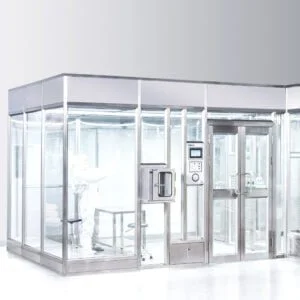
The inherent design of a modular cleanroom provides a superior foundation for precise control. Its rigid, sealed panel envelope is exceptionally effective at maintaining positive pressure differentials. This is a critical differentiator that prevents the infiltration of unconditioned, contaminated air from adjacent spaces, especially during door openings and personnel movement. This stable envelope supports a highly efficient recirculating airflow design, where conditioned air is repeatedly filtered and returned, drastically reducing the energy required to treat large volumes of fresh outside air.
Operational and Financial Flexibility
Modularity redefines cleanroom infrastructure from a fixed, permanent asset into a flexible, scalable resource. This allows pharmaceutical manufacturers to align cleanroom capacity and environmental control capability directly with specific product lifecycles and pipeline uncertainty. The ability to reconfigure or expand a controlled environment with minimal disruption reduces the financial risk of infrastructure obsolescence. This scalability ensures that capital investment in temperature and humidity control systems can grow precisely with manufacturing needs.
Simplified Maintenance and Validation
The systematic construction of modular units facilitates easier access to service pathways for HVAC components like sensors, humidifiers, and cooling coils. This accessibility translates to reduced downtime for maintenance and calibration. Furthermore, the standardized nature of modular components can streamline the validation process. While the physical build is simplified, the regulatory focus rightly intensifies on proving sustained operational control through documented performance, making the integrated monitoring system even more crucial.
HVAC System Design for GMP Compliance
Integrated Load Calculation and Zonal Control
GMP-compliant HVAC design begins with precise calculations of thermal and humidity loads, accounting for factors like process equipment, personnel, and lighting. Modern modular approaches increasingly utilize standalone, modular Air Handling Units (AHUs) that provide decentralized, zonal control. This architecture allows for tailored environmental conditions in different process areas—such as a lower humidity setpoint in a powder handling suite—while enhancing overall system resilience.
Redundancy and Failure Management
A core GMP principle is ensuring continuity of critical processes. Decentralized modular AHUs offer inherent redundancy; the failure of a single unit typically impacts only its designated zone, not the entire facility. This design limits the scope of potential deviations and supports business continuity for high-value manufacturing. The system architecture must be planned to isolate and manage failures without compromising adjacent controlled environments.
Filtration and Air Delivery Integration
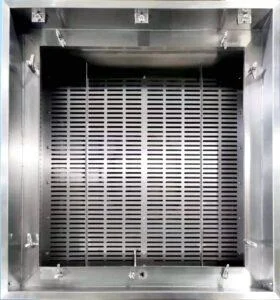
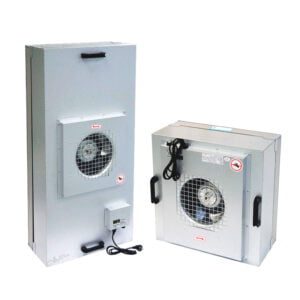
The final step in the environmental control chain is the integration of conditioned air with terminal HEPA/ULPA filtration. This is often achieved through Fan Filter Units (FFUs) or integrated filter housings within the AHU. The design must ensure that the air delivered to the cleanroom meets both the temperature/humidity setpoints and the required particulate cleanliness level simultaneously. This seamless blending is non-negotiable for compliance with standards like ISO 14644-4, which governs the integration of essential systems in cleanroom design.
| System Component | Key Function | Design Consideration |
|---|---|---|
| Air Handling Unit (AHU) | Conditions air | Modular, decentralized control |
| Dehumidification | Controls humidity | Major energy consumer |
| Fan Filter Unit (FFU) | Final HEPA/ULPA filtration | Meets cleanliness class |
| System Architecture | Provides redundancy | Limits failure impact |
Source: ISO 14644-4 Cleanrooms and associated controlled environments – Part 4: Design, construction and start-up. This standard specifies requirements for integrating essential systems like HVAC into cleanroom design to achieve and maintain specified environmental and cleanliness levels.
Critical Technical Considerations and Best Practices
Justification of Setpoints and Tolerances
The single most impactful best practice is the rigorous justification of environmental setpoints and their allowable tolerances. Specifications should be grounded in product stability data and process requirements, not arbitrary strictness. Realistic tolerances prevent the procurement of unnecessarily complex systems that are more prone to failure and costly to operate. This justification document becomes a cornerstone for both system design and regulatory audits.
Pressure Cascade and Containment
Effective environmental control must include a defined pressure cascade to contain particulate and microbial contaminants. The HVAC system must be designed to maintain this cascade under all operational conditions, including equipment operation and door openings. This often requires sophisticated control logic and responsive variable air volume (VAV) systems that can adjust airflow to maintain differential pressure, even as filters load over time.
Component Redundancy Strategy
For critical processes, redundancy for key HVAC components—such as chillers, humidifiers, or control sensors—should be evaluated based on risk to product quality and operational continuity. The decision involves a cost-benefit analysis weighing the probability and impact of failure against the investment in backup systems. A modular, zonal design inherently provides a level of system-level redundancy that monolithic central plants lack.
Energy Efficiency Strategies for Operational Cost Savings
Capitalizing on Modular Envelope Efficiency
The insulated panel envelope of a modular cleanroom is a first-line defense against thermal load, reducing the demand on cooling and heating systems. Coupled with a recirculating airflow design that primarily conditions clean, internal air rather than energy-intensive outside air, the base efficiency is significantly higher than in many traditional constructions. These inherent advantages establish a low baseline for operational energy consumption.
Active Efficiency Technologies
To further reduce operating costs, several active strategies are essential. Variable Frequency Drives (VFDs) on fans and pumps allow motors to run only at the speed needed to meet current demand, yielding substantial energy savings. Specifying high-efficiency chillers and compressors, while sometimes involving a higher upfront cost, pays dividends in long-term utility savings. Implementing an intelligent Building Management System (BMS) enables optimized, scheduled control and prevents systems from working at cross-purposes.
The Financial Advantage of Accelerated Depreciation
A critical, often overlooked financial benefit is the treatment of modular cleanrooms as personal property rather than real estate for tax purposes. This frequently allows for accelerated depreciation schedules (e.g., over 7 years instead of 39 years for traditional building construction). This creates a tangible improvement in near-term cash flow through tax savings. Any credible total cost of ownership analysis must include this financial advantage to accurately compare project economics.
| Strategy | Implementation | Financial Impact |
|---|---|---|
| Envelope Design | Insulated panels | Reduces thermal load |
| Airflow Management | Recirculating air | Conditions clean air |
| Motor Control | Variable Frequency Drives (VFDs) | Reduces energy consumption |
| Asset Depreciation | Modular construction | Accelerated schedule (e.g., 7 years) |
Source: Technical documentation and industry specifications.
Validation and Monitoring for Continuous Compliance
The Qualification Lifecycle
As modular designs standardize the physical build, proving sustained control through rigorous validation becomes paramount. The integrated HVAC system must undergo the standard qualification protocol: Installation Qualification (IQ) to verify correct installation per design; Operational Qualification (OQ) to demonstrate it functions as intended across its operating ranges; and Performance Qualification (PQ) to prove it consistently maintains the specified temperature, humidity, and pressure conditions under simulated or actual production loads.
The Role of Continuous Monitoring
A robust BMS or dedicated environmental monitoring system is non-negotiable for GMP compliance. This system provides real-time, continuous data logging of all critical parameters, creating an indelible audit trail. It manages alarms for excursions, facilitates trend analysis, and significantly reduces the manual overhead of compliance record-keeping. The compliance strategy thus evolves from proving build quality to demonstrating documented, ongoing control, as emphasized in standards like USP General Chapter <797>.
Data Integrity and Review
The monitoring system must be designed with data integrity principles (ALCOA+) in mind. This includes secure, time-stamped data storage, access controls, and automated data backup. Regular data review is essential not just for compliance, but for proactive maintenance—identifying trends like gradual filter loading or seasonal humidity shifts before they cause an excursion.
| Qualification Phase | Proof Objective | Key Tool |
|---|---|---|
| Installation (IQ) | Correct installation | Documentation review |
| Operational (OQ) | Intended function | System testing |
| Performance (PQ) | Consistent conditions | Environmental monitoring |
| Ongoing Compliance | Real-time data logging | Building Management System (BMS) |
Source: USP General Chapter <797> Pharmaceutical Compounding—Sterile Preparations. This standard details requirements for monitoring environmental parameters like temperature and humidity, including frequencies and data logging, to ensure the quality of sterile preparations.
Selecting and Sizing Your Modular Control System
Adopting a Partnership Procurement Model
Selecting a system requires evaluating vendors on their lifecycle support capabilities, not just the initial purchase price. This includes design assistance, commissioning support, validation documentation packages, and availability of service contracts and spare parts. The vendor should be viewed as a long-term operational partner who understands the regulatory landscape and can support future changes.
Accurate Sizing and Future-Proofing
The process starts with a precise, professional load calculation. Undersizing leads to an inability to maintain setpoints; oversizing causes short-cycling, poor humidity control, and wasted energy. Sizing must also account for future scalability. A key advantage of a modular cleanroom HVAC system is the ability to add capacity in tandem with cleanroom expansion, ensuring the environmental control system is never a bottleneck to growth.
Architectural Decision: Integrated vs. Central
The choice between using standalone modular AHUs within each cleanroom zone versus connecting to a central plant HVAC system involves weighing control, redundancy, and cost. Modular AHUs offer superior zonal control and inherent redundancy but may have a higher unit cost. Central systems can be more efficient at scale but create a single point of failure. This decision reflects the industry’s broader shift toward treating cleanrooms as configurable, performance-guaranteed products with predictable timelines and costs.
| Selection Factor | Key Question | Best Practice |
|---|---|---|
| Vendor Evaluation | Lifecycle support vs. initial cost | Partnership approach |
| System Sizing | Based on load calculation | Account for future scalability |
| Architecture Choice | Integrated AHU vs. central plant | Weigh redundancy and control |
| Procurement Focus | Predictable timeline and cost | Configurable, performance-guaranteed product |
Source: ISO 14644-4 Cleanrooms and associated controlled environments – Part 4: Design, construction and start-up. This standard provides guidance on the design process, including system specification and vendor selection, to ensure the cleanroom facility meets its performance requirements.
Implementing a Future-Proof Environmental Control Strategy
Designing for Inherent Adaptability
A future-proof strategy leverages modularity at its core. The initial design should accommodate potential process changes—such as increased heat load from new equipment or stricter humidity requirements—with minimal disruption. This involves planning for additional utility connections, allocating space for future AHU expansions, and ensuring the BMS has unused capacity for additional sensors and control points.
Investing in Digital Infrastructure
The cornerstone of a sustainable strategy is investing in an integrated BMS and comprehensive digital monitoring infrastructure from the start. This system manages the ongoing compliance burden efficiently, provides data for continuous improvement, and forms the backbone for any future integration with broader manufacturing execution or enterprise systems. It turns environmental data from a compliance necessity into a strategic asset for process optimization.
Aligning Infrastructure with Business Agility
Ultimately, this approach treats the modular cleanroom and its environmental control system as a flexible, depreciable asset. It can be reconfigured, relocated, or expanded to meet evolving manufacturing needs, pipeline developments, or regulatory changes. This directly aligns capital infrastructure with strategic business agility, allowing pharmaceutical companies to respond to market opportunities without being constrained by their facility’s environmental control capabilities.
Successful temperature and humidity control hinges on three priorities: justifying setpoints based on science, not speculation; designing for operational efficiency and resilience from the start; and implementing a digital monitoring framework that ensures continuous compliance. The goal is a controlled environment that is both rigorously stable and strategically adaptable.
Need professional guidance on implementing a precise and compliant modular environmental control system? The experts at YOUTH can help you design a solution that balances performance, efficiency, and long-term flexibility. Contact us to discuss your specific cleanroom requirements.
Frequently Asked Questions
Q: How do you justify temperature and humidity setpoints for GMP compliance without over-engineering the system?
A: Setpoints must be based on a documented risk assessment of product stability and process needs, not arbitrary tightening. Define the minimum viable range, such as 20-24°C and 30-60% RH, as justified by preventing microbial growth or powder clumping. Overly tight tolerances force significant engineering trade-offs and exponential cost increases. For projects where product sensitivity is not extreme, plan for wider, justified tolerances to reduce system complexity and capital expenditure.
Q: What are the key advantages of using a modular HVAC system for cleanroom environmental control?
A: Modular HVAC, often using standalone Air Handling Units (AHUs), provides decentralized, zonal control with inherent operational redundancy. This design limits the impact of a single component failure to a specific module, enhancing business continuity for critical processes. The sealed, insulated panel envelope of a modular cleanroom also supports efficient recirculating airflow and positive pressure. This means facilities managing high-value or variable production batches should prioritize this architecture for its scalability and risk mitigation benefits.
Q: How does the cleanroom classification decision impact the design of the temperature and humidity control system?
A: The target ISO class is a foundational decision that dictates the required air change rates and filtration level (HEPA/ULPA), which directly influences the HVAC system’s architecture and capacity. The environmental control system must be seamlessly blended with the contamination control strategy from the outset, as detailed in standards like ISO 14644-4. This means selecting a higher ISO class (e.g., ISO 5) locks in a more complex and costly control system, so classification should be driven by strict process necessity.
Q: What energy efficiency strategies are most effective for modular cleanroom temperature and humidity control?
A: Capitalize on the inherent efficiency of the insulated envelope and recirculating air design by employing variable frequency drives (VFDs) on fans, specifying high-efficiency chillers, and using an intelligent Building Management System (BMS) for optimized control. A critical financial advantage is that modular systems often qualify for accelerated depreciation, improving near-term cash flow. For any total cost of ownership analysis, you must include these depreciation benefits to accurately evaluate the return on investment against potential upfront costs.
Q: How should validation and monitoring be approached for a modular cleanroom’s environmental parameters?
A: Validation must follow a lifecycle approach—Installation (IQ), Operational (OQ), and Performance (PQ) Qualification—to prove the system is installed correctly and maintains specified conditions like temperature and humidity. A robust BMS is essential for continuous, real-time data logging to meet audit requirements, as emphasized in guidelines like EU GMP Annex 1. This shifts the compliance burden from proving build quality to demonstrating documented, ongoing control, so budget for both the initial qualification and the permanent monitoring infrastructure.
Q: What criteria should we use to select a vendor for a modular environmental control system?
A: Move beyond initial cost and evaluate vendors on lifecycle support capabilities, including design assistance, validation support, and future reconfiguration services. The industry shift is toward configurable, performance-guaranteed products, so procurement should prioritize partners who offer comprehensive services from concept through operational life. This means for projects with uncertain long-term needs or a desire for predictable operational costs, you should select a vendor positioned as a long-term operational partner, not just a equipment supplier.
Q: Why is dehumidification a critical technical consideration in pharmaceutical cleanroom HVAC design?
A: Dehumidification is often the most energy-intensive load, and overly tight humidity control can necessitate costly specialized chillers and significantly increase operational expenses. The system must manage latent heat gains while maintaining the specified relative humidity range, typically 30-60% RH, to prevent product and process issues. If your operation is in a high-humidity climate or involves moisture-sensitive processes, plan for a detailed latent load analysis and evaluate energy recovery options during the design phase to manage lifetime costs.
Related Contents:
- Modular Laminar Air Flow Units for Cleanrooms
- Modular BIBO Designs: Flexibility for Your Facility
- Environmental Monitoring in Sterility Test Isolators
- GMP Compliant Air Filters | FDA Requirements Cleanroom Validation
- Laboratory Cleanroom Air Systems | Research Facility Guide
- Biotechnology Cleanroom Equipment | Sterile Processing
- Energy Efficiency in LAF Garment Cabinet Design
- The Complete Modular Cleanroom Guide for Facility Managers and Operations Directors: Standards, Design, and Implementation Best Practices 2025
- Understanding Cleanroom Air Quality Standards | Filter Requirements