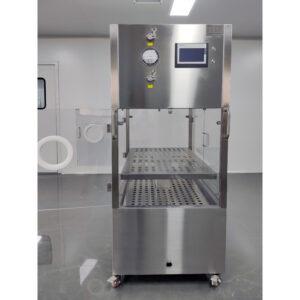
Selecting the right pass box material is a critical but often oversimplified decision in cleanroom design. The choice between stainless steel and powder-coated steel directly impacts operational reliability, compliance risk, and total facility cost. Many teams default to the lower upfront cost of coated steel, underestimating the long-term implications for maintenance, validation, and contamination control in GMP environments.
This decision requires a strategic lens. It’s not merely a material specification but a risk management exercise that balances initial budget against lifecycle performance and regulatory scrutiny. The correct choice depends on your specific cleanroom zones, cleaning protocols, and the strategic need for future flexibility in a highly regulated industry.
Stainless Steel vs Powder-Coated Steel: Core Differences
Material Composition and Inherent Properties
Stainless steel, particularly grades 304 and 316, is an alloy offering inherent corrosion resistance from its chromium and nickel content. Grade 316 adds molybdenum for superior resistance to chlorides. Its surface is non-porous, durable, and integral to the material. Powder-coated steel uses a cold-rolled steel substrate protected by a thermally cured polymer layer. Its performance is entirely dependent on the integrity of this applied coating, which acts as a barrier rather than an inherent property.
The Strategic Risk Decision
This fundamental difference dictates long-term risk. Selecting stainless steel is an investment in predictable, validated performance over decades. Opting for powder-coated steel is a calculated bet on process stability; it assumes cleaning agents and transfer materials will never evolve beyond the coating’s specific chemical resistance. Industry experts note that this bet can sacrifice long-term flexibility. If protocols change, the coated unit may become a liability.
Application Philosophy
The core difference extends to design philosophy. Stainless steel units are often built with fully welded, radiused corners as a direct GMP compliance driver. Powder-coated designs must accommodate the limitations of the coating process, which can affect seam integrity and corner profiles. We compared units from multiple manufacturers and found that the design features enabling easy cleanability are more consistently executed in stainless steel construction.
Cost Comparison: Initial Investment vs Total Cost of Ownership
Analyzing Capital Expenditure
A straightforward procurement analysis will always show a lower initial capital cost for powder-coated steel pass boxes. This makes them attractive for projects with tight upfront budgets or for applications perceived as less critical. However, this view is incomplete. It fails to account for the total financial impact over the asset’s lifecycle, where operational and maintenance costs accumulate.
Modeling Total Cost of Ownership (TCO)
A strategic TCO model reveals a different picture. Stainless steel’s higher upfront cost is offset by minimal maintenance, negligible repair costs, and a longer operational lifespan, often exceeding 20 years. Powder-coated units carry hidden costs: potential coating repair, periodic recoating, and the risk of premature replacement if substrate corrosion occurs. Furthermore, operational workload differs. Stainless steel withstands aggressive, validated cleaning regimens. Coated surfaces may require gentler, more frequent protocols to preserve integrity, impacting long-term labor and material costs.
The Data-Driven Financial Picture
The following table quantifies the key cost factors, providing a framework for your own TCO analysis.
| Cost Factor | Stainless Steel | Powder-Coated Steel |
|---|---|---|
| Initial Capital Cost | Higher upfront investment | Lower upfront cost |
| Maintenance Cost | Minimal over lifecycle | Higher potential cost |
| Coating Repair Cost | Not applicable | Required for breaches |
| Operational Lifespan | Long (20+ years) | Shorter, risk of replacement |
| Cleaning Protocol Cost | Aggressive agents allowed | Gentler, more frequent protocols |
Source: Technical documentation and industry specifications.
Durability & Cleanability Compared for GMP Compliance
Surface Integrity and GMP Mandates
Durability and cleanability are inseparable for GMP compliance. Regulations like EU GMP Annex 1: Manufacture of Sterile Medicinal Products mandate surfaces that are smooth, impervious, non-shedding, and easily cleanable. Stainless steel’s inherent resistance to scratching and impact ensures its polished surface maintains these qualities over time. Powder-coated steel offers good cleanability when new, but the coating is vulnerable to abrasion from routine wiping and impact from transferred items.
The Consequence of Coating Failure
Any chip or scratch in a powder coat exposes the underlying steel to corrosion. This breach creates a microscopic site that can harbor contaminants and biofilms, complicating cleaning validation and increasing microbial risk. In contrast, a scratch on stainless steel, while undesirable, does not create a corrosion site that compromises the entire material’s integrity. This distinction is a major compliance differentiator during audits and environmental monitoring reviews.
Validating Cleanability Over Time
Long-term cleaning validation is more straightforward with stainless steel. Its consistent surface properties allow for reproducible cleaning results. Powder-coated surfaces introduce a variable; as the coating ages or sustains minor damage, its cleanability profile can change, potentially requiring re-validation. The table below details how material attributes directly impact GMP compliance.
| Attribute | Stainless Steel | Powder-Coated Steel | GMP Compliance Impact |
|---|---|---|---|
| Surface Integrity | Inherent, non-porous | Coating-dependent | Direct compliance driver |
| Scratch/Impact Resistance | High | Vulnerable to abrasion | Prevents particulate accumulation |
| Seam Design | Fully welded, radiused corners | Coated seams | Critical for cleanability |
| Long-term Validation | Easy to validate | Complicated by coating breaches | Increases compliance risk |
| Particulate Generation Risk | Low | High if coating degrades | Harbors contaminants |
Source: EU GMP Annex 1: Manufacture of Sterile Medicinal Products. This guideline mandates materials that are smooth, impervious, non-shedding, and easily cleanable to prevent microbial contamination, directly informing the durability and cleanability requirements in this comparison.
Chemical Resistance: Which Material Handles Harsh Disinfectants?
Inherent vs. Applied Resistance
Chemical resistance is non-negotiable given the use of sporicides and aggressive agents like hydrogen peroxide vapor (VHP) or chlorine-based solutions. Stainless steel, especially grade 316, offers excellent, inherent resistance to a wide spectrum of chemicals. Its performance is a material property. Powder-coated steel’s resistance depends entirely on the specific polymer formula. While modern epoxy or polyester coatings are robust, they can be degraded by repeated exposure to strong solvents or oxidizing agents.
Degradation and Particulate Risk
Coating degradation manifests as gloss loss, softening, chalking, or cracking. This not only compromises the protective barrier but can also introduce polymer particulates into the clean zone. Such particulate generation is a critical failure mode in controlled environments. Stainless steel provides a reliable, predictable response to chemical exposure, a requirement underscored in standards like the ASME BPE: Bioprocessing Equipment Standard for surfaces requiring cleanability and sterility.
Selection for Decontamination Protocols
Your facility’s specific decontamination cycle dictates the required material. For processes involving frequent VHP or bleach-based cleaning, stainless steel is the low-risk choice. For zones using milder disinfectants like diluted alcohols, a high-quality powder coat may suffice, but with an acknowledged risk if protocols change. The comparative data below highlights the performance gap.
| Disinfectant/Chemical Type | Stainless Steel (Grade 316) | Powder-Coated Steel |
|---|---|---|
| Chloride-based agents (e.g., bleach) | Superior resistance | Coating formula dependent |
| Hydrogen Peroxide (VHP) | Excellent inherent resistance | Potential degradation risk |
| Strong Oxidizing Agents | Maintains surface integrity | Risk of gloss loss/cracking |
| Sporicides & Alcohols | Wide spectrum resistance | Polymer-specific performance |
| Particulate Generation | Low risk | High risk if coating fails |
Source: ASME BPE: Bioprocessing Equipment Standard. This standard provides detailed specifications for materials of construction and surface finishes to ensure cleanability and sterility, which includes defining the chemical resistance required for surfaces exposed to harsh sanitizing agents in bioprocessing environments.
Performance in Critical vs. Support Zone Applications
Mandates for Critical Zones
In Critical Zones (Grade A/B, ISO 5-7) where product is exposed, stainless steel is the unambiguous standard. Grade 316 is often specified for its superior chloride resistance. This material supports validated cleaning, sterilization (e.g., VHP), and provides the necessary assurance for aseptic processing. An underspecified material here creates compounding validation liabilities and operational risk.
Risk-Based Assessment for Support Zones
In Support or Controlled Zones (ISO 7-9), the risk profile changes. Powder-coated steel or hybrid designs become viable options, but only after a formal risk assessment. This assessment must evaluate the materials being transferred, the frequency of transfer, and the zone’s contamination control objectives. The hierarchy of control dictates that the pass box type and material must be matched to the specific need.
Zone-Based Material Selection Framework
The selection logic follows a clear, zone-based rationale. Easily overlooked details include the distinction between ISO 7 and ISO 8 support zones, where the frequency of material transfer might justify different material choices even within the same classification.
| Cleanroom Zone (ISO Class) | Recommended Material | Key Rationale |
|---|---|---|
| Critical Zone (A/B, ISO 5-7) | 316 Stainless Steel | Unambiguous standard; supports sterilization |
| Critical Zone (A/B, ISO 5-7) | 304 Stainless Steel | Typically sufficient |
| Support Zone (ISO 7-8) | 304 Stainless Steel | Standard for controlled zones |
| Support Zone (ISO 8-9) | Powder-Coated or Hybrid | Post-risk-assessment viability |
| All Zones (for interiors) | Stainless Steel Interior | Compliant material contact surface |
Source: ISO 14644-4: Cleanrooms and associated controlled environments — Part 4: Design, construction and start-up. This standard provides requirements for cleanroom construction and materials based on zone classification, directly informing the material selection rationale for different levels of contamination control.
Maintenance, Validation, and Lifecycle Considerations
Operational Workload and Protocols
Maintenance protocols diverge significantly. Stainless steel supports aggressive, validated cleaning with a wide range of agents, requiring mainly routine visual inspection for damage. Powder-coated surfaces demand gentler cleaners and meticulous inspection for coating integrity—chips, scratches, or discoloration. This adds procedural steps and training requirements for operational staff.
Streamlining Qualification (IQ/OQ/PQ)
From a validation perspective, stainless steel’s long history of use in pharmacopeial standards simplifies documentation. Its predictable performance supports easier installation (IQ), operational (OQ), and performance (PQ) qualification. Powder-coated units require additional verification that the coating specification matches the chemical resistance claims for your specific disinfectants, adding a layer of complexity to the qualification dossier.
Lifecycle and Future-Proofing
Considering the entire lifecycle, stainless steel provides a durable platform for the facility’s intended lifespan. It also future-proofs the operation against changes in cleaning technology or regulatory expectations. As facilities move toward data-enabled equipment, the robust construction of stainless steel pass boxes provides a reliable host for integrating sensors for particle monitoring or differential pressure logging, supporting predictive maintenance and data-driven compliance.
Hybrid Designs: Combining Materials for Cost & Performance
The Strategic Compromise
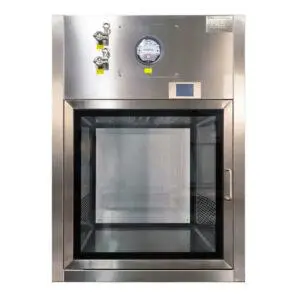
Hybrid designs offer a pragmatic balance, typically featuring a stainless steel interior chamber with a powder-coated steel outer casing. This approach leverages stainless steel’s superior cleanability and chemical resistance on all critical product-contact surfaces while reducing material cost on the non-critical exterior. It reflects smart market segmentation for cost-sensitive yet compliant applications.
Ideal Application Scope
This solution is most viable for static pass boxes in controlled support zones (ISO 7-8). It provides a fully compliant interior for material transfer while offering a durable exterior finish. The decision hinges on a risk assessment that justifies the external coating, considering factors like room pressurization, exterior cleaning frequency, and potential for accidental impact in the surrounding corridor.
Design and Integration Notes
Successful hybrid design requires careful attention to the interface between the two materials. The joint must be sealed and designed to prevent moisture ingress or contamination trap. Furthermore, specifying a high-quality laminar airflow pass box with a stainless interior ensures the critical HEPA-filtered chamber meets the highest hygiene standards, while the exterior cost is optimized. This is a direct application of value engineering without compromising core function.
Selection Framework: Choosing the Right Pass Box Material
Step 1: Define the Transfer Requirement
First, map the transfer process to the contamination control hierarchy. Determine if a static or dynamic pass box is required based on the need for particle washout or containment. This defines the functional type before material selection even begins.
Step 2: Zone Classification Dictates Core Material
For Critical Zones (ISO 5-7), specify 316 stainless steel throughout. For Controlled Zones (ISO 7-8), 304 stainless steel is typically sufficient and cost-effective. For Support Zones (ISO 8-9), powder-coated or hybrid designs enter the conversation as viable options, but not defaults.
Step 3: Conduct a Formal Risk Assessment
For zones where coated or hybrid options are considered, a formal risk assessment is mandatory. This assessment must evaluate:
- Chemical exposure from disinfectants.
- Physical abrasion risk from items and cleaning.
- Required operational lifespan and facility lifecycle.
- Impact of potential coating failure on product and process.
Step 4: Finalize with TCO and Strategic Analysis
Weigh the Total Cost of Ownership model against your strategic risk appetite. Acknowledge that the lowest upfront cost often carries higher long-term operational and compliance risk. Ensure the selected material supports reliable, validated operation for the duration of your facility’s planned use.
The decision between stainless steel and powder-coated pass boxes ultimately balances compliance certainty against budget constraints. Prioritize stainless steel for any product-exposure or critical zone application. Consider hybrid designs only after a rigorous, documented risk assessment for support zones. Always model the Total Cost of Ownership, not just the purchase price.
Need professional guidance on specifying the right pass box for your cleanroom’s zone and risk profile? YOUTH provides expert consultation and compliant cleanroom equipment solutions tailored to pharmaceutical and biotech requirements. Our team can help you navigate material selection, design specifications, and validation support.
Contact Us to discuss your specific project needs and request detailed product specifications.
Frequently Asked Questions
Q: How do you justify the higher upfront cost of a stainless steel pass box for a controlled zone?
A: Justification requires a total cost of ownership analysis. While powder-coated steel has a lower capital cost, stainless steel’s minimal maintenance, longer lifespan, and ability to withstand aggressive cleaning reduce long-term operational expenses. The EU GMP Annex 1 mandate for easily cleanable surfaces further supports this choice. This means facilities with strict hygiene protocols should prioritize stainless steel to lower lifecycle costs and compliance risk.
Q: What is the primary compliance risk of using powder-coated steel in a cleanroom pass box?
A: The main risk is coating degradation from abrasion or harsh chemicals, which exposes the underlying steel to corrosion. This breach creates a site that can harbor microbial contaminants and compromises cleaning validation. Standards like ISO 14644-4 emphasize cleanable, durable surfaces. If your operation uses sporicidal disinfectants, plan for increased inspection and potential recoating costs with powder-coated units.
Q: When is a hybrid pass box design with different interior and exterior materials a viable option?
A: A hybrid design, featuring a stainless steel interior and powder-coated exterior, is viable for static pass boxes in controlled support zones (e.g., ISO 7-8). This balances the compliant, cleanable surface for material contact with cost savings on the non-critical outer shell. For projects where budget is constrained but interior GMP compliance is non-negotiable, this approach can be justified through a formal risk assessment.
Q: Which stainless steel grade should be specified for a pass box in a critical zone with high chemical exposure?
A: Specify grade 316 stainless steel for critical zones (Grade A/B) with exposure to chlorides or oxidizing agents. The added molybdenum provides superior inherent resistance compared to grade 304. The ASME BPE standard provides relevant guidance on material specifications for bioprocessing. This means facilities transferring sterile materials or using harsh disinfectants must use 316 to ensure long-term surface integrity and validation stability.
Q: How does pass box material selection impact cleaning validation and routine maintenance workload?
A: Material dictates cleaning agent aggressiveness and inspection frequency. Stainless steel allows validated use of strong disinfectants with mainly routine inspection. Powder-coated surfaces require gentler protocols and vigilant checks for coating chips to prevent substrate corrosion. If your facility requires frequent, validated decontamination cycles, stainless steel simplifies procedures and reduces long-term labor for maintenance and documentation.
Q: What key factors should we evaluate in a risk assessment for a powder-coated pass box?
A: Assess the specific chemical exposure from disinfectants, the frequency and physical abrasion of cleaning routines, and the required operational lifespan of the equipment. The assessment must confirm the coating polymer’s compatibility with your agents. This means operations with stable, mild cleaning protocols in lower-risk support zones may find powder-coated steel acceptable, but any planned change in chemicals or procedures introduces significant risk.
Related Contents:
- Aluminum vs Stainless Steel HEPA Housing Boxes 2025
- VHP Pass Box Validation: IQ/OQ/PQ Compliance Checklist
- VHP Pass Box Market Forecast: 2025-2030 Growth Analysis
- VHP vs Traditional Pass Boxes: Key Differences Compared
- HPL Cabinets vs Stainless Steel: Which is Best for You?
- LAF Garment Cabinets: Stainless Steel Advantages
- Material Comparison for Laminar Air Flow Units
- Stainless Steel Chemical Shower Rooms: Durability Guide
- Cleanroom Sinks: Stainless Steel vs. Epoxy Resin Comparison