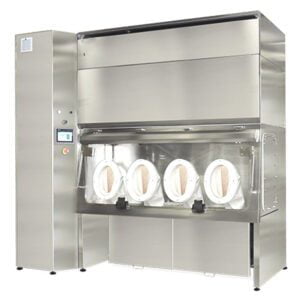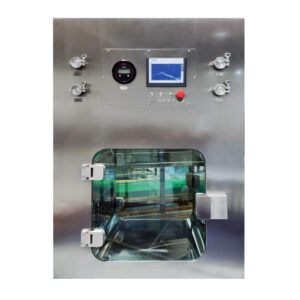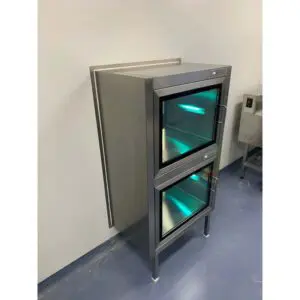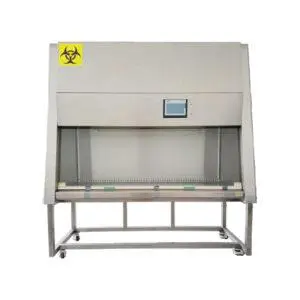
For professionals specifying cleanroom equipment, the ISO 14644-1 classification is the non-negotiable starting point. Yet, many procurement decisions treat it as a simple label, overlooking its profound mathematical and operational implications. This misstep leads to costly over-specification or, worse, non-compliant installations that jeopardize product integrity and regulatory approval.
The strategic importance of this standard has intensified. Global supply chains demand universal fluency, while evolving regulatory frameworks like EU GMP Annex 1 layer additional requirements onto the ISO baseline. Selecting equipment is no longer just about fitting a room; it’s about engineering a controlled ecosystem where every component supports the target cleanliness class.
The Core Principles of ISO 14644-1 Classification
A Mathematical Foundation for Cleanliness
The ISO 14644-1 standard is built on a precise logarithmic formula: Cn = 10^N × (0.1 / D)^2.08. This establishes that each increment in the ISO class number (N) represents a tenfold increase in the maximum allowable particle concentration (Cn) for a given particle size (D). This isn’t an arbitrary scale; it’s a rigorous engineering framework that dictates the entire contamination control strategy.
The Exponential Cost of Cleanliness
The logarithmic relationship has a direct, exponential impact on capital and operational expenditure. Achieving a cleaner class requires a step-change in engineering. Moving from an ISO 7 to an ISO 5 environment, for instance, isn’t a 20% increase in effort—it demands air change rates that jump from approximately 50 to over 400 per hour, alongside vastly more sophisticated filtration and airflow control. This principle makes the target ISO class the primary driver of your project’s financial and technical intensity from day one.
Understanding the ISO 14644-1 Classification Table
From Formula to Actionable Limits
The classification table translates the core formula into practical, enforceable limits for equipment specification and room validation. It defines the maximum permissible particles per cubic meter for each ISO class at specified particle size thresholds, most commonly ≥0.5 µm and ≥5.0 µm. For example, an ISO 5 cleanroom must not exceed 3,520 particles ≥0.5 µm per cubic meter. This quantitative benchmark is the definitive target for all integrated cleanroom equipment performance.
Evolving Validation Strategies
While the table provides the limits, the methodology for verifying them is evolving. A purely geometric sampling grid is no longer sufficient in highly regulated environments. Under frameworks like GMP, a science-based risk assessment now dictates particle counter placement. This means focusing on areas of highest contamination risk, such as near fill lines or critical equipment surfaces, rather than just statistically representative locations. In my experience, this shift demands early collaboration between quality, engineering, and validation teams to define these critical zones before equipment is even installed.
The Quantitative Benchmark
The following table provides the definitive particle concentration limits that form the basis of all cleanroom and equipment specification.
| ISO Class | Max Particles (≥0.5 µm/m³) | Max Particles (≥5.0 µm/m³) |
|---|---|---|
| ISO 5 | 3,520 | 29 |
| ISO 6 | 35,200 | 293 |
| ISO 7 | 352,000 | 2,930 |
| ISO 8 | 3,520,000 | 29,300 |
| ISO 9 | 35,200,000 | 293,000 |
Source: ISO 14644-1:2015. This standard defines the maximum allowable particle concentrations for each ISO class at specified particle sizes, providing the quantitative benchmarks for cleanroom classification and equipment specification.
How ISO Classes Relate to Legacy Standards (FS 209E)
Navigating a Dual-System Environment
Despite ISO 14644-1 being the global standard, the legacy U.S. Federal Standard 209E remains in common parlance, creating persistent market friction. Professionals must maintain fluency in both to avoid specification errors, especially in global supply chains where documentation may reference either system. Equivalencies are approximate but essential for communication.
The Regulatory Overlay
The ISO classification is often just the foundation. Regulated industries impose additional strata of requirements. For pharmaceutical manufacturing, standards like EU GMP Annex 1: Manufacture of Sterile Medicinal Products map its own Grades (A-D) onto ISO classes, adding critical mandates for microbial monitoring, occupancy states, and gowning. Specifying equipment for an ISO 5 room is different from specifying it for a Grade A zone, even though they share a cleanliness baseline—the latter carries the full weight of GMP compliance.
Mapping the Standards
This table clarifies the approximate equivalencies between the dominant standards, which is crucial for interpreting legacy specifications and regulatory documents.
| ISO 14644-1 Class | FS 209E Equivalent | Key Regulatory Overlay Example |
|---|---|---|
| ISO 5 | Class 100 | EU GMP Grade A |
| ISO 6 | Class 1,000 | EU GMP Grade B |
| ISO 7 | Class 10,000 | EU GMP Grade C |
| ISO 8 | Class 100,000 | EU GMP Grade D |
Note: FS 209E uses particles per cubic foot; equivalencies are approximate.
Source: EU GMP Annex 1: Manufacture of Sterile Medicinal Products. This guideline maps its own cleanliness grades (A-D) onto ISO classes, adding requirements for microbial monitoring and occupancy states, which is critical for pharmaceutical equipment specification.
Cleanroom Occupancy States: As-Built, At-Rest, In-Operation
Three States of Control
ISO 14644-1 defines three distinct occupancy states for classification, each representing a different challenge level. As-Built certifies the empty room. At-Rest includes equipment installed and operating but without personnel. In-Operation is the ultimate test, with full production activity and personnel present. Equipment performance is formally validated in the At-Rest state but must be designed to survive the In-Operation reality.
The Human Factor
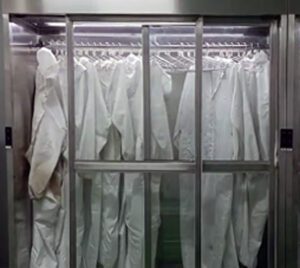
The transition from At-Rest to In-Operation highlights the dominant contamination source: human operators. People constantly shed skin particles and microbes. Consequently, the investment in high-grade air handling and advanced filtration systems must be matched by ancillary investments in garment systems, rigorous gowning protocols, and airlock design. The cleanest equipment is undermined by poor procedural controls.
Defining the Challenge States
Understanding these states is fundamental to setting realistic performance expectations for both the room and the equipment within it.
| Occupancy State | Personnel & Activity | Primary Contamination Source |
|---|---|---|
| As-Built | Empty room, no activity | Construction & equipment installation |
| At-Rest | Equipment installed and running | Equipment operation |
| In-Operation | Full production with personnel | Human operators (skin particles) |
Source: ISO 14644-1:2015. The standard defines these three states for classification, establishing that equipment performance is validated in the “At-Rest” state and critically challenged in the “In-Operation” state.
Key Design Criteria for ISO-Compliant Cleanroom Equipment
Materials and Surfaces
The target ISO class dictates every material choice. Surfaces must be smooth, non-shedding, and easily cleanable. Electropolished 304 or 316 stainless steel is the benchmark for critical applications. The design must eliminate particle traps—rounded corners, minimal seams, and a lack of ledges are non-negotiable features that support effective sanitization.
Minimizing Generated Contamination
Equipment must be engineered to minimize its own particle generation. This requires sealed bearings, non-volatile lubricants, and motors designed for cleanroom use. Furthermore, the equipment’s form factor must not disrupt the unidirectional or laminar airflow patterns that sweep contamination away from critical zones. A bulky machine can create turbulent eddies that compromise local cleanliness.
Principles for Integration
Adhering to these core design principles ensures equipment supports, rather than sabotages, the cleanroom environment.
| Design Principle | Material Example | Critical Feature |
|---|---|---|
| Non-shedding surfaces | 304/316 Stainless steel | Smooth, electropolished finish |
| Design for cleanability | Rounded corners | Minimal ledges and seams |
| Minimal particle generation | Sealed bearings | Non-volatile lubricants |
| Airflow compatibility | Low-profile design | No disruption to laminar flow |
Source: Technical documentation and industry specifications.
Verification, Monitoring, and Maintaining ISO Compliance
Certification vs. Continuous Control
Initial certification is a discrete event proving the integrated system (room + equipment) meets the target class at a defined state. However, compliance is dynamic, not permanent. There is a strategic imperative for continuous environmental monitoring with networked particle counters to provide real-time assurance that the operational environment remains in control.
The Hidden Operational Cost
Organizations often budget for the capital cost of certification but underestimate the ongoing operational burden. Maintaining compliance requires dedicated labor for data review, investigation of excursions, and periodic requalification. This complexity is driving growth in specialized service verticals—outsourcing monitoring and compliance to expert providers can be a strategic decision that allows internal teams to focus on core production.
Selecting Equipment Based on Your Target ISO Class
Matching Performance to Class
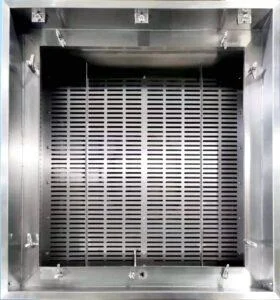
Equipment selection is a primary cost-control lever. For ISO 7/8 applications, standard cleanroom-grade materials and basic sealing may suffice. For ISO 5/6 environments, equipment often requires integrated HEPA filtration units or custom shrouding to maintain local unidirectional airflow and protect the critical process. The performance requirement escalates sharply with each cleaner class.
The Strategic Value of Modularity
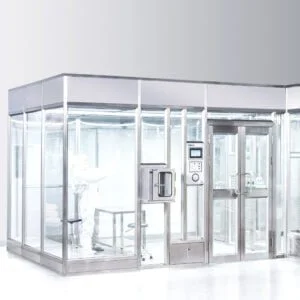
Given the steep cost curve, modularity has emerged as a key strategic flexibility lever. Modular cleanrooms and mobile equipment carts allow for rapid reconfiguration and scalability. For R&D, pilot plants, or fast-evolving industries like medtech, this approach reduces long-term capital risk and accelerates iteration, providing crucial agility.
Integration Needs by Class
This guideline helps align equipment specifications with the practical demands of different cleanliness levels.
| Target ISO Class | Air Change Rate (approx.) | Equipment Integration Need |
|---|---|---|
| ISO 7 | ~50 per hour | Standard cleanroom-grade materials |
| ISO 6 | ~90 per hour | Enhanced sealing, smooth surfaces |
| ISO 5 | >400 per hour | Integrated HEPA or custom shrouding |
Source: Technical documentation and industry specifications.
Integrating Equipment into Your Cleanroom Contamination Strategy
Holistic System Thinking
The final step is integrating each piece of equipment into a holistic Contamination Control Strategy (CCS). Placement must avoid airflow disruption. Maintenance and cleaning protocols must be as rigorously designed as the equipment itself. The cleanroom is the core of a broader controlled ecosystem that includes personnel, materials, and procedures.
Cleanliness as a Competitive Advantage
Beyond compliance, cleanliness is becoming a qualifiable product feature and a market differentiator. Case studies in precision manufacturing show that certification to a specific ISO class is used in marketing to justify price premiums and secure contracts in demanding sectors like aerospace and advanced electronics. Investing in a higher classification or rigorously validating an existing one can transform a compliance cost into a tangible competitive advantage.
The primary decision is defining your target ISO class, as it locks in the project’s technical and financial trajectory. From there, equipment selection becomes an exercise in matching particulate performance, material science, and airflow compatibility to that target. Finally, view compliance not as a one-time certificate but as a continuous operational state requiring dedicated monitoring and a holistic strategy that encompasses people, processes, and hardware.
Need professional guidance to specify equipment that meets your exact ISO classification and regulatory requirements? The experts at YOUTH can help you navigate the technical landscape from specification through to validation, ensuring your cleanroom ecosystem performs as designed. For a detailed consultation on your project parameters, you can also Contact Us.
Frequently Asked Questions
Q: How does the ISO 14644-1 classification formula impact cleanroom design costs?
A: The standard’s logarithmic formula means each step to a cleaner ISO class permits ten times fewer particles, driving an exponential increase in engineering requirements. For example, moving from ISO 7 to ISO 5 can require air change rates to jump from roughly 50 to over 400 per hour, demanding more advanced filtration and energy. This means facilities targeting a cleaner class must budget for significantly higher capital expenditure and operational intensity from the start of facility planning.
Q: What is the strategic difference between initial certification and ongoing ISO 14644-1 compliance?
A: Initial certification verifies your integrated cleanroom and equipment meet the target class at a defined occupancy state, but it is a single event. Maintaining compliance requires continuous daily particle monitoring with installed systems to ensure the operational environment stays in control. This creates a strategic need to budget for permanent monitoring hardware, software, and operational labor for data review, not just the one-time certification test.
Q: How do regulatory standards like EU GMP Annex 1 build upon the basic ISO 14644-1 classification?
A: While ISO 14644-1 provides the foundational air cleanliness classes, regulations like EU GMP Annex 1 layer additional mandatory requirements onto that baseline. For sterile manufacturing, Annex 1 maps its Grades A-D to ISO classes and adds specific mandates for microbial monitoring limits, occupancy states, and a holistic Contamination Control Strategy. This means specifying equipment requires mapping its performance to both the target ISO class and the precise regulatory overlay of your industry.
Q: Why are the three occupancy states (As-Built, At-Rest, In-Operation) critical for equipment selection?
A: These states define when classification is measured, directly linking equipment to operational risk. Your equipment must perform without degrading the environment from the “At-Rest” to the “In-Operation” state, where personnel are the primary particle source. This highlights that equipment must be designed to minimize its own particle generation from motors and moving parts. For projects where operational uptime is critical, you should validate equipment performance under the “In-Operation” condition to ensure it supports your target class during production.
Q: What are the key design features for ISO-compliant cleanroom equipment?
A: Compliant equipment uses smooth, non-shedding materials like 316 stainless steel and features designs for easy cleanability with rounded corners and minimal ledges. It must also minimize airflow disruption and particle generation, often requiring sealed bearings and non-volatile lubricants in moving parts. This means procurement should favor suppliers who understand these criteria as part of an integrated controlled ecosystem, not just as standalone hardware, to reduce compatibility risks.
Q: When selecting equipment, how does modularity provide a strategic advantage?
A: Modular cleanroom equipment and mobile units offer reconfigurable and scalable solutions, which is crucial given the steep cost curve of achieving cleaner ISO classes. This flexibility allows for rapid adaptation to process changes or new product lines without major capital investment in fixed infrastructure. For R&D, pilot plants, or fast-moving sectors like medtech, investing in modularity reduces long-term capital risk and accelerates time-to-market.
Q: How should particle counter placement for validation move beyond a simple geometric grid?
A: Modern practice, especially under GMP, requires placement based on a formal risk assessment of areas with the highest contamination risk to the product, such as near critical equipment surfaces. This shifts validation from a purely statistical exercise to a science-based activity focused on product protection. This means your quality and engineering teams must collaborate to define these critical zones before testing begins.
Related Contents:
- ISO 14644 Cleanroom Equipment Standards | Compliance Guide
- ISO 14644-1 Laminar Air Flow Compliance
- ISO 14644 and GMP Compliance Standards for Cleanroom Equipment: Complete Certification Requirements and Testing Protocols
- LAF Garment Cabinets: Meeting ISO 14644 Standards
- ISO 14644 Cleanroom Air Filter Standards | Compliance Guide
- GMP Compliant Air Filters | FDA Requirements Cleanroom Validation
- Medical Device Cleanroom Equipment | ISO Class Requirements
- ISO 14644 Air Filter Standards | Regulatory Compliance Guide
- Biosafety Passboxes: Meeting ISO 14644 Standards