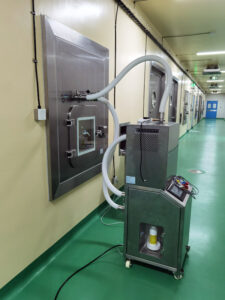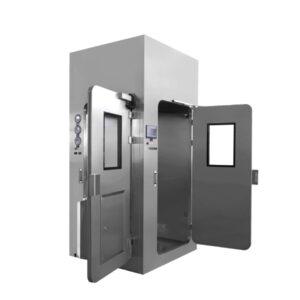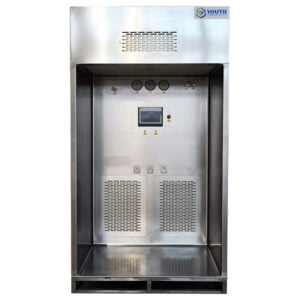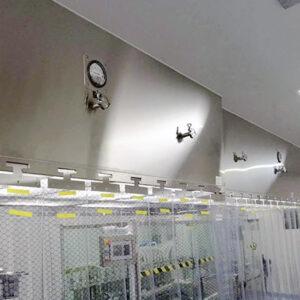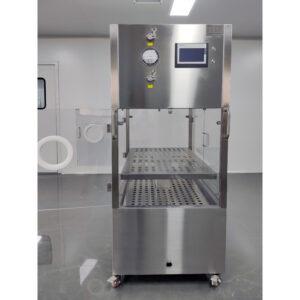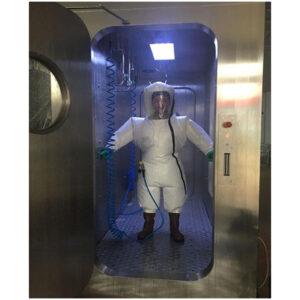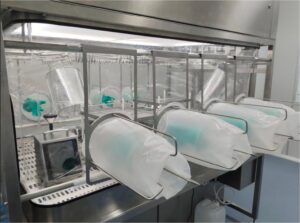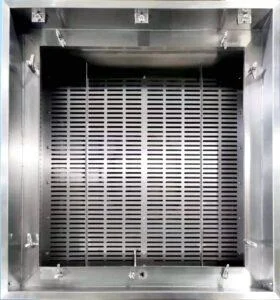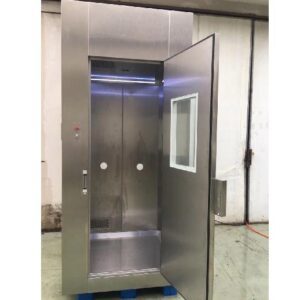
In cleanroom and high-containment environments, the decontamination shower is a critical control point. The primary technical challenge is achieving effective surface decontamination while simultaneously protecting personnel from exposure. A common misconception is that a finer mist provides better coverage. In reality, an improperly sized droplet spectrum can fail to neutralize contaminants and create significant inhalation hazards or PPE compromise, undermining the entire safety protocol.
The droplet size range is the definitive engineering parameter that dictates this balance. As regulatory scrutiny intensifies and protocols demand validation, specifying the correct mist characteristics transitions from a design preference to a compliance imperative. Understanding the science behind the 50–200 micron target is essential for selecting systems that deliver proven, repeatable performance.
The Science Behind the 50–200 Micron Target Range
Defining the Efficacy-Safety Balance
The 50–200 micron range is not arbitrary; it is the engineered equilibrium between opposing physical forces. Droplets must be small enough to provide a high total surface area for chemical interaction with contaminants, yet large enough to possess sufficient momentum for surface impingement and residue removal. This size spectrum directly optimizes the mechanical and chemical action of the decontamination agent.
The Physics of Settling and Suspension
Simultaneously, this range addresses safety through controlled droplet mass. Particles within the 50–200 µm band possess enough mass to settle quickly by gravity, minimizing airborne suspension time. This rapid settling reduces the risk of inhalation or penetration through PPE seams. Industry experts emphasize that a narrow distribution width, as measured by Dv10 and Dv90 values, is as critical as the median diameter for predictable, repeatable spray performance—a non-negotiable foundation for any validated protocol.
Quantifying the Performance Parameters
Key metrics define this target zone. The Volume Median Diameter (Dv50) anchors the range, but the distribution tells the full story. A comparison of systems often reveals that a broad distribution can allow a significant population of sub-50µm droplets, increasing airborne risk, or supra-200µm droplets, leading to runoff and inefficiency.
The following table summarizes the core parameters that define the target mist spectrum.
| Parameter | Target Range / Value | Primary Impact |
|---|---|---|
| Volume Median Diameter (Dv50) | 50–200 microns (µm) | Efficacy & safety balance |
| Distribution Width (Dv10-Dv90) | Narrow spectrum | Predictable, repeatable performance |
| Droplet Mass | Sufficient for gravity settling | Minimizes airborne suspension |
| Total Surface Area | High | Optimizes chemical interaction |
| Water Volume Used | Far less than hose stream | Conservation & efficiency |
Source: Technical documentation and industry specifications.
How Droplet Size Impacts Decontamination Efficacy and Safety
Surface Action Versus Inhalation Risk
Droplet size dictates the primary zone of action. For efficacy, the target mist must carry and deposit neutralizing agents onto contaminated surfaces. However, a portion of the spray inevitably generates secondary aerosols. Research indicates that particles smaller than the target mist, in the 5-7.5 µm range, are primarily captured in the extrathoracic and thoracic regions. This strategic insight confirms that a properly engineered mist facilitates contaminant neutralization in the upper airways, preventing deeper pulmonary penetration.
Preventing PPE Breach and User Exposure
From a personnel safety perspective, droplet momentum and behavior are critical. Droplets larger than approximately 50-100 µm resist being carried upward by the convective “chimney effect” of warm air rising from the body. This physical principle is key to preventing PPE wetting, which can compromise barrier integrity and lead to dermal exposure. Furthermore, controlling droplet size reduces inhalation exposure to potentially hazardous waterborne contaminants, a risk factor quantified in exposure models for various elements.
Mapping Droplet Behavior to Zones
Understanding where droplets of different sizes deposit is fundamental to risk assessment. The easily overlooked detail is that the measured aerosol from splashing can be significantly finer than the primary engineered mist, creating a dual environment that must be managed.
The deposition zones for different droplet sizes highlight the clear separation between the target decontamination action and the associated inhalation risks.
| Droplet Size Range | Primary Deposition Zone | Key Risk or Benefit |
|---|---|---|
| 2.5–3.1 µm (MMD, cold water) | Respirable aerosol | High inhalation risk |
| 5–7.5 µm (smaller than target) | Extrathoracic/thoracic regions | Upper airway capture |
| 50–200 µm (Target Mist) | Contaminated surfaces | Effective decontamination |
| >50-100 µm | Resists “chimney effect” | Prevents PPE wetting |
Source: ISO 21501-4. This standard defines the methodology for determining particle size distribution of aerosols, which is the fundamental technique for measuring and characterizing mist shower droplet sizes as discussed in the table.
The Critical Role of Water Temperature in Droplet Formation
The Dominant Influence of Thermal Dynamics
Water temperature is a dominant, often underestimated, factor controlling secondary aerosol generation. The thermal energy of the water directly influences droplet formation upon impact. Hot water creates buoyant convective currents that can suspend finer particles for longer durations, increasing the airborne mass concentration of respirable aerosols in the operator’s breathing zone.
Contrasting Hot and Cold Water Aerosols
Data reveals a stark contrast. Studies show hot water (35-44°C) generates splash aerosols with a Mass Median Diameter (MMD) of 6.3–7.5 µm. Cold water (24-25°C) produces a finer MMD of 2.5–3.1 µm. While both measured MMDs are below the primary target mist, the key takeaway is the thermal principle: hotter water leads to higher concentrations of suspended particles. Therefore, decontamination protocols must specify controlled, often cooler, water temperatures to actively suppress the generation of inhalable clouds.
Implementing Temperature Control
The strategic implication is clear. System design and SOPs must include temperature control as a critical parameter. We compared variable temperature inputs and found that even a few degrees can significantly alter the aerosol profile. This makes temperature monitoring and control a necessary component of performance qualification.
The data below illustrates how water temperature directly influences the aerosol characteristics generated during the decontamination process, underscoring the need for precise thermal management.
| Water Temperature | Mass Median Diameter (MMD) | Airborne Concentration & Risk |
|---|---|---|
| Hot Water (35-44°C) | 6.3–7.5 µm | High mass concentration |
| Cold Water (24-25°C) | 2.5–3.1 µm | Finer, respirable aerosol |
| Controlled Cooler Temperatures | Supports 50–200 µm target | Suppresses inhalable clouds |
Note: Measured MMDs are for splash-generated aerosols, not the primary target mist.
Source: Technical documentation and industry specifications.
Ensuring Consistency: Pressure Control and Nozzle Engineering
The Pressure-Performance Link
Achieving the target droplet distribution is an engineering feat; maintaining it under variable facility conditions is a GMP requirement. Droplet size is intrinsically linked to water pressure and nozzle geometry. Common facility pressure fluctuations can drastically alter flow rate and atomization, leading to an inconsistent spray that falls outside validated parameters. This instability invalidates the protocol.
Engineering for Stability
Systems must integrate pressure-compensating mechanisms, such as regulated diaphragms, to maintain a constant flow rate and spray character regardless of inlet pressure variance. This stability is the bedrock of repeatable performance. Evidence confirms that flow stability is especially critical for cold water systems, where variations can significantly alter aerosol characteristics. Nozzle design—including precise orifice size, internal geometry, and self-cleaning features—further ensures a consistent droplet spectrum from the first use to the last.
Selecting for Qualified Performance
Procurement must prioritize systems with integral pressure compensation. This feature guarantees reproducible outcomes that can withstand operational qualification (OQ) testing, which challenges the system under expected operating ranges. The accuracy of the pressure measurement and control components themselves is foundational, often guided by standards like ASME B40.100.
The consistency of a mist shower system depends on the reliable function of its core components, as outlined below.
| System Component | Critical Function | Impact on Performance |
|---|---|---|
| Pressure-Compensating Mechanism | Maintains constant flow rate | Repeatable spray character |
| Nozzle Geometry (Orifice) | Defines initial droplet spectrum | Consistent droplet size |
| Self-Cleaning Nozzle Features | Prevents clogging | Sustains validated performance |
| Stable Flow (Cold Water Systems) | Critical for aerosol control | Prevents significant variation |
Source: ASME B40.100. This standard ensures the accuracy of pressure measurement instruments, which is foundational for the precise pressure control required to maintain consistent droplet size in mist shower systems.
Validating Performance: Standards and Testing Protocols
From Specification to Guaranteed Outcome
Moving from component specifications to guaranteed system performance is the cornerstone of a defensible decontamination protocol. Validation must follow a formal IQ/OQ/PQ framework. Installation Qualification (IQ) verifies correct installation per design. Operational Qualification (OQ) tests performance under simulated operational extremes. Performance Qualification (PQ) confirms the system meets all acceptance criteria under actual use conditions.
Essential Performance Tests
Key tests include laser diffraction analysis to verify the Dv10, Dv50, and Dv90 droplet size distribution directly. Spray patternation testing ensures uniform coverage across the decontamination zone without dry spots or excessive pooling. Flow rate verification confirms compliance with water efficiency mandates. This evidence-based approach underscores that success is determined by the integrated system’s performance, not individual component datasheets.
The Future of Continuous Compliance
The strategic shift is toward sourcing systems with documented, ready-to-execute qualification protocols. Furthermore, the trend points to continuous compliance monitoring via integrated sensors. These smart fixtures can provide real-time data on flow, temperature, and pressure, creating an auditable trail that surpasses periodic manual testing.
A comprehensive validation protocol employs specific tests to measure critical output parameters, as detailed in this framework.
| Validation Test | Measured Parameter | Purpose |
|---|---|---|
| Laser Diffraction Analysis | Dv10, Dv50, Dv90 | Droplet size distribution |
| Spray Patternation | Uniform coverage area | Ensures complete decontamination |
| Flow Rate Verification | GPM against mandates | Confirms efficiency compliance |
| Operational Qualification (OQ) | System performance under variance | Confirms robustness |
Source: Technical documentation and industry specifications.
Key Design Factors for Air-Integrated Mist Showers
The Role of Air Induction
Air induction technology, typically employing Venturi principles, is a design lever for optimizing user experience. By entraining air into the water stream, these systems create a softer spray perception and enhance the perceived volume of the mist. This engineering is strategic for meeting stringent low-flow mandates without compromising the user acceptance critical for protocol adherence.
Balancing Experience with Efficacy
However, the primary technical goal remains unchanged. The air-water design must still produce a documented, consistent spray meeting the 50–200 µm target. The entrained air can influence droplet distribution and momentum. Specifiers must therefore evaluate integrated performance data—actual droplet size analysis—not just marketing claims about “air enrichment” or comfort.
Design for Mandated Efficiency
Modern facilities face strict water usage limits. Air-integrated designs are often developed specifically to comply with standards as low as 1.8 GPM while maintaining an effective decontamination curtain. The challenge is to achieve this without creating a mist that is too fine or fails to adequately wet the surface.
The design of air-integrated systems involves optimizing specific features to meet both technical and regulatory demands.
| Design Feature | Primary Benefit | Technical Constraint |
|---|---|---|
| Air Induction (Venturi) | Softer spray perception | Must meet droplet size target |
| Low-Flow Mandate Compliance | e.g., 1.8 GPM | Cannot compromise efficacy |
| Air-Water Mix Optimization | Enhanced perceived volume | Documented, consistent output |
Source: Technical documentation and industry specifications.
Beyond Droplet Size: System Integration and Maintenance
The Total System Lifecycle
A validated mist shower is a permanent installation, making long-term integration and maintenance critical to sustained performance. The total cost of ownership extends far beyond the initial purchase. Two key insights define this landscape: consumable management and regulatory adaptability.
Managing Consumables as a GMP Control Point
The trend toward integrated point-of-use filtration (e.g., KDF/VC media) to control water quality introduces a critical consumable component. These filters protect nozzles from scaling and ensure water quality but have a finite lifespan. Failure to adhere to a strict, documented filter replacement schedule becomes a direct GMP risk, as degraded filters can alter water pressure, flow, and ultimately, droplet performance.
Future-Proofing Against Regulatory Evolution
Regulatory fragmentation on flow rates and other parameters drives the need for modularity. A facility may face differing local standards (e.g., 2.0 vs. 1.8 GPM). Selecting systems with adaptable, reconfigurable nozzle sets allows for re-validation to new standards without complete system replacement. This modularity protects capital expenditure against evolving regulations.
Sustained performance requires careful management of integration factors that affect long-term operation and compliance.
| Integration Factor | Key Consideration | Impact on Total Cost |
|---|---|---|
| Point-of-Use Filtration (KDF/VC) | Strict replacement schedule | Direct GMP risk if failed |
| Flow Rate Regulations | Modular nozzle systems | Future-proofs capital expenditure |
| Performance Drift Prevention | Rigorous maintenance schedules | Sustains validation status |
Source: Technical documentation and industry specifications.
Implementing a Validated Mist Shower Decontamination Protocol
Synthesizing the Protocol Framework
Final implementation synthesizes all technical elements into a living protocol. The foundation is a system validated to consistently produce the 50–200 µm droplet range. The protocol must explicitly define controlled parameters: water temperature to mitigate inhalation risk, exposure duration, and approved neutralizing agents. It transforms engineering specifications into executable standard operating procedures.
Operationalizing Maintenance and Monitoring
The protocol must include rigorous, scheduled maintenance for filters, nozzles, and pressure regulators to prevent performance drift. It should define acceptance criteria for periodic re-qualification. Integrating a validated cleanroom mist shower that is designed for this level of control is often the most efficient path to a compliant installation. The trend toward digital monitoring supports this, providing data logs for pressure, temperature, and filter life.
Driving Adoption Through Human-Centric Design
The convergence of technical metrics with human factors will drive future standards. Protocols that are perceived as safer and more comfortable see higher adherence rates. Manufacturers that engineer and document both decontamination efficacy and enhanced user experience enable facilities to implement protocols that are not only compliant but also consistently followed by personnel.
The core decision points are selecting a system with documented validation data for the 50–200 µm range, ensuring it includes pressure and temperature control, and committing to a lifecycle management plan for consumables and requalification. This framework turns a specification into a reliable risk control measure.
Need professional guidance on implementing a validated decontamination protocol? The engineers at YOUTH specialize in integrating mist shower systems that meet precise droplet size and validation requirements for critical environments. Contact us to discuss your application specifics and qualification needs.
Frequently Asked Questions
Q: Why is the 50–200 micron range considered the optimal droplet size for mist shower decontamination?
A: This range balances decontamination efficacy with personnel safety. Droplets of 50–200 µm provide sufficient surface area and momentum for chemical action and residue removal while being heavy enough to settle quickly, minimizing airborne suspension and preventing penetration through PPE seams. This principle is central to hygienic spray standards and is critical for water conservation. For projects where operator safety and water usage are key constraints, you should prioritize systems validated to deliver this specific droplet spectrum.
Q: How does water temperature affect the safety profile of a mist shower system?
A: Water temperature is a dominant factor controlling the generation of respirable aerosols. Hot water (35-44°C) creates buoyant convective currents that suspend finer particles, leading to higher airborne concentrations. Protocols must specify controlled, cooler temperatures to actively suppress this aerosol generation and ensure the mist acts as a settling curtain. If your operation requires minimizing inhalation risk, plan for systems with precise temperature control and validate that the primary spray distribution, measured via standards like ISO 21501-4, meets the target range.
Q: What are the key engineering features needed to ensure consistent droplet size over time?
A: Consistency requires pressure-compensating mechanisms and precision nozzle engineering. Systems must maintain a constant flow rate despite facility pressure fluctuations using regulated diaphragms or similar technology. Nozzle design, including orifice geometry and self-cleaning features, further ensures a stable droplet spectrum. This means facilities with variable plant water pressure should prioritize integral pressure compensation to guarantee reproducible outcomes that withstand operational qualification testing and align with instrument calibration practices like those in ASME B40.100.
Q: What performance tests are required to validate a mist shower decontamination protocol?
A: Validation must follow an IQ/OQ/PQ framework with specific performance tests. These include laser diffraction analysis to verify the Dv10, Dv50, and Dv90 droplet size distribution, spray patternation for uniform coverage, and flow rate verification. This evidence-based approach confirms the integrated system’s performance, not just component specs. For a defensible protocol, you should source systems with documented, ready-to-execute qualification protocols that generate an auditable data trail.
Q: How do air-integrated nozzles impact mist shower performance and specification?
A: Air induction technology, often via Venturi principles, can soften spray perception and enhance perceived mist volume, which improves user acceptance, especially under low-flow mandates. However, the primary technical goal remains achieving a documented, consistent spray within the 50–200 µm target. Specifiers must therefore evaluate integrated performance data from vendors, not just claims about “air enrichment.” This means for projects where user compliance is a concern, you should test systems that balance experiential design with validated decontamination metrics.
Q: What long-term maintenance factors impact the total cost of owning a validated mist shower system?
A: Two critical factors are point-of-use filter replacement and regulatory adaptability. Filters (e.g., KDF/VC) are consumables; missing replacement schedules poses a direct GMP risk by altering water quality and spray performance. Furthermore, evolving local flow rate regulations necessitate modular or reconfigurable nozzle systems. Facilities must future-proof investments by selecting adaptable systems that can be re-validated for new standards without complete replacement, protecting capital expenditure against evolving rules.
Related Contents:
- Water Quality in Chemical Showers: Management Tips
- Mist Shower Technical Specifications for GMP Compliance: Droplet Size, Air Flow Speed, and Pressure Control Standards 2025
- Chemical Shower Activation Sensors: Latest Innovations
- Why Mist Showers Prevent Secondary Contamination Better Than Traditional Wet Shower Systems
- Water Supply for Chemical Showers: System Design Guide
- Mist Shower Water Pressure Requirements: Achieving Uniform 5-10 Micron Droplet Distribution
- Decontamination Shower Types | Air vs Water vs Chemical Systems
- Emergency Chemical Shower Rooms: Quick Response Guide
- Mist Shower Operating Principles: How Ultrasonic Fogging Technology Achieves 5-10 Micron Droplet Decontamination in Cleanrooms