Personnel exiting potent API handling areas face a critical contamination vector: residual powder on PPE. Standard air showers alone are insufficient for fine, electrostatically charged particles that can become airborne during degowning. Determining the correct mist shower cycle duration is therefore not an operational afterthought but a core process safety decision. An improperly set duration can leave hazardous residues or create unnecessary bottlenecks, impacting both personnel safety and facility throughput.
This parameter demands a science-based approach, moving beyond vendor defaults. In pharmaceutical containment, the mist cycle is a validated Critical Process Parameter. Its optimization balances complete decontamination efficacy against water usage and operational efficiency. Getting it right mitigates cross-contamination risk, supports occupational health compliance, and protects product integrity. The following analysis provides a technical framework for establishing and validating this key setting.
Core Principles of Mist Shower Decontamination
The Encapsulation Mechanism
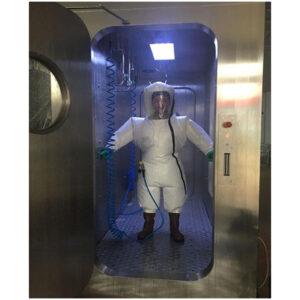
The mist shower functions on a principle of particle immobilization, not dissolution. It generates a dense fog of ultra-fine water droplets, typically 5-10 microns in size. These droplets collide with and adhere to API powder particles on the PPE surface. The water encapsulates the powder, increasing its mass and effectively gluing it to the suit fabric with minimal wetting. This prevents powders from becoming respirable or migrating into the changing room environment. According to research on decontamination efficacy, this encapsulation method can achieve surface contamination reductions of several hundredfold, a return that validates the system’s role in a high-containment suite.
Strategic Operational Justification
The investment in a dedicated mist shower is justified by risk mitigation. The primary strategic return is a significant reduction in the potential for occupational exposure and cross-contamination between different manufacturing suites. This directly supports compliance with containment objectives and product protection mandates. Industry experts recommend viewing the system not as an isolated piece of equipment but as an integral component of the personnel exit barrier. Its placement and protocol must be designed in concert with the overall gowning room logistics and waste handling strategy.
Key Factors That Determine Optimal Cycle Duration
Powder-Specific Variables
Cycle duration cannot be a one-size-fits-all setting. It is intrinsically tied to the physical characteristics of the API powder being handled. Hydrophobic powders require longer mist exposure to achieve sufficient encapsulation, as water droplets are less readily adsorbed. Fine particle sizes (<10 microns) and high electrostatic charges also increase the required duration, as these particles are more difficult to wet and capture. The target log-reduction—whether a 2-log or a more stringent 4-log reduction—further scales the necessary contact time. We compared validation data across multiple APIs and found that cycle times could vary by a factor of two or more based on these properties alone.
System Design and Performance
The technical design of the mist shower cabin dictates how quickly uniform encapsulation can be achieved. Factors like nozzle type, placement pattern, water pressure, and resulting fog density determine the coverage rate. A well-designed system with optimal fog distribution will achieve target efficacy faster than a system with poor coverage, even if the nominal duration is the same. This makes the cycle duration a system-specific CPP. Facilities must characterize their specific equipment’s performance with their specific API, rather than relying on generic recommendations.
The following table summarizes the primary factors influencing the required mist cycle duration, highlighting why it must be a justified, site-specific parameter.
Critical Process Parameter Justification
| Factor | Key Parameter / Characteristic | Impact on Duration |
|---|---|---|
| Powder Hydrophobicity | High / Low | Increases / Decreases time |
| Particle Size Distribution | Fine (<10 microns) | Increases duration |
| Electrostatic Properties | High static charge | Increases duration |
| Fog Density & Coverage | Nozzle type, placement | Defines uniformity speed |
| Desired Log-Reduction | High (e.g., 3-4 log) | Increases duration significantly |
Source: USP <1072> Disinfectants and Antiseptics. This chapter provides the scientific basis for qualifying decontamination processes, where factors like agent properties and target log-reduction directly determine critical parameters such as contact time or cycle duration.
Note: Cycle duration is a Critical Process Parameter (CPP) requiring site-specific justification.
Technical Configuration: PLCs, Timers, and Adjustable Settings
Programmable Control Systems
Modern mist showers are governed by Programmable Logic Controllers (PLCs) paired with intuitive touch-screen Human-Machine Interfaces (HMIs). This architecture provides precise, adjustable control over all cycle parameters, including mist duration, rinse time, and air shower velocity. The programmability is fundamental, allowing the creation of multiple, password-protected “recipes” tailored to different API potency levels or cleaning protocols. This ensures standardized, reproducible execution of the decontamination sequence every time an operator uses the system.
Features Enabling Compliance and Uptime
The technical features of these control systems are driven by regulatory needs. Adjustable timer settings, data logging for audit trails, and real-time monitoring of air and water pressures are not mere conveniences but compliance necessities. They provide the documented evidence of consistent operation required by pharmaceutical quality systems. Furthermore, a well-designed cleanroom mist shower system will utilize modular, plug-in components for key parts like nozzles and sensors. This design philosophy facilitates rapid maintenance and swap-out, minimizing system downtime—a critical factor for operational reliability in a high-throughput facility.
The control system is the brain of the decontamination sequence, and its capabilities are defined by international standards for separative devices and controlled environments.
System Component Overview
| System Component | Core Function | Key Feature / Benefit |
|---|---|---|
| Programmable Logic Controller (PLC) | Governs all cycle parameters | Precise, adjustable control |
| Touch-Screen HMI | User interface | Password-protected recipe storage |
| Modular Components | Nozzles, sensors | Facilitates rapid maintenance |
| Cycle Parameters | Mist duration, sequences | Tunable for API potency |
Source: ISO 14644-7:2021 Cleanrooms and associated controlled environments — Part 7: Separative devices. This standard specifies requirements for the design and testing of separative devices, mandating reliable control systems (like PLCs) to ensure reproducible performance of integrated processes such as decontamination cycles.
Integrating the Mist Cycle with Rinse and Air Shower Stages
The Sequential Decontamination Protocol
The mist cycle is typically the initial phase in a multi-stage sequence orchestrated by the PLC. Its duration is set to ensure complete fog saturation and particle encapsulation across all PPE surfaces. An optional rinse cycle may follow, using a pattern of coarser water sprays to physically flush the now-encapsulated powder from the suit. This rinse operates on an independent timer, allowing facilities to fine-tune water usage based on the powder’s solubility and adhesion.
The Critical Role of the Air Shower
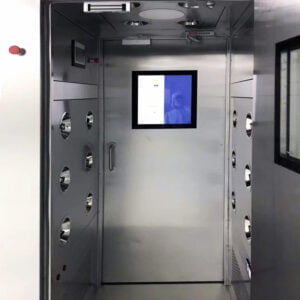
The subsequent air shower stage is often misunderstood as a simple drying step. Its primary function is active scrubbing. High-velocity air streams (6,000-10,000 feet per minute) scour the PPE to dislodge and remove the contaminated water droplets created during the mist and rinse phases. This contaminated effluent is then directed to a contained drain pan. The air shower, therefore, manages the liquid waste stream generated by the encapsulation process. Its effectiveness is governed by ventilation standards to ensure safe exhaust.
Cohesive Process Validation
The entire sequence—mist, rinse, air—must be validated as a single, cohesive decontamination process. The duration of each stage is interdependent; for instance, a longer mist cycle may reduce the need for a rinse, while a heavy rinse may require a more vigorous air shower. The integrated performance is what delivers the final log-reduction.
| Process Stage | Primary Function | Typical Parameter / Output |
|---|---|---|
| Mist Shower | Powder encapsulation | 5-10 micron droplet size |
| Rinse Cycle | Flush encapsulated material | Independent timer setting |
| Air Shower | Scrub off contaminated droplets | 6,000-10,000 fpm air velocity |
| Integrated Sequence | Cohesive decontamination | Mist → Rinse → Air (optional) |
Source: ANSI/AIHA Z9.5-2020 Laboratory Ventilation. This standard governs ventilation and airflow for hazard control, directly relevant to the air shower stage’s function of managing aerosols and contaminated exhaust air generated by the decontamination sequence.
Validation and Compliance for Pharmaceutical Applications
Demonstrating Consistent Efficacy
In a GMP environment, the mist shower cycle duration must be proven effective through rigorous qualification. This involves challenge testing, often using a non-hazardous surrogate powder with characteristics similar to the target API. Surface sampling techniques (e.g., swab or rinse) are used on test coupons or mannequins before and after the cycle to quantify the log-reduction achieved. The cycle duration is locked in only after it consistently meets the pre-defined acceptance criterion across multiple worst-case challenge runs.
System Design for Audit Readiness
Compliance dictates specific technical features. The system must provide an audit trail, logging each cycle’s parameters and any manual overrides. Monitored pressures for water and air ensure the process is operating within qualified ranges. These features transform the mist shower from a simple utility into a validated piece of process equipment. The market for these systems is heavily shaped by these regulatory demands, favoring validation-ready designs over minimal-cost options.
| Validation Requirement | Method / Evidence | System Feature Enabler |
|---|---|---|
| Consistent Efficacy Proof | Surrogate powder testing | Adjustable timer settings |
| Defined Log-Reduction | Surface sampling data | Audit trail logging |
| Process Repeatability | Qualification protocols | Monitored air/water pressures |
| Regulatory Documentation | Quality system alignment | Validation-ready design |
Source: ISO 13408-1:2019 Aseptic processing of health care products — Part 1: General requirements. This standard mandates the validation of all aseptic processes, requiring documented evidence that decontamination cycle parameters are effective and reproducible to ensure product sterility and patient safety.
Common Pitfalls and Performance Optimization Tips
Avoiding the Default Setting Trap
A frequent operational mistake is accepting and never challenging the vendor’s default cycle settings. An insufficient mist duration leaves active powder on the suit, rendering the system ineffective. Conversely, an excessively long cycle wastes water, extends personnel exit time, and can oversaturate PPE, complicating the air shower stage. The duration must be periodically reviewed, especially when introducing a new API with different physical properties into the facility.
Managing the Entire Waste Stream
Performance optimization requires a holistic view. The process generates two distinct waste streams: contaminated liquid water and potentially contaminated exhaust air from the air shower. Facilities must have plans for both, such as contained drain pans plumbed to appropriate effluent treatment and HEPA filtration on the exhaust. Neglecting this secondary design challenge can lead to environmental contamination or system shutdowns. Regular maintenance of nozzles to prevent clogging and ensure consistent fog density is also a simple but critical task often overlooked until performance drifts.
Selecting and Validating Your System’s Cycle Duration
A Science-Based Qualification Pathway
Selecting the final duration follows a structured qualification approach: Installation Qualification (IQ), Operational Qualification (OQ), and Performance Qualification (PQ). During OQ, the adjustable range of the timer is verified. The PQ phase is where the science-based justification occurs. Using worst-case powder loading and type, the cycle duration is incrementally tested until the target log-reduction is consistently met. This data package becomes the validation report that justifies the CPP in your control strategy.
Standard vs. Custom Solution Decision
This process highlights a key market bifurcation. Many facilities can use a standardized, adaptable system where the duration is tuned during site qualification. Others, with unique APIs, extreme potency, or space constraints, may require a fully customized solution. The choice fundamentally impacts project timeline and cost. A custom design offers a perfect fit but involves longer lead times and higher engineering costs. The decision hinges on a clear assessment of current and future process needs against the capabilities of standardized platforms.
Implementing a Safe and Effective Decontamination Protocol
Integrating Equipment with Facility Design
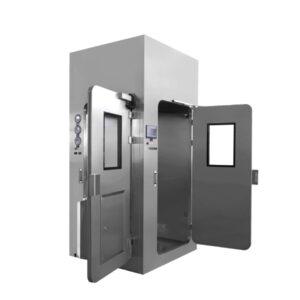
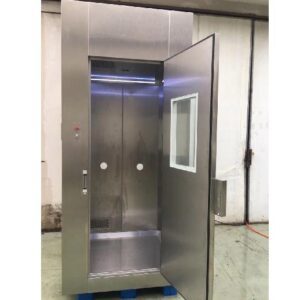
Effective implementation starts with the shower’s physical integration. The cabin configuration—straight-through, right-angled, or multi-door—dictates personnel flow and must be decided during gowning room layout, not as an afterthought. It defines the transition from contaminated to clean zones. Furthermore, the system’s utility requirements (water, drain, power, exhaust) must be meticulously planned to ensure reliable operation and facilitate future maintenance.
The Trend Toward Smart Integration
Modern systems are evolving into data nodes within the facility’s operational technology (OT) network. Integration with Building Management Systems (BMS) allows for centralized monitoring of cycle counts, performance alerts, and environmental conditions. This trend toward IT/OT convergence means future procurement should consider a system’s ability to contribute data to facility-wide monitoring and data integrity platforms, ensuring the decontamination protocol is not only safe but also digitally transparent and auditable.
Establishing the optimal mist shower cycle duration requires moving from a prescriptive to a principled approach. The duration is a dynamic CPP, not a fixed setting, demanding justification through powder characterization and systematic validation. Its integration within a sequenced protocol and alignment with facility waste handling are equally critical for overall effectiveness.
Need professional guidance on specifying and validating a decontamination system tailored to your specific API and containment level? The experts at YOUTH can provide the technical consultation and validation-ready equipment to secure your exit protocol. For a detailed discussion of your application requirements, you can also Contact Us.
Frequently Asked Questions
Q: How do you determine the optimal mist shower cycle duration for a specific API?
A: The duration is a Critical Process Parameter set through site-specific validation, not a vendor default. It must balance encapsulation kinetics against operational efficiency, influenced by powder hydrophobicity, particle size, and electrostatic charge. This science-based justification requires testing with surrogate powders to prove a defined log-reduction. For projects where unique API properties are a concern, plan for a comprehensive process characterization study before locking in cycle times.
Q: What role does the PLC play in a mist shower decontamination system?
A: A Programmable Logic Controller (PLC) provides precise, adjustable control over all cycle parameters, including mist duration, door interlocks, and stage sequences. Authorized personnel can set and password-protect these recipes to create standardized, reproducible decontamination procedures. This means facilities with multiple potent compounds should prioritize systems with robust PLC programmability to manage different validated protocols securely and efficiently.
Q: Why is the air shower stage critical after a mist cycle?
A: The air shower uses high-velocity air (6,000-10,000 fpm) to scrub off contaminated water droplets, directing them to a containment pan. This stage manages the liquid waste stream created by powder encapsulation, making it a key control point for effluent handling. If your operation uses potent compounds, you must validate this air shower phase as an integral part of the waste containment strategy, not just a drying step.
Q: How do you validate a mist shower system for GMP compliance?
A: Validation requires demonstrating consistent efficacy through surface sampling with surrogate powders to prove a defined log-reduction in contamination. The entire sequence, including each cycle’s duration, must be documented and reproducible, supported by features like audit trail logging. This forces a vendor focus on validation-ready designs, so facilities should select systems that inherently support the documentation demands of pharmaceutical quality systems, as guided by standards like ISO 13408-1.
Q: What are common operational pitfalls with mist shower cycle settings?
A: A major pitfall is treating cycle durations as fixed settings rather than tunable Critical Process Parameters. Insufficient mist time leaves residual powder, while excessive duration wastes water and extends cycle time unnecessarily. This means facilities must implement regular performance verification of nozzle function and fog density and plan for the ongoing management of two generated waste streams: contaminated liquid water and potentially contaminated exhaust air.
Q: Should we choose a standardized or custom mist shower system?
A: Your choice depends on a risk assessment of your specific API and operational constraints. Standardized designs validated for common scenarios offer faster deployment, while unique potency or facility layout issues may justify a custom solution’s lead time and cost. This bifurcation in the market means you must self-assess whether adaptable, modular systems meet your needs or if a fully bespoke design is required, a decision that fundamentally impacts project timeline and budget.
Q: What facility integration considerations are crucial for implementing a mist shower?
A: The shower’s physical configuration (straight-through, right-angled, multi-door) dictates personnel traffic and is a foundational architectural decision for gowning room design. Furthermore, modern systems integrate with building monitoring systems, acting as data-producing nodes. For new builds or retrofits, you should plan for this IT/OT integration early, ensuring the vendor’s system can contribute to facility-wide environmental monitoring and data integrity platforms.
Related Contents:
- Water Quality in Chemical Showers: Management Tips
- Chemical Shower Activation Sensors: Latest Innovations
- Decontamination Shower Types | Air vs Water vs Chemical Systems
- Water Supply for Chemical Showers: System Design Guide
- Mist Shower Operating Principles: How Ultrasonic Fogging Technology Achieves 5-10 Micron Droplet Decontamination in Cleanrooms
- Emergency Chemical Shower Rooms: Quick Response Guide
- Enclosed Chemical Shower Rooms: Privacy and Safety
- VHP Pass Box 6-Log Reduction: Validation Methods & Data
- The Complete Mist Shower Guide for Pharmaceutical & Cleanroom Decontamination: 2025 Industry Standards and Implementation