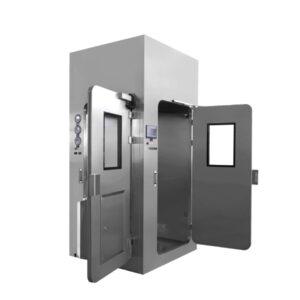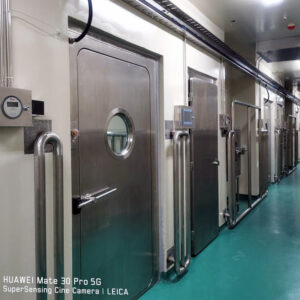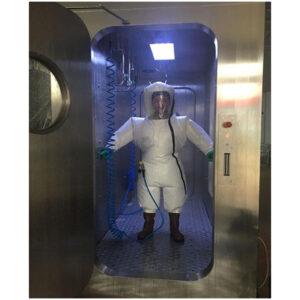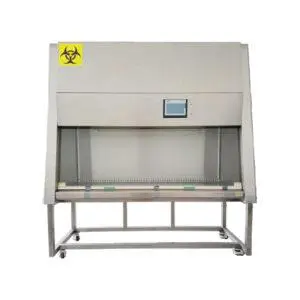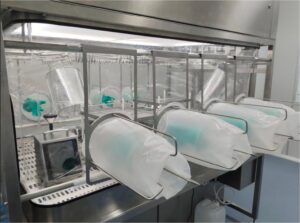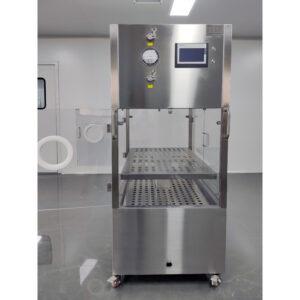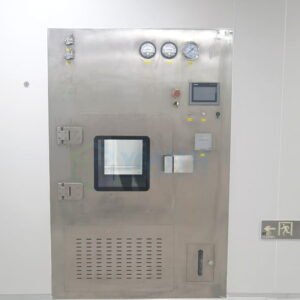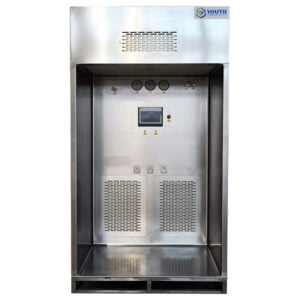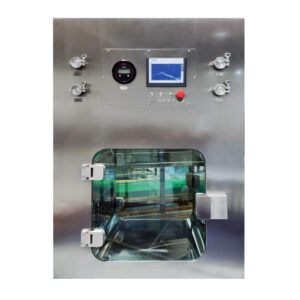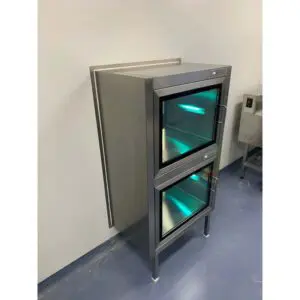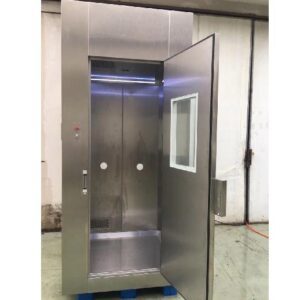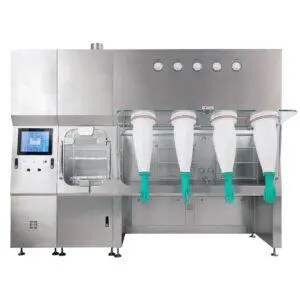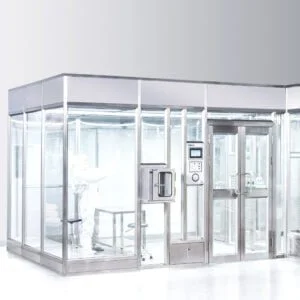
In sterile manufacturing, material transfer between cleanrooms presents a persistent contamination risk. Traditional methods rely heavily on manual procedures, introducing variability and documentation gaps. Vaporized Hydrogen Peroxide (VHP) pass box technology addresses this by automating a validated decontamination process directly within the transfer hatch. This transforms a simple physical barrier into an active, data-driven control point.
The regulatory landscape, particularly Annex 1’s emphasis on unidirectional flow and contamination control, demands deterministic solutions. VHP pass boxes provide a documented, repeatable sterilization cycle that hardwires compliance into the material transfer workflow. Understanding the technology’s principles, validation requirements, and operational nuances is critical for implementing a reliable barrier that supports product quality and regulatory standing.
How VHP Pass Boxes Achieve Sterilization: Core Principles
The Chemical Mechanism of Action
VHP achieves surface sterilization through low-temperature chemical oxidation. The antimicrobial efficacy stems from vaporized hydrogen peroxide generating hydroxyl free radicals. These radicals destroy essential cell components of microorganisms, including lipids, proteins, and DNA. This mechanism is effective against even resistant bacterial spores at ambient temperatures, making it ideal for heat-sensitive materials and components. The process leaves no toxic residue after proper aeration, only water vapor and oxygen.
Defining the 6-Log Reduction Standard
The core performance objective is a validated 6-log reduction, equating to a 99.9999% kill rate. This provides a sterility assurance level (SAL) of 10⁻⁶, meaning there is a less than one in one million chance of a single viable microorganism surviving on a treated item. This level of assurance is required for aseptic processing areas and critical transfers. It transforms the pass box from a passive transfer point into a critical physical and procedural barrier to enforce unidirectional material flow, directly addressing Annex 1 requirements. In my experience, facilities that treat the pass box as a validated sterilization process, not just a cabinet, see a marked reduction in environmental monitoring excursions at transfer points.
The Role as a Compliance Hardwire
By automating the kill process, VHP technology embeds compliance into the physical infrastructure. The system’s interlocked doors and programmed cycles remove operator discretion from the decontamination step. This reduces reliance on manual SOPs for wipe-downs and mitigates a major contamination vector. The generated cycle data provides objective evidence of each transfer event, shifting the quality assurance paradigm from periodic checks to continuous verification.
Key Components of a VHP Pass Box System
Chamber Construction and Material Science
The foundation is an airtight chamber designed for containment and cleanability. Construction from 316L stainless steel with polished, coved interiors is an active contamination control strategy. This material resists corrosion from oxidizing H₂O₂ and provides a smooth surface that denies microbial habitats. Inferior materials can degrade or absorb sterilant, creating an unvalidatable risk and compromising long-term performance. The chamber must maintain integrity throughout pressure differentials experienced during the vacuum or pulsed cycles common in VHP processes.
Integrated Sterilant Generation and Destruction
A dedicated VHP generator flash-vaporizes pharmaceutical-grade liquid H₂O₂ (typically 30-35% concentration). The distribution system, often a series of nozzles or a manifold, ensures even vapor dispersion throughout the chamber volume. Equally critical is the integrated catalytic aeration system. This component breaks down residual sterilant to safe levels (<1 ppm) post-cycle, which is a non-negotiable safety feature for operator protection. The efficiency of this system directly impacts chamber turnaround time.
Control and Air Handling Architecture
A Programmable Logic Controller (PLC) manages the entire decontamination sequence, from leak testing to final purge. Modern PLCs are 21 CFR Part 11-ready, making data integrity a core product feature with audit trails and electronic signatures. This shifts the validation evidence burden from the user to the equipment’s inherent design. A dedicated HEPA-filtered air handling unit maintains ISO Class 5 conditions within the chamber before and after the cycle, protecting the load.
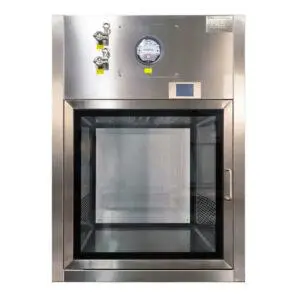
The table below details the primary subsystems and their functions.
Core System Architecture
| Component | Primary Function | Key Specification / Feature |
|---|---|---|
| Airtight Chamber | Contains VHP process | 316L stainless steel, coved interior |
| VHP Generator | Produces sterilant vapor | Flash-vaporizes 30-35% H₂O₂ |
| Catalytic Aeration System | Removes residual sterilant | Reduces H₂O₂ to <1 ppm |
| Air Handling Unit | Maintains chamber cleanliness | HEPA filtration (ISO Class 5) |
| Programmable Logic Controller (PLC) | Manages automated cycle | 21 CFR Part 11-ready data logging |
Source: ISO 14644-7: Cleanrooms and associated controlled environments — Part 7: Separative devices (clean air hoods, gloveboxes, isolators and minienvironments). This standard establishes core requirements for the design and performance of separative devices like pass boxes, directly governing the airtight integrity, material construction, and HEPA-filtered air supply critical to these components.
The Standardized VHP Decontamination Cycle Explained
Phase 1: Preparation and Conditioning
The validated cycle is a deliberate, automated sequence. It begins with a leak test to ensure chamber integrity, followed by a pre-conditioning phase. Dehumidification is critical here; reducing relative humidity enhances subsequent microbiocidal activity by preventing H₂O₂ condensation and ensuring proper vapor distribution. This phase sets the initial environmental conditions within the chamber, directly impacting the consistency of the gassing phase that follows.
Phase 2: Gassing, Dwell, and Aeration
The conditioning (gassing) phase injects VHP to a target concentration (often 1-2 mg/L). The system then maintains this concentration for a validated exposure time during the decontamination (dwell) phase. This is the critical microbiocidal period. The subsequent aeration phase catalytically removes residual H₂O₂ to below the 1 ppm safety threshold. Finally, a laminar flow purge re-establishes a protective HEPA-filtered air curtain. This 5-stage cycle is a dependent sequence; shortcutting any stage jeopardizes the 6-log claim and operator safety.
Cycle as a Data Node
The process exemplifies how the system functions as a connected data node. Real-time parameters—H₂O₂ concentration, pressure, temperature, humidity—are logged by the PLC. This data feeds into facility monitoring systems for predictive analytics and compliance dashboards, providing traceability for every item transferred. The cycle’s reproducibility is its greatest asset, eliminating the variability inherent in manual transfer methods.
The defined phases of a standard VHP cycle are outlined below.
The Five-Stage Process
| Process Phase | Core Objective | Critical Parameter / Action |
|---|---|---|
| Leak Test & Pre-conditioning | Ensures seal integrity, reduces humidity | Chamber dehumidification |
| Conditioning (Gassing) | Achieves target sterilant concentration | VHP injection to setpoint |
| Decontamination (Dwell) | Maintains microbiocidal conditions | Validated exposure time |
| Aeration | Breaks down residual vapor | Catalytic reduction to <1 ppm |
| Laminar Flow Purge | Re-establishes protective air barrier | HEPA-filtered air curtain |
Source: ISO 14937: Sterilization of health care products — General requirements for characterization of a sterilizing agent and the development, validation and routine control of a sterilization process for medical devices. This standard provides the framework for developing and validating a sterilization process, mandating the defined, controlled phases (like conditioning, exposure, and aeration) and critical parameter monitoring essential for a reliable VHP cycle.
Validating 6-Log Reduction: Methods and Standards
The Biological Indicator Challenge
Validation proves the system reliably achieves an SAL of 10⁻⁶. The definitive test is the Biological Indicator (BI) Challenge. Carriers inoculated with a known population of Geobacillus stearothermophilus spores (typically 10⁶) are placed in worst-case locations within the chamber, such as behind items or at the air return. A successful 6-log reduction is confirmed by no BI growth after incubation post-cycle. This biological challenge is the ultimate proof of efficacy.
Supporting Physical and Chemical Evidence
Chemical indicators provide a routine qualitative check for each cycle, showing exposure to sterilant via a color change. However, they do not prove lethality. Physical parameter mapping—verifying uniform H₂O₂ concentration, humidity, and temperature across the entire chamber volume—is essential. This data demonstrates the process was delivered consistently to all areas, supporting the BI results. We compared validation reports from multiple vendors and found the depth of this spatial mapping data is a key differentiator in assessing protocol robustness.
The Validation Lifecycle (IQ/OQ/PQ)
The entire validation lifecycle must be documented. Installation Qualification (IQ) verifies correct installation. Operational Qualification (OQ) confirms the system operates according to functional specifications. Performance Qualification (PQ) proves efficacy, challenging the system with the maximum intended load. Suppliers now compete on total cost of compliance, bundling pre-validated cycles and turnkey qualification services to reduce the customer’s hidden implementation and audit preparation costs.
A comprehensive validation approach incorporates multiple methods, as summarized in the table.
Comprehensive Validation Framework
| Validation Method | Purpose / Challenge | Success Criteria / Indicator |
|---|---|---|
| Biological Indicator (BI) Challenge | Definitive efficacy proof | No growth of G. stearothermophilus |
| Chemical Indicators | Routine qualitative check | Visual color change |
| Physical Parameter Mapping | Ensures uniform chamber conditions | H₂O₂ concentration, humidity, temperature |
| Installation Qualification (IQ) | Verifies correct installation | Documentation of setup |
| Operational Qualification (OQ) | Verifies functional performance | System meets operational specs |
| Performance Qualification (PQ) | Verifies efficacy with specific load | Achieves 6-log reduction on maximum load |
Source: ISO 14937: Sterilization of health care products — General requirements for characterization of a sterilizing agent and the development, validation and routine control of a sterilization process for medical devices. This standard outlines the comprehensive validation lifecycle (IQ/OQ/PQ) and mandates the use of biological indicators and physical parameter monitoring to substantiate the claimed sterility assurance level (SAL) of 10⁻⁶.
Operational Features and Critical Safety Considerations
Engineered Safety Interlocks
Electromagnetic door interlocking is fundamental. It physically prevents both doors from opening simultaneously, enforcing one-way flow and containing the vapor. The cleanroom-side door remains locked until aeration is complete and safe conditions (<1 ppm H₂O₂) are verified by integrated sensors. This interlock is a fail-safe mechanism that must be tested regularly as part of preventative maintenance.
Monitoring and Alarm Systems
Real-time H₂O₂ concentration monitoring with audible and visual alarms is mandatory. Sensors should be placed at critical points, including the chamber interior and exhaust stream. These systems protect operators from accidental exposure. Furthermore, AI integration, through image recognition or RFID tracking of loads, is shifting critical control from human procedures to automated systems. This reduces error in load logging and inspection, elevating overall quality system robustness.
Maintenance and Change Control
Routine maintenance of the catalytic destruct system, HEPA filters, and vaporizer is crucial for consistent performance. Any change to the load configuration, cycle parameters, or chamber interior (e.g., adding new shelving) requires a formal change control assessment and likely re-qualification. Treating the VHP pass box as a validated process means understanding that operational changes have direct validation implications.
Material Compatibility and Load Configuration for VHP
Assessing Material Suitability
While VHP is compatible with most metals and many polymers, its oxidizing nature requires pre-testing. Certain plastics (e.g., polycarbonate can cloud), elastomers, sensitive electronics, and instruments with tight tolerances may be degraded. A material compatibility study should be conducted for any novel or sensitive item before routine processing. This is a non-negotiable step in process development.
The Impact of Load Design
Load configuration directly impacts validation. Perforated shelves or racks are essential to ensure vapor penetration and prevent shadowing. Items should be arranged to minimize surface contact and allow free vapor circulation. Crucially, validation is specific to the load type and arrangement. The Performance Qualification (PQ) must challenge the maximum intended load in its worst-case configuration. This underscores that the pass box is validated as a process, not just a cabinet.
Strategic Material Choices
The construction materials directly impact lifecycle and microbe habitat. The industry-standard choice of 316L stainless steel with electropolished finishes is strategic. It ensures long-term resistance to the corrosive sterilant environment, maintains cleanability, and supports a validatable state of control over the equipment’s lifespan. Compromising on chamber material is a high-risk decision.
Comparing VHP to Other Transfer & Decontamination Methods
Versus Thermal and Chemical Methods
VHP offers distinct advantages over alternatives. Compared to dry heat ovens or autoclaves, VHP operates at low temperatures, preserving heat-sensitive materials like plastics and single-use assemblies. Versus manual chemical wipe-downs, it provides an automated, validated, and reproducible process with full documentation, eliminating operator variability and the risk of human error in technique or documentation.
Versus Alternative Gaseous and Radiation Methods
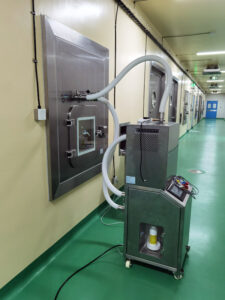
UV light pass boxes lack the penetrative ability and consistent kill rate of VHP, especially in shadowed areas or on irregular surfaces. Other gaseous methods, like chlorine dioxide, may have more restrictive material compatibility or require more complex neutralization. The emergence of mobile VHP trolleys further differentiates the technology by decoupling sterilization from fixed infrastructure, enabling flexible deployment and retrofitting.
The table below provides a direct comparison of common transfer decontamination methods.
Method Comparison Analysis
| Method | Key Advantage | Primary Limitation |
|---|---|---|
| VHP Pass Box | Automated, validated 6-log reduction | Material compatibility testing required |
| Dry Heat / Autoclave | High penetrative power, robust validation | High temperature damages heat-sensitive items |
| Chemical Wipe-Down | Low initial cost, simple | Operator-dependent, no automated documentation |
| UV Light Pass Box | No chemical residue, dry process | Poor penetration, shadowing effects |
| Mobile VHP Trolley | Flexible deployment, retrofittable | Decoupled from fixed air handling |
Source: Technical documentation and industry specifications.
Selecting and Implementing a VHP Pass Box: Key Criteria
Technical and Compliance Evaluation
Selection requires evaluating technical, compliance, and strategic factors. Technically, assess chamber size, cycle time, material compatibility, and aeration efficiency. Compliance-wise, prioritize data integrity features (audit trails, electronic signatures) and the availability of validation support services. The supplier’s ability to provide a complete validation package significantly impacts the total cost of ownership and speed to operational use.
Choosing an Operational Model
Strategically, decide between a fixed infrastructure model for high-throughput dedicated lines or a flexible service model using mobile units for agile, multi-product facilities. This reflects a market bifurcation and must align with long-term operational philosophy. Fixed units offer higher integration with facility BMS and potentially faster cycles, while mobile units provide flexibility for campaign-based manufacturing or facility upgrades.
Future-Proofing the Investment
Furthermore, consider interoperability with digital plant ecosystems. Future value lies in the equipment’s data output for predictive maintenance and overall equipment effectiveness (OEE) calculations. Finally, anticipate broader adoption by sterile non-pharma industries like advanced electronics and food, which may drive future innovation and cost variations.
The final selection should be guided by a multi-faceted decision framework.
Implementation Decision Framework
| Evaluation Category | Key Technical/Compliance Criteria | Strategic Consideration |
|---|---|---|
| Technical Performance | Chamber size, cycle time, aeration efficiency | Throughput vs. agility needs |
| Compliance & Validation | 21 CFR Part 11 data integrity, validation support | Total cost of compliance (TCO) |
| Operational Model | Fixed infrastructure integration | Dedicated high-throughput lines |
| Operational Model (Alt.) | Mobile, flexible deployment | Multi-product, agile facilities |
| Future-Proofing | Interoperability with digital ecosystems | Data output for predictive analytics |
Source: Technical documentation and industry specifications.
Implementing a VHP pass box system is a strategic decision that hardwires contamination control into material transfer workflows. The priority is selecting a system whose validation rigor matches your product risk, with data integrity features that simplify audit readiness. The operational model—fixed or mobile—must align with facility design and production agility requirements.
Need professional guidance on integrating a validated decontamination process into your cleanroom material flow? The experts at YOUTH specialize in engineered contamination control solutions, including advanced sterilization and transfer hatch systems. Contact our technical team to discuss your specific application and validation requirements.
Frequently Asked Questions
Q: How do you validate that a VHP pass box achieves a true 6-log reduction?
A: Validation requires a multi-faceted approach combining biological and physical challenges. The definitive test uses biological indicators (BIs) with Geobacillus stearothermophilus spores placed in worst-case locations, with no growth confirming the kill rate. This is supported by detailed mapping of physical parameters like H₂O₂ concentration and temperature across the chamber volume. For a compliant installation, you must execute a full IQ/OQ/PQ lifecycle, where the framework for process validation is guided by standards like ISO 14937. This means your validation protocol should be designed and documented from the start, not treated as an afterthought.
Q: What are the critical safety features to look for in a VHP pass box system?
A: Mandatory safety features include electromagnetic door interlocks to enforce unidirectional flow and contain vapor, and a catalytic aeration system that reduces residual H₂O₂ to below 1 ppm before door release. Real-time H₂O₂ concentration monitoring with alarms is also essential for operator safety. This engineering directly supports containment requirements outlined in standards for separative devices like ISO 14644-7. If your facility handles potent compounds, prioritize these fail-safe mechanical and monitoring features over systems relying solely on procedural controls.
Q: How does material compatibility impact the validation and use of a VHP pass box?
A: VHP’s oxidizing nature can degrade certain plastics, elastomers, and sensitive electronics, so material pre-testing is a necessary step. Crucially, your performance qualification (PQ) must be executed with the maximum intended load and its specific configuration, as validation is tied to the process, not just the empty cabinet. This means you should finalize your standard transfer items early in the procurement process to ensure your validation scope is accurate and to avoid costly re-qualification later.
Q: Why is 316L stainless steel construction specified for VHP pass box chambers?
A: This material is an active contamination control strategy. 316L stainless steel resists corrosion from hydrogen peroxide and its polished, coved interior surfaces deny microbial habitats, which is fundamental for maintaining a cleanable and validatable environment. Using inferior materials creates an inherent risk that cannot be fully mitigated through procedures. For long-term operational integrity and audit readiness, you should view the chamber material as a non-negotiable specification, not just a cost item.
Q: How does a VHP pass box’s automated cycle enforce compliance compared to manual wipe-downs?
A: The automated, multi-stage cycle provides a reproducible and fully documented decontamination process, eliminating the variability inherent in manual chemical wiping. It functions as a connected data node, logging all critical parameters (time, concentration, temperature) to provide objective evidence of each cycle’s execution. This transforms the pass box from a passive transfer point into a deterministic barrier that hardwires compliance. If your goal is to reduce human error and strengthen your quality system’s data integrity, automated VHP offers a significant advantage over manual methods.
Q: What are the key decision factors when choosing between a fixed VHP pass box and a mobile unit?
A: Your choice hinges on throughput needs versus operational flexibility. Fixed systems are ideal for dedicated, high-throughput lines requiring constant material transfer. Mobile VHP trolleys offer agile deployment for multi-product facilities or retrofits, decoupling sterilization from fixed infrastructure. This reflects a strategic bifurcation: you must decide if your operational philosophy values predictable, integrated workflow or adaptable, service-based decontamination capacity.
Related Contents:
- VHP Pass Box Aeration Systems: Complete Technology Guide
- VHP Pass Box 6-Log Reduction: Validation Methods & Data
- VHP Pass Box Validation: IQ/OQ/PQ Compliance Checklist
- VHP Pass Box Market Forecast: 2025-2030 Growth Analysis
- Optimal VHP Concentrations: Sterilization Efficiency Guide
- VHP vs Traditional Pass Boxes: Key Differences Compared
- Laboratory VHP Pass Box Applications: Research Best Practices
- VHP Pass Box: Definition & Core Functions Explained
- VHP-Compatible Materials: Comprehensive 2025 List