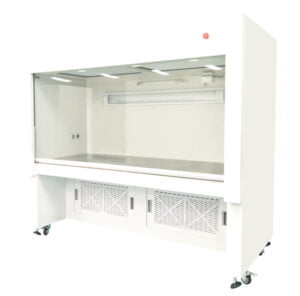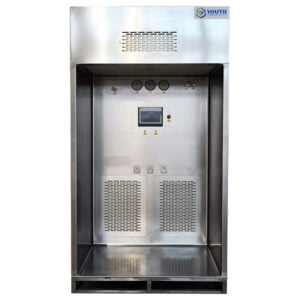
Designing and specifying cleanroom equipment is a high-stakes technical exercise. A single specification error can cascade into regulatory non-compliance, process contamination, or unsustainable operational costs. Professionals must navigate a complex matrix of international standards, application-specific regulations, and competing performance tiers, where the cost of over-engineering can rival the risk of under-specification.
The convergence of stricter global regulations and advanced manufacturing demands has made equipment selection more critical. The right specifications ensure not only initial certification but also long-term operational resilience, data integrity, and controlled total cost of ownership. This guide breaks down the core equipment categories and their performance parameters to inform confident, strategic decisions.
Understanding Cleanroom Classification Standards (ISO 14644-1)
The Foundation of All Specifications
Every cleanroom design and equipment specification originates from its target ISO classification. The ISO 14644-1 standard provides the universal language, defining maximum allowable concentrations of airborne particles per cubic meter. This classification is not a suggestion but a rigid performance envelope that dictates air change rates, filter efficiency, and monitoring requirements. Selecting an ISO Class 5 over a Class 7 environment fundamentally changes the project’s technical and financial scope.
From Standard to Strategic Segmentation
The industry has responded to this standardized framework by developing distinct equipment and construction tiers. We see a clear market segmentation serving the vastly different needs of semiconductor fabrication, pharmaceutical aseptic filling, and medical device assembly. This segmentation reveals that the initial classification choice is a strategic business decision. It locks in capital expenditure ranges and defines long-term operational complexity, making early alignment with production and quality teams essential.
A Practical Reference for Planning
The following table translates the ISO standard into actionable context for equipment planning. It connects the particulate limits to common industrial applications.
| ISO Class | Max Particles ≥0.5 µm/m³ | Typical Application |
|---|---|---|
| ISO 5 | 3,520 | Pharmaceutical filling |
| ISO 6 | 35,200 | Medical device assembly |
| ISO 7 | 352,000 | Pharmaceutical compounding |
| ISO 8 | 3,520,000 | Electronics manufacturing |
Source: ISO 14644-1: Cleanrooms and associated controlled environments — Part 1: Classification of air cleanliness by particle concentration. This foundational standard defines the airborne particulate cleanliness classes and their maximum allowable particle concentrations per cubic meter, which dictate the performance requirements for all cleanroom equipment.
HVAC System Design: Airflow, Pressurization, and Air Change Rates
The Engineered Lung of the Cleanroom
The HVAC system is the active contamination control engine. Its design parameters—air change rates (ACH), airflow patterns, and pressurization—are direct derivatives of the target ISO class. For stringent ISO Class 5 environments, ACH can exceed 600 per hour, requiring robust fan arrays and precise ductwork. Unidirectional (laminar) airflow protects critical zones like filling lines, while non-unidirectional patterns may suffice for less critical areas. The system must maintain stability against external and internal particle loads.
Pressurization as a Regulatory Directive
Room pressurization, typically maintained at 10-15 Pascals, controls the directional flow of air and potential contamination. This is where application-specific regulations take precedence. For example, USP-797 for non-hazardous drug compounding requires positive pressure to protect the product, while USP-800 for hazardous drugs mandates negative pressure to protect personnel. This single regulatory parameter creates two fundamentally different cleanroom architectural and HVAC designs. Overlooking this distinction guarantees a costly retrofit.
Key Design Parameters in Practice
HVAC specification requires balancing these interdependent parameters to achieve the target environment efficiently.
| Parameter | Typical Range | Key Determinant |
|---|---|---|
| Air Change Rate (ACH) | 10 to 600+ per hour | Target ISO Class |
| Room Pressurization | 10-15 Pascals | Contamination flow control |
| Airflow Pattern | Unidirectional or Non-unidirectional | Critical zone protection |
Source: Technical documentation and industry specifications. While specific design parameters are derived from ISO 14644-1, pressurization schemes are often mandated by application-specific regulations like USP-797 and USP-800 for pharmaceutical compounding.
HEPA vs. ULPA Filters: Efficiency, Specifications, and Selection
Defining the Final Barrier
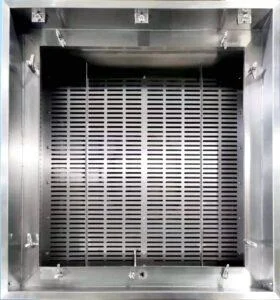
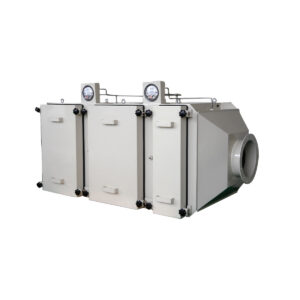
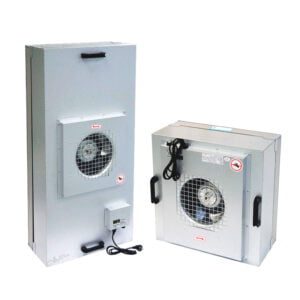
Final air cleanliness is achieved at the filter face. High-Efficiency Particulate Air (HEPA) and Ultra-Low Penetration Air (ULPA) filters are classified by standards like EN 1822. A HEPA filter (e.g., H13) must capture at least 99.95% of 0.3-micron test particles. A ULPA filter (e.g., U15) targets 99.9995% efficiency at 0.12 microns. Selection is not about “better” but “appropriate” for the ISO class and the size of contaminants relevant to the process.
The Selection Trade-Off: Efficiency vs. Pressure Drop
Higher efficiency filters present a higher resistance to airflow, increasing the static pressure load on the HVAC fans and energy consumption. The decision framework must weigh the required cleanliness level against acceptable operational costs. Furthermore, filter integrity is validated through in-situ leak testing (DOP/PAO testing), a non-negotiable part of commissioning and periodic recertification. In my experience, specifying filters with documented test reports from accredited labs avoids delays during validation.
Core Performance Specifications
The following table clarifies the fundamental efficiency thresholds that separate these filter classes.
| Filter Type | Minimum Efficiency | Test Particle Size |
|---|---|---|
| HEPA (H13) | 99.95% | 0.3 microns |
| ULPA (U15) | 99.9995% | 0.12 microns |
Source: EN 1822: High efficiency air filters (EPA, HEPA and ULPA). This European standard specifies the classification, performance testing, and marking requirements for high-efficiency particulate air filters, defining the critical efficiency thresholds for HEPA and ULPA filters.
Environmental Monitoring: Pressure, Particles, and Control Systems
The Network of Verification
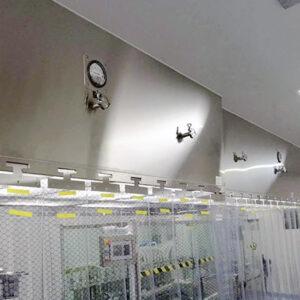
A cleanroom is only as good as its verification system. Continuous environmental monitoring provides the data to prove controlled conditions are maintained. This network includes differential pressure sensors for pressurization, airborne particle counters for ISO class compliance, and sensors for temperature and humidity. Data feeds into a Building Management System (BMS) for real-time control, alarm logging, and audit trails. This traceability is a core regulatory expectation.
The Convergence of Equipment and Data
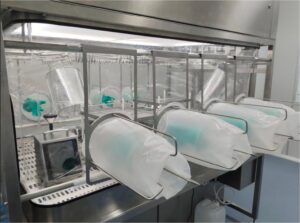
The role of monitoring is expanding. It’s no longer limited to the room environment. Modern production equipment, such as servo presses or filling machines, now embed sensors to document process parameters like force, speed, and time. This transforms standalone machinery into active quality assurance nodes within a broader data ecosystem. The strategic implication is clear: data integrity is now a mandatory performance feature across all cleanroom equipment, not just environmental monitors.
Material Transfer Equipment: Pass Boxes and Airlocks Explained
Isolating the Transfer Process
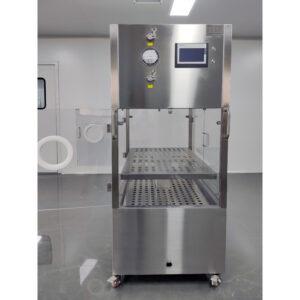
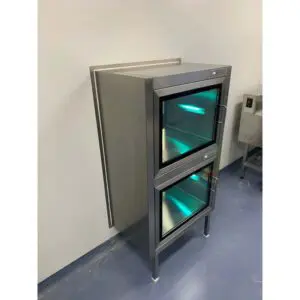
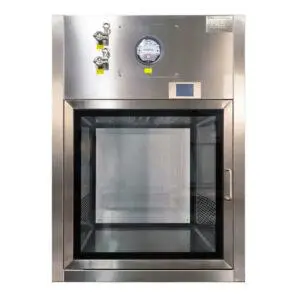
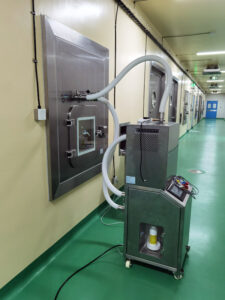
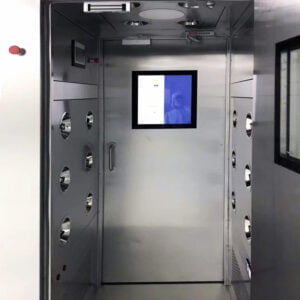
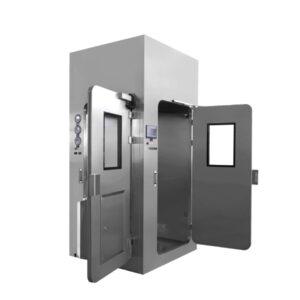
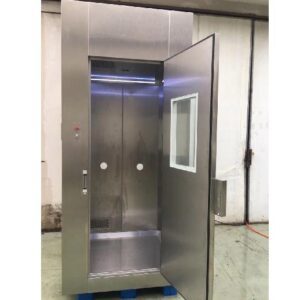
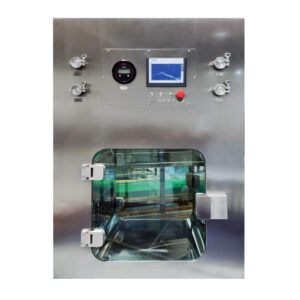
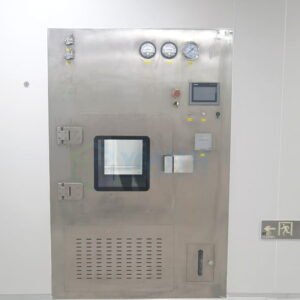
Materials and components must enter and exit without compromising cleanliness. Pass boxes and airlocks provide this isolation. Static pass boxes, for transfers between areas of equal classification, use interlocked doors to prevent both being open simultaneously. Dynamic pass boxes add HEPA-filtered purge cycles to decontaminate items moving from a lower to a higher classification area. The choice directly impacts contamination risk and workflow speed.
Understanding the Operational Burden
Dynamic pass boxes represent a significant recurring operational expense. Their HEPA filters and UV-C lamps require scheduled replacement, and their blower systems need verification. This creates a direct hierarchy of cost and maintenance: a dynamic unit is far more operationally intensive than a static one. Strategic process mapping is essential to specify the correct type at each transfer point, avoiding both contamination risk and unnecessary operational costs.
Cleanroom Construction: Wall, Ceiling, and Sealing Components
The Impervious Envelope
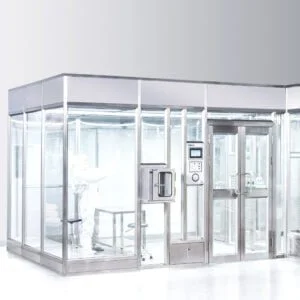
The cleanroom envelope must be non-particulating, non-porous, and easily cleanable. Modern panel systems use materials like powder-coated steel, fiberglass-reinforced plastic, or stainless steel. The critical factor is not just the material, but the design of the joint and sealing system. Any seam is a potential leak point for air and contamination. The industry trend is toward systems that minimize field-applied sealants, which are prone to human error and degradation.
The Shift to Integrated Sealing and Sustainable Specs
A key innovation is the move to pre-engineered sealing. For example, some cleanroom ceiling grid systems now feature integrated gaskets on grid members and wall angles. This eliminates the dependency on perfect field-applied caulking beads, reducing installation risk and improving long-term seal integrity. Furthermore, material selection is increasingly guided by sustainability. Manufacturers now provide EPDs and HPDs to meet corporate ESG goals, making environmental impact a new specification criterion.
Operational Protocols: Maintenance, Testing, and Decontamination
The Non-Negotiable Cost of Compliance
Sustained performance is impossible without rigorous protocols. Scheduled maintenance is a fixed operational cost, not an optional activity. This includes periodic integrity testing of main HEPA/ULPA filters, replacement of pre-filters, and calibration of all monitoring sensors. For dynamic pass boxes, filter and UV-C lamp replacement schedules must be strictly followed. These intervals are defined by usage and environmental load, not a calendar.
Building an Accurate TCO Model
A common specification mistake is underestimating these recurring costs. The total cost of ownership (TCO) for a cleanroom is often dominated by operational expenses, not capital investment. A rigorous TCO model must account for filter changes, decontamination supplies, validation testing, and the labor to perform these tasks. This operational burden is a primary driver for adopting more automated, closed processing systems that reduce human intervention—the largest source of contamination.
Standardized Maintenance Intervals
Adhering to manufacturer and best-practice schedules is critical for compliance and performance.
| Component | Maintenance Interval | Key Activity |
|---|---|---|
| Pre-filters (Pass Box) | ~6 months | Replacement |
| HEPA filters (Pass Box) | 6-12 months | Replacement |
| UV-C Lamps | ~4000 hours | Replacement |
| HEPA/ULPA Filters | Scheduled | Integrity testing |
Source: Technical documentation and industry specifications. Maintenance schedules are based on manufacturer recommendations and operational best practices to ensure sustained cleanroom performance, with intervals varying based on usage and environmental load.
Selecting Cleanroom Equipment: A Decision Framework
Starting with Non-Negotiables
Equipment selection begins with immutable constraints: regulatory compliance (USP, ISO, FDA) and the target ISO class. These factors dictate the minimum performance tier for every major system. From this foundation, the process must integrate specialized production machinery. A low-vibration, low-dust servo press isn’t just a production tool; it’s an active component of the contamination control strategy. Specifying such equipment requires early collaboration between process engineering and facility design teams.
Evaluating Cost and Future-Proofing
The decision then moves to evaluating capital expenditure against long-term operational efficiency. This is where TCO analysis is vital. Furthermore, selecting equipment with data output capabilities—whether for filter pressure drop, particle counts, or machine cycle parameters—future-proofs the facility. This data interoperability enables the move toward integrated monitoring and predictive analytics, turning a cleanroom into a smart, responsive system. For those evaluating specific components, reviewing detailed cleanroom filter specifications and performance data is a necessary step in this technical evaluation.
A Holistic Selection Matrix
A structured framework ensures all critical factors are weighed.
| Decision Factor | Primary Consideration | Strategic Goal |
|---|---|---|
| Regulatory Compliance | USP, ISO standards | Non-negotiable requirement |
| Performance Tier | Target ISO Class | Technical suitability |
| Total Cost of Ownership | Capital vs. operational expense | Long-term efficiency |
| Data Interoperability | Equipment sensor output | Future-proofing |
Source: Technical documentation and industry specifications. This framework integrates technical requirements from standards like ISO 14644-1 with strategic operational and financial considerations for holistic equipment selection.
Effective cleanroom operation hinges on three integrated priorities: aligning HVAC and filtration specs with the target ISO class from day one, rigorously budgeting for the full lifecycle of maintenance and validation, and selecting equipment that contributes data to a centralized control strategy. This approach moves beyond mere compliance to create a resilient, efficient, and auditable production environment.
Need professional guidance to specify or validate your cleanroom systems? The experts at YOUTH provide technical consultation and high-performance components to meet stringent classification and regulatory demands. Contact us to discuss your project parameters and performance requirements.
Frequently Asked Questions
Q: How does the target ISO class determine the specifications for our cleanroom’s HVAC system?
A: The ISO 14644-1 classification sets the maximum allowable particle concentration, which directly dictates your HVAC’s critical design parameters. This includes required air change rates, which can range from 10-20 per hour for less stringent classes to over 600 for an ISO Class 5 environment. This means selecting your ISO class is a strategic capital expenditure decision that locks in the complexity and cost tier of your entire air handling system from the outset.
Q: What is the practical difference between selecting HEPA versus ULPA filters for our application?
A: The choice hinges on your required particle capture efficiency and target ISO class. HEPA filters, classified under standards like EN 1822, capture at least 99.95% of 0.3-micron particles, while ULPA filters target 99.9995% at 0.12 microns. ULPA filters create higher air resistance, increasing energy costs. For projects where sub-0.3-micron particle control is not critical, specifying HEPA over ULPA avoids unnecessary operational expense and system strain.
Q: How do regulatory requirements for drug compounding impact cleanroom pressurization design?
A: Compounding regulations mandate opposite pressurization strategies, creating two distinct architectural designs. USP-797 requires positive pressure for non-hazardous drugs to protect the product, while USP-800 mandates negative pressure for hazardous drugs to protect personnel. This single parameter dictates the entire HVAC airflow strategy, making early regulatory consultation essential to avoid costly design failures and facility retrofits.
Q: What are the key operational costs for maintaining material transfer equipment like dynamic pass boxes?
A: Dynamic pass boxes require significant recurring maintenance, representing a predictable operational expense. Key costs include replacing HEPA filters every 6-12 months, changing pre-filters approximately every 6 months, and swapping UV-C lamps after roughly 4000 hours of operation. If your process flow requires frequent transfers between cleanliness zones, plan for these scheduled costs in your Total Cost of Ownership model, as they can surpass the initial equipment investment.
Q: How should we approach selecting cleanroom construction materials beyond basic performance?
A: Modern selection should include sustainability and installation risk. Look for systems like gasketed ceiling grids that eliminate field-applied sealant, reducing dependency on skilled labor. Furthermore, evaluate material transparency documents like Declare Labels and Environmental Product Declarations (EPDs) to meet corporate ESG procurement criteria. This means your specification process should balance long-term cleanability with upfront installation consistency and environmental impact goals.
Q: Why is data output capability becoming a critical feature for cleanroom equipment selection?
A: Equipment that outputs performance data, from filter pressure drops to particle counts, enables integrated facility monitoring and future analytics. This data stream is foundational for building a facility-wide digital twin for predictive maintenance, as highlighted in industry practices like IEST-RP-CC001. For operations aiming for compliance resilience and operational efficiency, prioritizing interoperable, data-capable equipment future-proofs your investment against evolving smart facility standards.
Q: What framework should we use to balance technical and business factors when selecting cleanroom equipment?
A: Start with non-negotiable regulatory and ISO class targets, then integrate production machinery as active contamination control components. Weigh upfront capital against long-term operational costs like filter replacements and calibration labor. Finally, consider data interoperability for future monitoring. This holistic framework means aligning equipment performance tiers with your application’s specific risk profile and your organization’s commitment to operational efficiency over the asset’s lifecycle.
Related Contents:
- ULPA vs HEPA Filters for Laminar Flow Units
- HEPA vs ULPA Filters: Choosing the Right Option
- HEPA vs ULPA Air Filters | Cleanroom Efficiency Standards Guide
- ULPA vs HEPA for Laminar Units 2025
- What Are Cleanroom Air Filters | HEPA vs ULPA Basics
- GMP Compliant Air Filters | FDA Requirements Cleanroom Validation
- ULPA vs HEPA Housing Boxes: Cleanroom Performance Data
- HEPA Filter Systems | Air Handling Equipment Specifications
- HEPA vs ULPA Housing Boxes: Choosing the Right Filtration