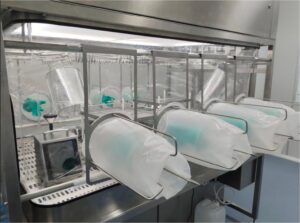
Selecting the right HEPA filter for a cleanroom is a critical operational decision. The choice between an H13 and an H14 filter is often misunderstood as a simple trade-off between 99.95% and 99.995% efficiency. This oversimplification can lead to costly system failures, where a leaky, higher-grade filter underperforms a perfectly sealed, “sufficient” one. The real challenge is integrating a filter that meets cleanliness targets without compromising airflow, energy efficiency, or long-term reliability.
The post-pandemic landscape has intensified scrutiny on air quality. Industrial processes in pharmaceuticals, battery manufacturing, and medical devices now demand near-cleanroom purity. This shift requires a system-level approach to filtration, where third-party validation data and airtight installation become more critical than theoretical filter media percentages. The goal is not just to purchase a component, but to guarantee a performance outcome.
What Is an H13 HEPA Filter and Its 99.95% Efficiency Standard?
Defining the H13 Classification
An H13 HEPA filter is classified under the EN 1822 standard by its minimum 99.95% filtration efficiency at the Most Penetrating Particle Size (MPPS), typically around 0.3 microns. This rating is not a sieve size but represents the point where filtration mechanisms are least effective. Particles both larger and smaller are captured with even higher efficiency through interception, impaction, and diffusion. This makes H13 filters highly effective against fine dust, bacteria, and viruses attached to carrier particles.
The Strategic Implication of “Sufficiency”
The strategic value of this “sufficient” standard is validated by independent testing. Empirical viral testing has demonstrated over 99.9% reduction of airborne pathogens in real-world settings using H13-based systems. This provides concrete evidence that H13 efficiency meets stringent biosecurity requirements. In our analysis, this makes third-party validation data a more critical purchasing criterion than theoretical percentages alone, shifting the focus from component specs to proven system performance.
H13 vs. H14: Key Performance and Cost Differences
Beyond the Marginal Efficiency Gain
The decision between H13 (99.95%) and H14 (99.995%) involves critical trade-offs beyond a marginal gain in single-pass capture. The higher media density of an H14 filter creates a greater initial pressure drop. This reduces achievable airflow for a given fan and increases energy consumption. More critically, the higher operating pressure elevates the risk of leakage at gaskets and seals.
The Leakage Performance Paradox
A leak-prone H14 system can see its whole-system efficacy plummet below 85%, negating its theoretical advantage. Therefore, a perfectly sealed H13 system often outperforms a leaky H14 installation. This underscores a fundamental procurement principle: focus must shift from filter media specs alone to testing the complete sealed assembly under operational conditions. Catastrophic performance failure is more often due to installation integrity than media grade.
The following table quantifies the key operational differences between H13 and H14 filters:
H13 vs. H14: Key Performance and Cost Differences
| Parameter | H13 HEPA Filter | H14 HEPA Filter |
|---|---|---|
| Minimum Efficiency (MPPS) | 99.95% | 99.995% |
| Initial Pressure Drop | Lower | Higher |
| Energy Consumption | Lower | Higher |
| Leakage Risk | Lower | Higher |
| Whole-System Efficacy | >85% (if sealed) | Can be <85% (if leaky) |
Source: EN 1822-1:2019. This standard defines the classification and performance testing for HEPA filters, establishing the official efficiency grades (H13, H14) and the Most Penetrating Particle Size (MPPS) test method critical for this comparison.
How Does H13 Efficiency Impact Cleanroom Classification?
Supporting ISO Cleanroom Standards
The 99.95% efficiency of an H13 filter is sufficient to support cleanroom environments up to ISO Class 5 under ISO 14644-1 standards. Its suitability is determined by balancing required cleanliness with practical system dynamics to achieve mandated air change rates (ACH). A filter’s rated flow and pressure drop must be carefully matched with the HVAC fan’s performance curve. This integration is vital, as a mismatch can lead to underperformance, wasted energy, and equipment strain.
The Industrial Purity Trend
A clear trend shows industrial processes in sectors like pharmaceuticals and lithium batteries now requiring near-cleanroom purity. This blurs the line with traditional controlled environments and pushes industrial suppliers to adopt higher-grade, cleanroom-caliber filtration and monitoring. The H13 filter becomes a bridge technology, offering validated high-efficiency filtration suitable for both formal cleanrooms and advanced manufacturing spaces where contamination control is critical.
Operational Costs: Energy Consumption and Filter Lifespan
Analyzing Total Cost of Ownership
Operational economics are dominated by energy use and replacement frequency. An H13 filter’s manageable pressure drop translates to lower fan energy consumption compared to H14. Lifespan is highly variable, typically 3-6 months, and is directly extended by effective pre-filtration. Omitting pre-filters is a false economy that leads to premature HEPA clogging, spiking replacement costs and downtime.
Monitoring and Predictive Maintenance
Performance is monitored via differential pressure gauges, with replacement triggered at 1.5-2 times the initial drop (often 200-250 Pa). This variability logically leads toward smart, IoT-enabled pressure sensors and predictive maintenance. These technologies enable servitization models where customers pay for guaranteed air quality outcomes rather than physical filter replacements, aligning supplier incentives with long-term performance.
The key cost drivers and monitoring metrics are summarized below:
Operational Costs: Energy Consumption and Filter Lifespan
| Cost Factor | Typical Range / Metric | Key Influence |
|---|---|---|
| Filter Lifespan | 3 – 6 months | Pre-filtration effectiveness |
| Replacement Trigger | 1.5 – 2x initial ΔP | Differential pressure gauge |
| Final Pressure Drop | 200 – 250 Pa | End-of-life indicator |
| Energy Consumption | Lower vs. H14 | Initial pressure drop |
| Maintenance Model | Predictive (IoT sensors) | Servitization trend |
Source: Technical documentation and industry specifications.
Which Applications Are Best Suited for H13 Filters?
Optimal Efficiency Balance
H13 filters are optimal for applications where their efficiency balance provides sufficient protection without incurring the system penalties of H14. This includes pharmaceutical packaging, medical device manufacturing, hospital operating suites, and certain electronics assembly. The key is the operational environment. For many controlled environments, the H13 standard represents the point of diminishing returns, where additional efficiency gains are offset by disproportionate increases in cost and operational complexity.
Media and Coating for Industrial Use
Industrial H13 filters often use polyester media with PTFE coating for mechanical strength and anti-fouling. This enables reliable function in oily, moist conditions beyond standard labs. Specific media and coating selection is decisive for suitability. In the post-pandemic market, differentiation has shifted toward verified whole-system performance. This creates a tiered market where H13-based systems with independent pathogen testing and airtight sealing dominate the professional and high-end segments. For projects requiring reliable performance in challenging conditions, specifying the correct industrial-grade HEPA filter media is a foundational step.
Key Technical Specifications for System Integration
Matching Specs to System Design
Successful integration hinges on matching technical specs to system design. Critical specifications include the filter’s rated airflow (e.g., 1800 m³/h), its initial and final pressure drop, and its temperature/humidity resistance (often 70-80°C, 100% RH). The frame material—galvanized steel, aluminum, or plastic—must ensure integrity under operational pressure. The pleated design maximizes surface area to balance efficiency and resistance.
Avoiding the DIY Pitfall
A common DIY pitfall is selecting filters based only on physical size, ignoring the fan performance curve. The filter’s specified airflow must match the fan’s operational point at the system’s static pressure, not its maximum free-air rating. This requires technical literacy in fluid dynamics for effective implementation. System designers must reference standards like ISO 29463-1:2017 to ensure all components are interoperable.
The table below outlines the primary specifications that must be aligned during system design:
Key Technical Specifications for System Integration
| Specification | Typical Example / Range | Integration Consideration |
|---|---|---|
| Rated Airflow | 1800 m³/h | Must match fan curve |
| Temperature Resistance | 70 – 80°C | Environmental suitability |
| Humidity Resistance | Up to 100% RH | Environmental suitability |
| Frame Material | Galvanized steel, aluminum | Integrity under pressure |
| Design Feature | Pleated media | Surface area vs. resistance |
Source: ISO 29463-1:2017. This international standard specifies the performance requirements and testing for high-efficiency filters, providing the framework for key technical parameters like airflow, temperature, and construction relevant to system integration.
Maintaining Performance: Validation, Leak Testing, and Replacement
Non-Negotiable Initial Validation
Sustained performance relies on rigorous initial validation and ongoing maintenance. Installation Integrity Testing (IIT) or leak testing at MPPS is non-negotiable to confirm the sealed assembly’s integrity, as leakage is the primary failure point. Regular monitoring via differential pressure gauges is essential. In loosely regulated markets, this creates both risk and opportunity.
Setting De Facto Standards
Leading brands can differentiate by self-regulating through transparent adoption of EN1822 and independent testing, effectively setting the de facto industry standard. Replacement should be based on pressure data, not a fixed calendar schedule, to optimize cost and performance. This practice feeds into advanced predictive maintenance platforms, transforming filtration from a reactive cost center into a managed performance parameter.
The essential maintenance activities and their purposes are defined here:
Maintaining Performance: Validation, Leak Testing, and Replacement
| Activity | Key Metric / Standard | Purpose |
|---|---|---|
| Initial Leak Test | Installation Integrity Testing (IIT) | Confirm sealed assembly |
| Test Standard | EN 1822 at MPPS | Validate filter integrity |
| Primary Failure Point | Gasket and seal leakage | Catastrophic performance loss |
| Ongoing Monitoring | Differential pressure gauges | Track filter loading |
| Replacement Basis | Pressure data, not schedule | Optimize cost & performance |
Source: IEST-RP-CC001.6. This IEST Recommended Practice provides detailed procedures for testing and certifying HEPA filter installations, including leak testing (IIT) methods essential for maintaining performance as outlined in the table.
Selecting the Right HEPA Filter: A Decision Framework
A Holistic Selection Process
Selection requires a holistic decision framework that moves beyond filter class. First, define the required cleanroom class and pathogen reduction needs, using third-party validation data as a key criterion. Second, conduct a system-level analysis, modeling airflow and pressure drop to ensure the H13 filter allows the HVAC system to meet ACH targets without overloading.
Specification and Supplier Priorities
Third, specify media and coatings (e.g., PTFE) for specific environmental challenges. Fourth, mandate a multi-stage design with appropriate pre-filters to protect the HEPA investment. Finally, prioritize suppliers that provide evidence of whole-system leak testing and support smart monitoring capabilities. This framework ensures the chosen solution delivers reliable, efficient, and cost-effective air purity. It transforms the procurement question from “What efficiency rating?” to “What performance outcome can you guarantee?”
The decision ultimately hinges on validated system performance, not isolated component specs. Prioritize suppliers who provide evidence of whole-assembly leak testing and can reference relevant standards like the Chinese National Standard GB/T 13554-2020 for projects in that region. This ensures technical compliance and operational reliability.
Implementing this framework requires defining cleanliness targets with third-party validation data, not theoretical percentages. It demands a system-level analysis to ensure your HVAC can achieve target air changes with the selected filter’s pressure profile. Finally, it mandates specifying the correct media and sealing for your environment while insisting on proof of installation integrity.
Need professional guidance to navigate these specifications and integrate a guaranteed-performance HEPA solution? The engineers at YOUTH specialize in translating cleanroom requirements into reliable, efficient filtration systems. For a direct consultation on your project parameters, you can also Contact Us.
Frequently Asked Questions
Q: How does the 99.95% efficiency of an H13 HEPA filter actually impact cleanroom classification?
A: An H13 filter’s 99.95% efficiency at the Most Penetrating Particle Size (MPPS) is sufficient to achieve and maintain environments up to ISO Class 5 per ISO 14644-1 standards. The critical factor is integrating the filter’s airflow and pressure drop with your HVAC fan’s performance curve to reliably meet the required air change rates. This means facilities targeting ISO Class 5-7 should model their full system to ensure the H13 filter enables the necessary airflow without overloading the fan.
Q: What are the real-world performance trade-offs between H13 and H14 HEPA filters?
A: The primary trade-off is between marginal theoretical capture and significant system penalties. An H14 filter’s higher media density increases initial pressure drop, raising energy costs and potentially reducing airflow. More critically, the higher operating pressure elevates the risk of leaks at seals, which can degrade whole-system efficiency below 85%. This means a perfectly sealed H13 assembly often outperforms a leaky H14 installation, so procurement must prioritize verified assembly integrity over filter media specs alone.
Q: What technical specifications are most critical for integrating an H13 filter into an existing HVAC system?
A: You must match the filter’s rated airflow and its initial/final pressure drop to your fan’s performance curve at the system’s operating static pressure. Also verify the filter’s temperature and humidity resistance and frame material integrity under pressure. A common error is selecting filters based only on physical size, ignoring the fan curve. For projects integrating new filtration, you should require full system modeling to prevent underperformance and excessive energy consumption.
Q: How should we maintain and validate an H13 HEPA filter installation to ensure ongoing compliance?
A: Sustained performance requires initial Installation Integrity Testing (IIT) at MPPS to confirm the sealed assembly has no leaks, followed by regular monitoring via differential pressure gauges. Replacement should be triggered when pressure reaches 1.5-2 times the initial drop, not by a fixed calendar schedule. This practice logically leads toward IoT-enabled sensors and predictive maintenance. If your operation is in a loosely regulated market, you can mitigate risk by adopting the rigorous leak testing protocols defined in EN 1822-1:2019.
Q: Which industrial applications are best suited for H13 filters instead of H14?
A: H13 filters are optimal where their efficiency provides sufficient protection without the system drawbacks of H14, including pharmaceutical packaging, medical device manufacturing, and certain electronics assembly. For harsh industrial environments, specify H13 filters with polyester media and PTFE coatings for strength and resistance to moisture or oil. This means operations in oily or humid conditions should prioritize media and coating specifications over a minor efficiency gain to ensure reliable, long-term function.
Q: What is a practical decision framework for selecting the right HEPA filter grade?
A: Move beyond filter class by first defining your cleanroom class and pathogen reduction needs, using third-party validation data as a key criterion. Second, conduct a system-level analysis to ensure the filter allows your HVAC to meet air change targets. Third, specify media and coatings for environmental challenges, and fourth, mandate multi-stage pre-filtration. This framework means you should prioritize suppliers that provide evidence of whole-system leak testing, as outlined in practices like IEST-RP-CC001.6, to guarantee performance.
Q: How do operational costs for an H13 HEPA filter compare to higher grades?
A: Operational costs are dominated by energy use and replacement frequency. An H13 filter’s lower initial pressure drop compared to an H14 results in lower fan energy consumption. Lifespan, typically 3-6 months, is extended by effective pre-filtration to prevent premature clogging. This means omitting pre-filters is a false economy; for cost-sensitive operations, you should invest in a robust multi-stage filtration design to protect the HEPA investment and minimize total cost of ownership.
Related Contents:
- H13 vs H14 HEPA Housing Box Efficiency Comparison
- HEPA Filter Systems | Air Handling Equipment Specifications
- Cleanroom Air Filter Performance Metrics | Technical Specifications
- HEPA Filter Testing: Ensuring Optimal Performance
- H10 vs H13 vs H14 HEPA Filter Classifications: Complete Performance Specifications and Efficiency Standards Comparison for Industrial Buyers [2025 EN 1822 Update]
- HEPA vs ULPA Filters: Choosing the Right Option
- The Complete HEPA Filter Selection and Implementation Guide for Industrial Facilities: 2025 Standards, Compliance Requirements, and Performance Optimization Strategies
- HEPA Filter H14 vs H13 for Weighing Booth Applications: Which Grade Do You Need?
- HEPA Filters in Biosafety Cabinets: A Deep Dive