Selecting the right HEPA filter for a weighing booth is a critical technical decision with direct operational and financial consequences. The choice between H13 and H14 grades is often oversimplified to a matter of “better” filtration, leading to costly over-specification or inadequate protection. Professionals must navigate a complex trade-off between certified efficiency, system dynamics, and total cost of ownership.
This decision is increasingly pivotal as regulatory scrutiny intensifies and energy costs rise. A misaligned filter selection can compromise product integrity, inflate operational expenses, and fail compliance audits. Understanding the nuanced performance differences and their real-world implications is essential for designing a contamination control strategy that is both effective and efficient.
HEPA H13 vs H14: Defining the Core Efficiency Difference
The Certified Performance Gap
The distinction is quantified by the EN 1822 standard, which classifies filters based on their minimum particle capture efficiency at the Most Penetrating Particle Size (MPPS). H13 filters are certified for 99.95% efficiency, allowing a maximum leakage of 0.05%. H14 filters are ten times more efficient at the MPPS, with a 99.995% efficiency and only 0.005% maximum leakage. This order-of-magnitude difference is the foundation of the specification.
Application in Contamination Control
For weighing booth applications, this efficiency translates directly to the level of particulate containment. The H14’s superior capture of ultra-fine particles, such as potent active pharmaceutical ingredients (APIs) below 0.3 microns, provides a higher safety margin. However, a critical, easily overlooked detail is that this performance is only guaranteed by a certified filter from an accredited test lab. Procurement must be based on these test reports, not unverified marketing claims of “True HEPA.”
The Table of Core Specifications
The following table defines the fundamental efficiency parameters that differentiate H13 and H14 filters according to the official standard.
| Filter Grade | Minimum Efficiency (MPPS) | Maximum Leakage |
|---|---|---|
| H13 | 99.95% | 0.05% |
| H14 | 99.995% | 0.005% |
Source: EN 1822-1:2019. This standard defines the classification and performance testing for HEPA filters, establishing the certified particle capture efficiency at the Most Penetrating Particle Size (MPPS) for H13 and H14 grades.
Cost & Operational Impact: H13 vs H14 Total Cost of Ownership
Beyond the Initial Purchase Price
The filter’s purchase cost is a minor component. The denser media of an H14 filter creates higher initial airflow resistance. To maintain the critical laminar flow velocity of 0.36–0.54 m/s, the fan system must work harder, consuming significantly more energy over the filter’s operational life. This energy premium is the dominant cost driver for H14 systems.
Longevity and Maintenance Implications
Higher initial pressure drop also impacts service life. In environments with substantial particulate loads, the H14 filter will reach its maximum allowable pressure drop faster than an H13, triggering more frequent replacements. A comprehensive TCO analysis must model these factors over a 5-year period. In our comparisons, for standard applications, the operational advantage of H13 often outweighs the marginal efficiency gain of H14.
Analyzing the Total Cost Factors
Evaluating TCO requires a structured comparison of all contributing operational factors, as outlined below.
| Cost Factor | H13 Filter | H14 Filter |
|---|---|---|
| Initial Filter Cost | Lower | Higher |
| Airflow Resistance | Lower pressure drop | Higher pressure drop |
| Energy Consumption | Lower | Significantly higher |
| Service Life | Longer | Potentially shorter |
Source: Technical documentation and industry specifications.
Performance Compared: Filtration, Airflow, and System Dynamics
The Inherent Trade-Off
Selecting a filter grade involves balancing ultimate efficiency against system airflow. While H14 offers higher particle capture, its density restricts airflow. This creates a design bottleneck: engineers must choose between maximum filtration and maintaining designed air change rates. For a weighing booth, consistent, unidirectional airflow is as critical as filter grade for sweeping contaminants away from the critical zone.
The Dominant Failure Point: System Integrity
Filter efficiency is a paper specification without proper installation. Industry experts consistently stress that bypass leakage around the filter seal or through housing gaps is the most common performance failure. A leaky H14 system can perform below 85% efficiency, worse than a perfectly sealed H13 unit. Therefore, investing in a validated, leak-proof design is more consequential than the choice between H13 and H14.
Comparing Key Performance Parameters
The following table contrasts the operational performance characteristics that result from the physical properties of H13 and H14 filter media.
| Performance Parameter | H13 Filter | H14 Filter |
|---|---|---|
| Particle Capture | 99.95% efficiency | 99.995% efficiency |
| Airflow Restriction | Lower inherent resistance | Higher inherent resistance |
| System Leakage Impact | Critical failure point | Critical failure point |
| Air Change Rate Maintenance | More efficient | Less efficient |
Source: ISO 29463-1:2017. This international standard provides the framework for classifying filter efficiency and testing resistance, which are key to understanding the performance trade-offs between H13 and H14 filters.
Which Filter Is Better for Standard vs. High-Risk Applications?
Defining Standard Protection Needs
For standard powder weighing where the goal is product protection from ambient dust, a well-sealed H13 system is typically sufficient. It aligns with ISO Class 5 (Class 100) air cleanliness standards and provides a robust balance of protection and operational efficiency. The risk assessment here focuses on general particulate exclusion.
Mandating Maximum Containment
H14 is reserved for high-risk applications. This includes handling highly potent or toxic compounds where operator protection is paramount, processing sterile materials, or when the weighing booth interfaces with a EU GMP Grade A zone. The decision must be driven by a formal risk assessment that identifies the need for a barrier against ultra-fine, hazardous particulates. In these scenarios, the higher operational cost of H14 is justified.
Application-Based Filter Selection
The appropriate filter grade is directly tied to the specific application and its associated contamination control goals, as summarized in this guide.
| Application Type | Primary Goal | Recommended Filter |
|---|---|---|
| Standard Powder Weighing | Product protection from ambient dust | H13 |
| Handling Potent/Toxic Compounds | Maximum containment | H14 |
| EU GMP Grade A Zone | Sterility assurance | H14 |
| ISO Class 5 (Class 100) | General particulate control | H13 |
Source: EU GMP Annex 1. This guideline mandates HEPA-filtered air and specifies air quality grades for sterile manufacturing, directly informing filter selection for high-risk pharmaceutical applications.
Critical System Design: Beyond the Filter Grade
The Imperative of Multi-Stage Filtration
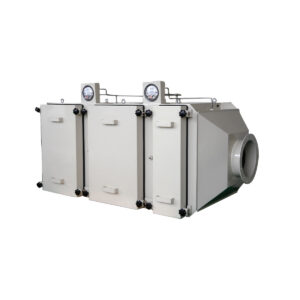
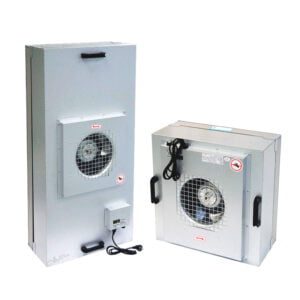
The HEPA filter should not be the first line of defense. A robust pre-filter (F7-F9 grade) upstream is non-negotiable. It captures larger debris, protecting the expensive HEPA filter from premature loading and clogging. This extends service life and maintains optimal airflow, a critical factor for TCO that is often underestimated in initial specifications.
Ensuring Leak-Tight Integrity
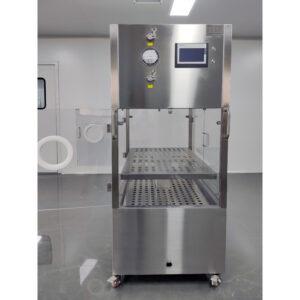
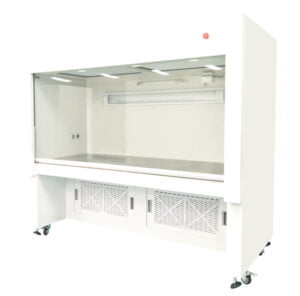
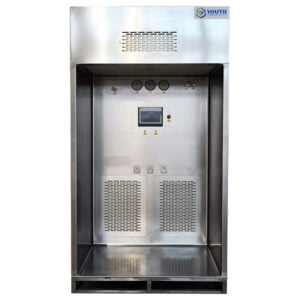
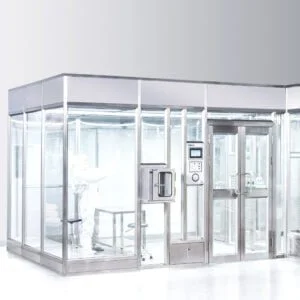
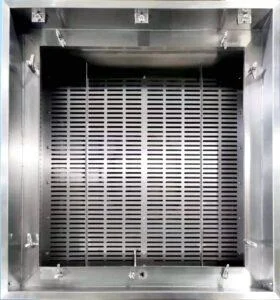
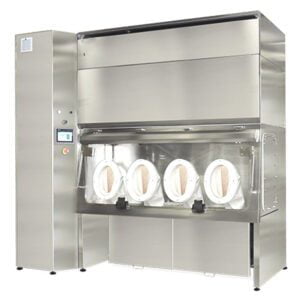
The filter must be housed in a casing designed for leak-tight sealing, employing proper gaskets and clamping mechanisms. The system’s aerodynamic design must also ensure a uniform, laminar airflow pattern that effectively sweeps particles from the weighing zone into the return grilles. This complete contamination control strategy is what defines a high-performance dispensing and weighing booth, not the filter grade alone.
Installation, Validation, and Ongoing Maintenance Requirements
The Non-Negotiable Leak Test
Post-installation validation is mandatory. Every HEPA filter system must undergo an in-situ leak test, typically using an aerosol photometer to scan the entire filter face and seal perimeter. This test certifies installation integrity and is the only way to verify the system performs to its rated specification. It moves the project from paper compliance to demonstrated performance.
Implementing Proactive Maintenance
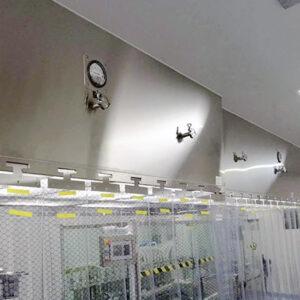
Ongoing operation is managed through differential pressure gauges across the pre-filter and HEPA stages. Monitoring these gauges schedules replacements based on actual loading, not arbitrary time intervals. Designs that facilitate easy, leak-free filter changes directly lower long-term maintenance costs and reduce downtime. Proactive validation and monitoring also position facilities well for increasing regulatory scrutiny on documented contamination control.
Key Requirements for Lifecycle Management
The lifecycle of a HEPA system is governed by specific validation and maintenance activities, as detailed below.
| Requirement | Key Activity | Driver/Standard |
|---|---|---|
| Post-Installation Validation | Leak test (aerosol photometer scan) | Mandatory certification |
| Ongoing Maintenance | Monitor differential pressure gauges | Schedule replacements |
| Filter Change Design | Easy, leak-free access | Lowers long-term costs |
| Regulatory Compliance | Proactive validation & monitoring | Increasing scrutiny |
Source: IEST-RP-CC034.3. This recommended practice details the test methods for in-situ leakage scanning of installed HEPA filters, which is the critical procedure for validating installation integrity.
Key Decision Criteria for Your Weighing Booth Selection
Establishing a Decision Hierarchy
Selection requires a prioritized set of criteria. First, conduct a formal risk assessment of the materials handled to define the necessary protection level. Second, mandate third-party filter certification and post-installation leak testing as contractual requirements. Third, evaluate the complete system design, including pre-filtration, airtight housing, and fan capability.
Avoiding the Cost of Over-Specification
Fourth, analyze the Total Cost of Ownership, giving significant weight to energy consumption. Finally, resist over-specification. Selecting a “medical-grade” H14 for a standard application incurs unnecessary capital and operational expense with no tangible benefit. The goal is to match the system’s capability precisely to the application’s risk profile.
Prioritized Selection Framework
A structured approach to selection ensures all critical factors are considered in the correct order of importance.
| Priority | Decision Criteria | Key Consideration |
|---|---|---|
| 1 | Material Risk Assessment | Potency, toxicity, sterility |
| 2 | Filter & System Certification | Third-party test reports |
| 3 | Complete System Design | Pre-filtration, airtight housing |
| 4 | Total Cost of Ownership (TCO) | Energy, service life, maintenance |
| 5 | Avoid Over-Specification | Match grade to application |
Source: Technical documentation and industry specifications.
Making the Final Choice: A Step-by-Step Selection Framework
A Defensible Five-Step Process
A structured framework ensures an optimized, defensible choice. Step 1: Define Requirements. Use product risk and operational standards (ISO, EU GMP) to classify your application as standard or high-risk. Step 2: Prioritize System Integrity. Specify a booth design with a validated leak-proof housing and mandatory pre-filtration. Step 3: Model Performance. Require suppliers to model airflow and energy consumption for both H13 and H14 configurations in your specific booth size.
From Analysis to Action
Step 4: Analyze TCO. Compare 5-year projections including energy, filter replacements, and maintenance labor. Step 5: Validate and Certify. Contractually require certified filter test reports and post-installation leak testing as a condition for final payment. This process shifts the conversation from generic filter grades to a performance-guaranteed system solution.
The final decision hinges on aligning certified filter performance with your specific risk profile, not pursuing a generic “higher grade.” Prioritize system integrity over paper specifications, and let a detailed TCO analysis reveal the most cost-effective configuration for your operational lifespan. For standard powder handling, a well-engineered H13 system typically delivers optimal value. For high-risk containment, the H14’s efficiency justifies its operational premium.
Need professional guidance to specify or validate your weighing booth solution? The engineers at YOUTH can help you apply this framework to your specific materials and compliance requirements. Contact us to model your TCO and design a system that balances protection with efficiency.
Frequently Asked Questions
Q: What is the actual performance difference between an H13 and H14 HEPA filter for a weighing booth?
A: The core difference is certified particle capture efficiency at the most penetrating size. An H13 filter is rated for 99.95% efficiency (0.05% leakage), while an H14 achieves 99.995% (0.005% leakage), making it ten times more efficient. This classification is defined by standards like EN 1822-1:2019 and ISO 29463-1:2017. This means for handling ultra-fine, potent compounds, H14 provides a critical performance margin, but for standard protection, H13’s efficiency is often sufficient.
Q: How does choosing an H14 filter over an H13 impact our long-term operating costs?
A: The higher initial filter cost is minor; the significant impact is on operational expenses. The denser H14 media creates greater airflow resistance, requiring a more powerful fan to maintain required laminar flow. This leads to substantially higher energy consumption over the filter’s lifespan and can shorten its service life due to reaching maximum pressure drop faster. For projects where energy efficiency is a priority, expect H13 to deliver a lower total cost of ownership for non-critical applications.
Q: Is a higher-grade H14 filter always the better choice for pharmaceutical weighing?
A: No, the application’s risk profile dictates the correct choice. A well-sealed H13 system is typically adequate for standard powder weighing and aligns with ISO Class 5 standards. H14 is reserved for high-risk applications involving highly potent, toxic, or sterile compounds, or when the booth serves a EU GMP Grade A zone as per EU GMP Annex 1. This means facilities should conduct a formal risk assessment of the materials handled before specifying the filter grade.
Q: Beyond the filter grade, what are the most critical design features for an effective weighing booth?
A: Overall system integrity is paramount. Essential features include a multi-stage filtration system with a robust pre-filter (F7-F9) to protect the HEPA and extend its life, and a leak-tight filter housing with proper gaskets. The system must also ensure a uniform, unidirectional laminar airflow pattern. This means investing in a verified, leak-proof design and proper airflow dynamics is more important for performance than the choice between H13 and H14 alone.
Q: What validation is required after installing a HEPA filter in a weighing booth?
A: Post-installation leak testing is non-negotiable to certify installation integrity. This involves an aerosol photometer scan of the entire filter face and seal perimeter, a method detailed in practices like IEST-RP-CC034.3. This validation confirms the system’s actual performance, moving beyond paper specifications. If your operation requires guaranteed containment, plan for this mandatory test and ensure it is contractually required from your supplier.
Q: How should we evaluate vendors and specify filters to avoid misleading claims?
A: Procurement must be based on third-party certification from accredited labs, not marketing terms like “True HEPA.” Mandate that suppliers provide certified test reports for the filters, aligning with standards such as ISO 29463-1:2017. Also, contractually require post-installation leak testing. This means you should prioritize vendors who offer transparent, certified performance data over those using ambiguous grade descriptions.
Q: What is a practical framework for selecting between H13 and H14?
A: Use a structured, five-step process. First, define requirements via a risk assessment. Second, prioritize system integrity with leak-proof design and pre-filtration. Third, model airflow and energy use for both grades in your specific booth size. Fourth, analyze the 5-year total cost of ownership including energy and replacements. This means for a defensible choice, you should combine risk analysis with operational modeling before finalizing your specification.
Related Contents:
- Weighing Booth vs Scale Room: Which is Right for You?
- Precision Weighing Booths for Pharmaceutical Industry
- H13 vs H14 HEPA Housing Box Efficiency Comparison
- What is a Weighing Booth? Essential Facts Explained
- Boost Productivity with Automated Weighing Booths
- The Ultimate Guide to Weighing Booths [2025 Edition]
- Emerging Trends: The Future of Weighing Booth Technology
- Weighing Booth ROI: Maximizing Your Investment
- 7 Steps to Perfectly Calibrate Your Weighing Booth