Most FAT sign-off problems with laminar flow hoods trace back to a single omission: the acceptance criteria were written against a supplier’s adjustable range, not against the actual installation. The mismatch stays invisible through procurement, surfaces during commissioning, and forces either a rework cycle or an underdocumented workaround that creates a defensibility gap at the next audit. The specific judgment that separates a clean approval from that cycle is whether the target velocity band has been confirmed against opening size, work height, and load geometry before the test begins — not afterward. What follows gives you the decision tools to make that confirmation concrete and to recognize when tuning has reached its limit.
Air-speed checks that matter before FAT approval
Approval sign-off on a laminar flow hood depends on more than confirming a velocity reading falls inside the supplier’s stated range. The supplier’s adjustable range — commonly 0.2–0.5 m/s — describes mechanical capability, not acceptance criteria. Before FAT, the team needs to confirm that the approved target velocity band reflects what the specific installation actually requires, and that the band itself sits within the 0.36–0.45 m/s window commonly associated with ISO Class 5 and GMP-aligned design practice.
A band outside that window is not automatically disqualifying, but it warrants explicit justification. If the approved band skews toward 0.2–0.3 m/s because the supplier set it low during initial configuration, and the installed opening is large or the product geometry creates significant obstruction, the protection level may be structurally inadequate regardless of whether the unit technically passes the test as written. The reverse — a band set at the upper end to compensate for a poorly configured unit — carries its own risks, covered in the next section.
The two checks that matter most going into FAT are the simplest to state and the most frequently skipped.
| Check | What to Confirm | Why It Matters |
|---|---|---|
| Target velocity band | Ensure the approved band falls within 0.36–0.45 m/s for ISO Class 5/GMP compliance | Outside this range risks particle control failure and regulatory non-compliance |
| Band vs. physical installation | Confirm the target band matches actual opening size and load geometry, not just the supplier’s adjustable range (e.g., 0.2–0.5 m/s) | Mismatch leads to inadequate protection or wasteful energy consumption |
Confirming both checks before FAT prevents the most common late-stage friction: a measured reading that satisfies the supplier’s criteria while failing to satisfy the buyer’s actual protection requirement.
Opening size and load geometry behind the target velocity band
A nominal velocity figure means very little without knowing what it has to accomplish across. A 0.36 m/s reading over an unobstructed, standard-width opening behaves differently than the same reading over a wide opening with equipment, tubing, or work pieces already in place. The velocity band in the specification should reflect the working condition, not the empty-hood configuration the supplier used to set the initial fan speed.
Opening width and height directly affect how much air volume is required to maintain a coherent unidirectional flow pattern at the work surface. A wider opening needs proportionally more volume to deliver the same protective effect at the product level. If the target band was established using a narrow or lightly loaded reference condition, and the actual installation is larger or more obstructed, the approved velocity may not produce the flow behavior the team expects during operation. This is not a calibration error — it is a design input that was never verified against physical reality.
Work height matters for a different reason. Velocity measured at filter face and velocity reaching the work surface are not the same number. As the distance from the filter increases, the flow can diverge slightly, decelerate, or be disturbed by room turbulence or nearby equipment. A target band confirmed only at the filter face, without accounting for the critical work zone height, gives an incomplete picture of what the product actually experiences. The practical implication is that FAT measurements should be planned at the work height relevant to the process, not just at the most convenient measurement plane.
Load geometry — the actual footprint, height, and shape of equipment or materials placed inside the hood during operation — introduces local obstructions that redirect airflow, create recirculation zones, and alter effective velocity at the surfaces that matter most. Approving air speed in the unloaded state and assuming it transfers to the loaded condition is a common planning shortcut that creates a defensibility gap. The loaded versus unloaded test condition question is addressed more directly in the measurement-method section, but the reason it matters starts here: opening size and load geometry are the physical inputs that determine what velocity band is actually needed.
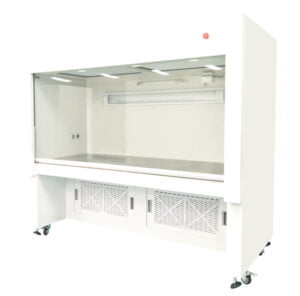
For teams evaluating a Laminar Flow Hood for a new process line, confirming these inputs before specifying the target band — rather than accepting the supplier’s default configuration — is what makes the FAT result meaningful rather than procedural.
Fan-speed increases that create turbulence instead of protection
When a smoke visualization test produces a weak or uneven pattern, the instinct is to increase fan speed. The logic seems direct: more velocity should mean more protection. In practice, pushing air speed above approximately 0.45 m/s in a laminar flow hood tends to work against the goal rather than toward it.
Laminar flow protection depends on a coherent, unidirectional air curtain that sweeps particles away from the product in a predictable path. That coherence requires velocity to stay within a range where the flow remains stable. Above that range, the flow transitions toward turbulence — not dramatically, and not always visibly in a quick smoke test, but enough to create recirculation zones around obstructions, lift settled particles back into the work zone, and undermine the parallel streamlines that give the hood its protective function. A smoke test performed immediately after a fan-speed increase may look cleaner at the face because the smoke moves faster, but the behavior at the work surface and around real equipment geometry can be worse than it was at the lower, unstable-looking speed.
The downstream consequences extend beyond airflow quality. Pushing fan speed higher than the design balance point accelerates filter loading, shortening maintenance intervals and increasing operating cost. It also places mechanical stress on the fan motor and drive components that shows up as elevated noise and vibration. Design figures of ≤62 dB for noise and ≤3 µm for vibration are useful indicators here — not primarily as comfort parameters, but as signals that the unit is operating outside its intended mechanical range. When either figure is exceeded after a fan-speed adjustment, the adjustment is the problem, not the symptom.
| Risk | Limit / Effect | Consequence |
|---|---|---|
| Turbulence from excessive velocity | Air speed above 0.45 m/s disrupts laminar flow and stirs up contaminants | Worsens protection despite better-looking smoke; defeats ISO Class 5 goals |
| Exceeding noise and vibration limits | Noise > 62 dB or vibration > 3 µm indicates mechanical strain | Operational degradation and potential regulatory issues beyond comfort concerns |
The practical decision rule is straightforward: if the smoke pattern remains unsatisfactory after fan speed is adjusted within the 0.36–0.45 m/s design band, increasing fan speed further is unlikely to fix the problem and is likely to create new ones. The source of the poor pattern is almost always geometry, uniformity, or measurement method — not insufficient velocity.
Uniformity readings versus isolated peak numbers on test sheets
A test sheet that shows a strong peak velocity reading at one or two points can look more impressive than a sheet showing a moderate but uniform profile across a full measurement grid. The peak-reading sheet is often the weaker result.
The reason is practical: a high single-point velocity tells you what the air is doing at one location under the specific conditions of the test. It says nothing about what the air is doing two centimeters to the left, at work height versus filter face, or downstream of the first piece of equipment the operator places inside the hood. Protection depends on what the flow does across the entire work zone under realistic conditions — and that is only visible in a full grid measurement.
ISO 14644-3:2019 establishes a grid-based testing framework for unidirectional flow devices precisely because single-point readings are insufficient for evaluating flow uniformity across a clean zone. A test that measures only convenient or favorable locations, without defining a systematic grid, cannot support a defensible compliance record. The issue is not whether any individual reading meets a threshold — it is whether the distribution of readings across the grid demonstrates stable, uniform flow throughout the critical zone.
The failure pattern in practice looks like this: a supplier submits test data showing strong velocity at two or three measured points, and the buyer approves based on those numbers. During validation or audit, a grid-based evaluation reveals significant velocity variation across the work zone — including low-velocity zones near edges, corners, or at work height behind an obstruction. At that point, the FAT data that was used for approval cannot be reconciled with the validation data, and the discrepancy requires explanation. That explanation is difficult to make credibly when the original test method was not defined in the purchase specification.
The more reliable criterion for FAT approval is a documented, grid-based velocity profile that shows acceptable uniformity across the full measurement plane. A profile with moderate variation that stays within the design band throughout the grid is more defensible — and more protective — than a profile with strong peaks and uncharted gaps.
Measurement-method gaps that trigger supplier disputes
Disputes over FAT results almost always become visible late — after the test is complete, when the buyer’s acceptance criteria and the supplier’s test data cannot be reconciled. The root cause is almost always earlier: the measurement method was never agreed in writing before the test was designed.
Supplier specifications typically define an adjustable air speed range — commonly 0.2–0.5 m/s — without specifying how that range is to be measured during acceptance testing. That range describes mechanical capability across the filter’s service life: the unit may start at 0.5 m/s with a clean filter and drift toward 0.2 m/s as the filter loads over time. Both figures are real operating conditions, and the pass/fail meaning of any measured velocity depends entirely on which condition the test was capturing. A buyer who expects 0.36–0.45 m/s at final loaded condition and receives a test result showing 0.48 m/s at clean-filter condition has not necessarily received a non-compliant unit — but without prior agreement on test condition, the result cannot be evaluated.
The same problem appears in measurement grid definition and instrument placement. An anemometer positioned at the center of the filter face, 50 mm from the surface, in an empty hood, will produce a different reading than the same instrument positioned at work height, 300 mm back, with equipment in place. Neither position is inherently wrong, but they measure different things, and using them interchangeably between supplier test and buyer verification produces results that cannot be compared.
| Measurement Gap | Risk if Left Undefined | What to Agree Before FAT |
|---|---|---|
| Measurement grid, instrument position, and test condition | Supplier’s adjustable range (0.2–0.5 m/s) becomes unverifiable; results are not reproducible | Define grid spacing, anemometer placement, and whether the test is loaded or unloaded |
| Clean filter vs. loaded filter state | Initial speed (0.5 m/s) vs. final speed (0.2 m/s) can change pass/fail outcome | Agree whether FAT uses a clean filter, a loaded filter, or both, and which speed band applies |
The resolution is straightforward but must happen before FAT, not during it. The purchase specification or FAT protocol should define: the measurement grid spacing and reference points, instrument type and placement height, whether the test is performed with a new filter, a conditioned filter, or both, and which velocity band applies to each test condition. Teams working through detailed specification reviews for airflow equipment will find the LAF Unit Specifications | Technical Parameters & Standards a useful reference for understanding which parameters need explicit definition versus which are typically covered by manufacturer defaults. Agreeing on method in advance is the only way to make FAT results verifiable — and to prevent a supplier disagreement from becoming a commissioning delay.
Geometry changes required when airflow stays unstable
There is a point at which adjusting fan speed, repositioning the anemometer, or rescheduling the smoke test stops being engineering troubleshooting and starts being delay without resolution. That point is reached when the airflow pattern remains unstable after velocity has been confirmed within the design band and the measurement method has been verified as correct. At that stage, the problem is not speed — it is geometry.
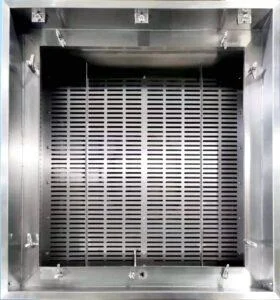
Unstable airflow in a laminar flow hood typically has a physical cause: a filter plenum that distributes air unevenly across the face, a housing profile that creates edge turbulence, an opening configuration that allows room air to intrude at angles that disrupt the unidirectional stream, or a filter-to-work-height ratio that cannot maintain coherent flow across the distance involved. None of these respond to fan-speed adjustment. Increasing velocity against a structural flow problem either maintains the turbulence at higher speed or shifts it to a different part of the work zone.
IEST-RP-CC002, which addresses unidirectional-flow clean-air devices, provides a useful design-intent reference here: the defining characteristic of a unidirectional-flow device is the maintenance of parallel, non-mixing air streams across the critical zone. When that characteristic cannot be achieved after basic tuning, it is an indication that the device geometry does not match the application requirement — not that the application requirement needs to be relaxed.
The practical corrective path depends on where the instability originates. A non-uniform face velocity profile that persists across multiple fan speeds typically points to plenum or diffuser configuration. Edge turbulence that worsens at higher velocity points to housing geometry or opening proportions. Recirculation zones that appear only with equipment loaded suggest that the work zone depth or opening clearance is insufficient for the actual process setup. In each case, the correct response is a design modification — a change to the physical configuration — rather than continued velocity adjustment.
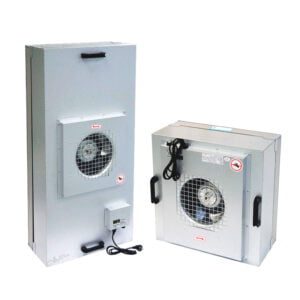
The Fan Filter Unit (FFU) selection also plays a role here: units designed with variable-speed drive and matched plenum geometry offer more flexibility to correct minor distribution imbalances without structural changes. But where the flow instability is rooted in the hood’s overall dimensional or proportional design, that flexibility has limits. Recognizing that threshold before FAT — rather than discovering it during repeated retest cycles — is what keeps the qualification timeline intact.
The most consistent source of pre-approval problems is the gap between what the specification says and what the installation actually requires. Closing that gap means confirming the target velocity band against real opening dimensions, work height, and loaded product geometry — not just against a supplier’s configurable range — and agreeing on the exact measurement method before the FAT protocol is issued. Those two steps remove most of the conditions that produce disputed results, compliance gaps, or commissioning delays.
If airflow uniformity remains problematic after those inputs are properly defined and fan speed is tuned within the design band, the next question is not how much more velocity to apply — it is whether the hood geometry is matched to the application. Knowing that threshold in advance, and building it into the purchase specification as a design confirmation requirement rather than a post-FAT discovery, is the practical difference between an approval that holds up under audit and one that requires explanation.
Frequently Asked Questions
Q: Does the 0.36–0.45 m/s target band still apply if the process runs at a work height well below the filter face?
A: Not automatically — the band needs to be confirmed at the actual work height, not just at the filter face. Velocity decays and flow can diverge as distance from the filter increases, so a reading that satisfies the band at face level may fall below the protective threshold by the time it reaches the critical work zone. The FAT measurement plane should be set at the height where the product actually sits.
Q: If the article’s advice is followed correctly during FAT, what is the immediate next step before qualification can proceed?
A: Document the agreed measurement grid, instrument placement, filter condition, and target band in a signed FAT protocol addendum before any validation run begins. FAT sign-off confirms the unit performs as specified under defined test conditions — but that result only supports the downstream validation record if the method is captured formally. Without that document, a later audit has no verifiable link between FAT data and validation data.
Q: At what point does noise or vibration become a reliable signal that something is wrong with the airflow setup, rather than just a comfort issue?
A: When either figure exceeds the design limits — typically ≤62 dB for noise and ≤3 µm for vibration — after a fan-speed adjustment, the unit has moved outside its intended mechanical operating range. At that point the readings are diagnostic, not incidental: they indicate the fan is compensating for a flow problem rather than delivering stable, balanced airflow. Continued operation in that state accelerates filter loading and increases maintenance frequency independent of any airflow quality concern.
Q: Is a grid-based velocity profile always required, or only when the hood is large or heavily loaded?
A: A grid-based profile is required whenever the FAT result needs to be defensible under audit — regardless of hood size or load level. Single-point readings are insufficient because they cannot reveal velocity variation across the work zone, low-velocity zones near edges, or the performance drop that occurs behind real obstructions. ISO 14644-3:2019 sets a grid-based framework for unidirectional-flow devices precisely because the distribution of readings across the full plane is what determines whether flow is genuinely uniform, not whether any individual point clears a threshold.
Q: How should a buyer decide whether a geometry redesign is worth pursuing versus replacing the hood entirely with a better-matched unit?
A: The decision turns on where the instability originates. If the root cause is a plenum distribution imbalance or minor housing geometry issue, targeted design modifications to the existing unit are usually faster and less costly than replacement. If the instability traces to the hood’s overall dimensional proportions — opening width relative to depth, or filter-to-work-height ratio — those are structural constraints that a modification is unlikely to resolve adequately, making a replacement the more defensible path. Identifying the specific physical cause through a structured airflow investigation, rather than continuing retest cycles, is what makes that cost comparison possible to evaluate accurately.