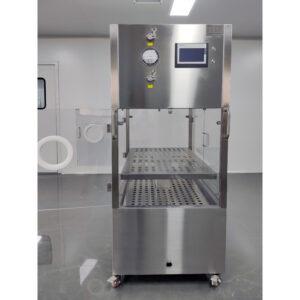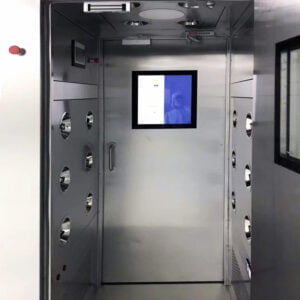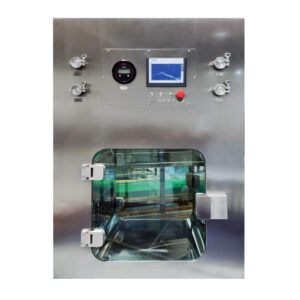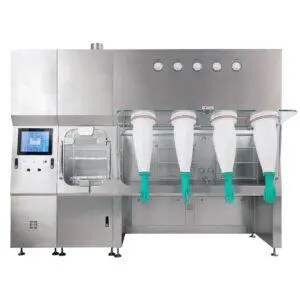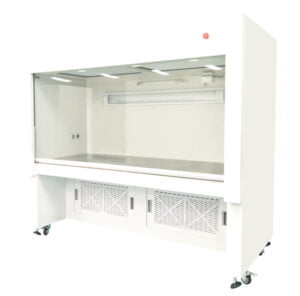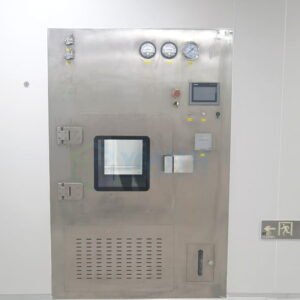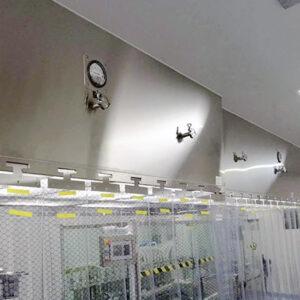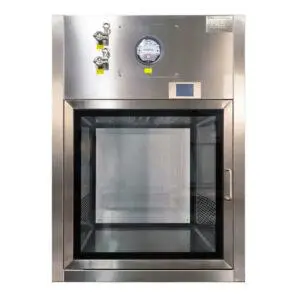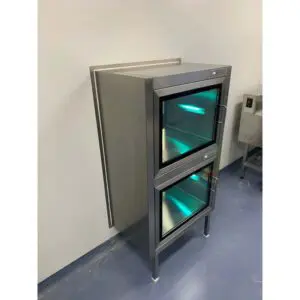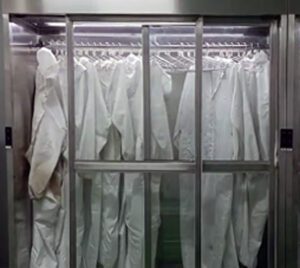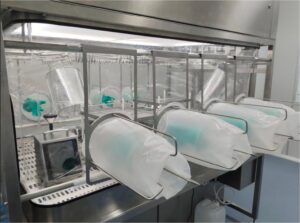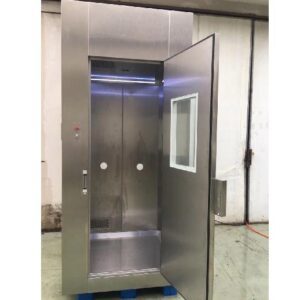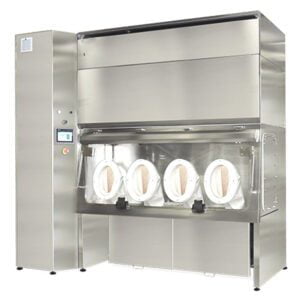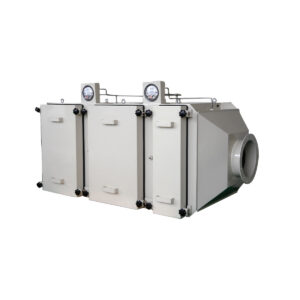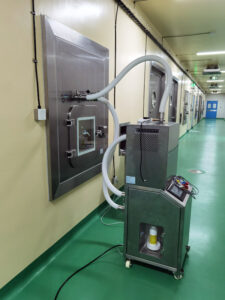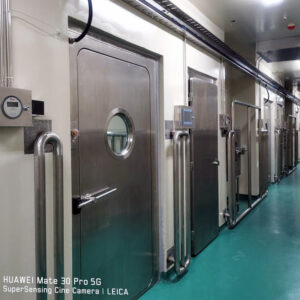
In cleanroom operations, the pass box is a critical but often under-specified component. Selecting the wrong type or neglecting its performance specifications can create a contamination vector that undermines the integrity of your entire controlled environment. The decision isn’t merely about a transfer window; it’s about ensuring material flow doesn’t compromise your facility’s ISO classification or product sterility.
This focus is essential because regulatory scrutiny and quality standards demand documented control over every process. A pass box with inadequate filtration or unvalidated airflow fails this requirement. Understanding the technical specifications for HEPA filters and airflow standards is non-negotiable for maintaining compliance and protecting high-value processes in pharmaceutical, semiconductor, and biotech manufacturing.
What Are the Core Pass Box Types and Their ISO Class Limits?
Defining Static and Dynamic Systems
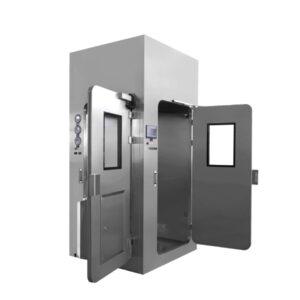
The fundamental choice is between static (passive) and dynamic (active) pass boxes. A static unit lacks internal air cleaning, relying entirely on the pressure differential between the two connected rooms to prevent cross-contamination. This design imposes a significant limitation: it cannot actively scrub particles from items placed inside or from air entering during door cycles. Consequently, its use is restricted to transfers between environments of lower cleanliness.
The ISO Classification Dependency
The compatibility of a pass box with your cleanroom is dictated by ISO 14644-1, which classifies air cleanliness by particle concentration. A static pass box, with no active filtration, cannot maintain conditions cleaner than the dirtier of the two rooms it connects. This inherent limitation caps its application at supporting transfers for ISO Class 7 (10,000) areas or lower. For any process requiring entry into an ISO Class 5 (100) or Class 4 (10) environment, a static box is inadequate and presents an unacceptable risk.
Making the Strategic Selection
The selection is a primary contamination control strategy. Industry experts recommend mapping all material transfer routes during facility design. This proactive planning identifies which junctions require dynamic units to protect critical zones. A common mistake is specifying static boxes for cost savings, only to discover during qualification that they cannot support the required material flow for higher-grade cleanrooms, leading to costly retrofits.
The following table clarifies the operational limits of each pass box type based on its design:
Pass Box Type and Cleanroom Compatibility
| Pass Box Type | Internal Air Cleaning Method | Maximum Supported Cleanroom Class |
|---|---|---|
| Static (Passive) | No active filtration | ISO Class 7 (10,000) |
| Dynamic (Active) | Integrated HEPA filter & fan | ISO Class 5 (100) |
| Dynamic (Active) | Integrated HEPA filter & fan | ISO Class 4 (10) |
Source: ISO 14644-1: Classification of air cleanliness. This standard defines the nine ISO cleanliness classes (ISO Class 1 to 9) by maximum permitted particle counts, establishing the particulate cleanliness level that a pass box must maintain to be compatible with adjacent controlled environments.
How Dynamic Pass Boxes Achieve ISO Class 5 Airflow Standards
Engineering the Laminar Flow Profile
Achieving ISO Class 5 conditions requires precise engineering of the internal airflow. Dynamic pass boxes generate a unidirectional, vertical laminar flow. Air is drawn through a pre-filter, forced by a fan through the HEPA filter in the ceiling, and flows downward in a smooth, non-turbulent stream across the chamber before being recirculated. This laminar profile is essential for sweeping particles away from transferred items and out of the critical zone.
The Critical Velocity Parameter
The effectiveness of this sweeping action hinges on maintaining a specific average face velocity. Standards and industry practice dictate a range of 0.38 to 0.57 m/s (75 to 112 fpm). Velocity below this range risks insufficient particle removal, while excessive velocity can create turbulence, defeating the purpose of laminar flow. This parameter is not a suggestion; it is a mandatory performance criterion verified during Operational Qualification (OQ). In my experience, units that allow for adjustable fan speed to fine-tune this velocity within the validated range offer greater long-term stability as filters load.
Construction as a Prerequisite for Performance
The airflow pattern is only as good as the chamber it flows through. Internal surfaces must be constructed of non-shedding, cleanable materials like stainless steel 304, with seamless, radiused corners. This design minimizes particle generation and allows for effective decontamination. Easily overlooked details like the quality of welds and finish can trap contaminants and fail visual inspection during audits. The strategic implication is clear: the higher initial cost of a properly constructed unit is justified by its cleanability and reliability during validation.
The technical specifications for achieving this standard environment are summarized below:
Key Parameters for ISO Class 5 Performance
| Key Parameter | Specification Range | Critical Function |
|---|---|---|
| Airflow Pattern | Unidirectional, laminar | Particle sweeping |
| Average Face Velocity | 0.38 – 0.57 m/s | Effective particle removal |
| Average Face Velocity | 75 – 112 fpm | Effective particle removal |
| Internal Material | Stainless steel 304 | Non-shedding, cleanable |
Source: Technical documentation and industry specifications.
The Critical Role of H14 HEPA Filters in 99.995% Filtration
Understanding H14 Classification and MPPS
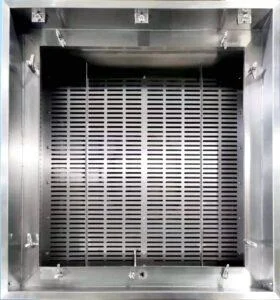
The H14 HEPA filter is the non-negotiable core of a dynamic pass box. Its performance is defined by the EN 1822 standard (also adopted as ISO 29463-1), which classifies it by its minimum efficiency of 99.995% at the Most Penetrating Particle Size (MPPS). The MPPS, typically between 0.1 and 0.3 micrometers, represents the particle size most likely to bypass the filter media. An H14 filter is specifically tested and certified to retain this challenging size with exceptional efficiency.
The System Dependency of Filter Performance
Specifying an H14 filter is only the first step. Its certified efficiency can be nullified by poor system design. Two interdependent factors are critical. First, adequate pre-filtration (using G4 or F8 filters) is essential to protect the HEPA from larger particles that would prematurely clog it, increasing pressure drop and reducing service life. Second, the filter must be installed in a properly designed housing that ensures the certified face velocity is maintained across its entire surface. A filter operating outside its designed velocity range may not perform at its rated efficiency.
Sealing and Housing Integrity
The filter media’s efficiency is meaningless if air bypasses it through poor seals. The gasket between the filter and its housing, and the seals of the housing itself, must be designed for zero leakage. This is why in-situ integrity testing post-installation is mandatory. According to research from filter manufacturers, the majority of “filter failures” detected during leak tests are actually seal or frame bypass issues, not media failures, highlighting that procurement must prioritize total system integrity over filter cost alone.
The following table outlines the filtration standards that govern pass box performance:
HEPA Filter Efficiency Standards
| Filter Class (EN 1822) | Minimum Efficiency at MPPS | Most Penetrating Particle Size (MPPS) |
|---|---|---|
| H14 HEPA | 99.995% | 0.1 – 0.3 micrometers |
| Typical Pre-filter | G4 or F8 grade | Extends HEPA service life |
Source: EN 1822-1: HEPA/ULPA classification. This standard classifies high-efficiency filters, defining the H14 class by its minimum 99.995% retention efficiency at the Most Penetrating Particle Size (MPPS).
Key Design and Construction Features for Seamless Performance
Material and Fabrication Standards
The construction quality directly impacts cleanability and particle generation. Seamless welding on stainless steel 304 (with a minimum thickness of 1.5mm recommended for rigidity) is standard for interiors. Radiused corners (typically ≥25mm) are not an aesthetic choice but a functional requirement to prevent particle accumulation and allow for proper cleaning. Electropolished surfaces further reduce the potential for microbial adhesion and particle shedding. These features are prerequisites for successful cleaning validation and should be non-negotiable in your equipment specification.
Integrated Safety and Interlock Systems
Electronic door interlocks are a critical safety feature that prevents both doors from being open simultaneously, maintaining the integrity of the pressure cascade. UV-C germicidal lamps provide an additional layer of decontamination for the chamber interior. However, these systems introduce operational constraints. Interlocks require defined SOPs for use, and UV-C systems must have safety timers and interlocks that disable the UV lights when doors are open to protect personnel. We compared systems with manual vs. automated UV cycles and found the automated, interlocked systems significantly reduced the risk of operator error and exposure.
The SOP and Training Imperative
The most advanced safety features are ineffective without proper procedures and training. Developing detailed SOPs for loading, unloading, and decontamination cycles is essential. Staff must be trained not only on the procedures but also on the reason behind them—why doors cannot be forced open, why items must be wiped down before transfer, and why the UV cycle must complete. This human factor is often the weakest link in contamination control, making the investment in training as critical as the investment in the equipment itself.
Mandatory HEPA Filter Integrity Testing and Maintenance Schedules
The Integrity Test Procedure
Sustained compliance requires periodic verification that the HEPA filter and its seals are intact. This integrity or leak test, detailed in ISO 14644-3 and IEST-RP-CC034, is performed in-situ. An aerosol challenge (like PAO or DOP) is generated upstream of the filter. A photometer probe then scans the entire filter face, its frame, and the housing seals downstream. The acceptance criterion is stringent: any local leakage must be ≤0.01% of the upstream challenge concentration.
Establishing a Proactive Monitoring Schedule
For ISO Class 5 applications, this test is mandated at least annually, but many facilities opt for biannual testing as a risk-based precaution. This testing cadence should be formalized in a preventative maintenance schedule. Continuous monitoring is provided by a magnahelic gauge or digital sensor measuring the pressure drop across the filter. Establishing a baseline pressure drop after installation and filter replacement allows you to track the filter’s loading over time.
Shifting to Condition-Based Maintenance
The combination of periodic leak tests and continuous pressure monitoring enables a strategic shift from time-based to condition-based maintenance. Instead of replacing filters on a rigid calendar schedule, you can analyze the trend of increasing pressure drop and review historical leak test results. A filter showing a steady pressure increase but passing its annual leak test may have years of remaining service life. This data-driven approach optimizes filter lifespan and reduces long-term operational costs and waste.
The table below outlines the mandatory testing regimen for sustained compliance:
Mandatory Testing and Monitoring Schedule
| Test/Check | Frequency | Key Acceptance Criterion |
|---|---|---|
| Integrity (Leak) Test | At least every 12 months | Local leakage ≤0.01% |
| Differential Pressure | Continuous monitoring | Condition-based trigger |
| Integrity Test Aerosol | PAO or DOP | Standardized challenge |
Source: ISO 14644-3: Test methods and IEST-RP-CC034: HEPA/ULPA Filter Leak Tests. ISO 14644-3 specifies the test methods for cleanroom performance, including HEPA leak tests. IEST-RP-CC034 provides the detailed industry procedure for performing these in-situ leak tests.
Operational Qualification (OQ) and Performance Qualification (PQ)
The Scope of Operational Qualification (OQ)
OQ provides documented evidence that the pass box operates according to its design specifications. This phase tests all functional aspects: verifying correct fan operation and airflow velocity, confirming door interlock sequences work flawlessly, testing alarm functions for door faults or filter blockage, and validating UV-C timer and safety interlocks. OQ essentially answers the question: “Does every feature of this unit work as intended under defined test conditions?”
Demonstrating Performance Qualification (PQ)
PQ goes further, demonstrating that the unit consistently meets performance standards under simulated or actual use over time. This involves particle count testing inside the chamber under “at rest” and “in operation” conditions to prove it maintains ISO Class 5. It may also involve microbial challenges or particulate recovery tests to show it effectively decontaminates transferred items. The rigorous material and construction standards discussed earlier are what make passing these tests possible. A poorly fabricated chamber will fail particle count tests during PQ due to internal shedding.
The Total Cost of Ownership Reality
The high labor cost for validation specialists to execute OQ/PQ protocols reveals a key financial insight. The initial purchase price of the pass box is often a minor component of its Total Cost of Ownership (TCO). The recurring costs of validation, maintenance, and filter replacement dominate. Therefore, selecting a unit designed for easy service access, with straightforward filter change procedures and comprehensive documentation, is a financially sound decision that reduces downtime and specialist labor hours during its lifecycle.
When and How to Replace Your Pass Box HEPA Filter
Identifying Replacement Triggers
Filter replacement is driven by condition, not calendar. The primary triggers are a failed integrity test that cannot be resolved by reseating the filter or replacing gaskets, and an excessive pressure drop that reduces airflow velocity below the validated range (typically when pressure drop reaches 1.5 to 2 times the initial clean value). Physical damage to the filter media, such as punctures or torn pleats, also mandates immediate replacement. Monitoring these parameters allows for planned replacements, avoiding unplanned downtime.
Executing a Controlled Replacement
The replacement process itself is a controlled activity. Technicians must handle the fragile filter media with care, inspecting it for any shipping damage before installation. The filter must be installed in the correct airflow direction, clearly marked on its frame. All sealing surfaces must be clean, and gaskets must be properly seated. Crucially, the unit must not be returned to service until a full integrity test is performed on the newly installed filter to validate the installation. This post-replacement test is a regulatory expectation.
Documenting for Audit Readiness
Every filter replacement generates critical documentation that forms part of your audit trail. This includes the removal record (with old filter serial number), the installation record (with new filter serial number and certificate of conformity), and the post-installation integrity test report. Regulators treat this data integrity as direct evidence of a state of control. Implementing a digital logbook or CMMS to manage these records streamines audit preparation and demonstrates robust quality management.
The decision points for filter replacement are guided by the following conditions:
HEPA Filter Replacement Triggers and Actions
| Replacement Trigger | Action | Subsequent Requirement |
|---|---|---|
| Failed integrity test | Replace filter | Immediate post-replacement test |
| Excessive pressure drop | Replace filter | Validate airflow velocity |
| Physical media damage | Replace filter | Integrity test validation |
Source: Technical documentation and industry specifications.
Developing a Lifecycle Management Plan for Sustained Compliance
Formalizing the Maintenance Strategy
A lifecycle management plan integrates all previous elements—testing schedules, condition-based replacement, requalification protocols—into a single, sustainable document. It moves from ad-hoc reactions to proactive strategy. The plan should assign responsibilities, define procedures for routine checks (like visual inspections and pressure drop recording), and schedule the mandatory annual integrity tests and periodic requalification (OQ/PQ). It must also account for the resource planning required, including budget for specialist technicians and potential production downtime during testing.
Integrating Data for Informed Decisions
The plan’s effectiveness hinges on data integration. Trend analysis of pressure drop data and historical test results informs filter replacement forecasts and budget cycles. This analysis can also identify unusual patterns that may indicate operational issues, like a sudden pressure drop change suggesting a filter bypass. Maintaining a centralized repository for all pass box documentation, from initial DQ/IQ/OQ/PQ protocols to every service report, creates a complete asset history that is invaluable for investigations and audits.
Evolving Towards Smart Process Nodes
Strategically, the pass box is evolving from a simple transfer point to a smart process node. Future-focused planning should consider connectivity needs. Next-generation units may embed IoT sensors for real-time particle counting and filter health monitoring, transmitting data directly to facility-wide environmental monitoring systems (EMS). When specifying new equipment or planning upgrades, evaluating connectivity options positions the pass box as a data-generating control point within a digitized cleanroom infrastructure, enabling predictive maintenance and enhanced quality assurance.
A structured plan ensures all critical activities are scheduled and executed:
Components of a Lifecycle Management Plan
| Plan Component | Typical Cadence | Strategic Goal |
|---|---|---|
| Integrity Testing | Biannual / Annual | Condition-based maintenance |
| Requalification (OQ/PQ) | Post-maintenance / Periodic | Documented performance evidence |
| Data Review & Analysis | Continuous / Scheduled | Audit trail creation |
Source: Technical documentation and industry specifications.
Effective pass box management requires aligning equipment selection with your highest ISO class, committing to a rigorous validation and testing regimen, and adopting a data-driven, condition-based maintenance strategy. The priority is integrating this equipment into your quality system through documented procedures and comprehensive training. Neglecting any of these pillars introduces a documented risk to your process sterility and regulatory standing.
Need professional guidance on specifying and validating dynamic pass boxes or sourcing reliable fan filter units and laminar flow equipment? The technical team at YOUTH can support your project from design through qualification.
For specific technical consultations or project quotes, you can also Contact Us.
Frequently Asked Questions
Q: What is the key operational difference between static and dynamic pass boxes for material transfer?
A: Static units rely on the existing pressure differential between rooms and lack active air cleaning, which restricts their use to supporting environments of ISO Class 7 or lower. Dynamic pass boxes incorporate a fan and HEPA filter to generate their own laminar airflow, enabling them to create and maintain an ISO Class 5 environment internally. This means facilities planning transfers into ISO Class 5 or cleaner zones must specify dynamic pass boxes from the outset of material flow design.
Q: How do you verify that a dynamic pass box maintains its required ISO Class 5 environment?
A: You confirm performance through a two-stage qualification process. Operational Qualification (OQ) tests all mechanical functions like door interlocks and fan operation. Performance Qualification (PQ) then provides documented evidence that the unit consistently maintains the specified particulate cleanliness level under normal use over time. For projects where validation labor is a major cost driver, selecting a unit with service-friendly design and robust construction is a critical factor for controlling long-term ownership costs.
Q: What specific HEPA filter efficiency is required for an ISO Class 5 pass box, and how is it tested?
A: An H14-grade HEPA filter, as classified by EN 1822-1, is mandatory, providing a minimum efficiency of 99.995% at the Most Penetrating Particle Size (MPPS). Its integrity must be validated through periodic in-situ leak testing, following the methodology in ISO 14644-3, to ensure no bypass around the filter media or seals. This procedural rigor means your maintenance plan must budget for annual specialist testing to sustain compliance.
Q: When should you replace the HEPA filter in a dynamic pass box?
A: Replacement is condition-based, triggered by a failed integrity test, an excessive pressure drop that compromises the required 0.38-0.57 m/s airflow velocity, or visible physical damage. A new filter must be immediately leak-tested post-installation, and all steps must be documented to create an audit trail. This approach shifts your strategy from fixed schedules to performance monitoring, allowing you to maximize filter service life and reduce long-term operational costs.
Q: What are the critical design features to look for in a pass box for high-grade cleanrooms?
A: Prioritize seamless construction with non-shedding materials like stainless steel 304, radiused corners for cleanability, and integrated safety interlocks that prevent simultaneous door opening. These features are non-negotiable prerequisites for successful cleaning, validation, and preventing cross-contamination. If your operation requires frequent transfers, plan for the associated development of detailed SOPs and staff training to manage these built-in safety constraints effectively.
Q: How does a lifecycle management plan for a pass box reduce long-term compliance risk?
A: A formal plan integrates condition-based filter replacement, schedules mandatory HEPA filter integrity tests, and outlines requalification protocols, creating a predictable framework for sustained control. It accounts for the significant recurring costs of specialist labor and potential downtime. This strategic view positions the pass box as a controlled process node, enabling you to budget accurately and prepare for future integration with facility-wide environmental monitoring systems.
Related Contents:
- HEPA Filter Testing: Ensuring Optimal Performance
- VHP Pass Box Pressure Control: ISO 14644 Compliance
- VHP Pass Box Market Forecast: 2025-2030 Growth Analysis
- Aerospace HEPA Housing Box Requirements & NASA Standards
- What is the Efficiency Rating of HEPA Housing Boxes?
- Pass Box Pressure Differential Requirements: How to Maintain Optimal Airflow Between Cleanroom Zones
- Airflow Velocity Testing for Mobile LAF Carts
- VHP Pass Box Validation: IQ/OQ/PQ Compliance Checklist
- The Complete Pass Box Selection and Implementation Guide for Cleanroom Contamination Control: 2025 Edition with GMP and ISO 14644 Compliance Framework