Selecting the wrong booth configuration for a potent compound becomes a project-stage problem rather than a procurement problem — the mismatch typically surfaces during commissioning qualification or a regulatory inspection, not at the point of purchase. At that stage, a booth that looked compliant on the specification sheet but lacks the structural features required for its assigned OEB level may require redesign, replacement, or a containment engineering review that delays production release by months. The decision that prevents this outcome is not choosing between a dispensing booth and a sampling booth as product categories; it is confirming that the booth’s airflow architecture, filtration configuration, and containment performance have been validated against the specific OEB classification of the compound it will handle. What follows gives procurement leads, EHS managers, and process engineers the criteria to make that judgment before infrastructure is committed.
Containment Level Classification: OEB 1–5 and the Occupational Exposure Band Framework
The occupational exposure band framework exists to answer one practical question: how much airborne containment does this booth need to provide? The answer drives every configuration decision that follows — airflow direction, exhaust mode, the presence or absence of glove ports, and whether surrogate powder testing is required before the booth can enter production use.
OEB classification organizes APIs and intermediates into bands based on their occupational exposure limit (OEL), which expresses the maximum airborne concentration considered safe for an eight-hour work period. The bands run from OEB 1, covering compounds with OELs above 1,000 µg/m³ where standard engineering controls are sufficient, up through OEB 5, covering highly potent active pharmaceutical ingredients (HPAPIs) with OELs below 0.1 µg/m³ that demand closed isolator technology. The critical planning threshold for booth selection sits between OEB 3 and OEB 4.
OEB 3 compounds — those with OELs in the 10–100 µg/m³ range — can be handled in a standard downflow dispensing booth operating at a face velocity of approximately 0.4 m/s, provided the booth is correctly installed and the airflow is uniform across the working opening. OEB 4 compounds, with OELs in the 1–10 µg/m³ range, require a minimum inward face velocity of 0.5 m/s at the working opening and a validated containment performance of less than 1 µg/m³ at the operator breathing zone. That gap — 0.4 m/s at OEB 3 versus 0.5 m/s with validated breathing-zone performance at OEB 4 — is where the majority of misselection errors originate. Teams specify face velocity and assume containment equivalence across both bands, without recognizing that the structural features required to achieve breathing-zone performance at OEB 4 go beyond airspeed alone.
At OEB 5, open-booth configurations are not appropriate regardless of airflow velocity. Compounds at this hazard level require barrier isolator technology with defined decontamination protocols, and any booth specification that presents itself as OEB 5-capable without full enclosure and validated decontamination access should be treated with caution.
Using OEB band as the primary filter for booth selection — before reviewing velocity specifications, filtration configuration, or vendor performance data — prevents the more expensive error of confirming hardware details on a booth that was never appropriate for the compound class.
Weighing Booth Design: LAF Direction, Filter Configuration, and Airflow Velocity Requirements
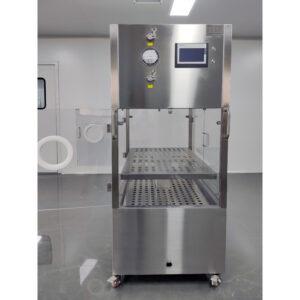
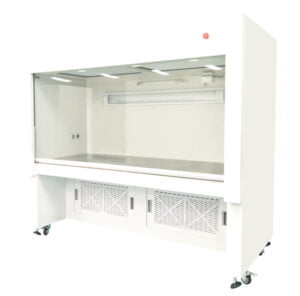
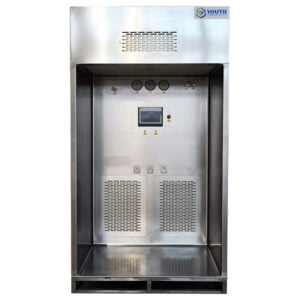
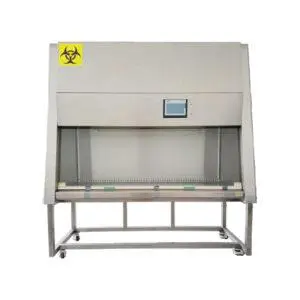
The dominant design for pharmaceutical powder dispensing is vertical laminar airflow with downflow recirculation, where HEPA-filtered air descends through the work zone, captures airborne particles, and returns through a low-level return plenum to be re-filtered before recirculation. This pattern creates a consistent curtain of clean air over the product and work surface while directing particulate away from the operator’s breathing zone. It is the configuration that underlies most dispensing booth installations for solid API handling.
Face velocity is the most frequently cited performance parameter in booth specifications, and the baseline figure recognized in industry practice is 0.45 m/s ±0.05 at the working opening. The adjustable range on configurable units typically spans 0.3 to 0.6 m/s, which is wide enough to accommodate OEB 3 through the lower range of OEB 4 requirements by adjusting velocity without hardware changes. However, a booth specification that lists velocity range without specifying the filtration stage configuration should prompt additional scrutiny, because velocity alone does not determine whether the booth can achieve the containment efficiency required at a given OEB level.
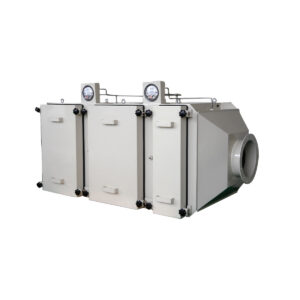
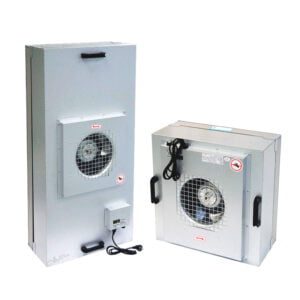
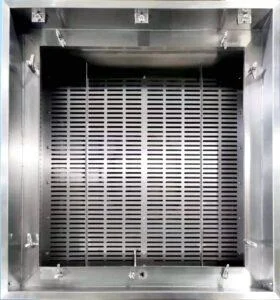
Filtration architecture directly determines the concentration of fine particles reaching the operator. A three-stage progression — pre-filter, intermediate filter, and final HEPA stage rated to EU H14 (99.995% efficiency at 0.3 µm) — represents a common and capable configuration for pharmaceutical powder applications. The pre-filter extends service life for the higher-efficiency stages and reduces maintenance frequency; the intermediate stage provides a first-pass capture layer for sub-micron particles before the HEPA stage handles final filtration. This is a standard implementation approach rather than the only compliant design, but it is a reasonable baseline to compare against when evaluating competing booth specifications.
The exhaust configuration introduces a harder trade-off that deserves attention early in procurement. Recirculating booths — those that return 100% of air through internal HEPA filtration without exhausting to atmosphere — are efficient for solid API dispensing: they reduce the HVAC load on the surrounding cleanroom and eliminate the cost of continuous makeup air supply. The limitation is explicit: recirculating configurations cannot be used for volatile solvent handling, where the risk of accumulating solvent vapor concentration inside the recirculation loop is a process and safety concern. Booths designed for limited solvent handling typically incorporate a partial exhaust configuration, diverting roughly 10–15% of supply air to atmosphere while recirculating the remainder. This reduces HVAC efficiency relative to full recirculation but extends the booth’s operational scope. The more consequential version of this trade-off — a full shift to 100% exhaust-to-atmosphere for volatile API sampling — carries significant infrastructure cost, including exhaust ducting, stack design, and continuous makeup air supply. Once a booth is installed in a recirculating configuration, converting it to full exhaust is rarely a simple retrofit.
Each of these design parameters interacts with the others, and the procurement decision becomes more defensible when they are reviewed together rather than in isolation.
| Design Parameter | Key Specification | Purpose / Functional Impact |
|---|---|---|
| Inward Face Velocity | 0.45 m/s ±0.05 baseline | Establishes the baseline airflow required for operator protection and containment. |
| Adjustable Air Velocity | 0.3 to 0.6 m/s typical range | Allows the booth to be tuned for different containment levels (e.g., OEB 3 vs. OEB 4). |
| Filtration System | Three-stage (pre-filter, intermediate, HEPA, EU-14) | Ensures progressive particle capture, with the final HEPA stage critical for high-level containment. |
| Airflow Pattern | Vertical, recirculatory HEPA-filtered downflow | Core design for product protection and operator safety during powder handling. |
| Exhaust Configuration | Partial exhaust (e.g., 10-15% of supply air) | Design variant that allows for limited solvent handling but impacts HVAC efficiency. |
One functional detail that often goes unreviewed at specification stage is airflow uniformity across the face of the working opening. A booth that meets the 0.45 m/s baseline at the geometric center of the opening may have velocity gradients at the perimeter that create low-flow zones — entry points for cross-contamination or particulate escape during operator movement. Commissioning qualification should include multi-point velocity mapping at the working opening, not a single-point centerline measurement.
HPAPI-Specific Requirements: Closed Containment, Glove Port Integration, and Decontamination Access
For OEB 4 compounds and any API approaching the upper boundary of this band, open-face booth configurations present a structural limitation that increased face velocity cannot reliably overcome. The issue is not airspeed but geometry: an open working face creates conditions where operator movement, turbulence from material transfer, and the physical proximity of the operator’s upper body to the work surface can disrupt the laminar airflow pattern enough to allow particulate migration toward the breathing zone. Booths without perimeter air curtains or negative pressure chamber design regularly fail surrogate containment testing at OEB 4 requirements — a performance gap that appears only when the booth is tested under realistic worst-case conditions, not during a static velocity measurement.
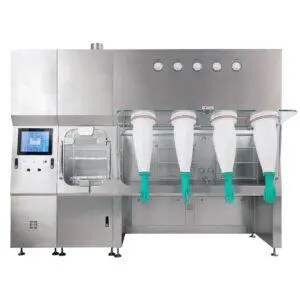
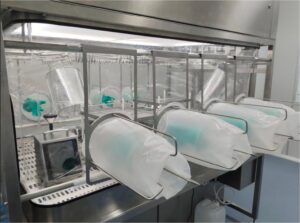
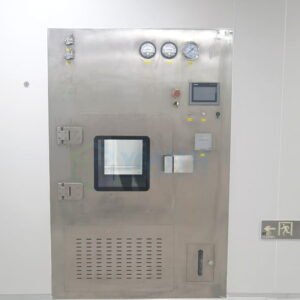
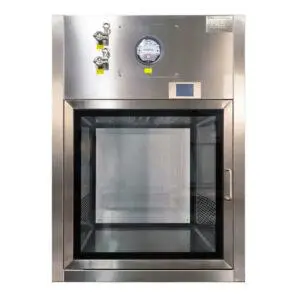
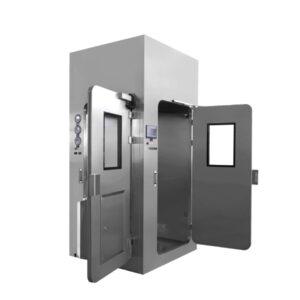
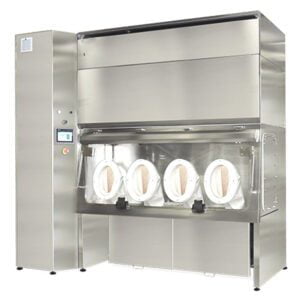
The structural response to this limitation is a move toward closed containment: an enclosed work chamber separated from the operator environment by a rigid barrier, with access managed through glove ports and visual monitoring through a fixed viewing window. This configuration maintains the integrity of the contained zone during material manipulation, dispensing, and transfer, because the operator’s arms enter the work zone through sealed port assemblies that prevent uncontrolled particulate exchange. For dispensing and sampling booths handling compounds in the OEB 4 range or above, glove port integration should be treated as a configuration requirement to confirm at specification stage, not an optional upgrade.
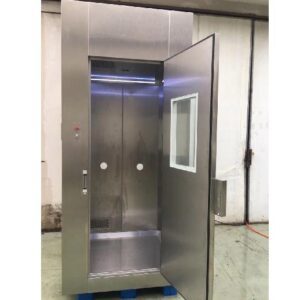
The interlocked access door is the feature most frequently underspecified in HPAPI booth procurement. An interlock ensures the chamber cannot be opened while the airflow system is inactive — a basic but essential protection against operator exposure during startup, shutdown, or a power interruption. Confirming that the interlock is hardwired into the booth’s control logic (rather than a procedural safeguard relying on operator discipline) is a straightforward review check that carries significant audit defensibility.
| Critical Feature | What to Confirm | Why It Matters for HPAPI Handling |
|---|---|---|
| Glove Port Access | Booth includes ports for direct material manipulation. | Enables handling of potent compounds while maintaining closed containment integrity. |
| Enclosed Work Chamber | Booth has a sealed chamber with viewing window and interlocked door. | Provides critical physical separation between operator and materials to maintain containment. |
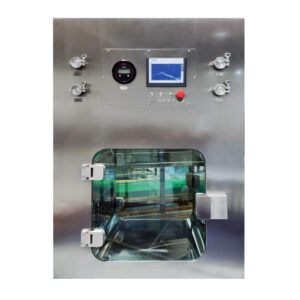
Decontamination access is the third feature that distinguishes an HPAPI-capable closed booth from a standard downflow dispensing configuration. The work chamber surfaces, glove ports, and any internal fixtures that contact the potent compound must be decontaminatable without breaching containment or creating secondary exposure risk for maintenance personnel. This typically means smooth, coved internal geometry with no dead zones, dedicated wash-in-place access points or removable liner panels, and compatibility with the decontamination chemistry appropriate for the specific compound. If the booth supplier cannot provide decontamination procedure documentation and material compatibility data for the compounds to be handled, that gap represents a validation obstacle that will not be resolved by face velocity data or filter efficiency certificates.
For organizations working with filter changeout at maintenance intervals, the filter replacement pathway on HEPA-equipped booths handling potent compounds warrants specific review. Bag-in-bag-out (BIBO) filter housings allow spent filter cartridges to be bagged and sealed in place before removal, eliminating direct contact exposure for maintenance staff. Where a booth operates in an environment with potent compound loading on the filters, BIBO housing configurations should be specified from the outset rather than retrofitted after commissioning.
Booth Performance Testing: Surrogate Powder Challenge and Containment Performance Benchmarks
The go/no-go threshold used by quality and EHS teams in pharmaceutical environments is straightforward: any compound with an OEL below 10 µg/m³ — which places it at OEB 4 or higher — requires surrogate containment performance testing conducted by a certified laboratory before the booth can be used in production, regardless of manufacturer face velocity claims. This criterion exists because face velocity and filter efficiency specifications describe what a booth is designed to do under static conditions; surrogate powder challenge testing measures what the booth actually does under conditions that simulate production use, including operator movement, material transfer, and realistic work procedures.
Surrogate powder testing uses a fine, non-hazardous powder — typically lactose monohydrate or naproxen — as a proxy for the actual API. The powder is dispensed inside the booth at a defined rate while air samples are collected at multiple points in the operator’s breathing zone. The resulting concentration data is compared against the containment performance target derived from the OEL for the compound the booth is intended to handle. Alignment with the ISPE Good Practice Guide for assessing particulate containment performance provides the methodology framework for this testing, ensuring that sampling locations, sampling duration, challenge rate, and analytical methods are defined consistently enough that results are comparable across test events and defensible in regulatory review.
A failure during surrogate testing does not necessarily indicate that the booth is irreparable. It does indicate that the booth, as installed and operated, cannot demonstrate the required containment performance under worst-case conditions. Common sources of surrogate test failure include non-uniform face velocity across the working opening, turbulence induced by the HVAC supply air entering the surrounding room, inadequate return air capture at the low-level plenum, and operator body positioning that disrupts the downflow pattern. Each of these is a correctable finding, but correction requires engineering analysis and retesting — a sequence that adds weeks to commissioning timelines and, if discovered during a regulatory inspection rather than planned qualification, carries substantially greater consequences.
The practical implication is that surrogate testing should be scheduled as part of the booth commissioning plan, before the compound assignment is finalized and before production scheduling assumes booth availability. Treating it as a post-installation confirmation step rather than a prerequisite for operational release is the single most common source of schedule compression in potent compound facility startups.
Regulatory Guidance: EU GMP Annex 1, ISPE Containment Manual, and OEL Documentation Requirements
Regulatory frameworks for booth selection and validation are applied selectively based on the facility context, compound class, and manufacturing scope — they are not uniformly applicable to every dispensing or sampling booth installation. Understanding which framework governs a specific installation determines what documentation must be generated, how testing must be structured, and where gaps in that documentation create audit risk.
EU GMP Annex 1, in its 2022 revision, applies directly to the manufacture of sterile medicinal products and defines contamination control strategy requirements that extend to containment equipment operating within sterile manufacturing environments. Where a dispensing booth is installed within or adjacent to a classified cleanroom environment supporting sterile product manufacture, Annex 1’s contamination control requirements are directly relevant to booth design, qualification, and ongoing monitoring. For general API dispensing or sampling operations outside sterile manufacturing scope, Annex 1 provides useful design principles but does not govern the installation as a regulatory mandate. Conflating the two creates over-engineered validation packages for non-sterile installations and, more importantly, may create the false impression that a booth in a non-sterile suite has been validated to a more demanding standard than the evidence actually supports.
EU GMP Annex 15, which addresses qualification and validation, introduces a separate timeline consideration that procurement teams regularly underestimate. Worst-case scenario definition for dispensing booth validation requires operational data: data on the maximum fill weights actually dispensed, the range of compounds processed, and the conditions under which operator movement during dispensing is most likely to challenge the airflow pattern. That data may take six to twelve months of routine operation to accumulate in sufficient quantity to define a defensible worst-case scenario. Booths commissioned for potent compound handling cannot always be fully validated and released for unrestricted production use as quickly as project schedules assume.
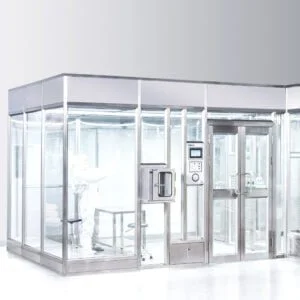
ISO 14644-1 governs airborne particle cleanliness classification for cleanroom and clean zone environments and applies directly where a dispensing or sampling booth operates within a classified cleanroom or is itself expected to maintain a specific particle cleanliness grade at the point of dispensing. Where a booth is specified to maintain ISO Class 5 at the work surface, classification testing per ISO 14644-1 is the governing methodology for verifying that claim. This is distinct from containment performance testing — a booth can maintain ISO Class 5 particle cleanliness at the work zone while still failing to contain respirable API particulate at the operator breathing zone, because these are separate performance parameters measured by different test methods.
OEL documentation is the connective tissue between the compound hazard classification and the booth performance specification. If the OEL for a compound changes — as hazard assessments are periodically revised — and the booth’s validated containment performance was not documented against a specific OEL target, the organization may be unable to demonstrate that the current configuration remains appropriate for the compound at its revised hazard level. Documenting the OEL basis for containment performance targets at the time of validation, and including that documentation in the change management system, is the step that prevents this from becoming an audit finding years after commissioning.
| Standard / Framework | What to Clarify | Impact on Booth Design & Operation |
|---|---|---|
| GMP & ISO Standards | Booth is designed with suitable materials for adherence. | Ensures the booth meets the material and construction requirements of pharmaceutical production environments. |
| ISO 14644-1 | Booth supports operations subject to airborne particle cleanliness classification. | Directly ensures the booth meets cleanroom classification requirements for particulate control. |
| ISPE Good Practice Guide | Containment performance verification is aligned with this guide. | Ensures validation testing follows industry-accepted methodologies for particulate containment. |
The ISPE Containment Manual and the associated Risk-MaPP guidance provide a coherent framework for linking compound hazard assessment to containment equipment selection and performance verification. Their value in the context of regulatory submissions is not that they carry legal force, but that demonstrating alignment with recognized industry guidance significantly reduces the burden of justifying design decisions to inspectors who are familiar with the same frameworks.
The most defensible booth selection is one where the OEB classification of the compound, the validated containment performance of the installed booth, and the documented OEL basis for that performance are all traceable to each other before production begins. The configurations that generate audit findings and commissioning delays are almost always those where one of those three elements was treated as implicit — assumed from a face velocity figure, inferred from a similar compound, or deferred until operational data was available.
Before procurement is finalized, the questions that most clearly separate a functional installation from a future qualification problem are: Has surrogate containment testing been required as a commissioning deliverable, not an optional verification? Is the exhaust configuration — recirculating or exhaust-to-atmosphere — aligned with the full range of compounds that may be processed in this booth over its service life, including any compounds under development? And is the OEL documentation that anchors the containment performance target current, and stored where it will be accessible during the next regulatory inspection? Answering those three questions at specification stage costs hours. Answering them after installation can cost months.
Frequently Asked Questions
Q: Our facility handles both OEB 3 and OEB 4 compounds — can a single booth configuration cover both, or do we need separate installations?
A: A single booth with adjustable face velocity can cover OEB 3 and the lower boundary of OEB 4, but only if surrogate containment testing has been conducted and passed under OEB 4 worst-case conditions for that specific installation. The adjustable velocity range of 0.3–0.6 m/s accommodates both bands mechanically, but velocity adjustment alone does not confirm containment equivalence at OEB 4 — breathing-zone performance must be validated independently. If surrogate testing confirms the booth meets the <1 µg/m³ breathing-zone target at OEB 4 parameters, dual-band use is defensible. If testing has not been performed, the booth should be restricted to OEB 3 assignments until it is.
Q: What happens if the compound’s OEL is revised downward after the booth has already been commissioned and validated?
A: The existing validation may no longer demonstrate that the booth is appropriate for the compound at its revised hazard level — unless the original documentation explicitly records the OEL value that anchored the containment performance target. If that OEL basis was not captured in the validation package and linked to the change management system, the organization cannot readily show that the current configuration remains compliant with the new classification. The immediate corrective step is to locate or reconstruct the OEL basis used at validation, assess the gap between the original target and the revised OEL, and determine whether the existing surrogate test data still supports the lower threshold or whether retesting under revised worst-case conditions is required.
Q: Is a recirculating booth ever acceptable for a compound that is processed in both solid and solution form at different stages?
A: No — a recirculating booth is not acceptable for any stage that involves volatile solvent handling, regardless of whether the same compound is handled in solid form elsewhere. The recirculation loop creates the risk of accumulating solvent vapor concentration inside the booth, which is both a safety and process concern. Where the same compound moves through solid and solution-phase handling steps, the exhaust configuration must be matched to the most demanding use case. If both steps will occur in the same booth, a 100% exhaust-to-atmosphere configuration is required, with the associated HVAC infrastructure costs planned from the outset. Attempting to manage this through procedural controls on a recirculating unit is not a defensible engineering solution.
Q: Once surrogate containment testing is passed, how often does the booth need to be retested to maintain its validated status?
A: The article establishes surrogate testing as a pre-production commissioning requirement but does not specify a requalification interval — that interval is determined by the facility’s ongoing monitoring program, any changes to the booth configuration or surrounding HVAC conditions, and the requirements of the applicable regulatory framework. As a practical starting point, periodic requalification is typically triggered by physical changes to the booth or room (filter replacement, relocation, room reconfiguration), a significant change in the compound portfolio processed in the booth, or a defined requalification cycle established during initial validation. Treating the initial surrogate test as a one-time event without a defined requalification trigger is a common gap that surfaces during regulatory inspections.
Q: How does a closed containment booth with glove ports compare to a barrier isolator for OEB 4 compounds — when does one become more appropriate than the other?
A: A closed containment booth with glove ports represents a practical middle configuration between an open-face downflow booth and a full barrier isolator, and its appropriateness for OEB 4 depends on whether surrogate testing confirms it achieves the <1 µg/m³ breathing-zone target under worst-case conditions for the specific compound and process. Where it passes that threshold, it offers lower capital cost and greater operational flexibility than a barrier isolator. A barrier isolator becomes the more appropriate solution when compounds approach the OEB 4–5 boundary or when the process involves conditions — high-energy powder generation, extended exposure duration, or complex transfer steps — that create turbulence a closed booth cannot reliably contain. The decision point is performance-test outcome, not OEB band alone.
Related Contents:
- Precision Weighing Booths for Pharmaceutical Industry
- Weighing Booth vs Scale Room: Which is Right for You?
- What is a Weighing Booth? Essential Facts Explained
- Boost Productivity with Automated Weighing Booths
- 7 Steps to Perfectly Calibrate Your Weighing Booth
- The Ultimate Guide to Weighing Booths [2025 Edition]
- Weighing Booth ROI: Maximizing Your Investment
- How to Calculate Required Air Velocity for Weighing Booth Containment Performance
- 5 Critical Safety Features in Modern Weighing Booths