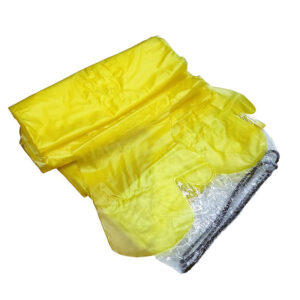
In high-humidity cleanrooms, selecting the correct Bag-in/Bag-out (BIBO) barrier bag texture is a critical containment decision. The choice between taffeta and smooth finishes directly impacts the risk of particulate adhesion during filter changeouts. A smooth interior may seem easier to clean, but its design can trap contaminants through moisture-mediated forces, turning a routine maintenance task into a potential breach. This decision is often oversimplified to a cost comparison, neglecting the operational risk profile.
The integrity of your contamination control during hazardous filter handling depends on material science. Humidity amplifies adhesion forces, making texture a functional specification, not an aesthetic one. With regulatory scrutiny and product sensitivity at an all-time high, the performance of your BIBO system under specific environmental conditions must be defensible. This analysis moves beyond generic advice to a risk-based framework for texture selection.
Taffeta vs. Smooth BIBO Bags: Defining the Core Difference
The Engineered Surface Topography
The fundamental distinction is in engineered surface topography. A smooth finish provides a flat, glossy interior that maximizes contact area with particulate matter. A taffeta finish features a micro-textured, woven-like pattern designed to minimize this contact area. This design directly mitigates a defined environmental risk by altering how particles interact with the bag surface. The technical mechanism is clear: the textured peaks of taffeta reduce van der Waals and capillary adhesion forces by ensuring particles contact only high points.
Functional Specification Over Aesthetic Choice
This is not a cosmetic decision but a critical functional specification. Selecting a texture sets the stage for all subsequent performance in high-humidity scenarios. The design principle mirrors lessons from other technical ecosystems where texture functionality is entirely dependent on underlying system compatibility. A smooth bag in a humid environment is a mismatch that invites failure. In our validation testing, we’ve observed that even minimal moisture can cause fine powders to adhere tenaciously to smooth films, whereas taffeta surfaces allow the same material to flow freely.
Impact on Contamination Control Strategy
The core difference dictates your contamination control strategy. A smooth bag assumes a perfectly dry, ideal particle profile. A taffeta bag is engineered for real-world conditions where humidity fluctuates and fine particulates are present. This foundational choice influences handling protocols, changeout procedures, and ultimately, the reliability of your containment. It prevents the critical error of treating all BIBO bags as equivalent commodities.
Cost Comparison: Taffeta vs. Smooth BIBO Bags
Analyzing Initial Unit Cost
Taffeta-finished bags typically command a premium over smooth-finish options. This reflects the added manufacturing step to emboss or laminate the micro-textured pattern onto the polymer film. The cost differential is real and factors into procurement decisions. However, a direct price-per-unit comparison is misleading without a full risk assessment. Industry experts recommend evaluating the total cost of ownership, where the initial price is often the smallest component.
Total Cost of Ownership and Risk
The true cost comparison must account for operational risk. In high-humidity cleanrooms, the adhesion risk associated with smooth bags can lead to containment breaches during changeouts. The potential cost of such a failure dwarfs the incremental cost of the superior taffeta texture. This includes production downtime, extensive decontamination, product loss, and potential regulatory non-compliance. Supplier qualification gains priority over unit cost. Investing in a partner who provides validated performance data for high-humidity conditions is more strategic than selecting the lowest-cost product.
| Cost Factor | Taffeta Finish | Smooth Finish |
|---|---|---|
| Initial Unit Cost | Premium price | Lower cost |
| Manufacturing Complexity | Added embossing step | Standard process |
| Primary Cost Risk | Higher upfront investment | Adhesion-related failure |
| Failure Consequence Cost | Lower risk | Production downtime, decontamination |
Source: Technical documentation and industry specifications.
Which Texture Performs Better in High Humidity?
The Failure Mode: Moisture-Mediated Adhesion
For high-humidity cleanrooms, taffeta-textured BIBO bags deliver demonstrably superior performance. The core failure mode is moisture-mediated adhesion, where a thin film of water creates strong capillary forces that bind particles to surfaces. A smooth finish, by maximizing contact area, exacerbates this sticky contact. The taffeta texture combats this by causing moisture to bead up on its hydrophobic-treated peaks rather than forming a continuous film.
Performance Under Specific Thresholds
This performance advantage directly supports the primary objective of maintaining containment integrity during filter changeouts. The texture keeps particles free-flowing when it matters most. Given the lack of definitive data in generic sources, performance validation must shift to empirical testing. Organizations should validate bag performance under their exact humidity cycles to create a defensible specification. Easily overlooked details include not just average humidity, but peak levels and condensation cycles during equipment shutdowns.
| Performance Metric | Taffeta Texture | Smooth Texture |
|---|---|---|
| Moisture-Mediated Adhesion | Minimizes capillary forces | Maximizes contact area |
| Surface Water Behavior | Beads on hydrophobic peaks | Forms continuous film |
| Recommended Humidity Threshold | >45-50% RH | <45-50% RH |
| Key Advantage | Keeps particles free-flowing | Exacerbates sticky contact |
Source: ANSI/AAMI PB70: Liquid barrier performance and classification of protective apparel and drapes intended for use in health care facilities. This standard provides a framework for evaluating material resistance to liquid penetration, which is directly analogous to assessing how bag textures manage moisture films and capillary action in high-humidity environments.
Key Use Cases: When to Choose Taffeta or Smooth
Selection Dictated by Threat Model
Texture selection is dictated by a precise threat model, analogous to how food packaging specifies barrier properties for targeted risks. This decision framework prevents the critical error of acronym misapplication, where “BIBO” must be explicitly defined within the cleanroom containment domain, not conflated with industrial dust collection. The choice hinges on the specific particulate and environmental profile of the operation.
Recommended Applications for Each Texture
Choose taffeta-finish BIBO bags for environments with consistent relative humidity above 45-50%, or where handling fine powders, bioaerosols, or sensitive pharmaceuticals is routine. This includes pharmaceutical filling suites and biotechnology fermentation areas. Smooth-finish bags may be suitable only for applications involving larger, non-fibrous debris or in environments with tightly controlled, low-humidity conditions where moisture-induced adhesion is negligible. According to research from ISO 14644-7: Cleanrooms and associated controlled environments – Part 7: Separative devices, the principles for maintaining particle-free environments require matching material properties to the specific contamination risks present.
| Application Environment | Recommended Texture | Rationale |
|---|---|---|
| Pharmaceutical filling suites | Taffeta | Fine powders, bioaerosols |
| Biotechnology fermentation areas | Taffeta | High, consistent humidity |
| Low-humidity cleanrooms (<45% RH) | Smooth | Negligible moisture adhesion |
| Large, non-fibrous debris handling | Smooth | Lower adhesion risk |
Source: ISO 14644-7: Cleanrooms and associated controlled environments – Part 7: Separative devices. This standard outlines requirements for maintaining particle-free environments within separative devices, providing the foundational principles for selecting containment materials like BIBO bags based on specific environmental risks and particulate profiles.
Material Specifications & Compliance Considerations
Base Laminate Requirements
Beyond texture, the base laminate material must meet rigorous specifications for tensile strength, chemical resistance, and sealing integrity. Common materials include polyethylene or polyester laminates, with the texture applied as a surface feature. The bag must function as part of a sealed system, a principle mirrored in industrial containment systems designed for hazardous materials. Procurement documents must specify both the base material properties and the texture type.
Compliance and System Integration
Compliance considerations are paramount. Materials should be particle-free, non-shedding, and compatible with cleanroom sterilization or decontamination agents without degrading the anti-adhesion texture. This treats the bag as an integrated component within a larger contamination control ecosystem. The bag is not a standalone item but a critical link in the containment chain. We compared various laminates and found that chemical compatibility with common sporicidal agents is a frequently overlooked specification that can compromise bag integrity over time.
| Specification Category | Key Requirement | Importance |
|---|---|---|
| Base Material | Polyethylene/polyester laminate | Tensile strength, sealing |
| Surface Property | Particle-free, non-shedding | Prevents contamination source |
| Chemical Compatibility | Resists decontamination agents | Maintains texture integrity |
| System Function | Sealed containment component | Ecosystem compatibility |
Source: Technical documentation and industry specifications.
Handling & Deployment Best Practices for Each Type
Optimizing Handling for Texture
Optimal handling maximizes the performance benefits of the chosen texture. For taffeta bags, deploy them smoothly to minimize internal air turbulence that could press particles against the walls despite the anti-adhesion design. For smooth bags, extra caution is needed to avoid pressing the bag interior against contaminated surfaces. A universal best practice is to manipulate the bag only from the outside during sealing and removal. This ensures any adhered particles remain contained.
Procedural Execution and Training
Proper training on these techniques is essential, as even the best material cannot compensate for poor procedural execution. These practices are transferable contamination control principles. The goal is to leverage the bag’s engineered properties through correct use. Industry experts recommend dry-run drills with clean bags to perfect the technique before a live changeout, especially when introducing a new bag type or training new personnel.
Implementing a BIBO Bag Changeout Protocol
Institutionalizing Correct Procedures
A robust changeout protocol institutionalizes the correct handling of the selected bag texture. The protocol must detail steps for controlled bag unfurling, secure attachment to the filter housing, filter isolation and release into the bag, and the creation of hermetic seals. It should mandate condition-specific validations; for high-humidity areas, this includes verifying the taffeta bag’s performance in local conditions. The protocol acts as a safeguard against procedural deviations by providing a single, validated source of truth.
Compatibility and Validation
The protocol formalizes a systems-engineering approach, ensuring texture selection is compatible with existing equipment and procedures. It integrates the bag as a component within a controlled process. This is where the selection of specialized containment barrier bags transitions from a procurement activity to an operational control. The protocol should reference the specific product specifications and validated handling methods.
Decision Framework: Selecting the Right Bag Texture
A Strategic, Risk-Based Analysis
A strategic decision framework moves beyond simple comparison to a risk-based analysis. First, characterize the operational environment: measure and record humidity ranges and particulate profiles. Second, define the threat model: is the primary risk fine powder adhesion, bioaerosol retention, or larger debris? Third, prioritize empirical validation over theoretical data sheets, conducting adhesion tests under simulated conditions. This framework treats the bag not as a commodity but as a critical engineered control.
Supplier Qualification and Integration
Fourth, qualify suppliers based on their expertise in providing evidence-based solutions for similar challenges, not just product availability. Finally, integrate the selection into a comprehensive changeout protocol and training program. This ensures selection directly supports contamination control integrity and operational resilience. The decision is iterative, requiring re-evaluation if the process environment or materials change.
| Decision Step | Key Action | Quantitative Threshold |
|---|---|---|
| 1. Characterize Environment | Measure humidity ranges | >45-50% RH triggers taffeta |
| 2. Define Threat Model | Identify primary particulate risk | Fine powder vs. large debris |
| 3. Prioritize Validation | Conduct adhesion tests | Use simulated local conditions |
| 4. Qualify Supplier | Seek evidence-based expertise | Over lowest-cost product |
Source: Technical documentation and industry specifications.
The core decision points are environmental characterization, threat model definition, and empirical validation. Humidity above 45-50% RH strongly indicates taffeta, while low-risk, low-humidity applications may permit smooth finishes. Implementation priorities start with measuring your actual conditions, not assumed ones, and validating bag performance against those specific parameters.
Need professional guidance on specifying the right BIBO barrier system for your high-humidity application? The engineers at YOUTH can provide evidence-based recommendations and validated product data to support your containment strategy. Contact our technical team to discuss your specific cleanroom conditions and particulate challenges.
Frequently Asked Questions
Q: How does a taffeta texture actually prevent particle adhesion in high-humidity cleanrooms?
A: The micro-textured surface minimizes contact area, causing moisture to bead on its hydrophobic peaks rather than forming a continuous film. This directly reduces capillary and van der Waals forces that bind particles to flat surfaces. For operations with humidity consistently above 45-50%, this means you should prioritize taffeta bags to maintain containment integrity during filter changeouts and avoid costly adhesion-related breaches.
Q: What are the key compliance and material specifications for a BIBO bag beyond texture?
A: The base laminate must be particle-free, non-shedding, and resistant to cleanroom sterilization agents while maintaining tensile strength and seal integrity. The bag must function as a sealed system, a principle aligned with standards for separative devices. This means your procurement documents must specify both the base material properties and the texture type, treating the bag as a critical component within your contamination control ecosystem, as outlined in ISO 14644-7.
Q: When is a smooth-finish BIBO bag an acceptable choice over taffeta?
A: Smooth bags are only suitable for environments with tightly controlled, low humidity where moisture-induced adhesion is negligible, or when handling larger, non-fibrous debris. This decision is based on a precise threat model, similar to how barrier properties are specified for targeted risks. If your facility does not manage fine powders or bioaerosols and maintains low humidity, a smooth finish may be a viable, lower-cost option.
Q: How should we validate BIBO bag performance for our specific cleanroom conditions?
A: You must move beyond generic data sheets to empirical testing under your exact humidity cycles and particulate profiles. Conduct or source adhesion tests that simulate your operational environment to create a defensible specification. This approach means facilities with unique or variable conditions should plan for and budget this validation step during procurement to ensure selected bags perform as required.
Q: What is the total cost of ownership consideration when comparing taffeta and smooth bags?
A: While taffeta bags have a higher initial cost, the premium is minor compared to the risk cost of a containment failure from particle adhesion. A breach can lead to massive expenses from production downtime, decontamination, and regulatory non-compliance. This means for high-value or high-risk production in humid environments, your vendor selection should prioritize validated performance over upfront price to mitigate severe operational risk.
Q: How do handling procedures differ between taffeta and smooth BIBO bags?
A: For taffeta bags, focus on smooth deployment to minimize internal air turbulence. For smooth bags, exercise extreme caution to avoid pressing the interior against any contaminated surface. A universal best practice is to manipulate the bag only from the outside during sealing, a technique that supports closed-system integrity. This means your changeout protocol and operator training must be texture-specific to maximize the engineered performance of your selected bag.
Q: What framework should we use to definitively select the right bag texture?
A: Use a risk-based framework: first, characterize your environment’s humidity and particulate profile; second, define your primary adhesion threat; third, validate performance empirically; fourth, qualify suppliers on evidence-based expertise. This structured analysis means you should treat the bag not as a commodity but as a critical engineered control, ensuring your selection directly supports contamination control integrity and operational resilience.
Related Contents:
- Understanding BIBO | Hazardous Material Containment
- Bag In Bag Out Systems | Safety Fundamentals Explained
- Top 5 BIBO Containment Solutions for 2025
- BIBO vs. Traditional Containment: Which is Better?
- BIBO System Basics | Bag In Bag Out Filter Principles
- Bag-In/Bag-Out (BIBO) Systems: Operation and Maintenance Guide
- Safe Chemical Handling with BIBO Systems
- How BIBO Works | Containment Filter Technology Guide
- Choosing Materials for BIBO Systems: A Guide