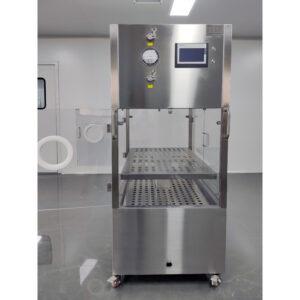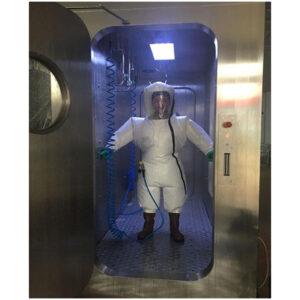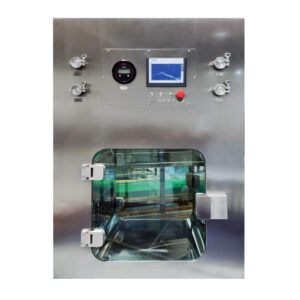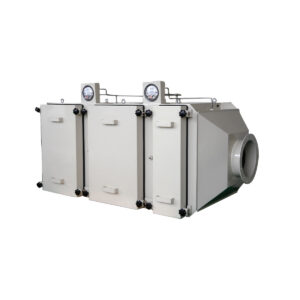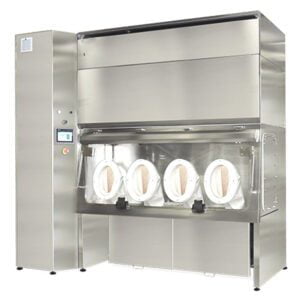
Specifying the wrong pass box type is one of the quieter ways a cleanroom project accumulates commissioning risk. The equipment arrives, the wall opening is cut, and it is only during qualification — or worse, during an audit — that the absence of active airflow control becomes a documented deficiency. The cost is not just the equipment; it is the documentation rework, the physical correction after installation, and the delay to IQ sign-off that follows. The judgment that prevents this is earlier than most teams expect: it is the decision about whether the pressure relationship between the two rooms, the direction of intended airflow, and the cleanliness gap between zones actually justify active transfer equipment before the purchase order is placed. What follows will help you work through those conditions with enough precision to make that decision defensible.
Dynamic pass box use cases in GMP material transfer
The most consequential planning rule for pass box selection is also the most frequently ignored: a dynamic unit is appropriate when the two rooms it connects sit at meaningfully different cleanliness levels, and a static hatch is sufficient when the rooms share the same classification. That distinction is not a regulatory prescription — EU GMP Annex 1 addresses contamination control logic without naming pass box types by classification — but the operational consequence of misapplying it is concrete. A static hatch between an ISO 8 corridor and an ISO 7 filling area cannot actively support the pressure cascade or remove the particles and microorganisms that materials carry across that boundary. The contamination risk is real, and the audit exposure when an inspector asks how material transfer is controlled at that point is difficult to manage without documented active protection.
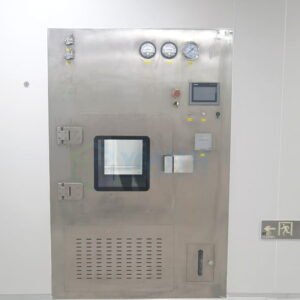
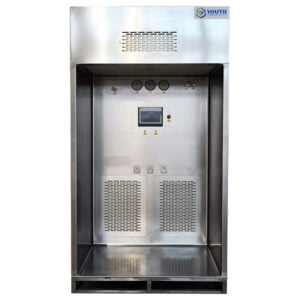
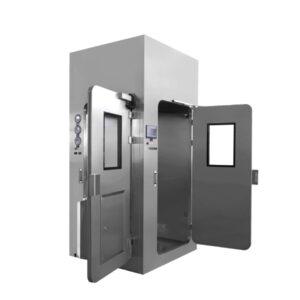
Where the cleanliness gap is significant, a dynamic pass box functions as a final-stage filtration step — purging particulates and biological contamination from materials and their outer surfaces before the receiving door opens. That role is most critical at entries to weighing rooms, filling and packaging areas, and airlocks bridging ISO 8 and ISO 5 zones. In those locations, the chamber air — if the unit is correctly specified and commissioned — is maintained at ISO 5 to ISO 7, which means the material environment during transfer is controlled to a standard approaching the receiving zone itself. That is the operational value being purchased: not just a door sequencing mechanism, but a conditioned intermediate space.
The selection logic is clearest when mapped against the actual transfer situation.
| Transfer Situation | Appropriate Pass Box | Reason |
|---|---|---|
| Transfer between rooms of different cleanliness levels (e.g., ISO 8 → ISO 7) | Dynamic | Active HEPA airflow removes particles and microorganisms, supports pressure cascade |
| Transfer between rooms of the same cleanliness level | Static | No active air purification needed; contamination risk is lower |
| Final‑stage material cleaning before critical zones (weighing, filling/packaging) | Dynamic | Filters dust and microorganisms, preventing batch contamination |
| Airlock between ISO 8 and ISO 5 zones | Dynamic | Maintains chamber air at ISO 5–7, protecting downstream cleanroom |
The table’s “reason” column is worth reading as a risk register rather than a specification checklist. Each scenario where a dynamic unit is recommended describes a situation where passive transfer would leave a protection gap that is difficult to explain to auditors without active airflow evidence.
HEPA airflow and pressure logic that justify active transfer equipment
The case for a dynamic pass box over a static hatch rests on what the active equipment actually does to the air inside the transfer chamber and at the room boundary. A built-in centrifugal fan draws air through a HEPA H14 filter and recirculates it continuously inside the chamber, maintaining laminar airflow at approximately 0.36 to 0.45 m/s. At that velocity through an H14 filter, the internal chamber air approaches ISO 5 performance — a design figure associated with correct specification and commissioning, not a guaranteed output independent of installation quality. The figure provides a measurable performance benchmark for qualification testing under ISO 14644-3, which defines the test methods used to verify it, but the velocity itself is not set by the standard.
The pressure logic matters as much as the filtration. When one door of a static hatch opens, the pressure differential between the two rooms partially equalises at that boundary. If the pressure cascade runs from clean to less-clean — ISO 5 toward ISO 8, for example — a momentary pressure loss during transfer can allow a brief reversal of airflow direction. A dynamic pass box limits that effect by maintaining internal positive pressure relative to the less-clean side, supporting the intended cleaner-to-less-clean gradient even during door operation. This is a planning criterion and operational justification for active equipment, not a guaranteed outcome: the room design, wall penetration sealing, and door sequencing all affect whether the cascade is actually preserved in practice.
The feature-by-feature comparison with static pass boxes is structural enough to carry in tabular form.
| Airflow/Control Feature | Dynamic Pass Box | Static Pass Box |
|---|---|---|
| Built‑in HEPA filter and centrifugal fan | Yes – continuously recirculates and purifies internal air | No |
| Laminar airflow velocity (HEPA H14) | 0.36–0.45 m/s (achieves ISO‑5 cleanliness) | N/A |
| Pressure loss prevention between cleanrooms | Maintains pressure cascade; prevents reverse airflow during door operation | Cannot actively limit pressure loss or airflow direction |
| Air zoning support (cleaner‑to‑less‑clean gradient, e.g., ISO 8→7→5) | Actively supports directional airflow logic | Relies solely on room‑to‑room pressure difference |
The prose implication of the table is this: if the transfer route cannot benefit from any of the active features in the left column — because the rooms share a cleanliness class, the pressure relationship is flat, or the receiving zone has no special airflow requirements — then the added complexity of a dynamic unit is engineering overhead without corresponding risk reduction. The decision to specify active equipment should be traceable to at least one of those features providing a genuine protection function in that installation.
Interlock and filter access details that affect qualification
The interlock and filter service details of a dynamic pass box do not drive the equipment selection decision, but they determine how much qualification work the unit creates after it arrives. Two engineering choices carry the most downstream consequence: whether the interlock is electronic or mechanical, and whether the HEPA filter can be replaced without disassembling the unit.
Electronic and mechanical interlocks both prevent simultaneous door opening — the fundamental containment function — but they do so with different implications for qualification planning. An electronic interlock uses electromagnetic locks and programmable door-sequencing logic, which means it can be integrated with a building management system or SCADA, and its operation can be documented and verified during IQ/OQ in a way that is straightforward to defend in audit. The trade-off is that electronic interlocks introduce wiring dependencies: if the electromagnetic lock routing and control validation are not confirmed with the room’s BMS before fabrication, those gaps surface during installation as modifications that delay IQ sign-off. A mechanical interlock avoids that dependency — it is simpler to validate initially and has fewer failure points — but its fixed logic makes it harder to adapt if transfer protocols change or if future requirements demand more complex sequencing.
| Aspect | Electronic Interlock | Mechanical Interlock |
|---|---|---|
| Door sequencing logic | Electromagnetic locks enforce proper opening sequence | Simpler physical linkage, less flexible |
| Flexibility | Programmable, can integrate with control systems | Fixed logic; harder to adjust for complex transfer protocols |
| Qualification planning impact | Requires coordination of wiring and control validation; supports documented interlock verification | Easier initial validation but may limit adaptability for future requirements |
| Operational reliability | Dependable if properly installed; wiring errors can delay commissioning | Fewer failure points but may be less robust in high‑traffic use |
Neither interlock type is the GMP-required choice. The decision should follow the operational complexity of the transfer protocol and the qualification documentation demands of the facility’s validation framework.
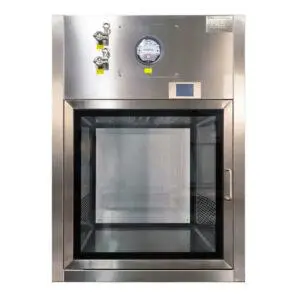
The filter access and pressure monitoring features are qualification planning inputs in a different way. DOP or PAO test ports allow HEPA filter integrity verification during qualification in accordance with ISO 14644-3 test methods — their presence is a prerequisite, not a convenience. If a unit arrives without accessible test ports, filter integrity testing cannot be completed to the required standard without modification. External filter replacement access — meaning the HEPA filter can be changed from the clean side without disassembling the unit — affects ongoing requalification: a design that requires disassembly to change the filter either extends downtime or pressures maintenance teams to skip the changeout, both of which create sustained performance risk.
| Feature | Purpose | What to Confirm |
|---|---|---|
| Integrated differential pressure gauge (0–500 Pa) | Monitors system performance and verifies pressure cascade | Gauge range and placement support routine observation and qualification logging |
| DOP/PAO test ports | Enables HEPA filter integrity validation during qualification | Ports are accessible and standard for ISO 14644 and GMP compliance testing |
| External filter replacement access | Allows HEPA filter change without unit disassembly, supporting maintenance and requalification | Design permits filter replacement from clean side; minimises downtime |
The practical review check before specifying a unit: confirm that test port locations are accessible in the installed position, that filter replacement access is on the correct side of the wall given the room layout, and that electromagnetic lock routing is resolved with the electrical design before fabrication begins. Those three items, left unconfirmed, account for a disproportionate share of commissioning delays on dynamic pass box installations.
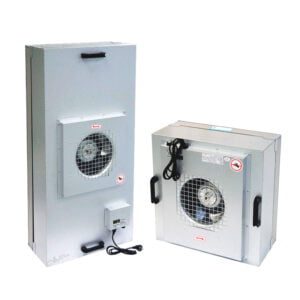
For teams evaluating how a dynamic pass box integrates with the rest of a cleanroom HEPA system, it is also worth confirming that the internal fan and filter specification are consistent with the airflow architecture of the surrounding zone — particularly when fan filter units or terminal HEPA housings in the same space are setting the room’s cleanliness baseline.
Commissioning delays from unclear pressure direction or door logic
Two misspecification patterns account for most of the commissioning problems that dynamic pass box installations generate. The first is substituting a static unit where an active one is required. The second is specifying a dynamic unit without resolving the pressure-direction logic between the rooms it connects.
The first pattern produces a deficiency that is difficult to explain to auditors because it is structural: a static hatch cannot provide active air protection for the receiving side, and no procedural control compensates for that absence. When the receiving room relies on the incoming material being conditioned by active HEPA airflow — as any ISO 5 to ISO 7 zone reasonably does — using a static hatch is not a minor documentation gap. It is a contamination control failure at the equipment selection stage, and commissioning inspectors will identify it as such. The consequence is not a comment to be addressed in the validation report; it is equipment replacement or physical modification after installation.
The second pattern is subtler and more common. A dynamic pass box is specified, the purchase order is placed, and the unit is fabricated — but the pressure relationship between the two rooms has not been formally confirmed. The intended airflow direction (clean to less-clean) may conflict with the actual room pressure differential as designed, or the door sequencing logic may be set up to open in a direction that allows a brief pressure reversal at exactly the moment the receiving door is accessed. These conflicts look minor during design review; they surface as commissioning comments when the pressure cascade test demonstrates that airflow movement during transfer is inconsistent with the intended zoning logic. At that point, the options are documentation rework to justify the actual pressure behaviour, physical correction of the room or unit, or a retest — all of which extend the qualification timeline.
| Risk Scenario | Consequence | What to Clarify Before Fabrication |
|---|---|---|
| Static pass box specified where dynamic unit is needed | Grave non‑compliance unexplainable to auditors; regulatory rejection | Confirm that transfer requires active HEPA airflow; verify cleanliness difference between rooms |
| Static pass box used when receiving side needs active air protection | Pressure cascade failure; commissioning rejection due to incorrect equipment | Check that receiving room relies on active air protection; pressure direction logic aligns with cleaner‑to‑less‑clean route |
The underlying cause of both patterns is the same: the pressure-direction relationship between the two rooms is treated as a detail to resolve after equipment selection rather than as the primary input to it. Confirming that relationship — including the direction of the pressure cascade, the nominal differential, and how the installed unit will interact with it during door operation — is a prerequisite to equipment specification, not a follow-on task. For more on how static and dynamic units differ structurally in ways that affect these decisions, the static vs. dynamic pass box comparison covers the design and application distinctions in detail.
Purchase threshold after airflow path and room relationship are confirmed
The practical purchase threshold for a dynamic pass box is a transfer route that involves a meaningful environmental difference between the two connected rooms. Where that difference exists — most clearly when material is moving into an ISO 4, 5, or 6 cleanroom, or across a classified-to-unclassified boundary — active HEPA airflow provides contamination risk reduction that a static hatch cannot replicate, and the equipment complexity is justified by the protection it delivers. Where the rooms share a cleanliness classification or the receiving zone has no special airflow requirement, the interlock and fan infrastructure adds qualification burden without a corresponding operational benefit.
One operational detail that affects transfer protocol planning more than most teams anticipate is the minimum chamber residence time. Before the receiving door can open, the dynamic pass box chamber needs adequate dwell time — typically in the range of 2 to 5 minutes — for the internal air to reach the intended cleanliness classification. This is a process design input, not a formally standardised regulatory requirement from a named authority, but it is a real constraint. In facilities with high material transfer frequency, that dwell time directly affects throughput, and the transfer protocol must account for it explicitly. A pass box that is correctly specified but used without enforcing the residence time does not deliver the contamination control it was purchased to provide.
The clearest way to frame the purchase decision is as a confirmation exercise rather than a selection exercise.
| Condition | Recommendation | Operational Impact |
|---|---|---|
| Material transfer into ISO 4/5/6 cleanroom | Highly recommend dynamic pass box | Active HEPA airflow protects high‑class environment |
| Transfer route involves meaningful environmental difference (e.g., classified to CNC, or between different ISO classes) | Specify dynamic unit | Added protection reduces contamination risk |
| Need for chamber to achieve higher air classification before receiving door opens | Requires minimum residence time of 2–5 minutes | Transfer protocol must include dwell time; affects throughput |
Buying a dynamic unit before the room relationship is confirmed does not reduce qualification exposure — it creates it. The commissioning failures described in the previous section are not primarily equipment failures; they are specification failures that originate at the purchase stage when the airflow path, door logic, and service access details are still unresolved. The dynamic unit earns its complexity only when all three of those conditions are locked before fabrication begins.
The most actionable output of this evaluation is a short pre-specification checklist: the pressure relationship between the two rooms is confirmed and documented; the intended airflow direction aligns with the cascade direction; interlock type is selected based on protocol complexity and BMS integration requirements; filter access and test port locations are confirmed in the installed position; and the residence time requirement is built into the transfer protocol before the unit is ordered. If any of those items cannot be confirmed, the purchase decision should wait — not because the equipment is wrong, but because unresolved installation variables will surface as qualification problems that are harder and more expensive to fix than they would have been to prevent.
A dynamic pass box is most defensible in audit when its selection is traceable to a documented environmental difference between the two rooms it connects, and when its qualification record shows that airflow velocity, pressure cascade behaviour, filter integrity, and interlock sequencing were all tested against confirmed design criteria. The equipment itself is the easier part. The pre-specification work that makes the qualification straightforward is where the real risk management happens.
Frequently Asked Questions
Q: What happens if the pressure differential between the two rooms hasn’t been measured before the dynamic pass box is ordered?
A: Delay the purchase until the pressure relationship is confirmed. A dynamic pass box specified without a documented pressure cascade direction will likely generate commissioning comments when qualification testing shows that airflow movement during transfer conflicts with the intended cleaner-to-less-clean gradient. At that point, the remediation options — documentation rework, physical correction, or retest — are more expensive than the pre-order confirmation would have been.
Q: Does a dynamic pass box make sense when the transfer frequency is high and throughput is a priority?
A: Only if the transfer protocol explicitly accounts for the chamber residence time. The 2–5 minute dwell period required for the internal air to reach the intended cleanliness class is a fixed constraint per transfer cycle. In high-frequency transfer applications, that dwell time directly limits throughput, and a unit used without enforcing it does not deliver the contamination control it was purchased to provide. If the residence time is operationally prohibitive, the facility design — not the equipment specification — needs to be revisited.
Q: Is an electronic interlock always the stronger choice for GMP qualification purposes?
A: Not necessarily — it depends on protocol complexity and BMS integration readiness. An electronic interlock supports more detailed IQ/OQ documentation and can be integrated with building management systems, which is an advantage in complex facilities. However, if electromagnetic lock routing and control validation are not resolved with the room’s electrical design before fabrication, those gaps appear during installation as modifications that delay sign-off. A mechanical interlock avoids that dependency entirely and is a legitimate choice when transfer sequencing is straightforward and BMS integration is not required.
Q: Can procedural controls substitute for a dynamic pass box when a static hatch has already been installed at a critical transfer point?
A: No. A static hatch cannot provide active air protection for the receiving side, and no written procedure compensates for that structural absence. Where the receiving room relies on material being conditioned by HEPA airflow before entry — as any ISO 5 to ISO 7 zone does — a static hatch represents a contamination control gap at the equipment selection stage. Commissioning inspectors treat this as a physical deficiency requiring equipment replacement or modification, not a procedural comment resolvable in the validation report.
Q: At what point does a dynamic pass box stop being worth the added qualification burden compared to a static unit?
A: When the two connected rooms share the same cleanliness classification and the pressure relationship between them is flat. In that situation, none of the active features — HEPA recirculation, pressure support during door operation, or conditioned dwell time — provide a protection function that a static hatch cannot replicate at lower complexity and qualification cost. The added interlock wiring, filter integrity testing, and BMS integration requirements become engineering overhead without a corresponding reduction in contamination risk. The dynamic unit earns its complexity only when a meaningful environmental difference between the two rooms exists and is documented.