Choosing the wrong clean air delivery device at the layout stage rarely surfaces as an obvious specification error — it shows up later, during qualification, when a distributed ceiling system cannot produce a defensible first-air boundary at the actual work surface, or during a routine filter change that requires partial ceiling disassembly nobody planned access for. The cost is not just procurement rework; it can be a delayed IQ/OQ cycle, an audit finding on contamination control rationale, or an ongoing maintenance burden that degrades pressure cascade integrity at every service event. The decision that resolves this is not which device is “best” — it is which device matches the protection location, the airflow direction the process requires, and the filter access method the facility can actually support. By the end of this article, you will be better placed to evaluate each device against those constraints before the layout is locked.
Clean Air Delivery Depends On Protection Location
Where clean air must arrive — and whose exposure it is managing — determines which device class belongs in the design. A ceiling supply module, a fixed terminal housing, and a local unidirectional work-zone unit are not interchangeable approaches to the same problem; they each address a different protection boundary, and conflating them early is one of the more consistent sources of qualification friction.
| Device Type | Protection Location | Primary Function |
|---|---|---|
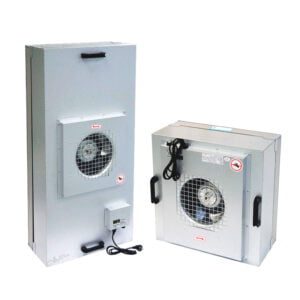
| FFU (Fan Filter Unit) | Ceiling — distributed supply | Modular unit delivering clean air downward at controlled velocity for broad coverage |
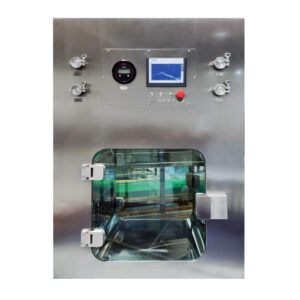
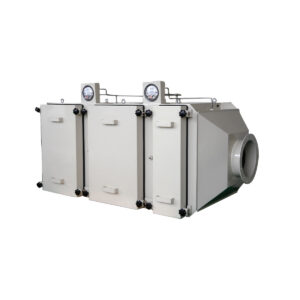
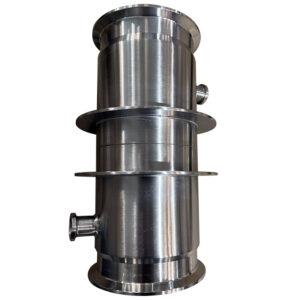
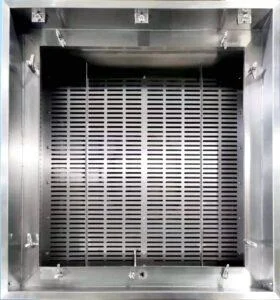
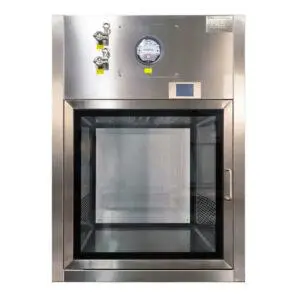
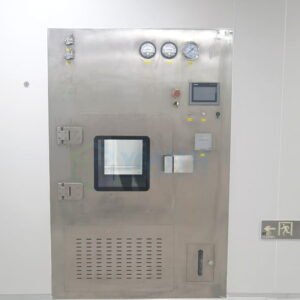
| HEPA Housing | Fixed terminal supply point | Houses a HEPA filter to deliver filtered air from ductwork to a specific location |
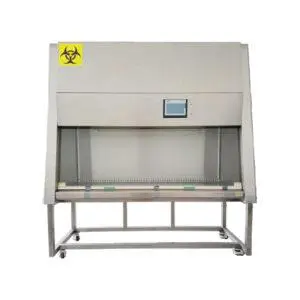
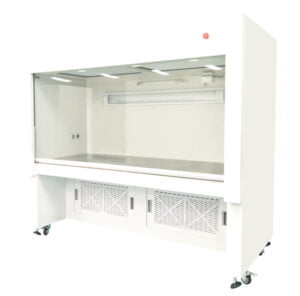
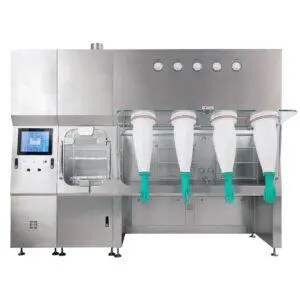
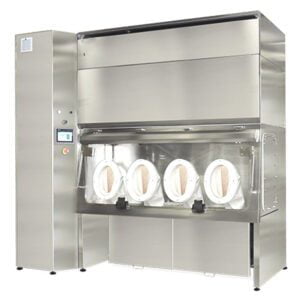
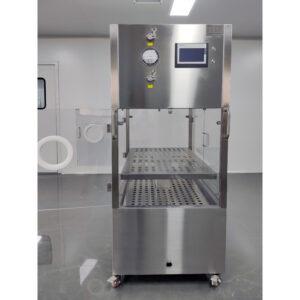
| LAF Unit (Laminar Airflow) | Local work zone | Self-contained unit providing unidirectional clean air at the work surface for product/personnel protection |
The table distinction is structural, but the practical implication is that each device’s role must be matched to a specific location in the contamination control strategy before any equipment specification begins. An FFU delivers clean air to the room environment. A HEPA housing delivers filtered air to a fixed terminal supply point within a duct system. A LAF unit delivers unidirectional clean air to the operation itself. All three may coexist in a single facility — or even a single room — without overlapping function, because they are protecting different zones at different distances from the critical process.
The planning error that produces the most downstream damage is treating room-level devices as substitutes for local-protection devices. Raising the general ISO class of an environment through ceiling-mounted FFUs does not automatically provide the defined first-air zone that a dispensing or filling operation requires. That gap — between environmental cleanliness and local process protection — is where contamination risk concentrates, and where auditors and qualification teams look first.
FFU Coverage For Distributed Ceiling Supply
Fan filter units are self-contained ceiling modules, each combining an integrated fan with a terminal HEPA or ULPA filter, and their defining function is distributed downward supply across a ceiling plane. At a face velocity of 0.3–0.45 m/s, the downward laminar profile sweeps particles away from the occupied zone below. That velocity range reflects established design practice for achieving unidirectional flow; it is not a regulatory threshold in itself, but sizing above or below it materially affects whether the room meets its ISO class under operational conditions.
Standard FFU footprints and their corresponding airflow outputs set the starting point for layout calculations.
| Size (ft) | Dimensions (mm) | Typical Airflow (m³/h) |
|---|---|---|
| 2 × 4 | 1175 × 575 | 650 – 1,000 |
| 4 × 4 | 1175 × 1175 | 1,300 – 2,000 |
Coverage ratio — the proportion of ceiling area occupied by active FFUs — is what translates module count into ISO class performance. The ratios below are design-practice targets, not pass/fail criteria, but operating at the lower bound of a coverage band for a given ISO class leaves little margin for real-world airflow losses and generally requires verification testing to confirm class achievement.
| ISO Cleanliness Class | Ceiling Coverage Ratio (%) |
|---|---|
| ISO 8 | 5 – 15 |
| ISO 7 | 15 – 25 |
| ISO 6 | 25 – 40 |
| ISO 5 | 35 – 70 (up to full coverage) |
Undersizing coverage for an ISO 5 or ISO 6 environment is a layout decision that almost always requires correction before qualification completes — adding modules after ceiling integration is complete involves ceiling penetration rework that was not scoped. The earlier failure point, though, is airtightness at the penetration. FFUs integrate with walkable and T-grid ceiling systems, and the seal between each module and the plenum boundary is where pressure cascade vulnerability concentrates. A leak at that joint allows unfiltered plenum air to bypass the filter, degrading both particle counts and the differential pressure the FFUs were installed to maintain. This is not a code violation in a generic sense — it is a failure mode that appears during room certification testing and is expensive to locate and seal after the ceiling is finished.
For large-scale ceiling coverage in a new or retrofit build, the Fan Filter Unit – FFU configuration needs to be matched to ceiling grid type and plenum access constraints early enough that penetration sealing and electrical routing are part of the fabrication scope, not afterthoughts.
HEPA Housing For Fixed Terminal Filtration
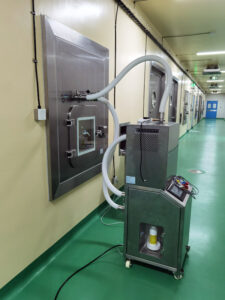
A HEPA housing serves a fundamentally different role from an FFU: it does not contain its own fan. It is a terminal filter housing installed at the end of a ducted HVAC supply, and its function is to deliver air that has already been conditioned and moved through the duct system as a filtered, clean supply to a specific location. The duct system provides the pressure and flow; the housing provides the filtration integrity at the point of delivery.
This distinction matters for design sequencing. HEPA housings are selected and sized in coordination with the air handling system, not independently of it. The filter grade installed in the housing — classified under ISO 29463-1:2024 — determines what the terminal supply actually delivers, and that grade must be matched to the room class and validated as installed, not assumed from duct design alone. A housing specified for H14 performance delivers that performance only if the filter is correctly seated and the housing itself is leak-free at its flanges and frame gaskets.
Where HEPA housings are most appropriate is in fixed-location supply points where the duct layout is already determined and the terminal filtration point is architecturally defined — ceiling supply grilles, wall supply plenums, or terminal supply boxes in GMP environments where the AHU capacity drives the flow rather than module-level fans. The trade-off against FFUs is loss of individual airflow control: a HEPA housing delivers what the duct supplies, without the stepless speed adjustment that EC-motor FFUs provide per module. If room conditions or production schedules require zone-level airflow modulation, ducted terminal housings require that control to be built into the AHU or VAV system rather than at the filter itself.
For retrofit situations where an existing duct system is already in place and adding fan-powered ceiling modules is structurally or electrically impractical, terminal HEPA housings may be the only feasible route to achieving upgraded filtration at the supply point — but that choice carries validation implications: the existing duct leakage and upstream filtration grade become part of what must be characterized and documented.
LAF Units For Local Work-Zone Protection
A laminar airflow unit addresses a protection boundary that neither ceiling FFUs nor HEPA housings are designed to establish: the defined clean zone immediately surrounding a critical operation. As classified under ISO 14644-7:2004 for separative devices, LAF units provide controlled unidirectional airflow at the work surface, and the “first air” arriving at the product or process comes directly from the filtered supply without passing over an operator, a tool, or an adjacent surface first. That geometry is what makes a LAF unit distinct from room-level clean air supply, regardless of how high the room’s ISO class is.
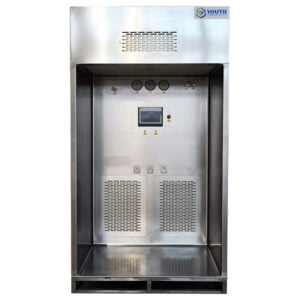
LAF units typically include a work surface integrated with the airflow system, making them applicable to clean benches, laminar flow hoods, and dispensing booths. The critical planning input is not room class — it is the nature of the operation and whether it requires its own protected boundary. A dispensing step carried out under ISO 5 local protection within an ISO 7 background environment is a common and defensible configuration; attempting to substitute that local protection with a higher FFU density in the ceiling is not, because the ceiling system does not define where clean air contacts the product.
The operational control point that LAF units provide — an independent airflow system with its own startup, speed control, and filter monitoring — is also relevant for validation. A LAF unit can be qualified as a discrete piece of equipment with its own performance envelope, which creates a cleaner audit trail than trying to attribute local cleanliness to a distributed ceiling system. For renovation projects and constrained spaces where retrofitting a full FFU ceiling is impractical, a Laminar Air Flow Unit – LAF Unit positioned at the critical operation can establish local ISO 5 conditions without requiring structural modification to the room above.
The mistake pattern here runs in both directions. Specifying LAF units everywhere when only the ceiling supply needs upgrading inflates cost and complicates room airflow balance. But replacing a genuine local LAF requirement with room-level FFUs leaves the actual work zone without a first-air boundary — and that gap is difficult to defend during qualification or a regulatory inspection, because the contamination control rationale for the critical step cannot be located in any documented equipment.
Device Selection Requires Access, Airflow And Test Inputs
Choosing between these three device types cannot be resolved from room class and airflow calculations alone. Filter access route, motor type, and in-situ testing capability each carry downstream consequences that become constraints during operation, maintenance, and recertification — and those constraints should be resolved at specification, not discovered later.
| Specification Factor | Available Options / Range | Design Impact |
|---|---|---|
| Filter Replacement Access | Room-side replaceable (inside cleanroom) | Reduces downtime and contamination risk; no plenum access required |
| Motor Type | EC motor (vs AC); energy saving 30–50 %, stepless speed control via 0–10 V, PWM, Modbus | Lower operating cost, precise airflow regulation |
| In‑situ Filter Testing | DOP injection and sampling ports | Enables ISO 14644‑3 integrity test without filter removal |
| Speed Setback (non‑production) | Supported by EC‑motor FFUs | Saves energy while maintaining pressure cascade |
| Filter Grade Options | H13 (99.95 %), H14 (99.995 %), ULPA U15 (99.9995 %) | Defines achievable particle cleanliness |
| Initial Cost | Lower than LAF units | Economical choice for large‑area ceiling deployment |
The trade-offs in the table interact as a set rather than as independent checkboxes. EC motor FFUs reduce energy consumption by an estimated 30–50% compared to AC motor equivalents, but that range depends on actual duty cycle, the degree of speed setback applied during non-production hours, and whether the control infrastructure — 0–10 V, PWM, or Modbus — is actually implemented. Specifying EC motors without implementing setback control or centralized speed regulation captures the hardware cost without the operating cost benefit.
Filter access route has a consequence that is easy to underestimate: room-side replaceable HEPA filters reduce filter change downtime and contamination risk compared to configurations requiring plenum access, but that advantage exists only if the ceiling integration has preserved airtightness at the penetration. A compromised penetration seal during a room-side filter change can depressurize the zone or allow unfiltered air ingress — exactly the scenario the room-side access was meant to avoid. This is a fabrication and handover checkpoint, not just a design preference.
In-situ filter integrity testing via DOP injection and sampling ports — referenced against the test framework in ISO 14644-3:2019 — should be treated as a design feature decision, not assumed. Not all FFU configurations include injection and sampling ports as standard, and adding them after installation may require module removal or ceiling penetration modification. If the qualification protocol requires in-situ testing at each terminal filter, the presence of those ports needs to be confirmed in the equipment specification before procurement, not during IQ.
The cost comparison between FFUs and LAF units is frequently used to justify device selection without accounting for what each device actually provides. FFUs carry lower initial cost per unit and are economical for large-scale ceiling coverage. That economy disappears when the critical operation still requires a dedicated local LAF unit — at which point both devices are needed, and the ceiling FFU cost does not substitute for the LAF cost. The more useful budget question is not which device is cheaper, but whether both are required and whether the procurement scope reflects that accurately from the outset. For technical detail on how FFU and LAF unit roles compare in practice, the FFU vs Laminar Air Flow Unit Comparison provides a direct equipment-level reference.
The concrete implication across all three device types is that protection location must be defined before device type is fixed — not after. Once layout is locked and ceiling integration begins, substituting device type involves structural rework, requalification scope changes, and procurement delays that were avoidable if the question had been asked earlier: where exactly does clean air need to arrive, and what is it protecting?
Before finalizing any specification, confirm the protected area boundary and whether it requires local unidirectional control or room-level supply; verify that filter access method is compatible with the ceiling or housing integration as built; and check that the test ports and motor control infrastructure required by the validation protocol are included in the equipment scope being procured. Those are the inputs that resolve the device selection — not room class alone.
Frequently Asked Questions
Q: Can a LAF unit be used as the sole clean air device in a small room, without any ceiling supply?
A: Only if the operation’s contamination control strategy requires nothing beyond the work-zone boundary the LAF unit defines. A LAF unit establishes first-air protection at the critical operation, but it does not control background particle counts in the surrounding room. If the process risk assessment requires a controlled room environment — not just a clean work surface — a background supply from FFUs or HEPA housings is still needed alongside the LAF unit. Relying on the LAF unit alone leaves the operator and surrounding surfaces unaddressed in the contamination control rationale.
Q: At what point does switching from AC to EC motor FFUs stop delivering meaningful energy savings?
A: The savings erode when speed setback is not implemented or when duty cycles are already close to continuous full speed. EC motors reduce energy consumption by an estimated 30–50% compared to AC equivalents, but that range depends on how much of the operating day runs at reduced speed and whether the 0–10 V, PWM, or Modbus control infrastructure is actually commissioned. A facility running ISO 5 conditions 24 hours a day with no production gaps has far less setback opportunity than a shift-based operation, and the EC motor premium may not recover through energy cost within a realistic equipment lifecycle.
Q: What happens if the existing ductwork has significant leakage and a HEPA housing is retrofitted to the terminal supply point?
A: The housing’s filter grade rating becomes unreliable as a standalone specification. A HEPA housing delivers the filtration performance it is rated for only at its own frame and gasket boundary — upstream duct leakage allows unfiltered air to dilute or bypass the conditioned supply before it reaches the terminal point. In a retrofit scenario, duct leakage rate and upstream filter condition must be characterized and documented as part of the validation scope, because qualification of the terminal housing alone does not account for what arrives at it through the duct.
Q: Is a higher FFU coverage ratio always the right response when a room fails ISO classification during qualification?
A: Not necessarily — coverage ratio is one variable, but airtightness at existing penetrations and airflow balance across installed modules should be investigated first. Adding FFU modules increases material and integration cost and requires ceiling rework, whereas a failed room that is already at the correct coverage ratio for its target ISO class may be failing because of plenum bypass through unsealed joints or uneven velocity distribution across the active ceiling area. Testing and sealing penetrations is a lower-cost first diagnostic step before expanding the module count.
Q: How should filter grade selection — H13, H14, or ULPA U15 — be documented to satisfy a regulatory inspection?
A: The grade must be tied explicitly to the contamination control rationale for the specific operation, not stated as a general facility standard. Inspectors and qualification teams look for a documented connection between the particle removal performance the grade delivers — 99.95% at MPPS for H13, 99.995% for H14, 99.9995% for U15 under ISO 29463-1:2024 — and the cleanliness requirement the process step demands. Specifying H14 across an entire facility without a step-level justification, or installing H13 in a location where the qualification protocol assumes H14 performance, both create audit exposure that the equipment specification alone cannot resolve.