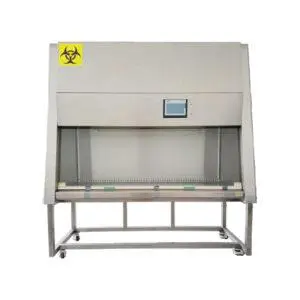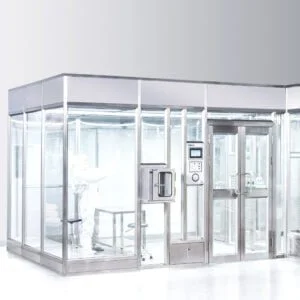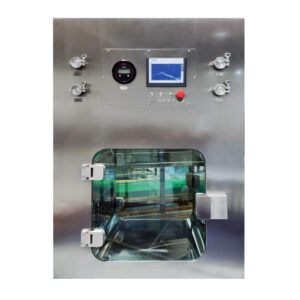
Qualification failures at weighing booths rarely originate from the equipment itself. They originate from ambiguity over who owns each test stage, what the acceptance criteria are, and whether supplier documentation is structured in a way the site’s quality system can absorb. The result is a booth that passed every factory check, arrived on time, and still took weeks to release because IQ evidence was missing, OQ acceptance criteria were undefined, or SAT records used the supplier’s format instead of the buyer’s approved template. The cost is not just schedule delay—it is the deferred use of a critical containment and weighing area, often on the critical path to batch release. The practical judgment the project team needs to make before any equipment leaves the factory is: who owns each test, what does a pass look like, and what format is the record in.
FAT, SAT, IQ, OQ and PQ Roles in a Booth Project
The FAT → SAT → IQ → OQ → PQ sequence is a well-established industry model for qualifying installed GMP equipment, but it is not a rigid regulatory stage-gate prescribed step by step by any single authority. EudraLex Annex 15 provides a process reference for qualification thinking—particularly the expectation that qualification is planned, executed against predetermined criteria, and documented—but it does not mandate FAT and SAT as discrete contractual deliverables in every project. How the stages are applied depends on equipment complexity, site QA requirements, risk assessment, and the project’s validation master plan.
For a weighing or dispensing booth, the most useful way to define stage roles is by what each stage is capable of proving. FAT proves the supplier built to specification in a controlled factory environment. SAT proves the equipment arrived undamaged and connects properly to the site’s utilities and room interface. IQ documents that the installed equipment matches the approved design and its documentation package is complete. OQ demonstrates that the booth operates within its specified parameters—airflow velocity, face velocity at openings, differential pressure, lighting, alarm functions—under defined test conditions in the actual room. PQ demonstrates that the booth performs acceptably during representative weighing operations, typically including product containment performance, operator exposure assessments, or process-specific criteria depending on the compound and risk classification.
The decision risk at this stage is in conflating these roles. Teams sometimes conduct OQ-level functional testing during FAT and then try to cross-reference those results as their site OQ evidence—which is not defensible if factory conditions differ materially from the installed environment. Conversely, deferring all functional testing to the site without a structured SAT can mean that transit damage or installation errors are only discovered during IQ or OQ execution, at which point rework costs and schedule impact are higher. Locking in role boundaries and ownership assignments before FAT begins is the decision that prevents both failure patterns.
Supplier Tests That Should Happen Before Shipment
FAT for a weighing booth should be planned around two distinct objectives: build conformance verification and functional specification confirmation. These are not the same, and conflating them leads to FAT protocols that are either too shallow to catch real defects or so extensive that they duplicate IQ steps unnecessarily.
Build conformance checks at the factory should cover structural integrity of the enclosure, panel fit and seal quality, filter installation conformance to design (filter type, cell size, frame sealing), fan unit electrical connections, control wiring, alarm circuit continuity, and lighting fixture installation. These are checks that can and should be done in the factory because they are independent of the cleanroom interface—they confirm the supplier built what was ordered, not how it performs in the final room.
Functional checks should cover the booth’s own systems: fan speed range and control response, differential pressure indicator or transmitter calibration, alarm setpoint activation, interlock logic where specified, and variable exhaust damper operation if included. Where the project specification includes a velocity profile measurement during FAT, treat the factory result as a confirmation of design intent under controlled conditions—not as a performance guarantee at the installed site. Factory air supply conditions, room pressurization, and exhaust resistance all differ from the final cleanroom, and ISO 14644-3 test methods are written in the context of actual installed and conditioned environments. A factory velocity measurement that passes the design target does not guarantee the same result after installation, particularly if the building HVAC is still being commissioned.
The critical supplier-side deliverable from FAT is not just a test result but a complete documentation package: as-built drawings, filter test certificates, calibration certificates for any instruments shipped with the booth, wiring diagrams, material certificates where specified, and the FAT protocol with signed test records. These documents will form part of the IQ package at the site. If they are missing or incomplete at FAT, the IQ cannot close without a deviation or a supplementary data request—both of which create delay. Review the documentation checklist before FAT execution, not after.
Site Tests That Depend on the Real Cleanroom Interface
SAT and OQ are the stages where the booth’s actual performance is determined, because performance is a function of the installed interface—room pressure regime, supply air quantity and quality, exhaust connection resistance, ceiling height, adjacent equipment, and operator traffic patterns. A booth that met every FAT target can still fail OQ if the room interface was not adequately specified or the installation introduced airflow obstructions not present in the factory test configuration.
SAT should confirm that installation is complete, utilities are connected within specified ranges, and the booth is mechanically and electrically ready for qualification testing. It is the right point to identify transit damage, missing components, and installation deviations before formal IQ begins. Discrepancies between FAT documentation and the physically installed unit—a substituted component, a different filter batch, a modified cable route—should be captured as deviations at SAT, not discovered mid-IQ.
OQ for a weighing booth typically covers airflow velocity profile at the work zone, face velocity at the sash or operator opening, containment performance under specified operating conditions, differential pressure relative to the adjacent room or corridor, alarm function verification, and lighting level confirmation. The acceptance criteria for each of these should be defined in the OQ protocol before execution—they should not be written around the results after testing. Where test results fall outside the accepted range, the deviation path needs to be defined in advance: is it an equipment adjustment, a design review, or a hold on IQ closure?
The most common OQ friction point for weighing booths is the interaction between room pressurization and booth exhaust performance. If the building HVAC is not fully commissioned and balanced at the time of OQ execution, results may not be representative of the operational condition. Running OQ in a partially commissioned cleanroom and then accepting those results as the baseline for PQ creates a defensibility gap. The decision before scheduling OQ is whether the room interface is stable enough for the results to represent the intended operating state.
PQ moves from equipment performance to process performance. For weighing areas, this typically means demonstrating that the booth protects the operator and product during actual or simulated weighing operations, usually with air sampling, surrogate compound exposure testing, or both depending on compound toxicity classification. PQ acceptance criteria are often defined by the pharmaceutical company’s containment strategy and occupational exposure band classification, not by the booth supplier—which means the PQ protocol needs to be written by or with the owner’s QA and EHS functions, not simply adopted from the supplier’s standard commissioning documentation.
Validation Master Plan Alignment With Supplier Documents
The VMP is the owner’s governing qualification document. Supplier documents—FAT protocols, calibration certificates, factory test reports—are supporting evidence, not substitute sections of the VMP. A common project error is to treat the supplier’s documentation package as the qualification record and then present it to QA as a completed IQ package. QA teams working under a formal VMP will typically require that supplier documents be assessed for adequacy: do they cover what the VMP requires, are acceptance criteria pre-specified, are records attributable and contemporaneous, and do they reference the correct equipment configuration as installed?
EudraLex Annex 15 frames the expectation that supplier documentation is evaluated as part of the qualification process—not assumed to be adequate by virtue of being supplied. This means the project team needs to compare the supplier’s document structure against the site’s IQ template before FAT, not after equipment is on site. If the supplier’s FAT protocol records test results in a format that does not map to the site’s IQ fields, the buyer’s team will need to supplement, cross-reference, or re-test. Knowing this in advance turns it into a planning task. Discovering it during IQ execution turns it into a deviation and a delay.
The alignment check should address at minimum: traceability of installed equipment to approved drawings and specifications, calibration status of test instruments used in qualification, completeness of filter documentation, adequacy of acceptance criteria for each test (pre-defined, not post-hoc), and deviation handling records where any test required a repeat or a conditional acceptance. Where gaps exist between supplier documents and VMP requirements, they should be captured in a gap matrix and resolved through supplementary testing, document updates, or a written risk-based justification before IQ is closed. Treating the gap-closure exercise as a document collection step underestimates the review work involved—particularly on first-time sourcing from a supplier whose document formats have not been previously qualified.
Handover Readiness Check for Owners, Criteria and Records
Handover readiness for a weighing booth is a defensibility gate, not a completion milestone. The question is not whether the booth is working—it is whether every qualification stage has an owner on record, an executed protocol with pre-defined acceptance criteria, a complete set of test records, and a closed deviation trail for anything that did not go straight through. In a GMP audit, any undocumented activity is treated as an activity that did not occur. This is not a cautionary note about good practice—it is the operational standard against which handover packages are reviewed. Missing FAT records, an unsigned IQ section, or an OQ attachment with a blank witness field are each a direct handover defect, not a minor administrative gap.
The handover package for a weighing booth should include, at minimum: the approved FAT protocol with executed results and any deviations closed; the SAT record confirming post-installation readiness; the IQ report with as-built drawing confirmation, calibration records, and document traceability; the OQ report with executed test data, acceptance criteria, and pass/fail determination for each test; the PQ report or a defined deferral with a risk-based rationale; change records for any equipment or configuration changes between FAT and final installation; and a summary of open and closed deviations across all stages.
Review the handover package against the VMP requirements before presenting it to QA for approval, not simultaneously. QA review of an incomplete package typically results in a formal hold on area release, which restarts the clock on every open item. If any qualification stage has not been executed—because it was deprioritized, assumed to be covered by another stage, or not assigned to an owner—the consequence is not a short correction cycle. It is a formal deviation, potential re-execution, and a documented explanation of why the gap occurred. Where an owner, acceptance criterion, record format, and deviation path were not defined before execution began, they were not defined at all.
The readiness check before submitting for QA approval should confirm: every protocol was approved before execution, every test has a result against a pre-defined criterion, every deviation was raised and closed through the site’s formal deviation system, all instrument calibration records are current, and the document package is attributable—signed, dated, and traceable to the individual who performed each test.
The practical consequence of an unstructured qualification approach for a weighing booth is not a failed test—it is a qualification package that cannot be closed, in a facility where the area cannot be released until it is. The decisions that prevent this outcome are made before the booth ships: stage ownership assigned, acceptance criteria written, document formats agreed, and the supplier’s documentation package reviewed against the site’s VMP requirements. Every gap identified before FAT is a planning task. Every gap identified during IQ or OQ execution is a delay with a formal record.
Before proceeding to FAT execution, confirm that the FAT protocol has been approved by the site QA function, that acceptance criteria are pre-defined for every functional test, that the documentation format has been reviewed against IQ template requirements, and that the deviation path for any non-conformance is defined. The same review logic applies at each subsequent stage. Qualification is not a sequence of tests—it is a sequence of decisions with documented evidence, and the handover package is only as strong as the weakest record in the chain.
Frequently Asked Questions
Q: Our weighing booth is a simple downflow unit with a constant-speed fan and no complex alarm logic. Does the OQ stage still need a full test protocol?
A: Yes, but the protocol scales to the unit’s documented design parameters. For a fixed-speed booth, OQ must still verify airflow velocity, filter integrity, and differential pressure relative to the room—even if those are not adjustable. The number of test cases reduces, but the requirement to demonstrate the installed unit meets its specification under defined conditions does not. Acceptance criteria are still set before execution, and the results form part of the qualification record.
Q: After the FAT protocol is approved but before execution, what single owner-side action does the most to prevent later IQ documentation delays?
A: Send the site’s approved IQ template and required data fields to the supplier, and agree how FAT test records and certificates will be formatted to feed directly into that template. This turns the document-structure review into a pre-FAT alignment step, so the FAT output lands in a shape the site’s quality system can absorb without reformatting or re-testing. In most projects, this is the highest-leverage action for avoiding IQ close-out holds.
Q: Under what conditions can SAT be skipped and the qualification stream move directly to IQ?
A: SAT can only be omitted when a documented risk assessment confirms the equipment arrived in a fully pre-verified state and the site installation involves no utility connections, room-interface changes, or mechanical assembly that could introduce defects. In practice, even a simple booth positioning and electrical tie-in justify a brief installation verification. Skipping SAT without a formal justification leaves an evidentiary gap that auditors will note, so the default should be a documented SAT, however streamlined.
Q: Should velocity profile testing be done at the factory during FAT, or left entirely for site OQ?
A: Perform a simplified velocity check at FAT to confirm design intent and catch gross filter or fan defects before shipment, but do not use that data as site OQ acceptance evidence. The factory’s supply-air conditions, pressurisation, and exhaust resistance differ from the cleanroom, so the FAT result is a design‑verification tool, not a performance guarantee. Site OQ must independently repeat the full velocity profile to qualify the booth under installed conditions.
Q: For a single small booth in a facility with limited QA capacity, is the upfront effort of aligning supplier documents to the VMP really justified?
A: Yes—the alignment work usually takes a few hours early in the project, while closing gaps discovered during IQ execution can take weeks. A rejected IQ package on a weighing booth that sits on the batch‑release critical path restarts the clock on area release and generates formal deviations. The resource trade‑off overwhelmingly favours doing the document comparison and gap resolution before the booth ships.