Sourcing the wrong controlled-environment equipment becomes expensive the moment commissioning starts — not at the quoting stage where the problem was created. Buyers who shortlist based on price and catalog variety often discover during factory acceptance testing, or worse, during a first-party audit, that the manufacturer cannot produce coherent documentation connecting the unit’s design drawings to its actual test records. That gap, invisible on a datasheet, can delay qualification by weeks and in regulated pharmaceutical or semiconductor environments, trigger a full restart of vendor evaluation. The questions that prevent this outcome have to be asked before the RFQ is released, not after a purchase order creates leverage in the wrong direction. By the end of this review, you will have a clearer sense of which signals to request, which gaps to treat as disqualifying, and which criteria are commonly mistaken for quality proxies when they are not.
Factory-review criteria that matter before RFQ release
The decision to issue an RFQ should not happen until a small set of measurable criteria are confirmed as baseline requirements, because setting them afterward shifts negotiation power entirely to the supplier. Filter efficiency and airflow velocity are the two figures that most directly affect cleanroom performance, and using them as explicit RFQ requirements — rather than leaving them as implied defaults — forces manufacturers to submit test data that can be compared side by side. A figure such as 99.97% filter efficiency at 0.3 µm is a design and planning benchmark drawn from widely used HEPA specifications; it is not a universal regulatory minimum for every application, but it gives the buyer a consistent reference point to evaluate whether manufacturer-supplied test reports are measuring the same thing.
Physical dimensions, weight, and power consumption are planning criteria, not performance criteria, and the failure to confirm them before RFQ closure routinely creates installation and logistics surprises that add cost without adding capability. A unit that doesn’t fit the intended bench envelope, exceeds floor load tolerance, or requires an electrical circuit upgrade introduces project friction that could have been resolved in two lines of the specification.
Each criterion below has a corresponding downstream consequence if it is skipped at this stage.
| Criterion | What to Confirm | Why It Matters |
|---|---|---|
| Filter efficiency | HEPA 99.97% at 0.3 µm | Provides a repeatable benchmark to compare manufacturer test data |
| Airflow velocity | 0.30 m/s | Ensures consistent cleanroom performance and air-change requirements |
| Physical dimensions | 24 × 24 × 35 in | Prevents installation/facility fit issues and unplanned cost |
| Unit weight | 72 lb | Informs logistics, benching, and floor-load planning |
| Power consumption | 37–115 W | Confirms electrical readiness and cooling load compatibility |
Setting these figures as requirements rather than questions also changes how manufacturers respond: a supplier that cannot fill in a row on this table either lacks the documentation or is building to specifications they do not own, which is itself a useful signal before the RFQ is even issued.
Engineering response and material control signals to verify early
A manufacturer’s willingness and speed in responding to material and design questions before a purchase order is one of the clearest early signals of engineering competence. If a supplier takes two weeks to answer whether the housing is epoxy-coated steel or thermoplastic, or cannot tell you whether their filter clamping uses an anti-bypass design, that response time reflects the actual state of their internal documentation — not a temporary communication delay.
Construction material matters for controlled-environment durability in ways that are not always obvious from a catalog photo. Epoxy-coated steel and stainless steel behave differently under repeated cleanroom cleaning protocols, and a microbial powder-finish coating on exterior steel surfaces reflects a specific engineering choice about contamination resistance that not every supplier makes. The distinction between thermoplastic and metal construction is not inherently a quality ranking — both have legitimate applications — but a manufacturer that cannot explain the design rationale for their material choice has likely not made it deliberately.
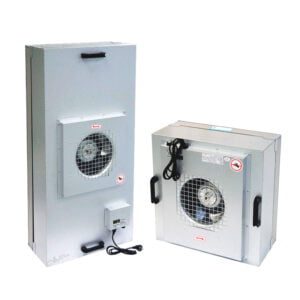
Filter clamping design and blower selection are two indicators that experienced buyers often overlook because they sit below the marketing layer. An anti-bypass clamping system that ensures the filter is fully seated and prevents air from routing around the media edge is directly relevant to contamination risk, not as a feature differentiator but as a basic mechanism for delivering the stated efficiency figure. A centrifugal EC blower paired with HEPA media without aluminum separators represents a design choice that reduces mechanical vibration and eliminates a common media bypass leak path — these are engineering decisions with maintenance and validation consequences. Neither feature should be treated as a universal industry requirement, but when one supplier shows both and another cannot explain their blower or media specification, the difference in engineering attention is meaningful.
| Signal to Verify | Indicator of Engineering Attention | Risk if Neglected |
|---|---|---|
| Construction material & coating | Epoxy-coated steel, stainless steel, or thermoplastic; microbial powder-finish coating | Incompatible materials may compromise cleanroom durability or sterility |
| Filter clamping & serviceability | Anti-bypass clamping design; tool-free filter changes | Higher contamination risk and increased maintenance downtime |
| Blower & media design | Centrifugal EC blower; HEPA media without aluminum separators | Vibration, noise, and potential media bypass leak paths |
The purpose of verifying these signals early is not to build a mandatory checklist but to reveal whether the manufacturer made deliberate design decisions or assembled a product from available components without tracking the trade-offs.
Catalog breadth that hides weak production discipline
A wide product catalog signals market coverage. It does not signal production discipline, and treating the two as equivalent is one of the most reliable ways to choose the wrong manufacturer for a controlled-environment application.
Manufacturers offering many model variations — different widths, airflow classes, sash configurations — can do so through configurator logic applied to a single underlying platform, or they can do so by offering nominal variants that are fabricated inconsistently because no single revision-controlled drawing governs the actual build. From the outside, both look like a broad, capable product line. The difference only becomes visible when you ask for the specific drawing revision used to build your unit, or when an audit requires you to trace a performance claim back to a specific test record. A manufacturer with production discipline will answer that question in a day. A manufacturer operating through loosely controlled catalog variants often cannot.
This failure pattern rarely surfaces at the quoting stage because catalogs are marketing documents. The discipline question has to be asked directly: can the factory provide a drawing number, revision level, and corresponding FAT record for a recently shipped unit of the model you are buying? Buyers who skip that question during shortlisting often reach commissioning with a unit that matches the catalog but cannot be validated because its paper trail is fragmented across a sales order, a supplier’s test report, and a datasheet that was last updated two product generations ago.
Wide accessory ranges and multiple model configurations are worth evaluating — they can indicate genuine customization capability — but they should be evaluated through the production discipline question, not instead of it. A manufacturer with twelve catalog variants and no coherent change-control process is harder to manage through a product lifetime than a manufacturer with four variants and clean revision history. For buyers working in pharmaceutical, biotech, or semiconductor environments where post-delivery changes trigger revalidation, that difference has a direct cost.
In-house capability versus outsourced build-and-test risk
The critical distinction in manufacturer evaluation is not whether a supplier uses any subcontractors — most do — but whether the manufacturer retains design authority, fabrication control, and test capability in house for the steps that affect performance and compliance. Suppliers who outsource critical build stages and then present the finished unit under their own brand create a change-control problem: if a subcontracted component is revised by the actual maker, the nominal supplier may not know until a discrepancy surfaces in a field unit or a follow-up order.
Availability of a ULPA filter upgrade — 99.999% efficiency at 0.12 µm — is a useful proxy for this question. A manufacturer that can offer this tier on its standard platform likely owns its filter sourcing relationships and has tested to that performance level internally. A supplier that can only offer HEPA and treats ULPA as a special-order item sourced from an unnamed third party is signaling that their test capability stops at the catalog specification; performance claims above that threshold rest on someone else’s data.
Compliance certifications such as ISO 9001, ISO 14001, UL, and CE are evidence of documented quality management systems, not evidence that no outsourcing occurs. They confirm that a process exists for tracking quality — they do not confirm that the process extends across every build stage or subcontractor. Treat certification possession as a positive signal that reduces the number of follow-up questions, not as a substitute for asking those questions. A manufacturer holding ISO 9001 certification that cannot show you a quality record for the specific unit being shipped has a gap between its system and its practice.
| Review Check | What It Signals About In-House Capability | Risk if Outsourced |
|---|---|---|
| ULPA filter upgrade availability (99.999% at 0.12 µm) | Manufacturer likely owns filter sourcing and testing, capable of higher performance tiers | Performance claims may rest on supplier data; no in-house verification |
| Compliance certifications (ISO 9001, ISO 14001, UL, CE, ENERGY STAR) | Documented quality management and systematic process control | Quality processes may be informal and harder to audit |
| Range of optional accessories (spill trays, mobile cart, UV lamp) | Depth of in-house fabrication and ability to handle tailored orders without outsourcing critical components | Customization requests may be subcontracted, increasing lead times and change-control risk |
The accessory range question — whether a manufacturer can supply spill trays, mobile carts, or UV lamp options as factory-fitted configurations — matters because it exposes whether the supplier controls their own production scope. A supplier that must subcontract a polypropylene spill tray introduces a coordination dependency into a relatively simple part of the order; the same pattern at the filter or blower level is a substantially higher risk.
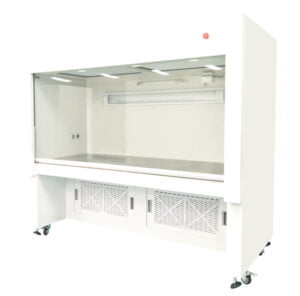
For buyers sourcing laminar flow hood solutions into regulated environments, the in-house capability question should be asked directly as part of supplier qualification, with a request for a recent example: show the drawing, the FAT data, and the production record for one completed unit of the relevant model. A manufacturer with real in-house capability will find that request routine.
Documentation gaps that slow manufacturer shortlisting
Shortlisting drag almost always originates from the same place: a manufacturer submitted for evaluation that cannot provide basic specifications without a follow-up request. A supplier listing that shows only a product name and a nominal model number — without filter efficiency, airflow velocity, construction material, or applicable certifications — forces the buying team into a second information-gathering cycle that adds days or weeks to a review that should already be converging.
The practical threshold here is whether a manufacturer, in their initial response or product data package, explicitly lists the certifications and performance figures that govern the application. Certifications such as ISO 5 cleanroom classification, FS209E, or USP 797 compliance — where relevant to the buyer’s application — are meaningful shortlisting accelerators because they provide a traceable documentation starting point. The important next step is requesting the actual test records and certification documents, not accepting the label as equivalent to verified compliance. A certification listed on a datasheet without a supporting test report is a claim, not evidence.
| Documentation Signal | Impact on Shortlisting | What to Clarify |
|---|---|---|
| Explicitly listed certifications (ISO 5, FS209E, USP 797) | Shortens evaluation by providing traceable compliance data upfront | Request copies of the exact certifications and test records |
| Minimal specifications (only product name) | Forces repeated information requests and delays sourcing decisions | Require filter efficiency, airflow velocity, and material details before further evaluation |
Buyers who reach shortlist closure without having collected this documentation are not saving time — they are deferring a problem that will resurface at qualification or audit with significantly less flexibility to address it. The suppliers who make this easy are, by that fact, demonstrating a documentation culture that has downstream value throughout the project. Suppliers who make it difficult before the purchase order are unlikely to improve after it.
For a structured comparison of documentation standards across different supplier types, the Laminar Flow Cabinet Suppliers Vendor Selection Guide covers pre-qualification requirements in more detail.
Broken change-control chains that disqualify the factory
A supplier that cannot connect the design drawing, the factory acceptance test data, and the change-control record for a given unit within a single production system is structurally too weak for controlled-environment procurement — regardless of how complete its certification list appears on a datasheet. This is not a minor administrative gap. It is a signal that the manufacturer does not treat the as-built unit as a controlled configuration, which means any post-delivery change — a filter upgrade, a blower substitution, a coating revision — may happen without formal documentation and without notification to the buyer.
The failure pattern typically surfaces at one of three moments: during factory acceptance testing when the buyer requests the FAT procedure and finds it does not reference the drawing revision on the order; during post-delivery revalidation when a filter replacement requires tracing the original filter specification and the record does not exist; or during a third-party audit when the auditor asks for the change history of a critical component and the manufacturer cannot produce it. By any of those moments, the leverage to address the problem through sourcing decisions is gone.
The relevant testing frameworks — ISO 14644-3 for test methods and ISO 14644-7 for separative device requirements — establish documentation expectations for performance verification that are difficult to satisfy if the underlying production records are fragmented. These standards don’t create the disqualifying condition, but they make it visible: a manufacturer that cannot meet the documentation requirements implied by these frameworks during a performance test is unlikely to maintain change-control integrity through a product’s operational life.
The practical review action is straightforward. Before shortlist closure, request one example of a completed change-control record from the manufacturer — ideally one that traces a design revision through drawing update, production impact assessment, and updated test data. The depth and speed of that response will tell you more about whether the factory is capable of controlling a regulated-environment product than any catalog, certification list, or RFQ response.
This single check — can the factory connect drawings, FAT data, and change control in one coherent system — should function as a minimum threshold, not an advanced audit criterion. For laminar airflow units deployed in pharmaceutical or semiconductor environments, the cost of discovering this gap after commissioning is substantially higher than the cost of asking the question before the purchase order is signed.
The most durable shortlisting framework for evaluating controlled-environment equipment manufacturers is built around production traceability, not catalog presentation. Before an RFQ is released, confirm the baseline performance figures and facility planning criteria explicitly. During supplier evaluation, test the manufacturer’s engineering response speed and material documentation depth. Before shortlist closure, request a sample change-control record and at least one example of a connected drawing-to-FAT production trail.
The manufacturers that clear those checks without friction are the ones with production systems capable of supporting what comes after delivery — qualification, revalidation, filter upgrades, and audit response. The ones that require repeated follow-up for basic documentation are showing you, early, the dynamic you will manage for the life of the equipment.
Frequently Asked Questions
Q: What should a buyer do immediately after a manufacturer passes the change-control and FAT documentation check?
A: Move directly to requesting a formal qualification package — including the specific drawing revision, FAT procedure, and test records for your exact model configuration — before the purchase order is signed. Confirming that a connected production trail exists is the checkpoint; collecting the actual documents for your order is the next action, because a manufacturer that produces them on request before commitment will support revalidation and audit response far more reliably than one that produces them only under contractual pressure.
Q: Does this evaluation framework still apply if the laminar flow hood is needed for a lower-risk application outside pharmaceutical or semiconductor environments?
A: The full framework is less critical for applications where post-delivery revalidation and third-party audits are not required, but the documentation and engineering-response checks remain useful regardless of regulatory context. The threshold that changes is change-control rigor: in a non-regulated environment, fragmented revision history is an inconvenience rather than a disqualifying condition. Filter efficiency verification, material traceability, and in-house FAT capability still affect whether the unit performs as claimed — those questions have no regulatory floor below which they stop being relevant.
Q: Is a manufacturer with a smaller, more focused product line preferable to one with a wide catalog, all else being equal?
A: A focused product line is not inherently better, but it reduces one specific risk: the probability that catalog variants are governed by loosely controlled or inconsistent drawings. A manufacturer with four well-documented models and clean revision history is operationally easier to manage over a product lifetime than one with twelve variants and no coherent change-control process — particularly when filter upgrades or component substitutions trigger revalidation. Catalog size only becomes an advantage when the manufacturer can demonstrate that production discipline scales across the full range, not just the flagship model.
Q: At what point in the sourcing process does requesting shop photos and sample test documentation actually slow things down rather than help?
A: It slows the process when requested after shortlist closure, because by that stage the buying team has reduced leverage and a supplier has less incentive to respond thoroughly. Requested before RFQ release, shop photos and sample documentation function as a fast filter — suppliers that respond quickly and completely self-select for the next stage, while those that stall or return incomplete answers reveal the documentation culture early enough to act on it. The drag that buyers attribute to documentation requests is almost always caused by making those requests too late, not too early.
Q: How should a buyer weigh a lower unit price from a supplier that passes most but not all of the documentation checks?
A: The financial comparison should account for the specific gap, not the overall pass rate. A supplier missing accessory sourcing transparency carries a different downstream cost than one that cannot produce a connected drawing-to-FAT record. The latter failure directly affects qualification timelines and audit exposure in regulated environments, where a delayed commissioning cycle or a restart of vendor evaluation will cost far more than the price difference on the unit. If the documentation gap relates to any step that touches performance verification or change control, the lower price does not offset the risk — it simply moves the cost to a point in the project where recovery options are more limited.