R&D labs that configure a cleanroom for one program and then try to adapt it for the next frequently discover that the room itself isn’t the constraint — the decisions made during initial setup are. Monitoring points placed for convenience rather than for workflow, wall formats chosen on cost alone, and expansion work that quietly severs return air paths are the patterns that create qualification delays and erode confidence in environmental records over time. The format decision — softwall versus hardwall, fixed versus expandable — has downstream consequences that don’t appear until a program is underway or a room is stressed by new users. Understanding which conditions actually change the recommendation is what separates a room that stays defensible through program shifts from one that has to be substantially reworked to stay operational.
R&D Workflow Variability and Cleanroom Format
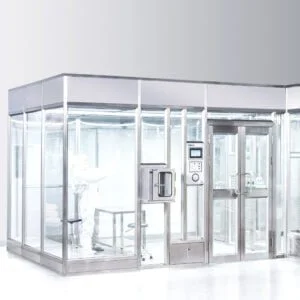
The core planning tension in R&D cleanrooms is that research programs change faster than permanent construction can accommodate. When a process changes mid-program — new equipment footprint, different ISO target, added personnel — a traditionally built room creates a choice between working around constraints or starting disruptive construction. Modular cleanrooms address this by using prefabricated components that can be reconfigured without rebuilding the envelope, and that distinction matters most when the reconfiguration timeline itself has project consequences.
Installation speed is the most immediate planning variable. Modular rooms are commonly deployed in weeks where traditional construction takes months — not as a guaranteed specification, but as a planning figure that reflects the difference between on-site fabrication work and factory-built component assembly. For R&D teams with funded programs and time-limited grants, that difference directly affects when work can begin and how much capital is committed before results are in.
What the speed and cost advantages don’t resolve is design discipline. ISO 14644-4:2022 establishes that cleanroom design should account for intended use from the outset — a principle that applies equally to modular rooms. A modular format gives a team the ability to reconfigure, but it doesn’t automatically protect the monitoring program, the pressure regime, or the change-control record when reconfiguration happens. Controlled flexibility requires that the room’s design decisions anticipate the types of changes that are likely, not just the initial layout.
| Aspect | Traditional Cleanroom | Modular Cleanroom |
|---|---|---|
| Modification requirements | Permanent construction; expensive and disruptive to alter | Prefabricated components allow easier reconfiguration without major construction |
| Installation timeline | Months | Weeks |
| Cost structure | Higher capital commitment | Lower upfront cost |
| Layout flexibility for shifting research | Limited; fixed design constrains workflow changes | High; rapid adaptation to new research demands |
The practical implication of that table is that choosing modular format resolves the construction-cost and timeline trade-off but opens a separate set of decisions about how changes will be managed once the room is in use. Teams that treat the format choice as the primary decision and defer the operational rules often find that the flexibility they planned for creates monitoring and recordkeeping problems they didn’t anticipate.
Softwall and Hardwall Use Cases in Labs
Softwall and hardwall formats are frequently compared on cost and lead time, but the conditions that actually determine which format fits a program are access control, pressure differential, and recordkeeping exposure — factors that are easy to underestimate before a program is underway and expensive to correct after.
Softwall cleanrooms are well-suited to short programs with limited personnel, low contamination sensitivity, and predictable traffic. The flexible curtain perimeter works when the room doesn’t need to maintain a differential against adjacent spaces and when everyone working in it is trained consistently. The risk is that softwall enclosures offer no meaningful barrier to personnel or cart ingress that hasn’t been formally authorized, and they don’t hold pressure. In shared R&D spaces where multiple teams cycle through, or where adjacent areas have meaningfully different cleanliness levels, that permeability becomes a contamination pathway that’s difficult to document.
Hardwall modular cleanrooms carry higher initial cost and require more planning for access points, but they create a defensible envelope. When a program requires differential pressure records — or when regulatory submissions, audits, or cross-contamination risk make environmental documentation meaningful — the hardwall format is the appropriate baseline. The mistake pattern here is deciding softwall is sufficient based on the program’s initial scope, then encountering pressure or access requirements once the program expands or a second user group is added. Switching formats at that point means rebuilding the enclosure and re-qualifying the room from the beginning.
A useful threshold: if the program would require a written justification for any monitoring excursion, or if pressure records will need to be referenced in any submission, the format decision should start with hardwall. Softwall is appropriate when the room functions as a process aid rather than as a documented controlled environment with a traceable record.
Monitoring Points Around Repeated Work Locations
Monitoring programs in R&D cleanrooms are often set up during initial qualification, when work positions are hypothetical and room geometry is the most visible reference. The result is that particle counters and environmental sensors end up at geometric room centers or at positions chosen for cable routing convenience rather than for where contamination is most likely to develop.
The operational problem is that contamination patterns in R&D rooms develop at repeated work locations — the bench where samples are handled, the position where equipment is staged before entry, the space near a door that gets used more than others. ISO 14644-2:2015 establishes that monitoring programs should be structured to provide evidence of air cleanliness performance relative to the room’s actual use, not just its geometry. That framing means monitoring locations should be derived from where work happens and where risk is highest, not from a floor plan grid.
For R&D rooms, this has a specific implication: the work positions themselves change as programs shift. A monitoring layout that was appropriate for one program may not capture the contamination pattern introduced by the next. The review check is whether monitoring locations are re-evaluated when work positions change in a meaningful way — not just when the room is physically reconfigured. If sensors haven’t moved but the primary work locations have, the environmental record may be clean while actual exposure risk at the new work positions goes uncharacterized. That gap is difficult to defend in an audit and difficult to detect from data alone.
For further detail on sensor placement and data integration approaches, Modular Cleanroom Real-Time Monitoring Systems: Particle Counters, Sensors, and Data Integration Options addresses how monitoring infrastructure can be structured to remain aligned with shifting use patterns.
User Rules for Materials Carts and Temporary Equipment
The hidden contamination risk in shared R&D cleanrooms is not the room changing — it’s the users changing. A room can have a stable layout and a clean qualification record while the personnel using it cycle through continuously, each group bringing carts, equipment, and staging habits that were never reviewed against the room’s contamination-control requirements.
Materials carts and temporary equipment are the most common uncontrolled variables. A cart brought in from an adjacent corridor carries particle load from that environment. Equipment staged near a return air grille disrupts airflow patterns that the room’s classification depends on. Neither of these is a guaranteed contamination event in every instance, but each represents a change to the room’s contamination profile that no one has reviewed or documented. In a shared lab with rotating users, these changes accumulate without any single person recognizing them as change events.
Written operational rules address this by defining what requires review before it enters the room. Practically, this means specifying which cart types are permitted and what their pre-entry cleaning requirements are, identifying where temporary equipment can and cannot be staged, setting a size or footprint threshold above which equipment staging requires a documented review, and establishing who is responsible for that review when a new user group begins working in the room. These are process details, not formal compliance mandates — but their absence is the most common reason shared R&D cleanrooms accumulate undocumented contamination-profile changes that eventually surface as unexplained monitoring excursions.
The failure pattern to watch for is a room that performs well during initial qualification and then gradually accumulates monitoring variability over six to twelve months without any single identifiable cause. That pattern is almost always the result of incremental, undocumented changes introduced by successive user groups, not equipment failure or room degradation.
Expansion Without Losing Clean Return Paths
Adding floor area to a modular cleanroom is operationally straightforward — panels can be added, the envelope can grow, and the floor plan can expand. What doesn’t scale automatically is the airflow infrastructure, and specifically the return air paths that the room’s classification depends on.
Clean return paths are the part of an expansion that floor plans fail to communicate. A layout drawing can show new panels added to an existing room and appear functional at a glance, but if the expansion blocks a return air grille, reduces return plenum access, or creates a dead zone where air cannot complete its recirculation path, the room’s pressure regime and particle dilution rate will be compromised. ISO 14644-4:2022 establishes that airflow design integrity must be maintained through construction and reconfiguration phases — a principle that applies directly to modular expansion work. The problem is that this integrity is easier to plan on paper than to confirm in the field, and disruptions to return paths typically surface during commissioning or the first equipment move rather than during layout review.
Service access is the secondary constraint that gets underestimated in the same way. HEPA filter housings, fan units, and plenum access panels need to remain reachable for inspection, replacement, and testing after the expansion is complete. An expansion that adds usable floor area while stranding maintenance access above a new wall panel is a layout that will require either partial teardown or compromised maintenance practice — neither of which is acceptable once the room is in use.
The planning check before any expansion is to trace the full return air path on the as-built drawing, not the proposed drawing, and to verify that every access point required for maintenance and testing remains accessible with the expansion panels in place. If either condition can’t be confirmed before panels are ordered, the expansion sequence should be reconsidered before procurement.
Change-Control Practices for Flexible Research Rooms
Modular flexibility doesn’t create uncontrolled flexibility on its own — that outcome comes from treating every layout or operational change as informal because the room format makes it easy to execute. The discipline gap in flexible R&D rooms is that teams apply change-control thinking to major reconfigurations but treat smaller changes — a new equipment position, a revised workflow, a different user group — as too minor to document. Over time, those minor changes accumulate into a room that no longer matches its qualification basis.
A practical change-control framework for flexible research rooms doesn’t need to be bureaucratically complex, but it does need to cover the right events. Physical reconfiguration — any change to panel positions, air supply locations, or return paths — should trigger a review of the monitoring plan and a confirmation that the airflow basis hasn’t changed. Operational changes — new user groups, new equipment categories, new work positions — should trigger a review of whether the contamination-control rules remain appropriate. Neither review needs to be a full requalification, but both should produce a written record that confirms the room’s classification basis is still intact after the change.
Where chemical or personnel safety intersects with reconfiguration — such as changes that affect ventilation for hazardous materials handling — OSHA laboratory standards provide a relevant reference for the safety review components of that decision, distinct from the ISO classification questions. These are parallel review obligations, not the same process.
The downstream consequence of skipping this discipline is a room whose monitoring data becomes increasingly difficult to interpret because the room’s actual configuration is no longer what the qualification record describes. That gap matters most when an anomaly occurs and the team needs to trace its cause — a review check that requires confidence in the room’s documented baseline. Without that confidence, the investigation starts from a weaker position, and the environmental record itself becomes harder to defend.
Modular format gives R&D teams genuine reconfiguration capability, but the value of that capability depends on whether the decisions that surround it — monitoring placement, format selection, expansion sequencing, user rules — are made with the same rigor applied to any other controlled environment. The rooms that hold their classification basis through program changes are the ones where flexibility was designed in from the beginning, not retrofitted after the first unexpected constraint appeared.
Before committing to a format or layout, the most useful pre-procurement exercise is to identify the most likely program changes over a two-to-three-year horizon and ask explicitly whether the proposed room handles those changes without requiring a monitoring re-establishment, a pressure regime rework, or a maintenance access compromise. That question surfaces the real constraints earlier, when they’re still inexpensive to resolve in the design rather than in the field.
Frequently Asked Questions
Q: Our R&D program only runs for three to four months — is a softwall room still appropriate if multiple teams will rotate through it during that time?
A: Rotating user groups change the risk profile enough that softwall is likely insufficient, even for a short program. The issue isn’t duration — it’s that multiple teams cycling through a shared space introduce uncontrolled cart traffic, varied staging habits, and inconsistent ingress discipline that softwall enclosures cannot physically contain or document. If different groups will be working in the room at different points, the access-control and recordkeeping exposure is closer to a multi-user shared facility than a short single-program room, and a hardwall format is the more defensible baseline from the start.
Q: After a room is qualified and in use, what should trigger a formal review of the monitoring plan rather than just continuing with the existing sensor positions?
A: Any meaningful shift in primary work positions should trigger a monitoring plan review, not only physical reconfiguration of the room. If the bench where samples are routinely handled has moved, if a new instrument has become the primary activity point, or if personnel traffic patterns have shifted toward a different area of the room, the existing sensor locations may no longer capture where contamination risk is actually highest. The review doesn’t have to produce a full requalification, but it should result in a written confirmation that sensor positions still correspond to the current work layout — otherwise the environmental record stays clean while actual exposure at the new work positions goes uncharacterized.
Q: If a modular room has already been expanded and we’re now finding monitoring variability we can’t explain, where should the investigation start?
A: Start by comparing the current as-built configuration against the qualification record to identify whether any return air paths or HEPA access points were compromised during the expansion. Unexplained monitoring variability in a recently expanded room most commonly traces back to a blocked or partially obstructed return air grille, a dead zone introduced by new panel placement, or a maintenance access constraint that has led to deferred filter inspection. Airflow disruptions from those causes don’t always produce obvious pressure alarms — they surface as gradual particle count drift or localized excursions that don’t correlate cleanly with personnel or process changes.
Q: How does the change-control obligation differ when a reconfiguration also affects ventilation for hazardous materials handling versus a straightforward layout change?
A: When ventilation for hazardous materials is involved, the review obligation splits into two parallel tracks rather than one. The ISO classification questions — whether airflow integrity, pressure regime, and monitoring placement remain valid after the change — stay within the ISO 14644 framework. But changes that affect how hazardous materials are ventilated also engage OSHA laboratory standards as a separate, concurrent safety review requirement. These are not the same process and should not be treated as interchangeable. A change that satisfies the classification review may still require an independent safety determination before it can proceed, and skipping that parallel review creates a compliance gap that isn’t visible in the environmental monitoring record.
Q: Is there a point at which cumulative small operational changes — new equipment, shifted workflows, additional users — should trigger a full requalification rather than individual documented reviews?
A: Yes, though the threshold is a judgment call rather than a fixed rule. Individual documented reviews are appropriate when each change is discrete and the room’s qualification basis can be confirmed as still intact after the review. When multiple changes have accumulated to the point where the current room configuration, user population, and workflow no longer closely resemble what the original qualification described, the documented record becomes a weak foundation for defending any monitoring excursion or audit inquiry. A practical signal is when tracing the cause of an anomaly requires reasoning through several undocumented or thinly documented changes in sequence — that gap in the baseline is itself the indicator that a requalification is more appropriate than another incremental review.