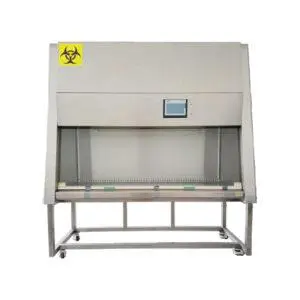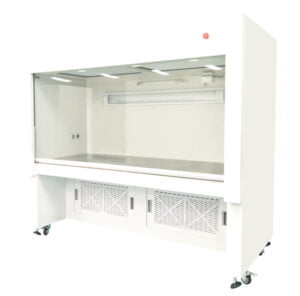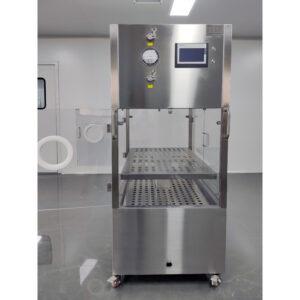
Most layout problems with a mobile laminar air flow cart are invisible until fabrication is complete. A team specifies an overall footprint that looks correct on a floor plan, misses the difference between that external dimension and the actual internal work area, and only discovers the mismatch when the cart arrives and the load envelope doesn’t fit. At that point, the options are rework, a replacement order, or a workflow compromise that introduces exactly the contamination exposure the cart was purchased to prevent. The decisions that prevent this — defining internal work dimensions, confirming access-side geometry, and walking the transfer route before drawings are issued — are all pre-fabrication judgments that most procurement processes treat as secondary to price and lead time.
Layout questions that affect protected material transfer
Before any fabrication drawing is issued, the layout of a protected transfer cart needs to resolve at least four questions: What is the actual internal work area available once structure, filter housing, and fan components occupy their volume? Which side or sides will operators access during loading and unloading? What is the maximum height and width of the load at every point in the transfer, including any packaging or fixture attached to it? And what is the clearance condition along every segment of the route, including doorways, airlocks, and corridor bends?
These are not compliance questions. No standard dictates specific answers, and framing them as a regulatory checklist misrepresents the risk. They are pre-purchase and pre-fabrication decision points that shape every downstream layout choice. A team that answers them early can make informed trade-offs between cart geometry, airflow direction, and route design. A team that defers them typically discovers the consequences after manufacturing, when correction is expensive.
The framing question underneath all four is simpler than it looks: can every operator complete every transfer step without breaking the protected envelope? If the answer requires caveats about technique or workarounds that depend on individual judgment, the layout has not been resolved — it has been deferred.
Load envelope and access-side choices inside the cart footprint
The internal work dimensions of a cart are always smaller than its external footprint, and the difference is not cosmetic. Filter housings, fan plenum assemblies, structural framing, and side panels all consume volume before any load is placed inside. On some configurations, the usable work area is meaningfully narrower or shallower than the external dimension suggests, and a load that was dimensionally specified against the footprint rather than the internal envelope will not fit without repositioning or modification.
This distinction needs to be resolved before manufacturing, not after. Once the fabrication drawing is issued with incorrect internal dimensions, the correction path involves either modifying structural components — which may affect airflow uniformity — or accepting a cart that cannot accommodate the intended load. Neither outcome is recoverable without cost or delay. The specification input to the manufacturer should state the required internal work dimensions first, with the external footprint treated as a consequence of those dimensions rather than the starting constraint.
Access-side geometry follows from the load envelope, not from general preference. A load that is deep relative to its width and must be inserted from the front creates a different operator position than a shallow tray inserted from the side. Both create different conditions for where hands and forearms are positioned during the transfer, which directly affects whether the operator’s body interrupts the clean air stream during loading or unloading. Defining the access side is therefore not an ergonomic preference — it determines whether the airflow geometry of the cart can actually protect the load during the transfer steps that matter most.
Tall fixtures and stacked bins that shadow airflow
Airflow protection fails at the load, not at the filter. A cart that meets its specified face velocity across the full filter area can still deliver compromised product if a tall fixture or stacked bin interrupts the clean air stream before it reaches the critical surface. The mechanism is straightforward: any object tall enough or wide enough to redirect or block airflow creates a low-velocity zone — a shadow — on its downstream side, and product placed in that zone is no longer in the protected stream regardless of what the cart’s airflow specification states.
The choice of airflow direction determines how susceptible a given load configuration is to this problem.
| Airflow Direction | Suitable Load Type | Risk if Mismatched |
|---|---|---|
| Vertical airflow cart | Large equipment transfer (prevents blockage) | Product may be shadowed out of the clean air stream |
| Horizontal airflow cart | Small materials (vials, etc.) | Product may be shadowed out of the clean air stream |
Mismatching airflow direction to load type is a failure pattern that often survives procurement review because the dimensional fit looks correct on paper. A horizontal-flow cart may have an internal work area large enough to hold a stacked bin array, but that doesn’t mean the horizontal stream will reach around or over the bins to protect the product stored behind them. Conversely, specifying a vertical-flow cart for small vials when a horizontal-flow cart would provide more direct, consistent coverage across a shallow work surface is a subtler mismatch — less likely to produce obvious failures, but capable of creating inconsistent protection across the work surface depending on fixture height. IEST-RP-CC002, which establishes the testing framework for unidirectional-flow device behavior, provides context for understanding how these clean-air devices perform under defined conditions, but it does not prescribe which airflow direction to select for a specific load type. That judgment depends on the load geometry, the fixture configuration, and how the two interact with the clean air stream during actual transfer operations.
Single-sided access versus larger open-transfer layouts
Single-sided access layouts serve a specific condition: corridors, airlocks, or transfer zones where width is constrained and the cart must be positioned with one face against a wall, a pass-through, or a restricted zone boundary. In those environments, concentrating access on a single side is not a preference — it is a practical necessity. The trade-off is that the operator position is fixed, the reach distance to the far edge of the work surface is determined by cart depth, and any load wider than a comfortable one-handed reach creates ergonomic pressure that often gets resolved through reaching across rather than repositioning.
Larger open-transfer layouts — configurations where access is available from two or more sides — reduce that ergonomic pressure by allowing operators to approach the load from the position that minimizes reach. They also support multi-person hand-offs without requiring one operator to lean across the other’s position or across the load itself. The cost is route width. An open-layout cart requires clearance on more than one side during the transfer, which means the route design has to account for that envelope not just at the cart’s parked position but throughout any segment where operators are actively loading or unloading.
Procurement decisions frequently underweight this trade-off because teams select based on cart dimensions and route width at the narrowest point, without accounting for the operator positions required at every transfer step. A cart that fits the corridor may still require access-side clearance that the corridor cannot provide during an active hand-off. Discovering that condition after purchase typically produces a workaround — a modified transfer sequence, repositioned shelving, or a technique accommodation — rather than a layout correction.
Route mockups that reveal handle and shelf conflicts
A physical route mockup — or a high-fidelity dimensional simulation — is the most reliable pre-purchase check for conflicts that don’t appear in floor plans. Handle protrusions, shelf bracket positions, caster offset, and lift mechanism geometry are all elements that interact with door frames, airlock seals, pass-through openings, and existing equipment in ways that two-dimensional layout drawings don’t capture. A cart with handles positioned at the height of a door lever strike plate, or with a shelf that extends beyond the internal work envelope at full extension, will create interference that halts transfer operations at the exact moment the load is most exposed.
The projects that discover these conflicts earliest are the ones that treat the route mockup as a pre-purchase verification step rather than a post-delivery troubleshooting task. That means confirming lift height at each doorway threshold, walking the cart through every corridor segment including turns, and positioning an operator at each access point to confirm that the handle geometry doesn’t require a grip change that moves the operator’s body into the clean air stream. It also means confirming that any shelf adjustment required during the transfer — raising or lowering a work surface to meet a pass-through height — can be completed without breaking the protected envelope.
This is not a formal qualification protocol, and it doesn’t need to be treated as one. It is a review check that costs a few hours of time before fabrication drawings are issued and can prevent weeks of delay after delivery. The projects that skip it typically do so because the schedule pressure to issue drawings is treated as more urgent than confirming fit. That prioritization reverses after the first conflict is discovered.
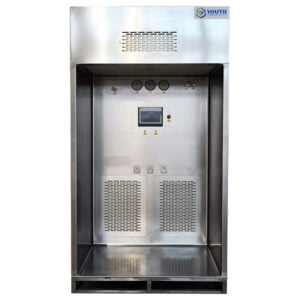
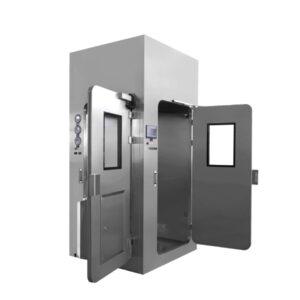
For teams evaluating specific configurations, the Mobile Laminar Air Flow Trolley product page provides dimensional detail on handle placement and shelf configurations that can be used as inputs to a route mockup before fabrication is confirmed.
Reach-across handling that means the layout is wrong
Reaching across a load during a transfer is not a technique problem. It is a geometry signal that the layout has not been correctly defined. When an operator must extend their arm across the load — whether to reach the far side of a tray, stabilize a container, or actuate a latch — their forearm passes through or disrupts the airflow field protecting the product. The result is contamination exposure at the exact moment the transfer is most active. Adjusting technique to minimize the reach doesn’t resolve the underlying condition; it manages it imperfectly and inconsistently across different operators and transfer sessions.
The correct resolution is to adjust the layout before purchase. Height-adjustable stands and work surface configurations address one version of this problem: if the working height is wrong for the operator, the natural biomechanical response is to reach rather than to reposition the whole body, and that reach crosses the load. Setting working height correctly — so the operator’s hands enter the clean air stream at the load’s level rather than above it — eliminates the postural condition that produces the reach. A laminar flow hood in a fixed installation can be designed around operator height from the outset; a mobile cart serving multiple operators or multiple transfer heights requires an adjustable solution rather than a fixed-height compromise.
The broader threshold is this: if the transfer cannot be completed with the operator’s hands remaining on the near side of the load throughout the entire sequence, the cart geometry is wrong for the application. That condition should be identified during the access-side and route review stages — not accommodated after delivery. Any layout that requires reaching across the load to complete a standard transfer step should be treated as a design flag that warrants correction before purchase, regardless of how the cart performs on its airflow specification alone.
The most consequential layout inputs — internal work dimensions, access-side geometry, airflow direction matched to load type, and route clearance — all need to be defined before fabrication drawings are issued. Each one is recoverable at the specification stage and expensive to correct after manufacturing. The reach-across condition is the clearest operational signal that one or more of these inputs was not correctly resolved: if the transfer sequence requires crossing the load, the layout geometry needs to change, not the operator’s technique.
Before confirming any fabrication drawing, confirm the internal work dimensions against the actual load envelope with packaging or fixtures included, verify the airflow direction against the load profile and fixture height, and walk the full transfer route with the cart — or a representative dimensional model — to identify handle and shelf conflicts at each threshold and turn. Those three checks, done before drawings are issued, cover the failure patterns that most commonly appear after delivery.
Frequently Asked Questions
Q: What happens if the transfer route cannot be modified to provide open-access clearance on more than one side?
A: A single-sided layout is the correct choice in that case, but it requires tightening the constraint on cart depth before purchase. If the cart is too deep for comfortable single-sided reach, the layout is already compromised — the appropriate response is to specify a shallower internal work envelope, not to accept the reach-across condition as a workflow reality.
Q: At what point in the procurement process should internal work dimensions be submitted to the manufacturer?
A: Before any fabrication drawing is issued, not during drawing review. The fabrication drawing should be a consequence of confirmed internal dimensions, not the document where those dimensions are discovered. Submitting the required internal work envelope — with packaging and fixtures included — as a specification input forces the manufacturer to show the external footprint as a derived result, which is the correct sequence for avoiding post-delivery mismatch.
Q: Does the reach-across threshold still apply if operators are trained to a consistent transfer technique?
A: Yes. Training reduces variability but does not change the geometry. If the layout requires any operator to cross the load to complete a standard transfer step, the airflow field is being disrupted every time that step occurs, regardless of how consistently it is performed. Technique accommodation is not equivalent to layout correction, and it breaks down under time pressure, operator changes, or load variations that shift where the far-side contact point is.
Q: Is a physical route mockup necessary if detailed CAD drawings of the cart and route are already available?
A: CAD review catches two-dimensional conflicts but reliably misses three-dimensional interference — handle strike height against door hardware, caster offset at threshold transitions, and the operator body position required at each access point. A physical or high-fidelity dimensional mockup is the check that reveals those conditions before fabrication. Teams with accurate CAD environments can reduce but not fully eliminate the need for a physical walk-through, particularly at airlocks and pass-through openings where seal geometry and threshold height create interference that is difficult to model completely.
Q: When does a vertical-flow cart stop being the better choice for tall fixtures and become the wrong selection instead?
A: When the load profile is shallow and distributed rather than tall and concentrated. Vertical airflow is well matched to loads with height that would shadow a horizontal stream, but on a shallow work surface holding small containers — vials, sample trays, low-profile components — horizontal airflow delivers more consistent, direct coverage across the critical surface. The crossover point is determined by fixture height relative to the internal work envelope: once the tallest fixture in the load configuration no longer presents a shadowing risk in a horizontal stream, the case for vertical flow weakens and the horizontal configuration’s surface-level coverage advantage becomes the deciding factor.