Most procurement delays in semiconductor cleanroom projects do not originate in the equipment selection phase. They originate in the specification phase, when a document goes out to suppliers before zone boundaries, chemical contamination scope, and acceptance criteria have been resolved. A supplier who prices against an incomplete specification will return a number that cannot survive a scope-alignment review, and the rework cost of correcting that gap after contract award consistently exceeds the time saved by issuing the RFQ early. The specification decisions that matter most — ISO class per zone, AMC scope, filter type, monitoring outputs, and acceptance test protocol — must be frozen together, not sequentially. What follows gives you a framework for identifying which decisions must come first, what belongs in the RFQ as hard line items, and when a modular package scope needs to be escalated before procurement begins.
What The Semiconductor Module Specification Must Decide First
The first decision is not the room footprint. It is the target particle class and whether that class applies uniformly to the entire enclosure or varies by zone.
ISO Class 5 is a reasonable planning baseline for most semiconductor manufacturing processes, but it is a starting point for the specification to confirm against process requirements, not a universal regulatory floor. Some processes operate comfortably at ISO Class 6; others require ISO Class 4 in specific inner rooms. The distinction matters for procurement because filter class, ceiling coverage, and airflow recirculation ratios all change significantly across that range. A supplier who prices a Class 5 specification will deliver a very different system from one who should have priced Class 4, and neither party may notice until airflow balancing begins.
Multi-zone configurations introduce a separate planning problem. A facility that requires an ISO Class 6 background with ISO Class 4 or Class 5 inner rooms cannot treat those boundaries as a layout preference to be resolved later. Zone boundary definitions control where wall systems terminate, where pressure differentials must be maintained, and how filtration density shifts between areas. If the specification does not draw those boundaries explicitly before RFQ issue, each supplier will make their own assumptions about scope, and the resulting quotations will not be comparable. Aligning particle class and zone boundary in the same document, before dimensions are finalized, eliminates one of the most persistent sources of scope gap in early supplier negotiations.
The process zone boundary also determines which team owns the requirement. In most semiconductor facility projects, particle class targets are set by facility engineering, while process-specific cleanliness requirements — including which zones need stricter control because of tool sensitivity — are owned by process engineers. If those two groups have not aligned before the specification is issued, the document will reflect one discipline’s requirements while leaving the other’s unspoken. That gap typically surfaces during layout review or acceptance testing, at which point modifying zone boundaries requires structural rework rather than a simple document revision.
How ISO Particle Class And AMC Scope Split Into Separate Requirements
Particle class and airborne molecular contamination control address different contamination mechanisms, and treating them as a single cleanliness line item is one of the most reliably costly specification errors in semiconductor cleanroom procurement.
Particle class, governed by ISO 14644-4:2022, defines the maximum permissible concentration of airborne particles by size. It drives filter type, airflow volume, and ceiling coverage — all of which are straightforward to scope and quote. AMC, addressed under ISO 14644-8:2022, defines permissible concentrations of chemical species that can deposit on or react with process surfaces. The control strategy for AMC requires its own filtration media — typically activated carbon or chemically impregnated filters — its own sampling point locations, its own media replacement intervals, and access provisions for maintenance that are structurally different from HEPA or ULPA service access. None of that is captured by specifying a particle class alone.
When AMC is described generically — as “chemical cleanliness” or “molecular contamination control” without specific targets — suppliers have no basis for including the right media, the right monitoring provisions, or the right chemical filtration access in their quotation. The scope simply falls out. The buyer discovers this omission during commissioning or process qualification, when chemical contamination events occur and no contracted mechanism exists to address them.
The consequence is not just a missing filter type. It is a missing infrastructure: no sampling ports, no media changeout access in the ceiling plenum, no baseline chemical concentration data to use as an acceptance reference. Retrofitting that infrastructure after the enclosure is built typically requires ceiling penetrations, panel modifications, and in some cases layout changes to accommodate service access — all at change order rates rather than contract rates.
Process-specific chemical sensitivity requirements make this even more granular. Photoresist handling areas, for example, may require wavelength-filtered glazing to control photoactive contamination — a requirement that is entirely chemical in character and entirely invisible to a particle class specification. These implementation details are not broadly applicable to every semiconductor application, but they illustrate why AMC scope must be defined process by process, with chemical targets, filter media type, sampling point locations, and access requirements listed as discrete items before the specification is sent out.
FFU, ULPA, Panel, And Monitoring Items To Put In The RFQ
The modular cleanroom speed advantage depends on resolving the component-level specification before the RFQ is issued, not after. Each item left ambiguous at RFQ stage becomes either a negotiation after contract award or a change order once installation begins.
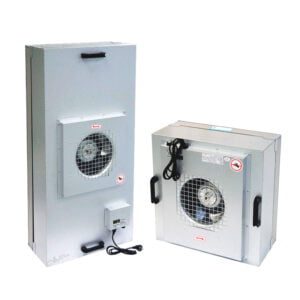
Fan filter unit motor type is one of the most consequential items to specify early. EC motor FFUs offer approximately 20–40% lower energy consumption and roughly 10 dB less noise than equivalent AC motor units — figures sourced from product-class comparisons that should be confirmed against individual supplier data sheets, but which are directionally significant enough to affect both operating cost and workplace environment. The problem is that the cost difference between EC and AC units is front-loaded into the equipment price. If the specification does not name EC motors before the supplier prices the package, the supplier will often default to AC units to stay price-competitive. Retrofitting to EC motors after contract award rarely recovers the full energy cost difference over the system’s operating life, because the unit price premium has been paid without the operating savings being factored into the budget approval.
Zone control panels, panel materials, ESD flooring, fire protection integration, and panel accessibility for future equipment transfer are each individually straightforward to specify, but each is also individually easy to omit when the specification is assembled under time pressure. A zone without its own intelligent control panel cannot be independently monitored or adjusted — a problem that becomes visible during operational qualification, not during quotation review. Anti-static panel materials are not a general cleanroom preference; in semiconductor environments they are a functional requirement for controlling electrostatic discharge risk to in-process components. Fire protection systems that are not specified to avoid particle release can compromise the ISO classification they are installed inside.
Each of these items, when left out of the RFQ, generates a scope conversation at the worst possible procurement stage.
| RFQ Component | What to Specify | Why It Matters |
|---|---|---|
| Fan Filter Units (FFU) | EC motors for energy efficiency and lower noise | 20–40% energy savings; ~10 dB quieter than AC FFUs |
| Zone Control Panel | Independent panel per zone for real‑time monitoring of temperature, humidity, differential pressure | Ensures zone‑level environmental control and monitoring outputs are in scope |
| Wall / Ceiling Panels | Powder‑coated aluminum, galvanized steel, stainless steel, glass, HPL; all with anti‑static properties | Affects durability, cleanability, and electrostatic control in semiconductor environments |
| Fire Protection Integration | Early smoke detection, concealed sprinklers, smoke exhaust designed to avoid particle release | Provides safety without compromising cleanroom particle control |
| Flooring | ESD PVC flooring with cleanroom‑grade surface characteristics | Prevents electrostatic discharge damage to sensitive components |
| Panel Accessibility | Removable wall sections or panels for future equipment transfer | Reduces retrofit cost and downtime |
The prose consequences are worth naming even after reviewing those line items: a specification that covers filter type and airflow but omits monitoring interfaces will produce a cleanroom that meets its particle class at acceptance testing and then operates without the zone-level data needed for ongoing process control. A specification that covers panels but not ESD flooring will pass visual inspection and fail electrostatic audit. The RFQ is only comparable across suppliers when all six categories above are named with equal specificity. A supplier who prices against a partial list will always return a lower number — and that number will not hold through scope alignment.
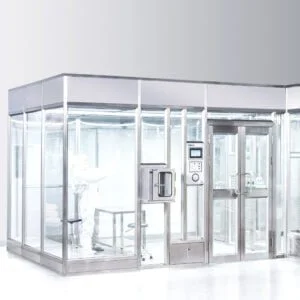
For buyers evaluating full component coverage across these categories, a purpose-built semiconductor cleanroom module addresses these as integrated items rather than as individually sourced components.
Acceptance Evidence Needed Before Supplier Comparison
Supplier quotations should not be compared before the acceptance test protocol is defined. A supplier who prices a lower ISO class, lighter particle testing, or no design qualification documentation will always appear cheaper than one who priced the full acceptance scope. That difference is not a cost savings — it is a scope gap that will reappear during commissioning, regulatory review, or process qualification.
Two categories of acceptance evidence should be required before procurement comparison begins. The first is operational: airflow balancing and particle testing conducted after installation to confirm that the installed system meets its specified ISO classification. This is not optional verification — it is the mechanism by which the buyer confirms that the theoretical design was correctly realized in construction. ISO 14644-4:2022 provides the governing framework for design, construction, and start-up verification, and any acceptance package should be traceable to its testing methodology. Without post-installation particle testing as a contracted deliverable, the buyer has no defensible basis for signing off on ISO classification compliance.
The second category is documentary: design qualification documentation and validation or certification support. This is not a universally mandated regulatory deliverable for every semiconductor application, but it is the evidence that protects the buyer during quality audits, customer inspections, and internal qualification reviews. A supplier who delivers a working cleanroom without documentation has transferred risk to the buyer — because when an auditor asks for evidence that the facility was designed, built, and started up to specification, the buyer must produce it or explain why it does not exist.
| Evidence Item | What It Confirms | Why It Matters |
|---|---|---|
| Airflow balancing and particle testing | ISO classification compliance per specified class | Verifies installed cleanroom meets particle control requirements |
| Design qualification and validation / certification support | Documented evidence for regulatory and quality assurance | Ensures acceptance package satisfies audit and operational readiness |
These two evidence categories should be listed as required deliverables in the RFQ, not as optional add-ons negotiated after supplier selection. A supplier who cannot commit to both should be treated as an incomplete quotation for comparison purposes, regardless of price.
For a broader view of how component selection and acceptance criteria interact across cleanroom system types, the article on cleanroom equipment selection and specification covers related trade-offs across ISO classes and application contexts.
When To Escalate From Modular Cleanroom Package To Fab Engineering Review
A modular cleanroom package delivers speed and procurement simplicity when the facility interface is clean — meaning the structural, utility, and integration conditions are within the package’s design assumptions. When they are not, the speed advantage inverts. Modular procurement moving ahead of an unresolved interface problem produces a faster path to a more expensive correction.
Two integration conditions consistently require escalation before the modular scope is finalized. The first is wall system compatibility with raised floor products. Modular panel systems are designed around specific connection geometries and structural tolerances. When the raised floor product already specified or installed uses a different interface geometry, the mismatch is not typically resolvable within the modular package — it requires fab engineering to evaluate the structural interface, determine whether an adapter solution is feasible, and specify the transition in a way that does not compromise either the floor system or the panel connection. Proceeding without that review produces rework during installation, at rates and timelines that neither the modular package contract nor the facility construction schedule anticipated.
The second condition is utility connection scope. Modular cleanroom packages define their own electrical, mechanical, and controls interface points. When power distribution, compressed air routing, or process gas connections require integration with existing facility infrastructure that operates on different specifications — different voltage levels, different pressure grades, different controls protocols — the integration work falls outside the modular package scope by definition. Facility engineering must map the existing infrastructure, define the interface requirements, and specify the transition before the modular package is contracted. If that alignment does not happen before contract award, the scope gap will be discovered during installation, when the modular package is complete and the utility connections do not fit.
| Integration Challenge | Risk If Not Escalated | Engineering Review Required |
|---|---|---|
| Wall system incompatibility with raised floor products | Mismatch and rework during installation | Fab engineering to resolve structural / interface mismatch |
| Utility connections (power, compressed air, process gases) beyond modular scope | Scope gaps and utility incompatibility | Facility engineering to integrate with existing infrastructure |
Neither of these conditions is a modular cleanroom deficiency. They are normal procurement boundary checks that apply whenever a modular system is being integrated into an existing facility rather than built into a greenfield space. The practical test is straightforward: if any integration item that the modular package depends on cannot be confirmed as resolved before the RFQ is issued, escalation to the relevant engineering discipline should happen before procurement, not after.
For a detailed review of how modular cleanroom features and components should be specified against contamination control requirements, the modular cleanroom features and performance specifications checklist covers the component-level decisions in structured form.
A semiconductor cleanroom specification that reaches the RFQ stage with ISO class, zone boundaries, AMC scope, filter class, monitoring outputs, and acceptance test protocol all defined will produce comparable supplier quotations and a contractually defensible acceptance path. One that reaches the RFQ with any of those items unresolved will produce quotations that cannot be compared on equal terms — and the cheapest one will almost always be the one that priced against the fewest requirements.
Before issuing the specification, confirm that particle class and zone boundaries have been agreed between facility engineering and process owners, that AMC targets are named as discrete line items with their own media and sampling requirements, that EC motor selection is explicit if energy and noise performance matter, and that acceptance test deliverables are listed as required scope. These decisions are easier to make during specification than at any later project stage, and they are significantly more expensive to correct after contract award.
Frequently Asked Questions
Q: What happens if facility engineering and process owners haven’t aligned on zone boundaries before the specification is issued?
A: The RFQ should not go out until that alignment is complete. If the two groups issue the specification under separate assumptions, each supplier will draw their own zone boundary conclusions, and the resulting quotations will price different scopes — making direct comparison impossible. More critically, misaligned zone boundaries discovered during layout review or acceptance testing require structural rework to correct, not a document revision. The specification stage is the only point in the project where boundary changes are cheap.
Q: If AMC targets are defined in the specification, what should the buyer do immediately after a supplier is selected to prevent chemical filtration scope from drifting during contract execution?
A: Require the supplier to submit a line-item confirmation of AMC deliverables — media type, sampling point locations, ceiling plenum access provisions, and media replacement intervals — before contract execution is finalized. Chemical filtration scope is the category most likely to be interpreted narrowly by a supplier under cost pressure. A written scope confirmation tied to the AMC targets in the specification creates a contractual reference point if the installed system omits sampling ports or access provisions that were assumed but never explicitly confirmed.
Q: Does the modular speed advantage still hold if only some interface conditions are unresolved — for example, if utility connections are confirmed but wall-to-floor compatibility hasn’t been reviewed?
A: No. A single unresolved interface condition is sufficient to invert the speed advantage. The modular package moves faster than stick-built construction only when all interface items are frozen. One unresolved compatibility issue — even one limited to a single wall connection geometry — will produce a scope gap that surfaces during installation rather than during specification, at change order rates and with schedule consequences that exceed what the modular timeline originally saved. The practical rule is binary: all interfaces confirmed, proceed; any interface unconfirmed, escalate before issuing the RFQ.
Q: How does specifying EC motor FFUs versus AC motor FFUs affect budget approval strategy, given that the savings are operational rather than capital?
A: The core trade-off is that EC motor units carry a higher unit price that must be justified in a capital budget, while the 20–40% energy savings accrue in an operating budget owned by a different cost center. If capital and operating budgets are not evaluated together during specification, procurement will default to AC units to minimize the capital number — and the facility will carry higher energy and noise costs for the system’s full operating life without that trade-off having been explicitly decided. The specification stage is the only point where this choice can be made with full cost visibility. Once AC units are contracted, the operating cost difference is locked in.
Q: Is post-installation particle testing always sufficient to confirm ISO classification compliance, or are there conditions where it can pass testing but still fail in production?
A: Post-installation particle testing confirms classification under the conditions present at the time of test — typically at-rest or controlled occupancy — and may not reflect the particle load generated by the actual process, tooling, and personnel present during production. ISO 14644-4:2022 distinguishes between as-built, at-rest, and operational classification states. A cleanroom that passes at-rest testing can exceed its ISO class in operational conditions if airflow recirculation ratios, tool exhaust integration, and gowning protocol were not designed against the production state. Acceptance testing should specify which classification state is being verified, and process owners should confirm that the tested state is representative of actual operating conditions before sign-off.