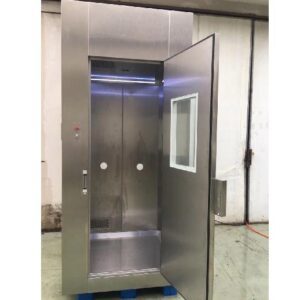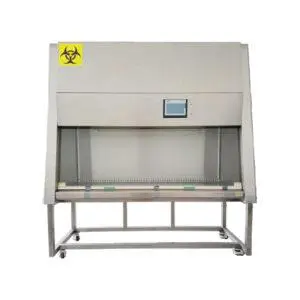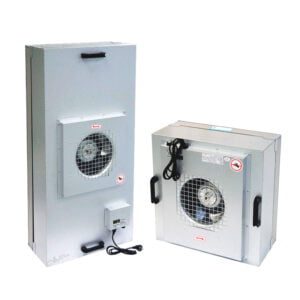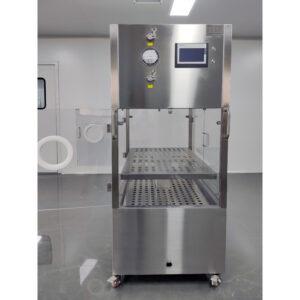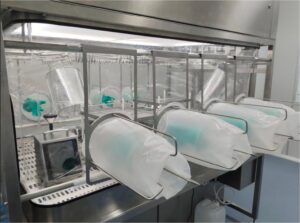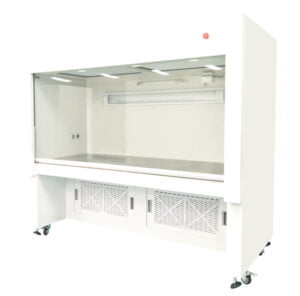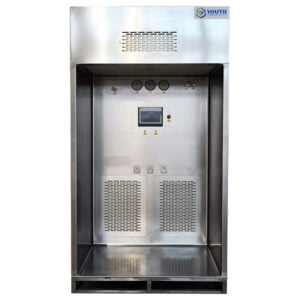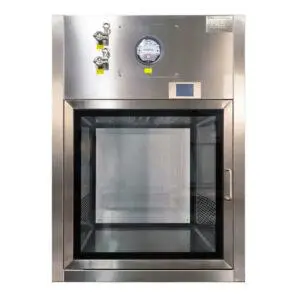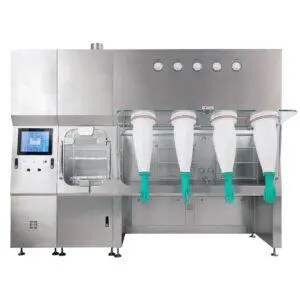
When a biosafety pass box sits between two rooms, the equipment itself is only one part of the question a project team needs to answer. The harder question is what sequence of transfer, decontamination, and recovery actions the organism, the material, and the room layout actually require—and whether the chamber, the room interfaces, and the waste route have been defined as one coordinated system before anyone compares equipment specifications. Getting this boundary wrong does not show up as a spec mismatch; it shows up as an operational gap between what the pass box can do and what the facility assumed it would do.
Risk Questions That Define the Biosafety Transfer Boundary
A biosafety pass box transfer sequence cannot be specified correctly until the facility risk assessment has answered a set of questions that are specific to the material and the room context, not to the equipment catalog. The organism or agent involved, its material form, the integrity of its container, the direction of transfer, and the credible exposure route together determine what the transfer sequence must achieve — and each of these inputs can change the answer independently of the others.
Container integrity matters because a sealed, verified container moving in one direction carries a different exposure profile than an open vessel, a breached container, or material whose containment status is uncertain. Where the container is verified and intact, the transfer sequence may need to address surface contamination only; where integrity is uncertain or compromised, the sequence may need to treat the transfer as if the material itself is exposed, which changes what the chamber must accomplish and what the operator must verify before and after the cycle.
Transfer direction changes the risk question as well. Material moving from a lower-containment space into a higher-containment space raises a different protection question than material moving outward, because the protection objective shifts between protecting the receiving environment and protecting the receiving personnel or the external environment. A pass box that handles one direction adequately does not automatically handle the reverse direction under the same assumptions.
The credible exposure route — aerosol, surface contact, puncture, or another route identified by the assessment — determines which chamber functions are relevant at all. A decontamination approach suited to surface-level contamination does not address an aerosol-generating event, and a chamber configured for one exposure route should not be assumed capable of addressing a different one without separate confirmation.
These risk questions are not a checklist that produces a standard answer. They are inputs that interact: the same organism can call for a different transfer sequence depending on material form and container state, and the same container type can call for a different sequence depending on the organism and the exposure route identified. The output of this stage is not equipment selection — it is a documented, site-specific description of what the transfer sequence must achieve, which then becomes the basis for comparing chamber functions and operator actions.
Separating Routine Transfer, Decontamination, Recovery, and Waste Removal
| Transfer sequence | Applicable condition | Planning decision |
|---|---|---|
| Routine clean transfer | Routine clean material movement | Define this sequence separately from decontamination, abnormal-load recovery, and waste removal. |
| Validated decontamination | A transfer requires validated decontamination | Match the sequence to the required chamber functions and operator actions. |
| Abnormal-load recovery | A load or transfer condition is abnormal | Define a separate recovery sequence and its operator actions. |
| Waste removal | Material leaves through the waste route | Coordinate the removal sequence with the waste route within the containment boundary. |
Treating “pass box operation” as a single procedure obscures the fact that a biosafety pass box may need to support several operationally distinct sequences, each with different chamber functions, different operator actions, and different points where something can go wrong. Conflating them into one generic procedure creates gaps at exactly the points where the sequences diverge.
Routine clean transfer is the baseline case: material with no indication of contamination moves through the chamber without requiring a decontamination cycle. The chamber function here is primarily about maintaining separation between the two adjoining spaces during the transfer, and the operator action is largely procedural — confirming interlocks, confirming the transfer is logged, confirming nothing bypasses the intended door sequence.
Validated decontamination is a materially different sequence. Here the chamber itself becomes an active treatment step, whether through a vaporized hydrogen peroxide cycle or another validated method, and the operator action shifts from procedural compliance to verifying that the decontamination parameters were met before the material or the chamber is released for the next step. Where this sequence is required, the chamber’s mechanical capability to deliver and confirm a validated cycle is not optional — it is the function the project is paying for.
Abnormal-load recovery addresses the case where a transfer does not go as planned — a container is found breached mid-cycle, a load fails an integrity check, or an unexpected condition is discovered inside the chamber. This sequence needs to be defined separately because the appropriate response is not simply “repeat the routine sequence” or “repeat the decontamination sequence”; it may require a distinct set of operator actions, including how the load is contained, how the chamber is treated before reuse, and who is authorized to declare the recovery complete.
Waste removal is distinct again because it is not a transfer in the conventional sense — material is leaving the controlled space permanently rather than moving toward further use, and the removal sequence must coordinate with whatever waste route exists beyond the chamber itself. A facility that has defined routine transfer and decontamination carefully but has not defined how waste removal interacts with the same chamber has left a gap precisely where containment responsibility is easiest to lose track of.
Coordinating Chamber, Room, Utility, Exhaust, and Waste Interfaces
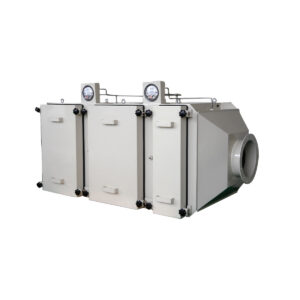
A biosafety pass box does not function as an isolated piece of equipment; it functions as one component within a containment boundary that also includes the adjoining rooms, the utilities that support decontamination (such as whatever generates or monitors a VHP cycle), the exhaust path, and the waste route. Specifying the chamber without first defining this boundary produces equipment that may be mechanically sound but operationally disconnected from the rooms it serves.
The practical consequence of this is that interface ownership needs to be resolved before equipment selection, not after. If the chamber requires a specific exhaust condition to complete a decontamination cycle safely, that exhaust path is part of the containment boundary whether or not it is physically part of the pass box. If the waste route downstream of the chamber has its own containment requirements, those requirements affect how the chamber’s waste-removal sequence is defined, even though the waste route itself may be an entirely separate piece of infrastructure.
This matters differently depending on how the chamber is positioned. Where a pass box serves as the sole transfer point between two spaces with meaningfully different containment levels, every interface — door interlocks, utility supply, exhaust, and waste — becomes part of what maintains the separation between those spaces. Where a chamber serves a more limited role within a broader containment system that has other dedicated transfer or decontamination points, the coordination burden on that single chamber’s interfaces may be smaller, but it does not disappear; it simply shifts to whichever boundary element is actually carrying the containment function for that specific interface.
Ownership documentation is the practical tool for avoiding gaps here. A facility team, an EPC contractor, and an equipment supplier each have visibility into different parts of this boundary — the facility team into the room and utility context, the contractor into the broader system integration, and the supplier into the chamber’s own mechanical and control functions. Without a documented record of who owns which interface, it becomes easy for an assumption to go unstated: the facility assumes the supplier’s chamber will handle a condition the chamber was never specified to address, or the supplier assumes the facility’s utility supply meets a condition that was never confirmed. Defining this boundary and its ownership before equipment selection is what allows the chamber specification itself to be meaningful rather than provisional.
Setting Safe States for Door, Seal, Power, and Cycle Failures
| Abnormal condition | Safe-state decision to specify | Decision boundary |
|---|---|---|
| Power loss | Define the project-specific safe state during and after loss of power. | A single default state is not supported for every biosafety application. |
| Door or seal fault | Define the safe state for the affected door or seal condition. | A universal interlock response should not be assumed. |
| Cycle interruption | Define the safe state for an interrupted decontamination cycle. | One VHP recipe should not be assumed to suit every application. |
| Residual chemical hazard | Define the safe state while the residual chemical hazard remains. | Base the condition on the credible exposure route identified by the facility risk assessment. |
Every biosafety pass box transfer sequence eventually has to answer a question that is uncomfortable to leave open: what happens when something fails mid-process, and what state does the system need to reach — and hold — until a person can intervene correctly? This question cannot be answered generically, because the correct safe state depends on what is inside the chamber, what stage of the sequence is interrupted, and what the facility’s risk assessment has identified as the credible exposure route.
Power loss is the clearest case where a single default assumption fails. A chamber that defaults to an unlocked or neutral door state on power loss may be appropriate where the material inside poses no exposure risk during an outage, but the same default could compromise containment where the chamber is mid-cycle with material whose exposure route is active. The project needs to specify what state the doors, seals, and any active treatment system should hold during a power loss and what state they should return to once power is restored, rather than assuming the chamber’s factory default is adequate for the application.
Door or seal faults raise a related but distinct question, because a fault detected during a routine transfer may call for a different response than the same fault detected mid-decontonation-cycle. An interlock response appropriate to one case can be inappropriate to the other, which is why a universal interlock behavior should not be assumed to cover every biosafety application the chamber might support.
Cycle interruption is its own category, particularly for decontamination sequences. An interrupted VHP cycle leaves open the question of whether the chamber contents should be treated as decontaminated, partially decontaminated, or untreated, and that determination affects whether the load can proceed, must be recovered under the abnormal-load sequence, or must be re-treated entirely. One VHP recipe or interruption response does not suit every material and organism combination, which means this decision needs to be made against the specific risk basis rather than inherited from a different application.
Residual chemical hazard is the condition that persists after a decontamination agent has been used but before it has fully cleared — a state where the chamber is not actively failing, but is not yet safe to open or release either, and the project needs to define what safe state applies while that condition remains.
Assigning Operator Actions and Evidence Owners for Abnormal Conditions
Defining a safe state is only half of what an abnormal condition requires; the other half is deciding who acts, what they are authorized to do, and who is responsible for the evidence that the condition was handled correctly. Where this assignment is left implicit, a chamber can reach the correct safe state mechanically while the surrounding facility response remains uncoordinated — nobody has confirmed who declares the recovery complete, and nobody owns the record that shows the sequence was followed.
The operator role in an abnormal condition is different from the operator role in a routine transfer. Routine operation generally calls for procedural compliance — following the defined sequence and confirming each step. An abnormal condition calls for judgment within defined boundaries: recognizing that the condition has occurred, applying the correct safe-state response, and knowing the limit of their own authority before escalating. A facility that trains operators only on routine sequences has not addressed this second requirement, regardless of how well the equipment itself performs.
Evidence ownership is a related but separate question. When a cycle is interrupted, when a door fault occurs, or when a load is found to be abnormal, something needs to record what happened, what state the chamber reached, and what action was taken — and a specific role needs to own that record rather than assuming it exists somewhere in a log. QA and validation teams typically have an interest in this evidence because it may support later decisions about whether a load can be released or whether the chamber itself needs requalification, but the facility needs to decide in advance whether that evidence ownership sits with the operator, with a supervising role, or with a quality function, rather than resolving it after an event has already occurred.
This assignment work is inseparable from the containment boundary established earlier, because an abnormal condition rarely stays confined to the chamber alone. A door fault during a cycle may have implications for the adjoining room; a residual chemical hazard may have implications for whoever next approaches the chamber. Assigning operator actions and evidence ownership only for the chamber itself, without extending that assignment to the rooms and personnel the boundary touches, leaves the same kind of gap that an undefined interface creates.
Acceptance Evidence for the Complete Containment Transfer Sequence
| Acceptance area | Evidence must establish | Decision boundary |
|---|---|---|
| Risk basis | The transfer sequence reflects the organism, material form, container integrity, transfer direction, and credible exposure route identified by the facility risk assessment. | Control selection remains site-specific and proportionate to the assessed risk. |
| Operating sequences | Routine clean transfer, validated decontamination, abnormal-load recovery, and waste removal are defined separately where applicable. | These sequences may require different chamber functions and operator actions. |
| Containment boundary | The pass box, adjacent rooms, decontamination utilities, and waste route are treated as one containment boundary with documented ownership. | Equipment selection follows definition of the complete boundary. |
| Abnormal conditions | Safe states are specified for power loss, door or seal faults, cycle interruption, and residual chemical hazards. | No single interlock or VHP recipe is presumed suitable for every biosafety application. |
Acceptance evidence for a biosafety pass box transfer sequence is not a single certificate or a single test result; it is a set of confirmations that, together, demonstrate the sequence was built on the right risk basis, covers the operationally distinct sequences the facility actually needs, treats the containment boundary as one coordinated system, and specifies safe states for the abnormal conditions the chamber can encounter. Evidence that addresses only the chamber’s mechanical performance, without addressing these other areas, does not establish that the transfer sequence is complete.
The risk basis is the foundation this evidence has to trace back to. Acceptance evidence should show that the organism, material form, container integrity, transfer direction, and credible exposure route identified by the facility’s own risk assessment were the basis for the sequence design, not a generic template applied without reference to that assessment. The WHO Laboratory Biosafety Manual frames this as a matter of proportionate control selection driven by risk assessment, which is a summary-level principle that still needs to be applied through a site-specific assessment rather than taken as a ready-made specification. The CDC’s Biosafety in Microbiological and Biomedical Laboratories guidance similarly treats risk assessment as the driver of mitigation choices, as advisory best practice rather than a regulatory mandate — useful for framing the acceptance question, but not a substitute for the facility’s own documented assessment.
Operating sequence evidence should confirm that routine transfer, validated decontamination, abnormal-load recovery, and waste removal have each been defined where the facility’s risk basis calls for them, rather than assuming one generic procedure covers all four. Containment boundary evidence should confirm that the chamber, the adjoining rooms, the decontamination utilities, and the waste route have documented ownership as one system, not as separately specified components that happen to sit next to each other. Abnormal-condition evidence should confirm that safe states have been specified for power loss, door or seal faults, cycle interruption, and residual chemical hazard, each against the specific risk basis rather than a default assumption.
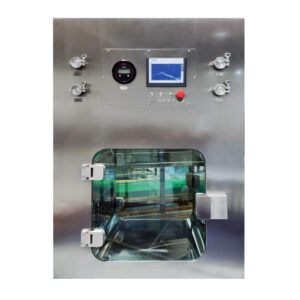
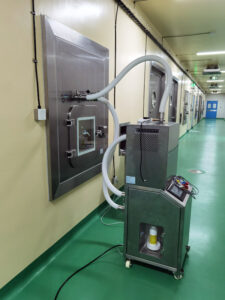
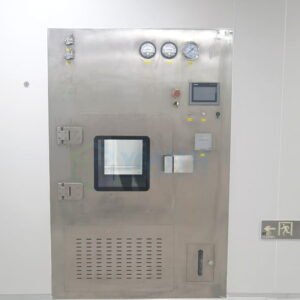
Where a project is reviewing equipment such as a biosafety pass box or a VHP pass box against this evidence set, the configuration and quotation review stage is where this documentation becomes directly useful — the facility’s risk assessment, defined sequences, and boundary ownership are the inputs a supplier needs in order to confirm which chamber functions and interlock behaviors match the application, rather than proposing a configuration based on assumptions the facility has not yet confirmed. A portable decontamination unit or a fixed VHP chamber may each satisfy a decontamination requirement mechanically, but only evidence tied to the facility’s own risk basis and boundary definition can confirm which configuration, interlock behavior, and cycle approach are appropriate for the specific application under review.
Frequently Asked Questions
Q: What information should be defined before comparing biosafety pass-box configurations?
A: Start with the facility risk assessment: identify the organism, material form, container integrity, transfer direction, and credible exposure route. Use those project facts to define a proportionate transfer sequence before comparing equipment functions.
Q: Can routine transfers, decontamination, abnormal-load recovery, and waste removal use one operating sequence?
A: Do not assume that one sequence covers all four activities. Define each applicable route separately, then identify the chamber functions and operator actions required for routine clean transfer, validated decontamination, abnormal-load recovery, and waste removal.
Q: What should be included in the containment boundary for a biosafety pass-box project?
A: Treat the pass box, adjacent rooms, decontamination utilities, exhaust interfaces, and waste route as one coordinated boundary. Document who owns each interface before equipment selection so that no part of the transfer path is left without a defined responsibility.
Q: How should the project define safe states for abnormal conditions?
A: Specify a project-specific safe state for power loss, door or seal faults, cycle interruption, and residual chemical hazards. Base each decision on the credible exposure route and required operator response rather than assuming one interlock response or VHP recipe fits every biosafety application.