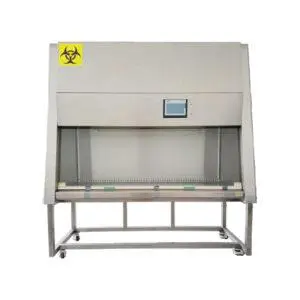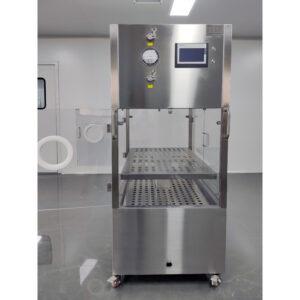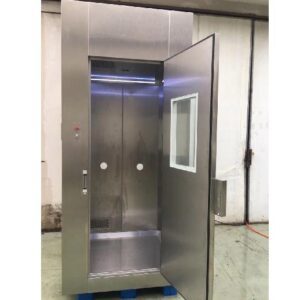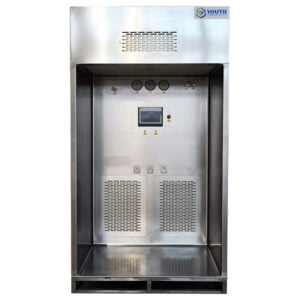
Semiconductor, electronics, and photonics fabrication areas rarely fail on particle count alone. A wafer coating step, a metrology step, and a wire-bond step can share the same room classification and still carry entirely different contamination, static, and thermal risks. The practical question for a project team is not which ISO class to specify, but which process step drives which control, and where that control has to be built into the room rather than assumed from the class number.
Process Risks That Particle Classification Does Not Cover
| Risk area | What particle classification establishes | What still has to be fixed for the project |
|---|---|---|
| Airborne particles | Classification by particle concentration at designated sampling locations | Required particle class and the sampling and verification basis |
| Airborne molecular contamination | Not established by particle classification | Whether airborne chemicals create process risk and, if so, the required chemical cleanliness assessment and grading |
| Surface deposition | Not established by particle classification | The process-specific surface deposition requirement |
| Electrostatic discharge (ESD) | Not established by particle classification | The process-specific ESD requirement |
| Tool-generated contamination | Not established by particle classification | The tool interfaces and contamination controls required at the affected process step |
Particle classification answers one question: how many particles of a given size appear at designated sampling locations in the room. That is a real and necessary measurement, but it describes only the particulate condition of the air, not the full set of contamination pathways that affect fabrication, coating, assembly, or test.
Airborne molecular contamination is a separate mechanism. Certain process chemistries release vapors or off-gas products that do not register in a particle count but can deposit on a surface, alter a coating’s chemistry, or interfere with a subsequent process step. Where a process is sensitive to this pathway, the project needs a chemical cleanliness assessment as a distinct decision from the particle class; where the process has no such sensitivity, that assessment may not be a project requirement at all. ISO 14644-8:2022 addresses assessment and grading of airborne chemical cleanliness, but only where airborne chemicals create process risk in the first place — it does not substitute for particle classification, and particle classification does not substitute for it.
Surface deposition is a third pathway. A room can meet its particle class at the sampling height used for classification while a horizontal surface below a tool accumulates deposition through gravitational settling, outgassing, or handling contact. Whether that matters depends entirely on the sensitivity of the surface in question — a bare wafer awaiting the next process step carries a different exposure than a packaged and sealed component.
Electrostatic discharge is a fourth, unrelated mechanism entirely: it is a charge-transfer risk tied to materials, handling, and grounding, not to airborne particle concentration. A room can be particle-compliant and still present an ESD risk to a charge-sensitive device if the flooring, garments, workstations, or ionization provisions are not matched to that device’s sensitivity.
Tool-generated contamination is the fifth category, and it originates from the process equipment itself — particles or vapors generated at the point of use rather than carried in the supply air. This risk is a function of the specific tool and process step, not of the room’s classification, and it requires an interface decision between the tool and the surrounding cleanroom rather than a room-level classification decision. ISO 14644-1:2015 establishes the particle-count basis, at designated sampling locations, and nothing beyond that scope; treating it as also covering viable, chemical, radiological, or surface cleanliness leaves those pathways unaddressed in the project brief.
Mapping Fabrication, Coating, Assembly, and Test to Control Needs
Each stage in a high-tech process line carries its own combination of the five risk categories above, and the combination changes as material moves through the line. A fabrication step working with reactive chemistries may carry meaningful airborne molecular and tool-generated contamination risk while the particle and ESD risk at that same step is comparatively contained by the process tool’s own enclosure. A coating step may reverse that balance: particle control at the point of deposition can dominate the requirement, while molecular contamination is controlled by the coating chemistry itself rather than by the room. An assembly step handling unpackaged, charge-sensitive devices can carry a governing ESD requirement even where particle and molecular risk are secondary. A test step, depending on what is being measured and how the device is handled, may return to a particle- or handling-dominated risk profile.
No single control assignment carries across all four stages, because the risk driving the requirement is not the same risk from one stage to the next. Assigning a uniform cleanroom control to every stage — using one design intent for particle, molecular, ESD, and handling risk regardless of which stage is under discussion — misallocates control effort: stages with a dominant non-particle risk get a particle-driven solution, and stages with a dominant particle risk may not get the local control they need.
The working method is to take each stage individually and ask which of the five risk categories governs at that specific point in the process, based on the materials, chemistries, and handling involved at that stage, rather than starting from a target classification and back-filling the other risk categories. Where a stage’s governing risk is unclear from the process description alone, that is information the project team needs to resolve before a control can be assigned — not a gap to be closed by defaulting to the room’s general classification.
Zoning Local Clean Areas Around the Most Sensitive Steps
Once a process step’s governing risk is identified, the next decision is where that control needs to live: in the general room, or in a local zone built around the step itself. A local clean zone becomes the relevant choice where a specific process step requires materially tighter control — of particles, molecular contamination, ESD, or a combination — than the surrounding room is designed to hold, and where extending that tighter control to the entire room is not the intended design approach.
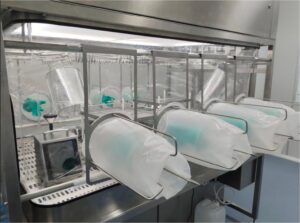
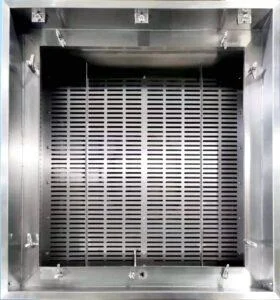
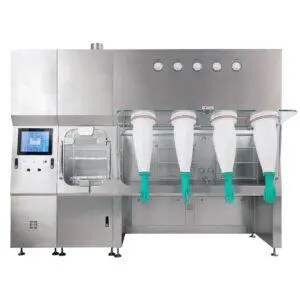
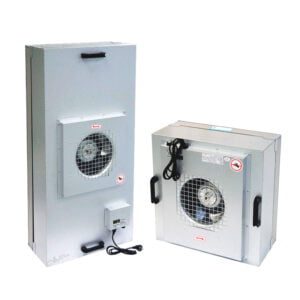
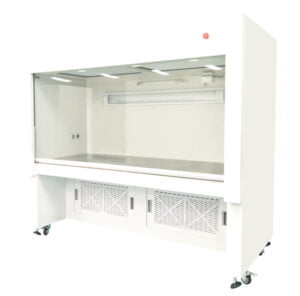
The equipment used to create that local condition, such as a fan filter unit or a HEPA/ULPA filtration stage integrated at the point of use, establishes a zone of elevated control within a room that otherwise operates at a different baseline. This is a room-air and local-zone design decision, not a statement about which classification number applies to the whole facility, and the equipment serving that role is distinct from process-tool components even where it is installed close to or interfaced with a tool.
Defining the zone is only the first half of the decision. The second half is defining how that zone will be accessed and tested once it exists. A local zone that cannot be reached for maintenance without disturbing its own control, or that has no defined verification point for confirming the elevated condition is being sustained, does not function as a durable local control — it functions as an assumption. The access question and the testing question have to be resolved together with the zoning question, not left for the installation phase, because the physical layout of the zone determines what access and testing are even possible afterward.
Where a project has several sensitive steps in sequence, each with a different governing risk, the zoning decision has to be made step by step rather than as a single zone drawn around the whole sequence — a zone sized for the most demanding step in the sequence may over-control the others, while a zone sized for convenience may under-control the step that actually needs it.
Coordinating Tool Exhaust, Utilities, Heat, and Maintenance Access
| Interface | Project decision to fix | Boundary to preserve |
|---|---|---|
| Process-tool exhaust | Assigned scope and the interface with the cleanroom package | Keep process-tool exhaust distinct from the room shell, FFU and filter equipment, controls, and fit-out scope |
| Process utilities | Assigned scope and the interface with the cleanroom package | Keep utilities distinct from the cleanroom equipment scope |
| Heat load | The heat-load risk at each affected process step and the cleanroom control it drives | Do not treat particle classification as a substitute for the heat-load decision |
| Maintenance access | The access needed at tool and local clean-zone interfaces | Coordinate the access decision with how the local zone will be accessed and tested |
A cleanroom brief that stops at classification and zoning leaves several coordination questions unresolved, and each one has a real effect on whether the finished room performs as intended.
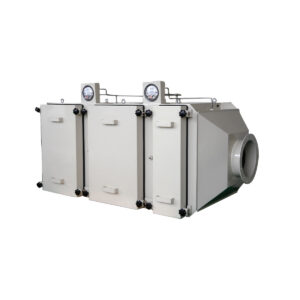
Process-tool exhaust is the clearest example. Exhaust removes tool-generated contamination and process byproducts from the space, but the exhaust system itself is a project element with its own assigned scope, and that scope has to be interfaced with the cleanroom package rather than assumed to be part of it. Where exhaust scope is left ambiguous, the room’s air balance, its pressurization relative to adjacent spaces, and its actual contamination performance at the tool can all diverge from what the classification and zoning decisions assumed.
Process utilities carry the same coordination requirement. Utilities serving the process tools are a distinct scope from the cleanroom equipment scope, and the interface between the two needs to be fixed explicitly rather than left to be resolved during installation.
Heat load is a separate coordination input that particle classification says nothing about. Process tools generate heat, and the room’s air handling has to be sized and controlled to manage that load at each affected step; a room correctly classified for particle cleanliness can still fail to hold its intended condition if the heat load at a given step was not accounted for in the design. The heat-load decision belongs with the process-step risk mapping, not with the particle classification.
Maintenance access is the coordination point that connects back to the zoning decision. A local clean zone or a tool interface built without a defined access path for maintenance creates a conflict later: the maintenance activity itself becomes a contamination or disruption event to the zone it is meant to service. The access decision made at the zoning stage has to account for how filters, tool components, or utility connections in that zone will actually be reached and restored to their controlled condition afterward.
Separating Supplier Equipment Scope from Process-System Responsibility
| Scope group | Items to allocate explicitly | Boundary decision for the brief |
|---|---|---|
| Cleanroom and equipment package | Room shell; FFU and filter equipment; controls; fit-out | State which named items are included and where each interface ends |
| Process systems and final qualification | Process-tool exhaust; utilities; final installed qualification | Assign the project responsibility explicitly rather than assuming these items are included in the cleanroom package |
The equipment package a cleanroom supplier delivers and the process systems that surround it are distinct project responsibilities, and confusing the boundary between them creates gaps that surface only after installation.
The cleanroom and equipment package covers items such as the room shell, FFU and filter equipment, controls, and fit-out. These are the components that establish the room’s air handling, envelope, and cleanliness-control capability. Process-tool exhaust, process utilities, and final installed qualification sit outside that package as a matter of project responsibility, even where they physically connect to it. A supplier delivering room shell, FFU and filter equipment, controls, and fit-out is not, by that delivery alone, responsible for the exhaust or utility systems serving the process tools installed inside the room, nor for the qualification activity that confirms the installed system performs as required.
This separation matters most at the interface points identified earlier: where tool exhaust meets the room’s air balance, where utilities cross into the cleanroom envelope, and where a local clean zone’s access and testing provisions meet the surrounding room design. Each interface needs an explicit owner. Assuming that a named cleanroom package automatically includes everything up to and including the process tool leaves exactly these interfaces unassigned.
This is also the point in project development where the information a buyer assembles — the process-step risk mapping, the zoning decisions, and the interface assignments already made — becomes the basis a supplier such as YOUTH would use to review a configuration or quotation request for a semiconductor cleanroom module, an FFU layout, or a HEPA/ULPA filtration stage. A request that specifies only a target classification, without the accompanying risk mapping and interface assignments, gives a narrower basis for that review than one that includes them.
Evidence to Fix Before Issuing the High-Tech Cleanroom Brief
| Evidence basis | What it can support | Limit to preserve in the brief |
|---|---|---|
| ISO 14644-1:2015 | Airborne-particle classification at designated sampling locations | It does not establish viable, chemical, radiological, or surface cleanliness |
| ISO 14644-8:2022 | Assessment and grading of airborne chemical cleanliness when airborne chemicals create process risk | It does not replace particle classification |
| ISO 14644-4:2022 | The path from requirements through design, construction, start-up, and verification | It does not prescribe a specific technology, process tool, or delivery scope |
Before a brief goes out for supplier review, the project team benefits from knowing exactly which evidence basis supports which claim, and where each basis stops.
ISO 14644-1:2015 supports the airborne-particle classification at designated sampling locations — a defined, verifiable basis for the particle-cleanliness aspect of the room, and only that aspect. It does not establish viable, chemical, radiological, or surface cleanliness, and a brief that cites this standard as evidence for any of those other conditions is citing it beyond its scope.
ISO 14644-8:2022 supports assessment and grading of airborne chemical cleanliness, and it becomes relevant only where the process-step risk mapping has already identified that airborne chemicals create a process risk for at least one step. Where no step in the mapping carries that risk, this standard has no bearing on the brief. Where a step does carry that risk, this standard does not replace the particle classification already established under ISO 14644-1 — both apply, addressing different pathways.
ISO 14644-4:2022 supports the sequence from requirements through design, construction, start-up, and verification — the procedural path a project follows to get from a stated requirement to a verified installed condition. It does not prescribe a specific technology, process tool, or delivery scope, so citing it does not resolve which equipment family, zoning approach, or exhaust interface a given project should use; those remain project decisions informed by the process-step mapping and the interface coordination already discussed.
Where the project brief states a required particle class, a chemical cleanliness requirement, a zoning boundary, an exhaust and utility interface assignment, and a maintenance access provision — each tied to the process step that drives it — the brief gives a supplier reviewing the request a defined basis for a configuration response. Where any of those items is missing, the gap is specific: it is not a general uncertainty about the project, but a named piece of evidence the project team still needs to fix before the brief can be treated as complete.
Frequently Asked Questions
Q: Is a specified particle class enough to define a high-tech cleanroom project?
A: No. Particle classification establishes airborne particle concentration at designated sampling locations, while airborne molecular contamination, surface deposition, ESD, heat load, and tool-generated contamination require separate project decisions. Map those risks to each fabrication, coating, assembly, and test step before assigning controls.
Q: When should a process step use a local clean zone instead of relying on the surrounding room?
A: Use a local clean zone when that step needs tighter control than the surrounding room. Before selecting the approach, define the step-specific risk, how operators or materials will access the zone, and how its required control will be tested.
Q: What information should be prepared before requesting a cleanroom equipment proposal?
A: Prepare a process map that identifies the required particle class and verification basis, any chemical cleanliness need, process-specific surface and ESD requirements, tool-generated contamination risks, heat loads, exhaust and utility interfaces, and maintenance access. This gives suppliers a defined basis for separating room controls from process-system needs.
Q: How can buyers compare supplier scope without leaving critical interfaces unassigned?
A: Compare proposals against an explicit scope split. Record whether the room shell, FFU and filter equipment, controls, and fit-out are included, then separately assign process-tool exhaust, utilities, and final installed qualification, with the endpoint of each interface stated in the brief.
Q: Which ISO 14644 reference should support each part of the project brief?
A: Match the reference to the decision it actually supports: ISO 14644-1 for airborne-particle classification, ISO 14644-8 when airborne chemicals create a process risk, and ISO 14644-4 for the path from requirements through design, construction, start-up, and verification. None of these references alone selects a process tool, fixes the delivery scope, or resolves every contamination risk.