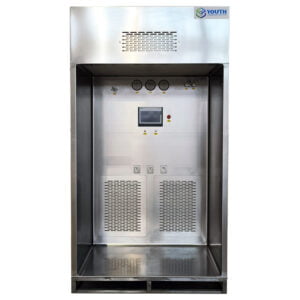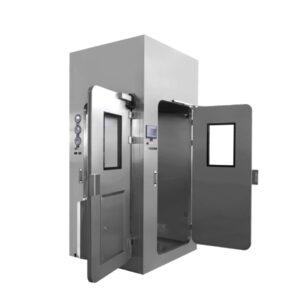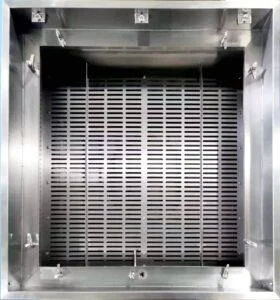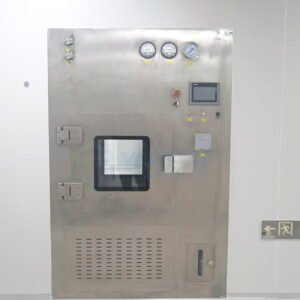
Choosing a bag-in-bag-out housing configuration for hazardous pharmaceutical exhaust is not a filter-selection decision. It is a containment decision that happens to use a filter as one of its components. Teams that start by comparing housing models before they have defined what the exhaust stream actually carries and how operators could be exposed to it tend to specify equipment that fits a generic safe-change category without fitting their process. The question that should come first is not “which BIBO housing” but “what is in this exhaust, and how could it reach a person during normal operation or during filter change.”
Define the hazardous substance and exposure route before selecting the housing
A BIBO housing exists to let a loaded filter be removed and replaced without the installation team contacting the captured material. That function only matters in proportion to what the filter has captured and how it could move if the containment boundary were breached. Dust captured from a milling or granulation exhaust behaves differently from aerosol generated by a liquid process, and both behave differently from a potent compound that is hazardous at concentrations too low to see or smell. The housing configuration that suits one of these does not automatically suit another, because the exposure route — inhalation, surface contact, or dispersal into the surrounding room — determines where the containment boundary needs to be strongest.
This is why a hazard-and-exposure assessment has to precede the equipment conversation rather than follow it. Where the exhaust stream carries a substance with an established occupational exposure limit, the assessment should identify that limit and the pathway by which the filter could release it during changeout. Where the hazard is physical (sharp, pyrophoric, or reactive dust) rather than toxicological, the controls shift toward handling and waste rather than operator exposure limits. The same housing family can serve both situations, but the stage count, sealing arrangement, and bagging method that make it effective are not the same.
The condition that most changes this judgment is whether the hazard is present only in the filter media after capture, or whether it can also exist in the ductwork and housing surfaces upstream of the filter. If contamination is confined to the filter face, a single safe-change stage addressing that filter may be sufficient. If the hazard can migrate upstream — through bypass, through the duct surface, or through condensation carrying dissolved compound — the assessment needs to extend further into the exhaust path than the filter itself, and the housing specification has to account for isolation points beyond the filter location. WHO’s guidance on GMP for pharmaceutical products containing hazardous substances addresses safe-change and bag-in-bag-out housings specifically in this hazardous-pharmaceutical context: it supports the principle that such housings protect operators and prevent captured-dust release during filter replacement, but that principle is scoped to products already identified as hazardous under a process-specific assessment, not a general biosafety filter-change rule applied without that assessment.
Without this step completed first, any housing specification is built on an assumption about the hazard rather than a documented one, and that assumption is exactly what a supplier or auditor will ask the project team to defend later.
Translate the risk assessment into isolation, bagging, decontamination, and waste controls
| Control area | Project definition to require | Decision boundary |
|---|---|---|
| Isolation | Isolation points and boundary matched to the identified exposure route | Defines where the exhaust path must be isolated for safe change |
| Bagging | Bagging method and containment boundary for captured material during filter replacement | Defines how captured material remains contained during changeout |
| Decontamination | Project-specific decontamination need, method, and boundary | Must follow the process hazard assessment; no universal procedure is established here |
| Waste | Project-specific route for contained waste from the changeout | Defines the handling and disposition boundary that the project must confirm |
| Operator protection | Controls matched to the identified exposure route and safe-change task | Must be derived from the process-specific exposure and containment assessment |
Once the hazard and exposure route are defined, the assessment has to be translated into a set of control decisions that a housing specification can actually express. These controls do not all derive from the same part of the assessment, and treating them as a single undifferentiated “safe-change” requirement tends to produce a housing that handles one control well and leaves another to be improvised on site.
Isolation is the first translation point: where does the exhaust path need to be sealed off from the rest of the system before the housing is opened for filter change, and how far does that isolation boundary need to extend upstream and downstream. A process that generates a steady low-level hazard may require isolation only immediately around the housing; a process capable of a transient high-concentration release may require isolation further into the duct run, with consequences for how many dampers the system needs and where they sit relative to the housing.
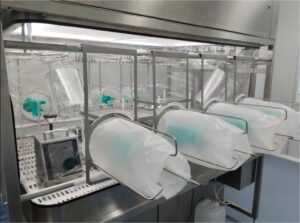
Bagging method follows a related but distinct logic: it defines how the filter and any contaminated material are enclosed as they are withdrawn, and the containment boundary that bagging has to maintain depends on whether the hazard is a solid particulate, an aerosol residue, or a substance that could still be active chemically or biologically after capture. A bagging method sufficient for inert particulate is not evidence that the same method contains a potent or reactive compound.
Decontamination is conditional rather than universal. Whether a housing needs an integrated decontamination capability, and what method that decontamination uses, depends entirely on the process hazard identified earlier — there is no default decontamination step that applies regardless of what the filter captured. Waste handling is similarly project-specific: the exhaust assessment should define where contained waste goes after removal and what handling it requires in transit, because the housing’s bagging and sealing choices need to produce waste that is compatible with that downstream route rather than waste that creates a secondary handling problem.
Operator protection sits across all of these: it is the outcome of isolation, bagging, decontamination, and waste controls working together for the specific exposure route identified, not an independent feature to specify on its own.
Separate filter classification from installed exhaust-path integrity
| Evidence level | What it can establish | What it does not establish |
|---|---|---|
| Filter classification, marking, and test-result documentation | The documented HEPA or ULPA filter class and filter-level assessment under the applicable ISO 29463 parts | Installed housing leak performance or the integrity of the complete exhaust path |
| Factory or pre-installation leak-test record | Leak-test evidence for the stated factory or pre-installation condition and recorded scope | Performance after final installation |
| Post-installation leak-test record | Leak-test evidence after installation under the stated project condition and test scope | Procedures, conditions, or acceptance details beyond the full applicable standard and project documents |
| Housing or exhaust-path qualification record | Project-specific installed evidence within the recorded configuration and qualification scope | A universal result outside that configuration or scope |
A HEPA or ULPA filter’s classification describes the filter media and its tested performance as an individual component. ISO 29463-1:2024 covers the classification, performance testing, and marking of these filters, which means a filter carrying this classification has documented evidence about the filter itself under the conditions that standard’s parts define. It does not describe what happens once that filter is seated in a housing, ducted into an exhaust system, and operated as part of an installed assembly.
This distinction matters because the two evidence levels answer different questions. Filter classification tells a buyer that the media meets a stated efficiency grade under test conditions. Installed-system integrity tells a buyer whether the specific housing, as built and sealed on site, actually routes air through that filter without bypass at the gasket, the frame, or the housing penetrations. A housing can be built around a correctly classified filter and still leak at an improperly compressed seal or a poorly fitted access door. Conversely, a housing with excellent mechanical integrity cannot compensate for a filter that does not meet its stated class.
Leak testing closes part of this gap, but it closes it only for the condition under which the test was performed. IEST-RP-CC034.5 scopes leak testing for HEPA and ULPA filters at the factory, before installation, and after installation as three distinct testing occasions. A factory or pre-installation leak-test record demonstrates leak performance under that earlier condition; it does not demonstrate performance after the housing has been transported, installed, connected to ductwork, and brought into service. Only a post-installation leak test, performed under the project’s actual operating condition, speaks to the exhaust path as it will function in use.
The condition that changes how much weight any of this evidence carries is scope: a qualification record is only as good as the configuration and test scope it was recorded against. A post-installation leak test performed on one housing stage does not extend to a second stage added later, and a record covering the housing alone does not extend to isolation dampers or ductwork outside that housing. Buyers evaluating a BIBO housing specification sheet should treat filter certificates, factory records, and installed test records as three separate evidence layers, each answering a narrower question than it might appear to at first.
Specify housing stages, materials, seals, dampers, and test access
| Specification item | Project information to request | Decision supported |
|---|---|---|
| Housing stages | Stage count and arrangement shown in the project drawings | Confirms the intended staged housing configuration |
| Materials | Material specification for the housing and relevant components | Confirms which construction is actually proposed |
| Seals | Seal specification and locations within the documented housing configuration | Confirms the proposed sealing arrangement |
| Dampers | Damper locations and stated isolation function | Confirms how the proposed configuration provides isolation |
| Test access | Test-port locations and intended access in the project drawings | Confirms whether the specified installed testing can be accessed |
Translating controls and evidence requirements into an actual housing specification means defining five categories of physical detail that project drawings need to show explicitly, because a general product description does not establish what a specific project is getting.
Housing stages refers to how many filtration and isolation stages the housing contains and how they are arranged relative to each other. A single-stage configuration isolates and bags one filter; a multi-stage configuration may separate pre-filtration from final filtration, each with its own isolation and changeout sequence. The stage count a project needs follows from the hazard assessment and the control translation already completed — a hazard requiring isolation further upstream may need an additional stage rather than relying on the final filter stage alone to do that work.
Material specification determines what the housing and its internal components are actually constructed from, which matters both for compatibility with the captured substance (reactive or corrosive materials may rule out certain housing or seal materials) and for compatibility with any decontamination method the project has specified. A decontamination approach that depends on a particular chemical or physical exposure needs housing materials that tolerate that exposure repeatedly.
Seals and their locations define where the containment boundary actually exists inside the housing. A seal specification that is accurate on paper but not matched by the as-built housing is a common source of the gap between classified filter performance and installed-path integrity discussed earlier. Drawings should show seal locations, not just assert that sealing is present.
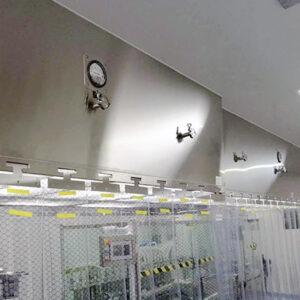
Dampers establish where and how isolation is achieved physically. The isolation points identified during the risk-control translation need a corresponding damper in the drawings; a project that calls for isolation at a particular point but shows no damper there has a specification gap, not a resolved requirement. Isolation dampers, pressure gauges, and test ports in BIBO exhaust systems work together to make isolation both achievable and verifiable, and drawings should show all three together rather than isolation alone.
Test access is the condition that makes post-installation leak testing possible at all. A housing without accessible, correctly located test ports cannot be leak-tested after installation regardless of what the filter classification states, which means test access has to be designed in before construction, not added afterward.
Request project evidence without treating GMP as a product certificate
A GMP reference, including WHO’s guidance on hazardous pharmaceutical products, establishes principles that a well-designed safe-change housing should satisfy; it is not a certificate that any particular housing, as delivered to a specific project, meets those principles in practice. Treating “GMP-compliant” as a label attached to a product rather than a conclusion drawn from project-specific evidence skips the step that actually matters to the buyer: confirming that this housing, in this configuration, with this filter class, these seals, these dampers, and this test access, satisfies the containment need identified for this exhaust stream.
The evidence that supports that conclusion is assembled from the categories already discussed rather than from a single compliance statement. Project-specific drawings showing the housing stages, materials, seal locations, and damper placement establish what was actually built. Filter classification and marking establish what the filter media is rated to do. Factory, pre-installation, and post-installation leak-test records establish how the assembled housing actually performed under each tested condition. Changeout instructions establish whether the bagging and isolation sequence defined during risk-control translation can actually be executed as specified. Qualification records tie all of this to the specific installed configuration rather than to a general product line.
When project information is supplied to a manufacturer such as YOUTH for configuration or quotation review, it is this evidence chain — the hazard assessment outcome, the required isolation and bagging approach, the stage and material requirements, and the test access needed — that allows the quotation to reflect an actual containment need rather than a generic BIBO housing description. A specification sheet request that only states “BIBO housing, GMP compliant” gives a supplier nothing to configure against; a request built from the categories above gives the supplier the information needed to propose a housing that matches the assessed hazard.
Where the project’s own documentation is incomplete — the hazard assessment has not identified an exposure route, or the isolation boundary has not been defined — that gap needs to be closed before equipment selection, not covered by a general compliance claim. A validation package covering IQ/OQ/PQ, pressure decay, and HEPA integity test documents is the record that eventually demonstrates the installed system meets its design intent, but it can only confirm a design that was actually specified against the project’s real hazard and containment requirements in the first place.
Frequently Asked Questions
Q: Can one BIBO housing specification be reused for every hazardous pharmaceutical exhaust?
A: No. Define the captured material, exposure route, and safe-change boundary for the specific process first, then derive the isolation, bagging, decontamination, waste, and operator-protection controls from that assessment.
Q: How can two BIBO housing proposals be compared on a like-for-like basis?
A: Compare them against the same project-defined hazard basis, containment boundary, stage arrangement, materials, seals, dampers, test access, changeout controls, and evidence scope. Treat an omitted item as an unresolved project decision rather than assuming the proposals are equivalent.
Q: What must be settled before accepting the filter-change instructions?
A: Confirm the isolation points, bagging and containment boundary, project-specific decontamination need and method, contained-waste route, and operator protections. The instructions should match the actual housing configuration and the exposure route identified for the process.
Q: Does a HEPA or ULPA filter certificate prove the integrity of the installed BIBO exhaust path?
A: No. Filter classification and test documentation establish filter-level evidence within their stated scope; installed integrity requires the applicable post-installation test record for the documented configuration and project condition.
Q: What should the project evidence package make traceable?
A: It should connect the drawings, materials, seals, dampers, test ports, changeout instructions, filter documentation, leak-test records, and qualification records to the proposed configuration. Each record should identify its condition and scope so factory, pre-installation, and post-installation evidence are not treated as interchangeable.
Q: Is a general GMP label enough to accept a BIBO exhaust design?
A: No. Acceptance should rely on project-specific configuration and qualification evidence tied to the hazardous material, exposure route, and defined containment controls; general GMP wording does not establish those details for the installed exhaust path.