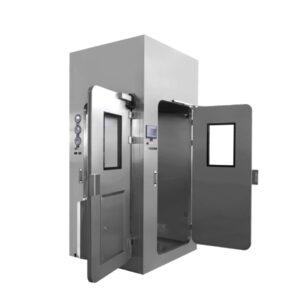
A high-temperature HEPA filter RFQ becomes answerable when it carries four things together: the process and filter position, the full thermal cycle rather than a single maximum temperature, the HEPA grade with its traceable element-test records, and the physical and airflow interface the filter has to fit. The conditions that actually change a supplier’s answer are measurable or drawable ones — peak exposure and dwell time, how often the oven cycles, the frame and sealing geometry already installed, and the airflow and pressure allowance the existing fan can deliver. A high-temperature HEPA filter here means a complete assembly whose media, separators, sealant, gasket and frame are all built for sustained heat, not a standard filter with a hotter label.
Identify the process, filter position and thermal cycle
Start the RFQ by naming the equipment and where the filter sits in its air path, because that single statement determines which air the filter cleans and which decision the quotation has to serve. Identify the oven, tunnel or chamber by type and designation, state whether the filter sits inside the heated circulation path or on an external fresh-air intake, describe the process being protected, and say whether this is a replacement for an existing filter or a new supply. Without those fields, suppliers receive an equipment-wide temperature rating and a photograph, and an equipment-wide rating does not describe what the filter itself experiences at its position.
The filter position matters more than it appears. A filter in a recirculating heated plenum sees the full chamber temperature during the dwell and again on every cycle, while a filter on an intake upstream of the heaters may see something close to ambient air with heat only reaching it by conduction or soak-back. Those are different products, and a supplier told only “250-degree oven” cannot tell which one you need.
The thermal cycle itself should be supplied as a profile, not a number. State the normal operating range, the peak exposure the filter position actually reaches, the dwell at that peak, the heating and cooling pattern, and the anticipated frequency of cycling over a working week. The complete assembly has to tolerate that service: media can survive a temperature that the sealant or gasket cannot, and repeated expansion and contraction loads the frame joints and the seal differently from a single steady soak. When the profile is attached, a supplier can state a conditional match — this configuration suits this profile, with this limitation — instead of quoting against an unexplained maximum-temperature label. If the peak at the filter position is not measured and only the chamber setpoint is known, say so; the process engineer or the equipment manufacturer holds that figure, and marking it as unknown is more useful than estimating it.
State HEPA performance and traceable test records
Ask for the exact offered grade and model identity, the test method, the test conditions and the traceable result documents that belong to the filters being supplied. A line reading “HEPA, H14 equivalent” tells you very little, because it names neither the classification framework used nor the documents that will arrive with the goods.
ISO 29463-1:2024 covers classification, performance testing and marking for high-efficiency filters and filter media, and its element-test parts separate the two properties that matter in a hot air path: overall efficiency and local leakage. ISO 29463-4:2011 specifies the scan method for determining leakage of filter elements, which is the test that finds a discrete pinhole or sealant fault rather than an average performance shortfall. For a high-temperature assembly those two findings are not interchangeable. An element can meet its efficiency class while carrying a local defect at a sealant line, and that is exactly the region thermal cycling stresses.
So the request should be specific: which grade is offered, under which part of the classification scheme, tested by which method, at which test conditions, and with which document identifiers tied to the delivered serial numbers. Ask whether the scan or leakage record applies to the individual filters shipped or to a type test of the design, because the two support different levels of traceability. A brochure efficiency figure describes a product family; a numbered test record describes the item in the crate. If a supplier offers results under a different national or regional method, that is workable, but the method and its conditions need stating in the quotation so the records can be compared on the same basis.
Supply the physical and airflow interface package
Where an existing frame, housing or clamping arrangement will be retained, the RFQ has to contain the interface as drawings and dimensions, not as a nominal size. Include overall dimensions and depth, the sealing geometry — gasket face, gel channel, knife-edge, or compression against a flat flange — the retention method and hardware, the airflow direction marking, and the service-access envelope through which the filter must pass during replacement.
A nominally correct size is the most reliable way to conceal an incompatible seal. Two filters of identical face dimensions can differ in gasket thickness, gasket material, flange width or frame depth, and any of those will leave a seal that holds at room temperature and opens as the assembly expands. Access is the second trap: a filter that fits the opening may still be unremovable once ductwork, heaters or a structural member sits in the withdrawal path, which turns a routine replacement into equipment disassembly. If a dimension cannot be measured without shutting down the oven, mark it explicitly as unknown rather than copying it from an old drawing. An explicit unknown invites the supplier to propose a check or offer an adjustable arrangement; a wrong number simply produces a filter that does not seal.
Airflow and fan capability belong in the same package, because the filter and the fan are selected together. State the required airflow and the pressure allowance available for the filter, and state the operating conditions they refer to — air temperature and, where relevant, density or altitude — then ask the supplier to state the corresponding basis for their quoted airflow and resistance data. Hot air is less dense, so a resistance figure measured at ambient conditions does not transfer directly to the duty inside a heated circulation loop, and volumetric flow through the same fan is not the same mass of air. A pressure number with no stated conditions is not comparable between two quotations. A clean initial resistance is also only half the picture; ask what final resistance the supplier assumes for change-out so the fan has margin to carry the filter through its service life, and so the housings maintain their intended flow pattern when the filter is dirty rather than new.
Request conditioning and handling deliverables
Some high-temperature filter configurations require a controlled first heat before the filter enters service, and whether yours does is a question the RFQ should put directly to the supplier. Media binders and adhesives in heat-resistant constructions can release volatile products during initial heating, so the offered configuration may need a defined conditioning procedure before product is exposed to the airstream.
Grieve publishes a named example for its internal oven HEPA filters, describing binder conditioning for those internal filters, distinguishing them from external fresh-air filters, and noting associated oven cleaning and careful handling of the filters. That example is useful as evidence that conditioning, cleaning and handling are documentation items a buyer should ask for; it is a manufacturer’s guidance for its own named internal oven filters, not a schedule or a numeric limit that transfers to another supplier’s configuration.
Request the deliverables rather than a general assurance: the actual conditioning instructions for the offered configuration, the installation state those instructions assume — filter installed in the oven, or conditioned separately — any cleaning implications for the chamber before or after conditioning, and the handling precautions for transport, unpacking and fitting. High-efficiency media in a rigid high-temperature frame is easy to damage at the pleat edges and the sealant line, and damage there shows up as local leakage, not as a drop in average efficiency. A supplier may document that its offered configuration follows a different preparation route or needs none, and that documented answer is a valid response — it closes the item, where silence leaves it open. Whether a filter that has been conditioned may then be released into production service is decided by the project’s approved procedure and its designated approver, not by the conditioning instruction alone.
Separate factory evidence from site verification
A factory test record describes the filter element; it does not describe the air path the element is installed into. Keep the two scopes in separate parts of the RFQ so that neither the supplier nor the installing contractor assumes the other has covered the gap.
The element-side evidence is what the manufacturer can produce before shipment: the efficiency classification, the leakage or scan record under the stated method and conditions, the marking, and the document identifiers linking those results to the filters delivered. That package tells you the filter left the factory meeting its class. It says nothing about the gasket compression achieved against your flange, the condition of the sealing face in a twenty-year-old housing, bypass around a clamping frame that has distorted through thermal cycling, or ducting that lets air short-circuit the filter face.
The installed side therefore needs its own defined scope in the RFQ: what will be verified on the assembled air path, under which conditions, against which acceptance criteria, and by whom. Say explicitly whether site verification is inside the supplier’s offer, inside the installing contractor’s offer, or carried by the buyer, and whether the oven can be tested at operating temperature or only cold. That distinction changes what any site result means. Acceptance of an installed filter is a formal decision under the project’s approved procedure and its designated approver; the RFQ’s job is to make sure someone is quoted to produce the evidence that decision needs, rather than discovering at commissioning that both parties priced the element test and neither priced the installed check.
Build the supplier response and deviation schedule
| Requirement | Offered configuration | Evidence identifier | Deviation | Responsible party |
|---|---|---|---|---|
| Process, filter position and thermal profile: normal range, peak exposure, dwell, heating and cooling pattern, anticipated cycling | Identify the complete assembly proposed for the stated service | Identify the document supporting compatibility with the attached profile | State any limitation against the supplied service profile | Name the party confirming configuration compatibility |
| HEPA performance and traceable element-test records | State the exact offered grade and model | Identify the test method, conditions and traceable result documents, including the applicable efficiency and local-leakage records | State any difference from the requested performance or record package | Name the party supplying the element-test documentation |
| Physical interface: dimensions, sealing geometry, retention, airflow direction and service access; unknown dimensions marked | Describe the match to the supplied interface drawings | Identify the corresponding configuration or interface drawing | Flag incompatible or unresolved dimensions, seals, retention or access | Name the party resolving each open interface item |
| Required airflow and pressure allowance, with operating conditions | State the corresponding airflow and resistance data basis | Identify the supporting data and its operating conditions | Flag differences in duty or data conditions that prevent direct comparison | Name the party confirming the airflow and pressure match |
| Conditioning, installation state, cleaning implications and handling precautions | State the preparation route for the offered configuration | Identify the actual conditioning and handling instructions, or the documented different preparation route | State any difference from the requested preparation deliverables | Name the party responsible for each preparation and handling activity |
| Installed verification, separate from factory element records | Define the proposed verification scope for seals, housing and airflow interfaces | Identify the applicable site-verification conditions and acceptance criteria | Flag omitted scope or unresolved criteria | Name the parties responsible for installation and site verification |
Issue the RFQ with a response schedule that asks each supplier to answer in the same structure: the requirement, the offered configuration, the evidence identifier, any deviation, and the responsible party for that item. The structure matters more than the formatting, because it forces a supplier either to confirm against your stated service or to name the limitation, and it makes those two answers visible side by side across quotations.
The value of the deviation column is that it surfaces partial matches before price comparison hides them. A row reading “thermal cycle: attached profile” invites either “compatible configuration, evidence document reference” or “compatible to the stated peak but not at the stated cycling frequency, alternative construction offered” — and the second answer is useful information, not a disqualification. Without that column, the same supplier quotes a lower price and the limitation appears after delivery. The responsible-party column does the same for scope: it shows which items nobody has claimed, which is usually interface resolution and installed verification. These columns collect what each supplier proposes and what each proposes to be responsible for; the contract, not the schedule, assigns the duty.
Before issuing, have the following ready to attach: the equipment identification and filter position, the measured or specified thermal profile with dwell and cycling frequency, interface drawings with unknown dimensions marked as unknown, the required airflow with its operating conditions and the available pressure allowance, and the name of the filter family you intend to compare against — YOUTH’s high-temperature HEPA air filters, for instance, if that is the reference configuration. A quotation returned against that package can be read as an engineering answer. One returned against a temperature and a face size can only be read as a price.
Frequently Asked Questions
Q: Is a matching size and maximum-temperature label enough to specify a replacement filter?
A: No. Match the complete assembly to the actual thermal cycle and installation interface. Include peak exposure, dwell, heating and cooling patterns, anticipated cycling, seal geometry and retention details; the same nominal size or temperature label does not resolve those checks.
Q: Can I request quotations before all installation dimensions are confirmed?
A: Yes, provided the unknown dimensions are clearly marked and remain unresolved in the quotation. Require each offer to identify which fit assumptions need confirmation and who will resolve them before accepting the proposed interface as compatible.
Q: How should I compare two offers that state the same HEPA grade?
A: Compare the evidence behind each offered model, not the grade label alone. Check the test methods, conditions and traceable efficiency and local-leakage records, then compare airflow and resistance data on a corresponding operating basis. Record differences that prevent a direct comparison before judging price.
Q: Does a factory filter test report cover verification after installation?
A: No. The element report and installed verification address different scopes. Define the checks, conditions, acceptance criteria and responsible parties for the assembled air path, including seals, housing and airflow interfaces, separately from the factory records.
Q: Should I require every supplier to follow the same conditioning schedule?
A: No. Require the preparation instructions for the configuration actually offered, including installation state, cleaning implications and handling precautions. A schedule for a named internal oven filter is not a universal requirement; compare each proposed preparation route and its responsibilities before treating quotations as equivalent.