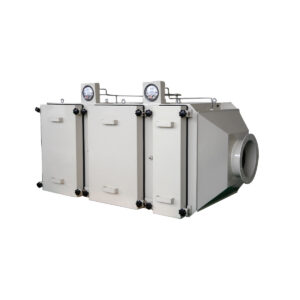
A high-temperature HEPA filter for an electronics clean oven is specified by naming the protected workpiece and its contamination sensitivity first, then matching a complete filter assembly — media, frame, bonding and seals together — to the temperature profile, airflow duty and cycling pattern of the position it occupies. The HEPA grade itself describes particle-removal performance at the element level; it does not answer whether the assembly survives repeated heating and cooling, and it does not address vapors or material emissions inside the chamber. Those are separate questions with separate evidence, and the specification is only useful when all of them are stated.
Define the workpiece and contamination sensitivity
Start the specification with what the oven is protecting, not with a filter class. A bake-out step for populated boards, a cure for an optical adhesive, a drying stage for coated wafers and a burn-in for finished assemblies all sit in heated air, but they differ in which surfaces are exposed, for how long, and at what point in the process a landed particle becomes a reject.
Name the workpiece, the process step and the defect that concerns you. A particle on a tacky coating before cure is permanent; the same particle on a cured, packaged assembly may be irrelevant. That distinction decides how much of the budget belongs to air cleanliness at all, and it sets the reference point for every later question about grade, resistance and service access.
Keep the contamination questions separate while you scope them. Airborne-particle control, the material compatibility of everything inside the hot air path, and vapor-related concerns such as outgassing or condensable residue are three different mechanisms with three different kinds of supporting evidence. Treating them as one “cleanliness” requirement is how a project ends up with a correctly classified filter that still fails to solve the defect it was bought for. Write each concern down as its own line in the inquiry, and say which one is driving the purchase.
Sensitivity also has a location. Decide whether the protected zone is the whole chamber volume, the product shelf immediately downstream of the filter face, or a loading opening where room air can enter during transfer. A filter placed in the recirculation path cleans air that is already inside the oven; it does not control what comes in through an open door, and that boundary should be noted now rather than discovered during commissioning.
Specify the heated recirculation duty and complete assembly
Give the supplier a duty statement for the exact position the filter occupies: temperature profile, airflow volume and the resistance the fan can accommodate, plus the cycling pattern the oven runs. The temperature profile means the operating setpoint, any ramp or dwell above it, and the maximum excursion the controls allow — not a single headline number. Airflow matters twice over, because face velocity determines both the filter’s pressure drop and how evenly the clean air reaches the workpiece.
Then ask for suitability of the whole assembly rather than of the media alone. Inside a hot recirculation duct, the glass or synthetic media, the frame material, the adhesive or potting compound that bonds the pack to the frame, and the gasket or sealing arrangement are all exposed to the same air at the same time. A media rating stated on its own leaves the bonded joints and the seal unaddressed, and those interfaces are where a thermally stressed filter usually loses its integrity first. The useful request is a single statement of the temperature and cycling conditions for which the complete assembly is offered, with the frame, bonding and sealing materials identified.
Cycling deserves its own line because it is a different stress from steady heat. An oven that holds temperature continuously subjects the filter to a stable thermal condition; one that heats and cools for every batch drives repeated expansion and contraction across materials with different coefficients. Over many cycles that differential movement works on the pack-to-frame bond and on the compression set of any gasket. Tell the supplier roughly how often the oven cycles and across what span, because an assembly specified only for a peak temperature may still be the wrong choice for a frequently cycled chamber.
Two practical details belong in the same conversation. First, the direction and uniformity of airflow across the filter face, since a filter sized for duct velocity but mounted against a restricted plenum will see local velocities well above the average. Second, whether the position is a sealed recirculation filter or a fresh-air intake, because the two see different temperatures and different particle loads even in the same machine.
Check whether the defect calls for a HEPA grade change
When a supplier answers a process defect by offering a higher HEPA grade, the first question is whether the defect is a particle at all. HEPA and ULPA classification describes how efficiently an element removes airborne particles, assessed and marked under the classification and performance-testing framework of ISO 29463-1:2024, which also covers how those test results are documented. That is a statement about particle capture by the filter element, and it carries no information about vapors, condensable residue, ionic contamination or handling damage.
So characterize the defect before changing anything. Particulate defects usually appear as discrete, localized inclusions with a size distribution and a shape that can be seen under magnification; their frequency often tracks with air handling, filter condition or door openings. Film haze, discoloration, tacky residue, surface energy changes and corrosion-related failures point instead to vapor-phase or material-emission mechanisms, or to contact and handling during loading. Raising from one HEPA class to a finer one will not remove an outgassed species from recirculated air, and it will raise pressure drop at the same airflow, which can reduce the air changes the oven actually delivers.
If the evidence does point to particles, then grade becomes a real variable, and it should be chosen against the sensitivity defined for the workpiece rather than against a general preference for a higher number. If the evidence points elsewhere, the controls are different in kind: material substitution inside the chamber, a change to the purge or exhaust arrangement, adsorptive media where it is compatible with the service temperature, or a change to handling at the loading step. Ask the supplier which mechanism the proposed change addresses, and expect the answer to name the mechanism, not the classification.
A useful intermediate step is to compare defect occurrence with and without the oven in the loop, and at different points in the process sequence. That evidence sits with the process engineer, not with the filter supplier, and it is what separates an air-path problem from one that was already present before the workpiece reached the oven.
Plan conditioning, cleaning and replacement access
Ask whether the offered assembly requires preparation before it is used on production parts, and get that instruction from the manufacturer of the specific assembly. Some internal oven filters are supplied with a binder in the media or an adhesive in the construction that the manufacturer directs to be conditioned, so that volatile material is driven off before clean product is exposed to the recirculated air. Grieve, for example, publishes a conditioning guide for the internal oven HEPA filters it names, distinguishes them from external fresh-air filters, and discusses associated cleaning and careful handling for those filters. That is a bounded, documented example rather than a universal rule — another assembly may have a different documented preparation route, or none — so the instruction has to come from the assembly you are buying.
Treat conditioning as part of the project schedule, not an afterthought. If preparation is required, it consumes oven time and has to happen before the first sensitive load, which matters for a line changeover or a filter replacement during a production week. Confirm during selection whether preparation is needed and roughly what it occupies, so the replacement plan is realistic.
Handling and cleaning are where high-temperature HEPA filters are most often damaged. The media pack is fragile, the pleats are easily dented, and a pinhole or a crushed pleat edge compromises the element regardless of its classification. Any cleaning of surrounding surfaces, frames or ductwork should follow the assembly manufacturer’s guidance and avoid contact with the media face. Where the process is particle-sensitive, decide in advance where the filter is unpacked and staged, because a filter damaged during transport into a hot, confined housing arrives at the sealing face already compromised.
Access is a design question, so raise it while the housing is still being specified. Determine whether the filter is reached from the fan plenum, through a side panel or from inside the chamber; whether the oven must be cooled and for how long before anyone can work at that position; and whether the retaining hardware can be operated in that space with the tools available. Clamping and gasket arrangements that are easy to seat on a bench can be difficult to compress evenly inside a hot ductwork cavity, and an unevenly seated gasket leaks whatever the element’s rating. If more than one suitable configuration remains after the thermal and particle requirements are met, compare them on resistance at the same airflow, on sealing and retention geometry, on replacement access and on the evidence package each supplier offers — a filter chosen on rating alone is how a project acquires a fan mismatch or an installation it cannot service.
Define installed and process-specific acceptance evidence
| Evidence to agree | Question it addresses | Boundary to retain |
|---|---|---|
| Filter-element classification and test records | What particle-removal performance is documented for the offered element? | Element records leave installed performance, thermal compatibility and process outcomes as separate questions. |
| Installed airflow or integrity evidence | What installed-system checks will be used for the oven air path? | Agree the applicable checks for the project; the cited cleanroom test-method reference supplies no universal high-temperature procedure or acceptance limit. |
| Process-specific checks and workpiece outcomes | What will the process owner require before releasing the changed filter for use? | Define acceptance for the protected electronics process; filter grade and installed checks alone do not establish acceptable workpiece outcomes. |
Agree before the order what will be accepted as proof at three separate levels: the element, the installed air path and the protected process. These are different questions, and conflating them is what leaves a project holding a certificate that does not answer the thing anyone actually wants to know.
Element-level documentation describes the filter as tested and marked by its manufacturer. The classification and test-result documentation framework of ISO 29463-1:2024 covers how high-efficiency filter elements are classified, assessed and marked; reading those records tells you what particle-removal performance has been documented for the element you are buying, and nothing about how it behaves once sealed into a hot duct. Installed performance is a project-level question. ISO 14644-3:2019 sets out test methods and apparatus for installed performance parameters in cleanrooms and clean zones, and the applicable checks and their limits for an oven recirculation position have to be agreed for the project; the published scope of that document supplies no high-temperature test procedure and no universal acceptance limit. Process-specific acceptance is different again, covering the workpiece outcomes the process owner will accept after a filter change.
One practical consequence: whoever releases a changed filter back into production is applying the project’s approved acceptance procedure, and that decision belongs to its designated approver. Define now who that is and which evidence they need to see, rather than discovering at the point of release that the available paperwork covers only the element.
For a productive supplier discussion, have ready the protected workpiece and the defect you are trying to prevent, the process step and its contamination sensitivity, the oven position with its temperature profile, airflow and cycling pattern, the available space and access for replacement, the fan’s resistance headroom, and a statement of what documentation your acceptance plan requires at each of the three levels. With those in hand, the conversation moves from filter grade — which is the easiest part to settle — to the assembly, sealing and service questions that determine whether high-temperature HEPA filters for electronics ovens actually protect the product once installed.
Frequently Asked Questions
Q: Can one filter specification cover several electronics oven recipes?
A: Only if its documented suitability covers the duty of each recipe. Compare the temperature profiles, airflow requirements and heating-and-cooling cycles at the filter position, along with each workpiece’s contamination sensitivity. A specification prepared for one recipe should not automatically be carried over to another.
Q: Should I choose a higher HEPA grade when contamination persists after a filter change?
A: First establish whether the remaining problem concerns particles. A higher particle-removal classification does not establish control of vapours, material emissions or contamination from workpiece handling. Match the proposed change to the observed defect before treating a grade increase as the solution.
Q: Are matching grade and dimensions enough to order a replacement filter?
A: No. Compare resistance at the required airflow, sealing and retention geometry, replacement access and suitability of the complete assembly for the oven’s thermal duty. Matching those two labels alone leaves important installation and operating questions unresolved.
Q: Can we reuse the conditioning procedure from another oven’s filter?
A: Use it only if it is documented as applicable to the replacement assembly. Preparation requirements can differ, and guidance for a named internal oven filter should not be generalized to every filter position. Confirm the applicable instructions before scheduling preparation, subsequent cleaning and handling around the protected process.