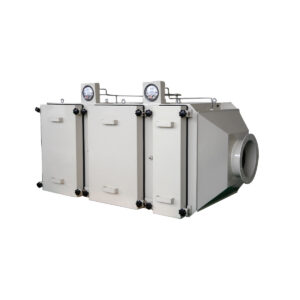
Silicone and ceramic seals answer different thermal duties, and the deciding variable is the declared temperature envelope of the complete filter construction at your installed location, not the seal material’s generic rating. Silicone gaskets and silicone-based potting compounds stay elastic and recover compression well, which suits sustained operation in the moderate high-temperature band and tolerates repeated cycling; ceramic fiber and ceramic-filled sealants hold up at temperatures where elastomers degrade, but they are far less resilient and behave more like a packed or set joint than a spring. A high-temperature HEPA filter seal therefore has to be chosen against three separate conditions — steady-state exposure, excursion peaks, and the number and rate of thermal cycles — because a material that survives a short excursion may not survive a thousand heat-up and cool-down events at the same joint.
Thermal profile information needed before comparing seals
| Thermal condition | Project information to document | Supplier comparison |
|---|---|---|
| Steady-state exposure | Steady-state temperature exposure at the filter location | Check the declared envelope for the complete filter construction against this exposure |
| Temperature excursions | Expected excursion conditions | Check excursion coverage separately from steady-state coverage |
| Thermal cycling | Expected cycle conditions | Check the declared envelope against cycling rather than relying on the seal label alone |
Before any seal comparison means anything, the thermal duty at the filter face has to be written down as a profile rather than a single number. That profile has three parts: the steady-state temperature the filter actually sees in service, the excursion conditions the process can produce (sterilization or depyrogenation ramps, upset conditions, burner or heater faults), and the cycling pattern — how often the installation goes from ambient to operating temperature and how fast.
These three conditions stress the seal in different ways. Steady-state exposure drives slow chemical breakdown and compression set, where an elastomer gradually loses the recovery force that keeps it sealed against the housing. Excursions attack the material’s short-term thermal limit. Cycling attacks the joint through differential expansion: the filter frame, the housing flange and the seal all grow and shrink at different rates, and a seal that cannot follow that movement opens a leak path at the gasket line even though the medium is intact.
Each of these has to be compared against the supplier’s declared envelope for the exact filter construction you intend to buy — frame material, media, potting or sealant, and gasket together. A seal label quoting a material temperature in isolation tells you about the material coupon, not about what happens where that material is bonded to a frame and clamped against a flange. Where the process engineer has not yet fixed the excursion case, that single missing value should be identified by name and closed before release, because it often decides the material more than the steady-state figure does.
Supplier evidence for the complete filter construction
| Evidence to check | What it supports | Evidence boundary |
|---|---|---|
| Complete-element classification and test-result documentation | Classification, performance assessment, and marking for the complete filter element | Does not select a seal material for a specific process |
| Declared temperature envelope for the exact filter construction | Comparison with the project’s steady-state exposure, excursions, and cycle conditions | A seal label alone does not establish the envelope of the complete construction |
| Filter leak-test documentation | Factory, pre-installation, or installed leak-test evidence, as applicable | Does not establish material compatibility or temperature limits |
Ask suppliers for evidence that describes the assembled filter, because classification, temperature declaration and leak-test records each cover a different part of the question and none of them covers all three. ISO 29463-1:2024 sets out classification, performance assessment, marking and test-result documentation for high-efficiency filters and filter media; it is a filter-element scope, so it tells you how the element is classified and marked but does not select a seal material for your process conditions.
The temperature declaration is a separate document and should be stated for the construction as supplied, not for a component. A useful declaration distinguishes continuous rating from short-term exposure, and says whether cycling was considered. If a supplier can only quote the gasket compound’s published limit, the practical consequence is that the limiting part of the assembly — often the adhesive or potting line between media and frame, or the frame-to-gasket bond — is still undefined.
Leak-test documentation forms the third evidence point. IEST-RP-CC034.5 covers HEPA and ULPA filter leak tests, with a scope spanning factory, pre-installation and installed testing. Leak-test records demonstrate integrity at the time and condition of test; they say nothing about how the seal material behaves chemically or at temperature, so they sit alongside the temperature declaration rather than substituting for it. A sensible evidence package for a high-temperature application therefore carries all three: classification and marking for the element, a construction-level temperature declaration, and leak-test records appropriate to the stage of the project.
Mating geometry compression and installation tolerances
A seal performs as a system with the housing it compresses against, so the interface drawing and the clamping method need confirming before the filter is released for manufacture. Silicone gaskets seal by elastic deflection and tolerate a reasonable range of flange flatness and bolt spacing, which makes them forgiving on knife-edge and flat-flange housings alike. Ceramic fiber seals compress plastically: they conform once, they do not spring back, and they depend on the housing maintaining its clamping force as the structure expands. That difference changes what the housing has to deliver, not just what the filter is made of.
Confirm the gasket cross-section and seating face, the free and compressed heights the design assumes, and the compression method actually used on site — bolted flange, spring clamp, cam or wedge latch, or a gel-channel arrangement. Each method applies a different load distribution. An under-compressed elastomer leaks at the corners; an over-compressed one takes a permanent set and loses recovery on the next cycle. A ceramic seal that is designed for a fixed clamp gap and then installed behind spring clamps may sit at a load the supplier never evaluated.
Installation tolerances matter as much as nominal dimensions at high temperature. Flange flatness, frame squareness, bolt-hole position and the thermal growth allowance between filter frame and housing all consume part of the available compression range. Where the filter is intended to replace an existing element in an installed housing, the housing’s as-built dimensions, not the original drawing, are the ones to verify. Agreeing these details with the supplier before release avoids the situation where a correctly specified high-temperature HEPA filter seal cannot be seated to the compression the declaration assumed.
Process-sensitive material declarations to request
Where the filtered air reaches an exposed product, a sterile zone or a sensitive electronic process, request material declarations and process-suitability evidence for the seal and potting compounds alongside the thermal data. Silicone is the usual starting point for elasticity and temperature resistance, but silicones can transfer low-molecular-weight siloxanes to the airstream, which matters in semiconductor, optical coating and certain analytical environments; condensable organics there are a process defect, not a housekeeping issue. Ceramic fiber is chemically inert and effectively non-outgassing, but it is a friable mineral and can shed fibers and particles at the joint if it is disturbed, abraded or exposed to high face velocity at a damaged edge.
The declarations worth asking for are the ones that map to the specific concern. For outgassing, request the compound identity and any volatility or condensable-matter data the manufacturer holds. For shedding, ask how the seal is retained and protected at the air-facing edge, and whether the material is supplied with a binder or facing. For chemical sensitivity, state what the seal will see — cleaning agents, process vapors, oxidizers, hydrogen peroxide, solvents — because elastomer compatibility is compound-specific and a generic “silicone” entry does not resolve it.
Where the process also involves sterilization or decontamination chemistry, the compatibility question belongs to the seal as much as to the media. Which materials are acceptable for a given clean process is decided by the project’s own material-suitability assessment and its designated approver, working from the declarations the supplier provides.
Seal verification and replacement access in the lifecycle plan
| Lifecycle review point | Evidence or project input | Decision use |
|---|---|---|
| Seal inspection | Planned inspection of seal condition | Defines how seal condition will be checked during the lifecycle review |
| Installed leak testing | Installed filter leak-test evidence | Supports verification of installed leak performance without establishing material compatibility or temperature limits |
| Replacement access | Confirmed access for filter replacement | Shows whether the replacement plan fits the installed arrangement |
| Filter element and housing joint | Separate evidence for the complete element and for the housing joint | Keeps one evidence point from standing in for the other |
Plan the seal’s verification and replacement at the same time as the filter is specified, because the filter element and the element-to-housing joint are separate evidence points and each needs its own check. A factory-tested element proves the medium and its potting line were sound when tested; it says nothing about whether the gasket is seated correctly in the housing you own. An installed leak test addresses the installed assembly, including the seat, within the scope described in IEST-RP-CC034.5 for installed filter leak testing. Keeping the two records distinct is what lets you diagnose a later failure as a media breach rather than a seal relaxation, or the reverse.
Visual seal inspection belongs in the same plan, with a defined point in the lifecycle at which the gasket is examined for compression set, hardening, cracking, gaps at the corners and — for ceramic seals — edge erosion or fiber release. High-temperature joints age at the seal before they age at the medium in many installations, so inspection intervals tied only to pressure drop will miss the deterioration that matters here. Record the seal condition against the installed test result so that a drifting trend is visible across requalification cycles.
Replacement access is a design decision, not a maintenance detail. Confirm that the housing can be opened, the clamping released and the element withdrawn at the installed orientation, with working clearance for the clamping tool and a place for the hot or contaminated element to go. Ceramic seals generally need replacement whenever the joint is broken, since the compressed material does not recover; silicone gaskets may be reusable or may not, depending on their service history, and whether a particular seal is returned to service is a decision for the project’s approved procedure and its designated approver rather than a general rule. For the supplier discussion, have ready the documented thermal profile including excursions and cycle frequency, the as-built housing interface drawing with its compression method and tolerances, the process chemistry and cleanliness constraints the seal materials must satisfy, and the access envelope available at the installed position.
Frequently Asked Questions
Q: Is either silicone or ceramic automatically the better seal choice for high-temperature HEPA service?
A: No. Treat the material name as an initial identifier, then qualify the exact filter construction against the documented steady-state exposure, excursions, and thermal cycles. Keep an option on the shortlist only when its declared envelope also fits the housing interface and the clean process conditions.
Q: What should an RFQ include so silicone and ceramic seal options are compared on the same basis?
A: Provide the three-part thermal profile, the mating-interface drawing, the compression method and installation tolerances, any sensitivity to outgassing, particle shedding, or chemicals, and the required leak-test stages. Also state replacement-access constraints so each offer can be checked against the same operating and lifecycle needs.
Q: When is process-suitability evidence needed even if the stated temperature envelope appears adequate?
A: Request it whenever seal-related outgassing, particle shedding, or chemical sensitivity could affect the clean process. Thermal evidence does not resolve those concerns, so compare the material declaration and process-suitability evidence with the project’s contamination limits before release.
Q: What should prevent a seal arrangement from being released for installation?
A: Hold release if the declared envelope does not address every documented thermal condition, the mating geometry or compression tolerances remain unconfirmed, relevant process-suitability evidence is unresolved, or the inspection, installed leak-test, and replacement-access plan is incomplete. These are separate checks, and passing one does not close the others.
Q: Can an installed leak test confirm that the chosen seal material is suitable for the process and temperature?
A: No. Installed leak-test evidence supports verification of installed leak performance; it does not establish material compatibility or temperature limits. Retain the leak-test result alongside the exact-construction thermal evidence, process-suitability evidence, and separate housing-joint check.