Two projects can target the same room and the same ceiling grid yet end up with completely different terminal hardware: one receives conditioned air through branch ducts into a passive HEPA housing, while the other uses ceiling modules that each carry their own fan. That difference is a coordination decision as much as a filtration decision, because it moves balancing, electrical supply, controls and service access to different parties. Neither arrangement proves a cleanliness class, an energy outcome or a maintenance burden on its own; those depend on the room duty, the system design and how the interfaces are assigned.
What Changes at the Cleanroom Ceiling in Each Architecture
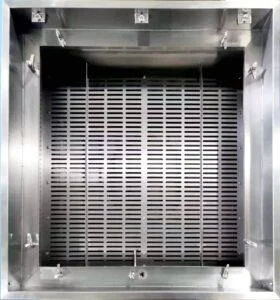
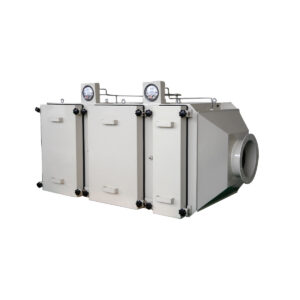
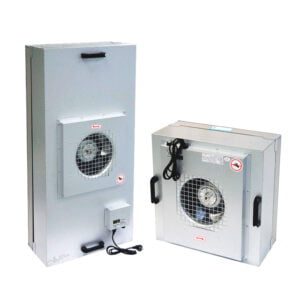
In a central ducted arrangement, a central air-handling unit supplies pressure through branch ductwork to a passive terminal HEPA housing at the cleanroom boundary — a ceiling filter housing fed by ducted air rather than by its own fan. In a decentralized arrangement, an FFU combines its own fan and filter in a ceiling module, and where the design provides a ceiling plenum, that module commonly draws from the plenum before delivering filtered air into the room (Fabtech Cleanroom). That source is third-party general design guidance, so the distinction describes the two terminal types; it does not establish a required cleanroom class or a performance result for any specific project.
The decision therefore changes the terminal from a duct-fed housing into a powered fan-filter module. It also relocates responsibility for air source, unit-level control, balancing and motor service, and it affects whether rooms can be mixed differently. None of those differences alone proves an airflow rate, an energy result, or that either route is superior; all of them depend on the actual system and have to be confirmed for the project.
The table keeps the sourced distinctions and the project-confirmation points side by side.
| Decision point | Central ducted supply | Decentralized FFU | Project implication |
|---|---|---|---|
| Terminal device | Passive terminal HEPA housing receives air from a central AHU | Ceiling module combines a fan and filter | Confirm whether each terminal is passive or powered |
| Air-delivery interface | Branch ductwork carries supply air to the terminal housing | Each FFU creates local fan pressure and commonly draws from a ceiling plenum | Coordinate duct or plenum space with the selected terminal type |
| Airflow adjustment | Central fan operation and terminal dampers are balanced as one system | Airflow can be set unit by unit | Define zoning, control and balancing responsibility |
| Service scope | Terminal filter and housing are serviced alongside the central air system | Distributed fan motors and filters create more ceiling service points | Confirm access, spares and failure-response responsibilities |
When Central Ducted Supply Fits the Project
Central ducted supply tends to fit projects that already have, or are being designed around, a central air-handling source and branch duct distribution capable of serving each terminal. In that architecture the central system and the terminal dampers share one balancing responsibility, so the questions worth answering are about the system as a whole rather than about a single ceiling device. The relevant YOUTH terminal family is shown on the HEPA Housing Box page, which routes readers to housing, filter-fit, ceiling or wall interface and sealing confirmation.
Before committing, the project team should be able to state the available fan pressure at each terminal, the duct routes, and how outlets will be balanced across the zone. It should also resolve the filter-housing inlet and seal interfaces, the access route for testing and replacement, and which party owns system-level commissioning. Because those outcomes depend on the actual fan, ductwork, terminal and room, this route cannot be described as always simpler, quieter or more efficient; any such claim has to be verified against the specific design.
When Decentralized FFUs Fit the Project
Decentralized FFUs tend to fit projects where the ceiling or plenum can support distributed powered fan-filter modules, and where unit-level airflow adjustment, zoning or later ceiling reconfiguration is useful. A supplier-authored comparison describes the distributed arrangement as using local fans with reduced branch ducting and easier modular expansion, and contrasts it with central AHU duct balancing, a more centralized failure domain, and upgrade considerations (American Cleanroom Systems). Cost, maintenance and reliability statements in that comparison are directional considerations rather than universal outcomes.
The same distribution that permits unit-by-unit setting also creates more distributed motors, heat, noise and ceiling service points. Buyer questions worth putting in writing include ceiling loading and module layout, electrical and control connections, access to fans and filters, the spares strategy, and how conditioning or makeup air reaches the FFU plenum. The YOUTH Fan Filter Unit – FFU page shows the relevant ceiling FFU product family and routes readers to project-specific filter, control and size confirmation. No guaranteed cost, energy, reliability or cleanliness-class outcome follows from choosing this route.
Interfaces to Confirm Before Selecting the Terminal Solution
Converting this comparison into a project handoff means giving the supplier a bounded set of inputs rather than a preference. The room or zone and its process objective set the air-delivery duty; the proposed central air-handling, duct or plenum concept sets what the terminal can be; ceiling-grid and service-access constraints set where it can sit and how it can be maintained. Control and electrical responsibility, plus the terminal filter-housing, seal and test-access expectations, have to be assigned before selection rather than negotiated after installation.
The YOUTH FFU and HEPA Housing Box pages establish relevant product navigation, but exact configuration, compatibility, performance and acceptance remain project-specific. For broader cleanroom-equipment selection and project-input questions, the equipment selection and specification guide is useful adjacent navigation only, not evidence for this comparison.
| Project input | Why it changes the decision | Confirmation needed |
|---|---|---|
| Room or zone and process objective | Establishes the air-delivery duty the terminal system must serve | Project team defines the objective and required verification basis |
| Central AHU pressure and branch-duct concept | Determines whether passive duct-fed terminal housings can be integrated and balanced | Engineer confirms pressure, routes and balancing approach |
| Ceiling grid, plenum and service access | Constrains terminal layout and access to housings, fans and filters | Buyer and supplier confirm space, support and access interfaces |
| Electrical and control concept | Distributed FFUs add powered terminal devices and unit-level control decisions | Controls and electrical responsibilities are assigned before selection |
| Filter fit, seal and test access | The terminal arrangement must coordinate the filter and its installed housing interface | Supplier confirms project-specific configuration and the project team defines verification criteria |
Final engineering selection remains with the project team and supplier, against the room duty, verification basis and acceptance criteria the project itself defines.
Frequently Asked Questions
Q: Can I replace a duct-fed terminal HEPA housing with an FFU of similar dimensions?
A: Similar dimensions do not establish an interchangeable installation. A duct-fed housing relies on central air pressure, while an FFU includes a local fan and commonly draws from a plenum. Review the air source, ceiling support, electrical supply, controls, seal, and service access before considering a replacement.
Q: Does choosing FFUs remove the need for a central air-handling system?
A: It does not settle that question. FFUs provide local fan-filter air delivery, but the project must still define how conditioned or makeup air reaches their plenum. Include that interface in the system review rather than assuming the powered ceiling modules cover the complete air-handling scope.
Q: Which option should I consider if different zones need separate airflow adjustment?
A: Decentralized FFUs offer unit-level airflow setting as a relevant option. Compare that benefit with the added distributed motors, electrical and control connections, and ceiling service points. A central ducted system instead requires coordination of the central fan and terminal balancing.
Q: How can I compare costs without overlooking part of either system?
A: Compare complete project scopes rather than terminal prices alone. Include central air supply and duct coordination for passive housings, and plenum conditioning, power, controls, fan access, and spares considerations for FFUs. Ask each supplier to identify its interfaces and exclusions before drawing a cost conclusion.