Evaluating FFU controls for phased cleanroom expansion starts with the operating states the room must support at each stage, not the ceiling layout the final phase will fill. The right control route for phase one may not scale to phase three, and committing to a network architecture before the zone boundaries and supervision requirements are confirmed can create integration debt that surfaces at the worst moment—commissioning week. The practical question is whether each phase can operate independently, which zones must respond to a shared command, and which later phases require individual unit identification or reassignment.
Define phases and active zones
The control brief begins with a clear separation of zones into three categories: active in the current phase, planned for a later phase, and temporarily inactive.
This distinction matters because a control arrangement must serve the room as it will actually operate at each stage, not only as it will look when every unit is running. A supplier reading a brief that conflates current and future zones has no reliable way to scope the active control load, the number of addressable points, or the commissioning sequence. No expansion reserve is implied by the final ceiling plan alone—each phase must be explicitly bounded.
Related Products
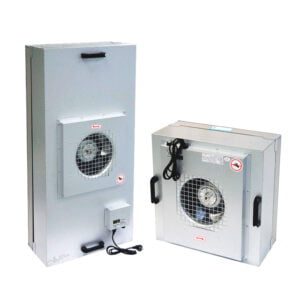
- Fan Filter Unit – FFU — Review the unit family against the documented airflow and interface brief.
- Mini Pleat HEPA/ULPA Air Filter — Check the filter family when defining the unit and replacement-filter boundary.
- Gel Seal HEPA/ULPA Air Filter — Review this filter interface option only where the proposed unit uses a compatible mating arrangement.
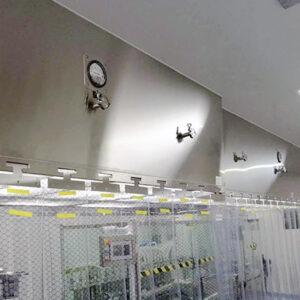
- Wall & Ceiling System — Coordinate the ceiling and plenum building interface with the proposed FFU arrangement; confirm the exact project scope.
For each active zone, record the number of units, their physical groupings, the cleanliness or pressure target the zone must hold, and any interdependencies with adjacent zones or return paths. For zones planned but not yet built, note the projected activation sequence and whether they will share a pressure boundary with an earlier phase when they come online. Inactive zones that will eventually connect to the system are worth flagging separately, because an installed but dormant unit can affect airflow balance in an adjacent active zone if it is not positively isolated.
This three-way split is the foundation every later control comparison depends on. Without it, the question “which control route fits this project?” has no stable answer.
Compare control routes by project need
Three control routes appear in most FFU projects, and the right starting point depends on the operating model of each phase, not on a general preference for sophistication.
Conditional control-route comparison
| Operating requirement | Route to compare | Decision-changing check |
|---|---|---|
| Independent phase operation with reachable units and no central supervision requirement | Local control | Reconsider if access or supervision needs change |
| A stable group should receive the same command | Offered group control | Confirm membership and how any individual-unit requirement is met |
| Individual identification, reassignment or central supervision across phases | Offered networked control | Confirm addressing, integration and later-unit provisions; a network label is insufficient |
Local control—a speed switch or analog dial at each unit—is the right starting point when each phase operates independently, staff can physically reach the units for adjustment, and central supervision is not a project requirement. It carries no integration dependencies, commissions phase by phase without waiting for a network, and matches a deliberately standalone operating model. Its limitation appears when the project later requires zone-level commands, audit records, or remote adjustment: at that point, local control does not extend, it is replaced. If access conditions or the supervision requirement changes during the project, reconsider this route against that changed requirement before proceeding.
Group or analog control fits phases where several units must receive the same command simultaneously and the zone boundary is stable. A single analog signal—commonly a 0–10 V DC voltage—can drive a group of units to the same speed set point. Compare any offered group-control route against the exact unit membership and signal boundary of the zone it will serve. A shared command simplifies daily operation within a fixed phase, but it does not address individual unit identification or later regrouping. If individual units within the group need to be identified separately—for filter integrity testing, for maintenance records, or for future reassignment to a different zone—confirm how the proposed arrangement supplies that before selecting group control.
A group command answers “what speed is this zone running?” but not “which unit in that zone is drifting.”
Networked control is the right comparison priority when later phases require individual unit addressing, zone reassignment, or central supervision. A network interface—whether BACnet, Modbus, or a proprietary protocol—can, in principle, support all three. In practice, a network label alone gives no assurance of protocol compatibility with the building management system, addressing capacity for the final unit count, or provisions for units not yet installed. When evaluating an offered networked route, ask for confirmation of the addressing scheme, the integration interface, and explicitly how future units will be added. If the offered network cannot satisfy those documented interfaces, retain the requirement and compare another confirmed arrangement rather than accepting a capability gap on the assumption it will be resolved later.
Consider a project where phase one is a small ISO 7 staging area with six units operating independently, phase two adds a connected ISO 6 corridor with twelve units that must respond to a zone command, and phase three adds a monitored ISO 5 filling zone requiring individual unit data at the building management system. Each phase calls for a different control route, and the phase-three requirement is what determines whether the network chosen in phase two can carry forward or must be replaced.
Document integration and change evidence
Each time a new phase activates, the assumptions that underpinned the earlier phase’s commissioning may no longer hold.
Adding units to an active network, changing zone groupings, or bringing a formerly dormant zone online can alter airflow balance, pressure differentials, and control loop behavior across the boundary. The record-keeping task before each activation is therefore not a formality—it is what allows the team to verify that the earlier phase still performs as it did when first accepted.
Before a new phase is activated, agree on three things in writing: which identifiers, settings, and operating records must transfer to the new configuration; which zones are affected by the change and require reverification; and who holds responsibility for each item. Controller capacity alone cannot close the addressing and handover questions. A system sized to support forty units does not automatically assign addresses, inherit previous speed settings, or document which technician made which change.
Record what transfers, what is reverified, and who is responsible before the first unit in a new phase is energized.
The verification scope for each new phase should be agreed before commissioning begins, not assembled afterward from whatever records are available. Added connections or changed groupings can alter the pressure and airflow assumptions that supported the earlier phase’s acceptance. Performance test summaries from similar projects do not supply a universal commissioning protocol, and a supplier that offers one should be asked to show how it maps to the specific zone boundaries and integration points of this project.
For projects running across multiple contract stages, the integration evidence also becomes part of the handover record between phases. If a controls subcontractor changes between phases, the identifier scheme, group assignments, and BMS integration points must be documented in enough detail that the incoming contractor can verify them without reconstructing them from the installed equipment.
Related Reading
- Map the Protected Process First: A Zone-by-Zone Brief for FFU, LAF, and HEPA Selection — Define the upstream process-zone brief before narrowing equipment scope.
- FFU, LAF, and HEPA Housing Interfaces: What to Confirm for Ducts, Power, Controls, and Service Access — Coordinate the neighboring air-path and utility responsibilities.
- FFU Maintenance Planning for Modular Cleanrooms: Access, Replacement and Testing — Plan the downstream service and evidence boundary before the unit layout is fixed.
Approve a bounded expansion plan
A phased expansion plan is approvable when each phase can be described as a bounded operating system, not as a step toward a final layout.
That means the plan for each phase includes: the active zone list with unit count and control route, the commissioning scope and acceptance criteria for that phase, the provisions made for later phases (capped conduit, reserved addresses, documented group membership), and the handover items that must be agreed before the next phase activates. A supplier reviewing a brief in this form can confirm lead times, integration dependencies, and commissioning support for each stage without assumptions about what the team intends to do later.
YOUTH designs FFU systems and control configurations to support staged activation, and the conversations that go well are the ones where the zone boundaries, the supervision requirement, and the integration interfaces are defined before the control route is selected—not after the hardware is ordered.
Before the expansion plan goes to a supplier for confirmation, have the following ready:
- Active zone map for each phase: unit locations, cleanliness or pressure targets, and pressure boundary relationships with adjacent zones.
- Control route decision for each phase with the operating rationale: why local, group, or networked control fits that phase’s actual operating model.
- Integration interfaces for any phase requiring BMS connection: protocol, addressing scheme, and the point in the phase sequence when the connection must be live.
- Handover checklist between phases: identifiers, settings, affected-zone reverification scope, and named responsibility for each item.
- Inactive zone inventory: units installed but not yet active, their isolation status, and when they are expected to enter the control scheme.
A plan built to this structure gives the supplier enough information to confirm what is in scope, flag what is not, and sequence commissioning support without ambiguity. Where any of these items is still open, name it as an open item with a decision date rather than leaving it implicit—an assumed provision in a phased control brief is where most schedule risk originates.
References
- ISO 14644-4:2022 Cleanrooms and Associated Controlled Environments – Part 4: Design Construction and Start-Up — Use the public requirements-to-verification scope to organize the project brief; it does not select a technology or contract model.
- ISO 14644-3:2019 Cleanrooms and Associated Controlled Environments – Part 3: Test Methods — Locate the installed performance-test scope; its summary provides no universal project acceptance limit.
- IEST-RP-CC036 Testing Fan Filter Units — Compare FFU test subjects before requesting matched operating-point evidence; detailed methods remain outside the public summary.
- ISO 14644-7:2004 Cleanrooms and Associated Controlled Environments – Part 7: Separative Devices — Distinguish local-device design scope from whole-process protection.
Frequently Asked Questions
Q: Should all phases use the same control arrangement?
A: Keep a common operating approach where it serves the zones, but do not force identical grouping if later phases have different ownership or access needs. Compare the whole phased brief before choosing a route that would require the first phase to be reworked.
Q: Is unused controller capacity enough to show that later expansion will be easy?
A: No. The later units also need an agreed addressing, connection and zone-assignment route. Capacity is only one item in a staged integration decision; it does not close the handover and verification tasks.
Q: What if only the new phase needs central supervision?
A: Define that requirement for the new zone and identify what information must cross the phase boundary. Do not assume every existing local unit must be replaced, or that separate systems can exchange data without confirmed interfaces.