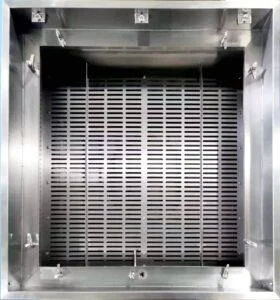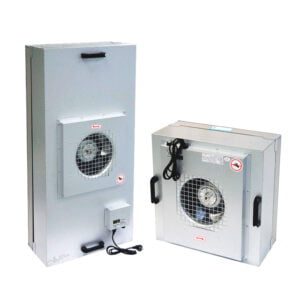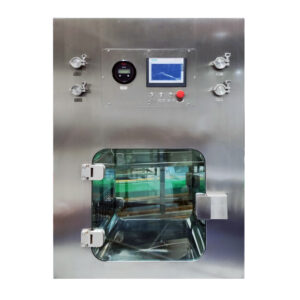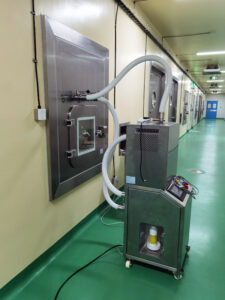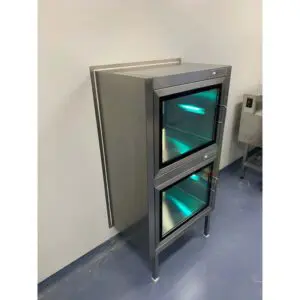
Selecting high-temperature HEPA filters for ovens and tunnels starts with the duty at each filter position, not with the equipment’s rated maximum temperature. Define the normal operating temperature, peak temperature, dwell time, cooling profile and cycling frequency the element will actually see where it sits, then compare models against that duty as a complete assembly of media, frame, seal and retention. A HEPA filter is an element classified for particle removal efficiency under a stated test basis; its suitability for hot service is a separate question about the materials and interfaces that hold the media in place, and the two pieces of evidence rarely come from the same test.
Assign the oven or tunnel duty to each filter position
Each filter position in a hot process needs its own temperature and airflow specification before any model comparison begins. An internal recirculation filter sitting in the hot air stream and an external fresh-air or supply filter upstream of the heaters face different thermal conditions in the same machine, so a single headline rating for the oven or tunnel is a starting input rather than a complete specification for every element in it.
The physical reason is simple: temperature in a convection oven or tunnel is a function of position relative to the heaters, the recirculation path and the point where ambient air enters. An element in the return leg may see close to the process setpoint; an element on the make-up air inlet may see something far closer to room conditions. A depyrogenation tunnel adds a further distinction, because the heating zone, the cooling zone and the laminar supply above the conveyor each have their own temperature band and their own filter duty.
Work the air path and write down, for every filter position, the air temperature at that point, the required volumetric airflow, and whether the position is in recirculated process air or in incoming fresh air. That record is what lets a supplier quote a configuration rather than a catalogue line, and it is what prevents a filter specified for the hottest zone from being installed where a standard element would have served, or the reverse.
Specify thermal cycling for the complete assembly
A filter position that heats and cools repeatedly needs a cycling specification, not just a maximum temperature. Describe the normal operating temperature, the peak temperature, how long the position dwells at that peak, how the equipment cools down, and how often the cycle repeats, then ask for evidence covering that complete duty.
The reason cycling matters is differential expansion. Glass-fiber media, the frame material, the sealant that bonds media pack to frame, the gasket and the clamping hardware all expand and contract at different rates. A stated maximum media temperature tells you what the media can tolerate; it does not describe how the bonded joint between pack and frame, or the seal against the housing face, behaves after many expansion and contraction cycles. Frame, seal and retention compatibility therefore belong inside the selection decision rather than being treated as hardware details settled later.
Continuous-duty tunnels and batch ovens produce very different cycling profiles from the same nominal temperature. A tunnel held at temperature for a production campaign imposes long dwell with few transitions; a batch oven that ramps and cools several times a shift imposes many transitions with shorter dwell. Say which pattern applies, and give the cooldown method as well, because forced cooling drives a steeper thermal gradient across the assembly than a free cool-down does. If a production schedule is not yet fixed, state the most frequent cycling the equipment is expected to support and ask the supplier to quote against that figure.
Review HEPA classification and thermal evidence separately
Treat the filter grade report and the thermal-compatibility documentation as two separate checks, both tied to the exact configuration being offered. The classification tells you what the element achieved for particle removal under the conditions of its test; the thermal documentation tells you whether that element’s materials and interfaces suit the service temperature and cycling you have specified. Neither substitutes for the other.
ISO 29463-1:2024 covers classification, performance testing and marking for high-efficiency filters and filter media, and it is used together with Parts 2 to 5. It is an element-level scope: it describes how a filter is classified and how the test result is documented and marked, and that framework sits alongside, not in place of, installed-system evidence and thermal-compatibility evidence. When you read a test record, confirm that it names the same model, size, media pack configuration and sealing arrangement as the item on the quotation, because a grade achieved on one build does not transfer automatically to a variant with a different frame or sealant.
Thermal evidence should be equally specific. Ask what temperature and cycling the stated rating refers to, whether it covers the assembled filter or only the media, and which frame, sealant and gasket materials the rating assumes. A high-temperature HEPA filter for an oven or tunnel typically differs from a standard element in exactly those components, so a change to any of them is a change to the thermal claim.
Compare conditioning, airflow and physical interfaces
| Selection check | Information to compare for each offered configuration | Decision it informs |
|---|---|---|
| Conditioning | Whether conditioning is prescribed, with the actual preparation instructions and resulting cleaning and handling tasks | Whether the configuration’s preparation requirements suit the project |
| Airflow and pressure basis | Required airflow and pressure basis at the same duty | Whether the assembly fits the fan and airflow requirement |
| Sealing geometry | The offered sealing geometry and the installation interface | Whether the element can seal in the intended position |
| Available envelope | The assembly’s space requirement and the available installation envelope | Whether the assembly fits the equipment |
| Withdrawal route | The element’s withdrawal route within the installation | Whether the element can be removed for replacement |
Once two or more assemblies have cleared the thermal-duty check, compare them on conditioning, airflow and pressure basis, sealing geometry, available envelope and withdrawal route at the same duty. These are the practical constraints that decide whether a thermally suitable element can actually seal, flow and be replaced in the installation, and an element that fails any of them leaves the equipment unable to do its job.
Conditioning is configuration-specific. Grieve documents a conditioning requirement for its named internal oven HEPA filters, together with the cleaning and careful handling that follow, and distinguishes those internal filters from external fresh-air filters. That is a manufacturer-specific instruction for a named configuration, not a rule that applies to every oven and tunnel filter: another manufacturer’s configuration may prescribe a different preparation route, or none. So ask whether the offered item requires conditioning before service, and if it does, bring the actual preparation instructions and the resulting cleaning and handling tasks into the comparison, because they become project tasks with their own time, access and labor implications.
Airflow and pressure basis decide fan compatibility. A deeper or larger-area media pack moves the same airflow at lower resistance, but it occupies more depth; a compact pack fits a tight plenum at the cost of higher pressure drop. In a recirculating oven the fan curve, the heater bank and the duct losses all sit in the same loop, so a substitution that raises filter resistance can reduce air velocity over the load and change the temperature uniformity the process depends on. Compare required airflow and the pressure figure on the same basis — same airflow, same test condition — or the comparison is not a comparison.
Sealing geometry and envelope are where paper selections commonly fail. Gasket-sealed, knife-edge gel-sealed and clamped-face arrangements each need a matching housing face and a matching clamping force, and the gasket or gel material must itself suit the service temperature. Confirm the assembly’s overall dimensions against the available opening including frame flanges and clamping hardware, and confirm that the element can be withdrawn along a clear path. A filter that can only be reached by dismantling ductwork or heater elements becomes an unplanned maintenance cost for the life of the machine.
As an illustrative comparison, assume two elements of the same grade meet the stated temperature and cycling duty, one with a deeper pack and gasket seal and one with a shallower pack and a clamped face. If the plenum depth is fixed and the fan has little margin, the shallower, higher-resistance element may fit but reduce recirculated airflow; if depth is available, the deeper element preserves fan margin. The deciding facts are the plenum dimension and the fan curve at operating temperature, both of which sit with the equipment manufacturer.
Define the installed verification before ordering
Agree the installed verification scope, the state the equipment will be in during testing, and the evidence that constitutes release, before the order is placed rather than after delivery. Factory filter tests and installed checks have different boundaries: a factory test characterizes the element as supplied, while installed integrity and airflow checks characterize the filter as mounted in its housing, with its seal engaged, in the assembled process-air system. Defining both early prevents a component test report from being treated as an account of the whole system.
ISO 14644-3:2019 sets out test methods and apparatus for installed cleanroom and clean-zone performance parameters, and it is the usual reference point when a project needs to describe installed airflow and filter integrity testing. Its published abstract does not supply a universal acceptance limit, and it does not provide a high-temperature test procedure, so settle explicitly with the equipment supplier and the test contractor at what temperature the installed checks will be performed — ambient, at operating temperature, or both — and how the result will be recorded. That choice affects access, instrument selection and scheduling, and it is far cheaper to resolve on the specification than on site.
The decision to accept an installed result and release the oven or tunnel for process use belongs to the project’s approved procedure and its designated approver. Your task at the selection stage is to make that decision possible: name who performs the test, what document is produced, and which parties sign it.
For a useful supplier discussion, have ready the position-by-position temperature and airflow duty, the cycling profile including peaks, dwell and cooldown method, the required filter grade and the test record format you expect for the offered model, the plenum dimensions and sealing arrangement at each position, the withdrawal access available, and the installed verification scope you intend to apply. With those in hand, a supplier can quote a configuration rather than a part number, and you can compare offers on the same basis.
Frequently Asked Questions
Q: Can I specify the same high-temperature HEPA filter for every position in an oven or tunnel?
A: Only if the offered assembly suits the duty and interfaces at every position. Internal recirculation and external supply locations can face different conditions. Compare each position’s temperature, airflow and installation requirements before treating one configuration as interchangeable across the equipment.
Q: How should I compare quotations when one lists only a maximum temperature?
A: Put both quotations against the same complete operating duty before choosing between them. Record normal temperature, peaks, dwell, cooling and cycling frequency for the relevant position, then check the offered frame, seal and retention arrangement against that duty. A maximum-temperature figure alone leaves those comparisons unresolved.
Q: Does every oven or tunnel HEPA filter need conditioning before use?
A: No universal conditioning requirement follows from this application. Conditioning is prescribed for some configurations, including the named Grieve internal oven-filter example, but another configuration may require different preparation. Establish which instructions apply to the exact assembly and account for any resulting cleaning and handling work before selecting it.
Q: Can a factory HEPA test report serve as the only evidence for releasing the installed system?
A: It does not establish the complete installed system’s condition. Keep the filter’s classification report separate from the agreed installed integrity and airflow checks. Before ordering, define the installation test scope, the state in which testing will occur and the evidence required for release.