Before a medical-device cleanroom can be accepted for operational use, someone has to decide whether the paperwork actually proves the room does what the user requirement specification said it must do. That judgment is harder than it sounds: a stack of passing test reports does not by itself show that every critical requirement was tested, that the installed configuration matches what was approved, or that a result obtained under one set of conditions still means something under another. The buyer’s task during commissioning review is to trace each claim back to a requirement, a method, and a resolved history, not simply to confirm that documents exist.
Tie Every Commissioning Record to a URS Requirement
| Traceability element | Commissioning evidence to name | Decision supported |
|---|---|---|
| URS requirement | The specific critical requirement being addressed | Whether the evidence can be traced to the agreed requirement |
| Inspection or test | The named inspection or test for that requirement | Whether a verification route is defined |
| Record | The named record containing the inspection or test evidence | Where the evidence can be checked |
| Evidence owner | The party named as owner of the record | Which party owns the evidence |
| Acceptance route | The agreed route for accepting the record | How the requirement enters the acceptance decision |
A commissioning package is only as useful as its connection to the user requirement specification and the approved design built from it. Where a critical requirement in the URS has no named inspection or test assigned to it, the commissioning record cannot show that the requirement was verified at all, no matter how complete the rest of the package looks. This is a structural problem, not a paperwork formality: commissioning evidence is organized around test types and system boundaries, while the URS is organized around what the room or process needs to achieve, and the two do not automatically line up unless someone has deliberately mapped one to the other.
The practical consequence is that a buyer reviewing a commissioning package should start from the URS, not from the test reports. For each critical requirement, there should be an identifiable inspection or test, a record where the result lives, a party who owns that record, and an agreed route by which the record enters the acceptance decision. Where any of these four elements is missing, the requirement is not actually closed, even if nearby tests passed. This matters most where a requirement sits across two system boundaries — for example where a room-level condition depends partly on installed air-handling equipment and partly on process equipment inside the room — because the evidence for each half may be generated by different parties and recorded in different documents.
Where the acceptance route is undefined, a passing result can sit in a file without ever being formally accepted into the commissioning decision. Asking the supplier or contractor to walk through the requirement-to-record mapping, rather than just producing a binder of test certificates, surfaces whether this traceability was built in from the start or assembled retroactively. A retroactively assembled mapping is not necessarily wrong, but it carries a higher chance that a requirement was tested informally, tested under the wrong conditions, or not tested at all, and the buyer needs to confirm which of these applies before relying on the package for acceptance.
Request Installation and As-Built Configuration Evidence
| Evidence item | What to verify in the record | Evidence boundary |
|---|---|---|
| Approved design | The approved design used as the comparison basis | Defines the project basis; it does not document the final installed condition |
| As-built configuration | The configuration recorded after installation | Documents the installed configuration; it does not by itself establish cleanroom performance |
| Installed components | The components identified in the installed configuration | Shows which installed components are represented in the record |
| Authorized approvals | The approvals attached to the relevant installation or as-built record | Shows the recorded approval status; it does not replace performance test evidence |
Performance test results only mean what they claim to mean if the thing that was tested matches the thing that was designed and approved. This is why installation and as-built evidence sits logically upstream of performance testing in a commissioning review, even though it is often treated as a lesser formality. The approved design is the comparison basis; it describes what was intended. The as-built configuration is a separate record describing what was actually installed. Where these two diverge — a substituted component, a relocated diffuser, a changed duct run — the performance test results are only valid for the as-built condition, not for the originally approved one, and the commissioning record needs to make that distinction explicit rather than treating the approved design as if it were the final state.
Identifying the installed components within the as-built record matters for the same reason. A configuration record that lists a system by type without identifying the specific installed components leaves open whether a later component change was ever reflected in the documentation the buyer is reviewing. This becomes relevant wherever the cleanroom envelope or air-handling equipment was adjusted after initial design approval, which can occur for reasons unrelated to performance, such as availability or coordination with other trades.
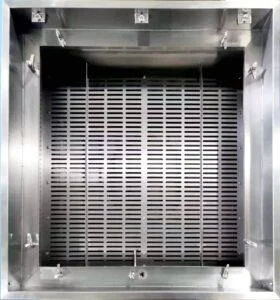
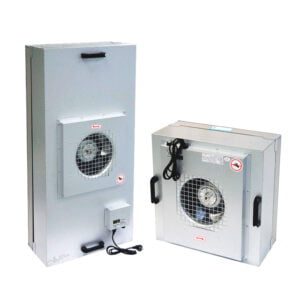
Authorized approvals attached to installation or as-built records show that someone with the authority to do so reviewed and accepted the recorded configuration. This approval status is useful to check, but it should not be mistaken for performance evidence: an approved as-built record confirms that the installed condition was documented and accepted as the basis for subsequent testing, not that the room performs as required. A buyer evaluating equipment such as a modular cleanroom structure, fan filter units, or HEPA housing boxes as part of the installed configuration should expect the as-built record to identify these components specifically enough that a later reviewer could confirm, without site access, what was actually installed. This is also where project-specific configuration information the buyer has already supplied becomes relevant to compare against: what was specified earlier in the project should be traceable into what the as-built record actually shows was installed.
Check Test Methods, Conditions, Instruments, and Calibration Status
| Test evidence field | What the record should identify | Traceability value |
|---|---|---|
| Test method | The named method used | Links the result to the method applied |
| Operating state | The cleanroom operating state during the test | Links the result to the recorded operating state |
| Environmental conditions | The conditions recorded during the test | Links the result to the recorded test conditions |
| Instrument | The instrument or apparatus used | Links the result to the test equipment |
| Calibration status | The recorded calibration status of the instrument | Keeps calibration status visible with the result |
| Result | The raw or summarized result | Preserves the reported outcome for review |
A test result reported on its own, without its method, conditions, instrument, and calibration status, is difficult to interpret and difficult to defend later. Cleanroom performance parameters are sensitive to how and under what conditions they were measured, which is why ISO 14644-3 exists specifically to define test methods, apparatus, and procedures for these parameters rather than leaving laboratories and commissioning teams to measure them inconsistently. The standard’s abstract does not establish a universal acceptance limit for any given project — that remains a matter of the project’s own contractual and design requirements — but it does mean that a stated test method should be checked against a recognized method rather than accepted as self-evidently valid.
The operating state recorded for a test changes what the result means. A cleanroom tested while unoccupied, with no process equipment running, can produce a different result than the same room tested during simulated or actual operation, because airflow patterns, particle generation, and pressure relationships change with occupancy and equipment state. A commissioning record that omits the operating state leaves the reader unable to determine which condition the result actually represents, and therefore unable to compare it meaningfully against a requirement that specifies a particular operating state.
Environmental conditions recorded at the time of test — and the instrument used, together with its calibration status — complete the chain that lets a later reviewer judge whether the result is trustworthy. An instrument operating outside its calibration period does not necessarily invalidate a result, but it does mean the result carries a flag that needs resolution rather than silent acceptance. Where a buyer is comparing cleanroom performance test records against each other, or against a device-process qualification built on top of them, the method, operating state, conditions, instrument, and calibration status need to travel with the result rather than being summarized away into a single pass or fail. IEST-RP-CC006 addresses the broader testing scope used to characterize cleanroom and clean-zone performance, though the specific limits applied on any given project remain contractual matters confirmed in the project documentation rather than in the standard’s publicly available scope.
Resolve Deviations, Failed Results, and Retest Traceability
| Record element | Link that must remain visible | What to check |
|---|---|---|
| Deviation | The related failed test, corrective work, and retest | Whether the deviation remains traceable through the full record chain |
| Failed result | The related deviation, corrective work, and retest | Whether the original failure remains visible |
| Corrective work | The initiating deviation or failed result and the subsequent retest | Whether the work can be traced back to the issue it addressed |
| Retest | The earlier deviation or failed result and the corrective work | Whether the retest is tied to the complete preceding history |
| Passing final result | The full deviation, failure, corrective-work, and retest chain | Whether a passing result hides an unresolved installation issue |
A final passing result is not evidence that nothing went wrong during commissioning; it is evidence that whatever went wrong was eventually resolved, or it may be evidence that the record simply does not show the earlier failure at all. The difference between these two situations can only be established by checking whether the passing result is linked backward to any deviation, failed test, or corrective work that preceded it.
Where a deviation or failed test exists in the project history, the commissioning record should preserve a visible chain: the failed result connects to the deviation that was raised because of it, the deviation connects to the corrective work performed in response, and the corrective work connects to the retest that followed. If any link in that chain is missing — particularly if the corrective work is not clearly tied to the specific issue it was meant to address — a reviewer cannot confirm that the fix actually addressed the cause of the failure rather than something adjacent to it. This matters more for installation-related deviations than for isolated measurement anomalies, because an installation issue that is only partially corrected can continue to affect performance under conditions the retest did not happen to reproduce.
The condition that most affects how much scrutiny this chain needs is where the deviation touched an installed component or configuration element rather than a transient environmental condition. A deviation caused by a condition that will not recur — an unusual transient event, for instance — is different in kind from a deviation traced to the installed configuration itself, because the latter implies that the same condition could reappear unless the corrective work changed the underlying installation. Where the corrective work record does not specify what was changed, a buyer cannot distinguish between these two cases, and the passing retest result alone does not resolve the ambiguity.
Asking for the complete chain — not just the final retest certificate — is the only way to confirm which of these situations applies. A supplier or contractor who can produce the full deviation-to-retest history for every failed result demonstrates that the documentation was maintained as events occurred, which is a different assurance than producing a clean set of final passing results after the fact.
Assemble the Evidence Needed for Operational Acceptance
| Evidence stream | Evidence to assemble | What it does and does not establish |
|---|---|---|
| Installation and as-built evidence | Approved design basis, as-built configuration, installed components, and authorized approvals | Documents the installed condition; it does not by itself establish cleanroom performance |
| Cleanroom performance testing | Test method, operating state, environmental conditions, instruments, calibration status, and results | Supports review of cleanroom performance under the recorded conditions; it does not establish device-process qualification or quality-system release |
| Device-process qualification | The project-specific device-process qualification evidence | Supports the separate device-process qualification decision; it is not established by cleanroom performance testing alone |
| Quality-system release | The project-specific quality-system release evidence | Supports the separate release decision; it is not established by cleanroom performance testing alone |
Operational acceptance depends on evidence that originates from more than one project party, and the parties do not always own the same scope. Installation and as-built evidence establishes what was actually built and approved against the design basis, but it does not by itself establish that the cleanroom performs as required — that is a separate determination made through performance testing. Cleanroom performance testing, in turn, establishes how the room behaved under the recorded test method, operating state, conditions, instruments, and calibration status, but it does not establish that a specific device or process qualifies for use in that environment, and it does not establish that the quality system has authorized release of product or process. Device-process qualification and quality-system release are distinct evidence streams, generally owned by different functions within the buyer’s own organization or by different contracted parties, built on top of the cleanroom performance evidence rather than replacing it.
ISO 14644-4 describes the process from cleanroom requirements through design, construction, start-up, and verification, which is useful for understanding how these stages relate sequentially, though it does not prescribe a specific contractual delivery method or project-specific acceptance criteria — those remain defined by the project’s own agreements. A buyer assembling evidence for an operational acceptance decision needs to confirm, stream by stream, which party owns which evidence, and whether the device-process qualification and quality-system release have in fact been completed using the cleanroom performance evidence as an input, rather than assuming that a completed cleanroom performance package automatically satisfies the later stages.
Where the buyer’s own project team has not yet defined how these streams connect — for instance, which function signs off on device-process qualification once cleanroom performance testing is complete — the commissioning package itself cannot resolve that gap, because it documents the cleanroom performance stream only. Clarifying this boundary before requesting a final evidence package avoids the situation where installation and performance evidence are complete and well organized, but the operational acceptance decision still cannot be made because the device-process or quality-system evidence was never assembled against it.
Frequently Asked Questions
Q: When should the commissioning evidence list be agreed?
A: Define it from the URS and approved design before commissioning records are assembled. Each critical requirement should already have a named inspection or test, record, evidence owner, and acceptance route so missing evidence is visible early.
Q: Does citing a cleanroom test standard define the project’s acceptance limits?
A: No. A referenced standard can identify relevant test methods and procedures, but the project-specific acceptance criteria and delivery route must be agreed separately against the URS and approved design.
Q: When can a cleanroom performance result be used in an acceptance decision?
A: Use it only with its recorded context: the test method, operating state, environmental conditions, instrument, calibration status, and reported result. Then compare that evidence through the acceptance route agreed for the corresponding URS requirement.
Q: Is a passing retest enough to close a failed commissioning test?
A: Not by itself. The passing retest should remain linked to the original failed result, the deviation, and the corrective work, with any unresolved installation issue made visible before acceptance.
Q: Can cleanroom performance testing also serve as device-process qualification or quality-system release?
A: No. Cleanroom performance testing supports review under the recorded test conditions, while device-process qualification and quality-system release require their own project-specific evidence and may be owned by different parties.