A project team choosing a cleanroom for a medical-device facility often reaches for two ISO standards at once: one for the particle environment, one for the quality system around it. The question that matters is not which standard is “higher” but which decision each one actually governs, and what remains a project-specific judgment that neither standard makes for the buyer.
Separate the Questions Each Standard Is Designed to Answer
ISO 14644 and ISO 13485 address different objects entirely, and confusing their objects is where planning errors start. ISO 14644 speaks to the physical controlled environment: how airborne particles are counted and classified, how a room or clean zone is designed and verified, and what test methods confirm that the space performs as classified. ISO 13485 speaks to the organization that designs, manufactures, or services the medical device: how it structures processes, records, responsibilities, and controls so that its products consistently meet customer and regulatory requirements.
Where a project team treats these as a single compliance checklist, two practical problems follow. The first is that a facility can hold a documented particle classification and still say nothing about whether the organization operating in that facility has a functioning quality-management system. The second is the reverse: an organization can hold a certified quality-management system and still have a cleanroom that was never classified, verified, or matched to the device’s actual manufacturing step. Each gap is invisible from inside the other standard’s documentation.
This separation also shapes who in the project should be asked which question. A cleanroom design engineer or HVAC contractor answers to classification, airflow, filtration, and room construction. A quality or regulatory affairs lead answers to document control, management review, corrective action, and supplier evaluation. When a facility manager requests evidence from a supplier, asking for “ISO compliance” without specifying which standard governs which deliverable produces answers that may be accurate but irrelevant to the actual gap in the project file.
The condition that changes the right question to ask is where in the device lifecycle the room sits. A room supporting final device assembly in a controlled environment raises classification and monitoring questions first. A room supporting incoming inspection or administrative functions within the same quality system may never need a particle classification at all, even though the organization’s quality-management system still governs how that room’s procedures are documented and reviewed. The standard that applies is a function of what the room does, not of the facility’s overall regulatory status.
Apply ISO 14644 to Particle Classification, Design, and Test Planning
| ISO 14644 source | Planning question it supports | Boundary to keep visible |
|---|---|---|
| ISO 14644-1:2015 | How air cleanliness is classified by particle concentration for cleanrooms, clean zones, and separative devices | The particle class does not establish a GMP grade or a microbiological condition |
| ISO 14644-4:2022 | How cleanroom requirements, design, construction, start-up, and verification are addressed | The standard does not prescribe a specific technology or process-equipment requirement |
ISO 14644 is published in parts, and selecting the correct part for a given planning question avoids both under-specifying and over-specifying what a room must demonstrate. ISO 14644-1:2015 governs the classification of air cleanliness by particle concentration for cleanrooms, clean zones, and separative devices. It answers the question “what particle class does this space meet,” and it does so purely in terms of particle concentration at stated sizes. It does not translate into a GMP grade or say anything about microbiological condition — a room can meet a stated particle class and still require separate microbiological monitoring and control measures appropriate to the device or process involved.
ISO 14644-4:2022 governs a different stage of the same facility’s life: design, construction, start-up, and verification. Where ISO 14644-1 answers what class a space achieves, ISO 14644-4 answers how that space should be designed, built, and brought into qualified operation so that the classification is achievable and demonstrable. This part does not prescribe a specific technology or process-equipment requirement, which means it leaves room for different air-handling approaches, filtration arrangements, or room configurations provided the design and verification steps are followed.
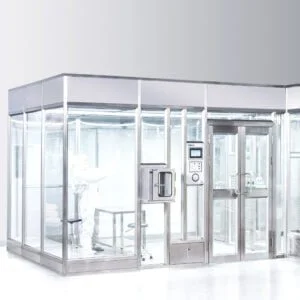
The practical consequence for a project team is sequencing. A classification target identified early (informed by ISO 14644-1) shapes the design and construction decisions that follow (informed by ISO 14644-4), including how air is supplied to the space, how pressure relationships are maintained, and how the room’s envelope and entry points are configured to protect the classified volume. A modular cleanroom structure, for instance, is one way project teams accommodate design and construction requirements under defined panel, door, and air-supply interfaces — but the classification target and the verification protocol remain governed by the ISO 14644 parts regardless of which construction approach delivers them.
Where the device or process changes, the classification target and the design response both change, even though the standard’s method does not. A team moving from one manufacturing step to another within the same facility may need a different particle class in each adjoining room, which means the design and verification work under ISO 14644-4 has to be repeated or extended per space rather than assumed to carry over from one room to the next.
Place ISO 13485 Within the Medical-Device Quality System
ISO 13485:2016 provides a quality-management framework intended to help an organization consistently meet customer requirements and applicable regulatory requirements for medical devices. It covers how processes are planned, documented, resourced, monitored, and improved across the organization — not how a specific room is built or classified. Reading ISO 13485 for guidance on cleanroom classification, airflow design, HEPA filtration grade, or equipment acceptance criteria will not produce an answer, because the standard does not contain that content.
What ISO 13485 does supply is the structural requirement that wherever a controlled environment is necessary to the product’s conformity, the organization must manage that environment through its quality system: defining the requirement, documenting the control, verifying that the control is met, and maintaining records that connect the facility’s performance to the product it supports. The standard requires that this management exist; it does not specify what the controlled-environment requirement should be for a given device.
This creates a dependency rather than an overlap. A quality-management system built under ISO 13485 needs an external, technical source — appropriate to the product and process — to populate the actual environmental requirement, and ISO 14644 is one of the sources that can supply that content for particle classification and room design. Without that external input, an ISO 13485-conformant quality system could still formally “manage” an environmental requirement that was never technically established, because the standard checks that a process exists and is followed, not that its technical content is correct for the device.
For a facility or QA manager, this means the quality-management system’s audit trail should show where the cleanroom’s classification and design basis came from, who approved it, and how changes to either are controlled — but the classification number itself, and the design rationale behind it, will not appear inside ISO 13485’s own text. Where a device’s regulatory pathway imposes additional environmental expectations beyond particle classification, those expectations enter the quality system the same way: as an external technical requirement that the quality-management framework then tracks, rather than one the framework originates.
Map Facility Evidence to Quality-System Records and Owners
A project frequently needs both bodies of work operating together, and the practical challenge is less about which standard applies and more about how facility evidence — classification reports, design and verification records, monitoring data — gets linked into the quality-management system’s own records rather than sitting in a separate file that nobody in the quality structure owns.
This linkage matters because a classification report or verification record produced under ISO 14644 has no standing within a medical-device quality system until someone with defined authority reviews it, approves it as meeting the project’s stated requirement, and places it under the same change-control discipline that governs other quality records. Where that ownership step is skipped, the facility can be technically compliant with its classification while the quality system has no documented basis for relying on that compliance — an audit finding that originates from a process gap, not a facility gap.
The condition that determines how much linkage work is needed is how the facility’s environmental requirement was originally set. Where the classification and design basis were defined as part of the device’s own process validation or risk assessment, the facility records map naturally onto existing quality-system documents, because the requirement already lives inside a quality-system-owned decision. Where the classification was set independently — by a design team or contractor working from general design practice rather than from a documented device-specific requirement — the quality system has to retroactively adopt that technical decision, assign an owner, and establish the approval and change-control steps after the fact, which is a less direct path and leaves more room for gaps between what the room does and what the quality system assumes it does.
Change control is the recurring point of failure in this linkage. A facility modification — a change to air supply, room configuration, or equipment affecting the classified space — has to trigger a quality-system review precisely because the original classification and design approval were quality-system records. If the facility side treats such a change as a maintenance matter only, the quality system’s records no longer reflect the room’s actual current state, even though no one has made an inaccurate statement at any single point in time.
Prevent Class Claims From Becoming Unsupported Compliance Claims
| Planned statement | Evidence that can support it | Conclusion that does not follow | Additional project basis needed |
|---|---|---|---|
| The controlled environment has an ISO particle classification | Classification evidence under ISO 14644-1 | A GMP grade, microbiological condition, or medical-device compliance conclusion | Intended use and applicable regulatory requirements |
| The organization uses a medical-device quality-management framework | ISO 13485 quality-system evidence | A selected ISO cleanroom class, airflow value, HEPA grade, or equipment acceptance criterion | Project-specific cleanroom and equipment decisions |
| The completed room is suitable for a particular device or process | Evidence from both facility controls and quality-system records may contribute | Suitability is not proved by either standard alone | The intended device or process, applicable regulatory requirements, and project-specific confirmation |
The most common planning error is not misunderstanding either standard individually but extending a true statement about one into an unsupported conclusion about the other. A documented ISO particle classification is a true and specific claim about air cleanliness; it is not, by itself, a claim about GMP grade, microbiological condition, or medical-device compliance, and presenting it as such substitutes a narrower technical fact for a broader regulatory conclusion the facility evidence was never designed to carry.
The same substitution risk runs in the other direction. A functioning quality-management system is a true and specific claim about how an organization manages its processes and records; it is not a claim about which ISO cleanroom class the organization’s rooms meet, what airflow values its equipment delivers, what HEPA grade its filtration achieves, or what acceptance criteria its equipment satisfies. A supplier or project document that cites ISO 13485 certification as evidence of a particular cleanroom performance level is making a claim the standard’s own scope does not support, regardless of how accurate the underlying quality-management claim is.
Where a project team wants to state that a completed room is suitable for a particular device or process, evidence from both the facility controls and the quality-system records may contribute to that judgment, but neither standard alone proves suitability, and the combination of the two does not automatically prove it either. Suitability depends on the intended device or process, the regulatory requirements that apply to it, and a project-specific confirmation step that connects the facility’s demonstrated performance to that specific intended use — a step that sits outside both standards’ documented scope.
For a buyer preparing a supplier review, the practical discipline is to trace every planned claim back to the narrowest evidence that actually supports it, and to name explicitly what additional project-specific basis is still needed before a broader conclusion is drawn. Where a classification report exists, it supports a classification statement and nothing wider. Where a quality-system record exists, it supports a quality-management statement and nothing wider. Where the project needs a suitability conclusion, that conclusion requires its own project-specific basis — the intended use, the applicable regulatory requirements, and a confirmation exercise — stated as what it is rather than inferred from either standard’s documentation alone. Supplying this information clearly when requesting a configuration or quotation review gives the party preparing that review an accurate basis for matching equipment and documentation to what the project record can actually support.
Frequently Asked Questions
Q: Does an ISO 13485 quality system determine the ISO class required for a medical-device cleanroom?
A: No. ISO 13485 provides a medical-device quality-management framework, while the required particle classification must be decided separately from the intended device or process, applicable regulatory requirements, and project-specific cleanroom needs.
Q: Is an ISO 14644 particle classification enough to show that a cleanroom is suitable for a particular medical device or packaging process?
A: No. The classification establishes air cleanliness by particle concentration, but suitability still requires a project-specific basis covering the intended device or process and applicable regulatory requirements; it does not establish a GMP grade or microbiological condition.
Q: What information should a buyer prepare before comparing modular cleanroom proposals?
A: Define the intended device or process, applicable regulatory requirements, proposed particle-classification basis, design and start-up questions, and any project-specific equipment acceptance criteria. Also state how facility evidence must connect to quality-system records, approvals, and change controls.
Q: How should facility evidence be connected to the medical-device quality system?
A: Assign a clear owner to each required facility decision and evidence item, then identify the related approval and change-control route. This makes the handoff traceable without treating ISO 14644 evidence as proof of ISO 13485 compliance or treating the quality system as a cleanroom design specification.
Q: What should be reviewed when a cleanroom design or operating requirement changes?
A: Check which facility evidence, quality-system records, approvals, and change controls are affected, and confirm the responsible owner before the change proceeds. The review should use the intended device or process and applicable regulatory requirements as the project-specific basis.